
Volume 18, Number 1—January 2012
Historical Review
Differential Mortality Rates by Ethnicity in 3 Influenza Pandemics Over a Century, New Zealand
http://wwwnc.cdc.gov/eid/article/18/1/11-0035_article.htm
Nick Wilson , Lucy Telfar Barnard, Jennifer A. Summers, G. Dennis Shanks, and Michael G. Baker
Author affiliations: University of Otago, Wellington, New Zealand (N. Wilson, L. Telfar Barnard, J.A. Summers, M.G. Baker); Australian Army Malaria Institute, Enoggera, Queensland, Australia (G.D. Shanks)
Abstract
Evidence suggests that indigenous populations have suffered disproportionately from past influenza pandemics. To examine any such patterns for Māori in New Zealand, we searched the literature and performed new analyses by using additional datasets. The Māori death rate in the 1918 pandemic (4,230/100,000 population) was 7.3× the European rate. In the 1957 pandemic, the Māori death rate (40/100,000) was 6.2× the European rate. In the 2009 pandemic, the Māori rate was higher than the European rate (rate ratio 2.6, 95% confidence interval 1.3–5.3). These findings suggest some decline in pandemic-related ethnic inequalities in death rates over the past century. Nevertheless, the persistent excess in adverse outcomes for Māori, and for Pacific persons residing in New Zealand, highlights the need for improved public health responses.
Evidence suggests that indigenous populations have been disproportionately affected more by influenza pandemics than other population groups. In the most detailed review to date for the Spanish influenza pandemic (1918–1920), Mamelund (1) reported elevated mortality rate ratios (RRs) for indigenous populations relative to European populations in North America: the continental United States (RR 3.2); Alaska (RR range 6.8–191.5); all of Canada (RR 4.8); Labrador, Canada (RR range 8.3–129.0) and Greenland (RR 4.9). This pattern was also apparent for the Sami in Nordic countries of Norway (RR 4.8), Sweden (RR 8.2), and Finland (RR 16.9). Indigenous Australians were particularly affected (RR 172.4), but so were indigenous Pacific persons in Guam (RR 3.2), Fiji (RR 4.8), Tonga (RR range 2.6–5.3), Samoa (RR 16.5), Nauru (RR 11.2), Tahiti (RR 10.9), and Hawaii (RR 4.1).
In contrast, little is known about ethnic gradients in outcomes for other influenza pandemics of the 20th century, such as the 1957 pandemic. More recently, many studies have considered the 2009 influenza pandemic, and there are reports of increased risk for either hospitalization or death for indigenous persons from Canada, the United States, Brazil, Australia, New Zealand, and New Caledonia (2,3). Other work involving 12 US states indicated elevated mortality RRs for American Indian/Alaska Natives (RR 4.0, 95% confidence interval [CI] 2.9–5.6) (4). Canadian research also identified First Nations (indigenous) ethnicity as an independent risk factor for increased disease severity, with the multivariable model accounting for age, sex, medical comorbidity, interval from onset of symptoms to initiation of antiviral therapy, rurality, and income (5). That is, First Nations ethnicity was associated with increased likelihood of being admitted to an intensive care unit (odds ratio 6.52, 95% CI 2.04–20.8), but this pattern was not seen for low-income persons or those residing in rural areas.
Despite this historical and more recent work, little evidence exists concerning how the ethnic mortality differential of pandemic influenza may have changed over time. Therefore, in this study we considered such data for Māori (the indigenous population of New Zealand) and to some extent for Pacific populations residing in this country.
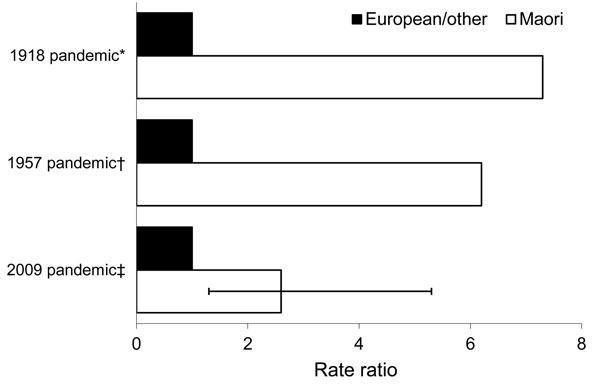
Figure 2. Mortality rate ratios (age-standardized on the basis of 2009 data) for Māori versus European/other New Zealanders (non-Māori/non-Pacific) during 3 influenza pandemics in New Zealand. *Data from (6); †official mortality rate data; ‡age-standardized to the Māori population. Error bar represents 95% CI.
.....//
Although further research is desirable, enough is now known about health inequalities in nations with indigenous peoples for government agencies and health care workers to pursue specific interventions. For example, in New Zealand, interventions should continue to raise the social and economic well-being of Māori, i.e., improve housing, reduce smoking, control obesity, improve management of diabetes, increase immunization rates, and improve access to health care services. Fortunately, many such interventions are part of New Zealand health sector activity and range from national-level smoking cessation campaigns to more local community-level programs such as a Let’s Beat Diabetes program. Other policy development is occurring, with new and substantive tobacco control measures recommended by a Māori Affairs Select Committee in late 2010 (36). These responses are also relevant to improving health protection for Pacific persons, albeit in different ways that are also culturally appropriate. In addition, improvements are needed for influenza vaccination coverage in more vulnerable populations and more pandemic planning on how to reduce inequalities in influenza outcomes for indigenous persons (highlighted in work to protect Australian Aboriginal peoples [37,38]; indigenous persons in the United States [39], and other ethnic groups in the United States [40]).
Analysis of multiple health data sources indicates large reductions in absolute mortality rates from pandemic influenza for Māori and European New Zealanders and is suggestive of some decline in relative ethnic health inequalities for pandemic mortality over the past century. However, the persistent Māori excess in hospitalizations and deaths for the 2009 pandemic highlights the need for additional research to clarify contributing factors. There remains an ongoing need for societal and public health action to reduce known risk factors for influenza infection and adverse health outcomes for indigenous populations such as Māori.
Historical Review
Differential Mortality Rates by Ethnicity in 3 Influenza Pandemics Over a Century, New Zealand
http://wwwnc.cdc.gov/eid/article/18/1/11-0035_article.htm
Nick Wilson
, Lucy Telfar Barnard, Jennifer A. Summers, G. Dennis Shanks, and Michael G. BakerAuthor affiliations: University of Otago, Wellington, New Zealand (N. Wilson, L. Telfar Barnard, J.A. Summers, M.G. Baker); Australian Army Malaria Institute, Enoggera, Queensland, Australia (G.D. Shanks)
Abstract
Evidence suggests that indigenous populations have suffered disproportionately from past influenza pandemics. To examine any such patterns for Māori in New Zealand, we searched the literature and performed new analyses by using additional datasets. The Māori death rate in the 1918 pandemic (4,230/100,000 population) was 7.3× the European rate. In the 1957 pandemic, the Māori death rate (40/100,000) was 6.2× the European rate. In the 2009 pandemic, the Māori rate was higher than the European rate (rate ratio 2.6, 95% confidence interval 1.3–5.3). These findings suggest some decline in pandemic-related ethnic inequalities in death rates over the past century. Nevertheless, the persistent excess in adverse outcomes for Māori, and for Pacific persons residing in New Zealand, highlights the need for improved public health responses.
Evidence suggests that indigenous populations have been disproportionately affected more by influenza pandemics than other population groups. In the most detailed review to date for the Spanish influenza pandemic (1918–1920), Mamelund (1) reported elevated mortality rate ratios (RRs) for indigenous populations relative to European populations in North America: the continental United States (RR 3.2); Alaska (RR range 6.8–191.5); all of Canada (RR 4.8); Labrador, Canada (RR range 8.3–129.0) and Greenland (RR 4.9). This pattern was also apparent for the Sami in Nordic countries of Norway (RR 4.8), Sweden (RR 8.2), and Finland (RR 16.9). Indigenous Australians were particularly affected (RR 172.4), but so were indigenous Pacific persons in Guam (RR 3.2), Fiji (RR 4.8), Tonga (RR range 2.6–5.3), Samoa (RR 16.5), Nauru (RR 11.2), Tahiti (RR 10.9), and Hawaii (RR 4.1).
In contrast, little is known about ethnic gradients in outcomes for other influenza pandemics of the 20th century, such as the 1957 pandemic. More recently, many studies have considered the 2009 influenza pandemic, and there are reports of increased risk for either hospitalization or death for indigenous persons from Canada, the United States, Brazil, Australia, New Zealand, and New Caledonia (2,3). Other work involving 12 US states indicated elevated mortality RRs for American Indian/Alaska Natives (RR 4.0, 95% confidence interval [CI] 2.9–5.6) (4). Canadian research also identified First Nations (indigenous) ethnicity as an independent risk factor for increased disease severity, with the multivariable model accounting for age, sex, medical comorbidity, interval from onset of symptoms to initiation of antiviral therapy, rurality, and income (5). That is, First Nations ethnicity was associated with increased likelihood of being admitted to an intensive care unit (odds ratio 6.52, 95% CI 2.04–20.8), but this pattern was not seen for low-income persons or those residing in rural areas.
Despite this historical and more recent work, little evidence exists concerning how the ethnic mortality differential of pandemic influenza may have changed over time. Therefore, in this study we considered such data for Māori (the indigenous population of New Zealand) and to some extent for Pacific populations residing in this country.
Figure 2. Mortality rate ratios (age-standardized on the basis of 2009 data) for Māori versus European/other New Zealanders (non-Māori/non-Pacific) during 3 influenza pandemics in New Zealand. *Data from (6); †official mortality rate data; ‡age-standardized to the Māori population. Error bar represents 95% CI.
.....//
Although further research is desirable, enough is now known about health inequalities in nations with indigenous peoples for government agencies and health care workers to pursue specific interventions. For example, in New Zealand, interventions should continue to raise the social and economic well-being of Māori, i.e., improve housing, reduce smoking, control obesity, improve management of diabetes, increase immunization rates, and improve access to health care services. Fortunately, many such interventions are part of New Zealand health sector activity and range from national-level smoking cessation campaigns to more local community-level programs such as a Let’s Beat Diabetes program. Other policy development is occurring, with new and substantive tobacco control measures recommended by a Māori Affairs Select Committee in late 2010 (36). These responses are also relevant to improving health protection for Pacific persons, albeit in different ways that are also culturally appropriate. In addition, improvements are needed for influenza vaccination coverage in more vulnerable populations and more pandemic planning on how to reduce inequalities in influenza outcomes for indigenous persons (highlighted in work to protect Australian Aboriginal peoples [37,38]; indigenous persons in the United States [39], and other ethnic groups in the United States [40]).
Analysis of multiple health data sources indicates large reductions in absolute mortality rates from pandemic influenza for Māori and European New Zealanders and is suggestive of some decline in relative ethnic health inequalities for pandemic mortality over the past century. However, the persistent Māori excess in hospitalizations and deaths for the 2009 pandemic highlights the need for additional research to clarify contributing factors. There remains an ongoing need for societal and public health action to reduce known risk factors for influenza infection and adverse health outcomes for indigenous populations such as Māori.