

Michael Coston
Editor, Senior Moderator
Denmark's SSI Issues Warning On Legionella in Hot Water Systems
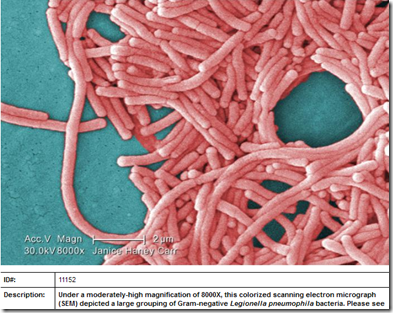
Legionella Bacteria - Photo Credit CDC PHIL
#17,039
While not a scientific law like Boyle's law or Torricelli's law, the Law of Unintended Consequences can be pretty much counted on turn up anytime you think some new idea will `fix things'.
One famous example was the introduction of South American Cane Toads to Australia in 1935 to control a pesky sugar cane beetle, which backfired when these poisonous, and highly promiscuous, invasive amphibians began to crowd out or kill other native species.
With Europe facing an unprecedented energy crisis this winter, there are now calls for Europeans to begin conserving energy in every way possible (see Euronews Energy crisis: Europeans 'must lower thermostats to prepare for Russia turning off gas supplies). Today Denmark's SSI (Statens Serum Institut) has issued a warning on a potential adverse health risk from lowering the thermostats on hot water systems; Legionella.
First a little background.
Legionella bacteria thrives in warm water, such as is commonly found in air-conditioning cooling towers, hot tubs, hot water systems, and even ornamental water fountains. When water is sprayed into the air the bacteria can become aerosolized and inhaled.
Those who are susceptible (often smokers, the elderly and the immunocompromised, etc.) can develop serious – even life threatening – pneumonia.
We know Legionella to be a major cause of infectious pneumonia, and that it sometimes sparks large outbreaks of illness. According to the CDC between 8,000 and 18,000 Americans are hospitalized with Legionnaire's Disease each year, although the actual number of infected is likely higher.
The CDC's website Controlling Legionella in Potable Water Systems recommends (among many other actions):
Energy conservation can cause growth of Legionella in hot water systems
The Danes must be careful that their attempts to save energy and money do not lead to the growth of Legionella here during the current energy crisis. Statens Serum Institut warns against lowering the temperature too much.
Lest anyone think that a home shower is an unlikely place to contract Legionella, we've seen this durable bacteria turn up in surprising places, including automobile windshield wiper fluid (see EID Journal: Vehicle Windshield Wiper Fluid As Potential Source Of Sporadic Legionnaires' Disease).
https://afludiary.blogspot.com/2022/10/denmarks-ssi-issues-warning-on.html
Legionella Bacteria - Photo Credit CDC PHIL
#17,039
While not a scientific law like Boyle's law or Torricelli's law, the Law of Unintended Consequences can be pretty much counted on turn up anytime you think some new idea will `fix things'.
One famous example was the introduction of South American Cane Toads to Australia in 1935 to control a pesky sugar cane beetle, which backfired when these poisonous, and highly promiscuous, invasive amphibians began to crowd out or kill other native species.
With Europe facing an unprecedented energy crisis this winter, there are now calls for Europeans to begin conserving energy in every way possible (see Euronews Energy crisis: Europeans 'must lower thermostats to prepare for Russia turning off gas supplies). Today Denmark's SSI (Statens Serum Institut) has issued a warning on a potential adverse health risk from lowering the thermostats on hot water systems; Legionella.
First a little background.
Legionella bacteria thrives in warm water, such as is commonly found in air-conditioning cooling towers, hot tubs, hot water systems, and even ornamental water fountains. When water is sprayed into the air the bacteria can become aerosolized and inhaled.
Those who are susceptible (often smokers, the elderly and the immunocompromised, etc.) can develop serious – even life threatening – pneumonia.
We know Legionella to be a major cause of infectious pneumonia, and that it sometimes sparks large outbreaks of illness. According to the CDC between 8,000 and 18,000 Americans are hospitalized with Legionnaire's Disease each year, although the actual number of infected is likely higher.
The CDC's website Controlling Legionella in Potable Water Systems recommends (among many other actions):
- Store hot water at temperatures above 140°F (60°C) and ensure hot water in circulation does not fall below 120°F (49°C). Recirculate hot water continuously, if possible.
- Store and circulate cold water at temperatures below the favorable range for Legionella (77–113°F, 25–45°C); Legionella may grow at temperatures as low as 68°F (20°C).
Energy conservation can cause growth of Legionella in hot water systems
The Danes must be careful that their attempts to save energy and money do not lead to the growth of Legionella here during the current energy crisis. Statens Serum Institut warns against lowering the temperature too much.
Last edited on October 3, 2022
Due to the current energy crisis, the authorities have various proposals for, and requirements for, saving on energy. Among other things, you can lower the temperature in hot water systems, and you can use less hot water by e.g. taking shorter baths, washing your hands in cold water and installing water-limiting measures, e.g. energy-saving showers.
However, both parts can contribute to increased growth of Legionella pneumophila in the water systems with a risk of infection and disease. It is therefore important that Danes think carefully before saving on energy.
Due to the current energy crisis, the authorities have various proposals for, and requirements for, saving on energy. Among other things, you can lower the temperature in hot water systems, and you can use less hot water by e.g. taking shorter baths, washing your hands in cold water and installing water-limiting measures, e.g. energy-saving showers.
However, both parts can contribute to increased growth of Legionella pneumophila in the water systems with a risk of infection and disease. It is therefore important that Danes think carefully before saving on energy.
Hot water systems can cause severe pneumonia
Most of our hot water systems contain Legionella pneumophila . The bacterium can cause a serious pneumonia called Legionnaires' disease. Infection occurs by inhaling atomized water that is contaminated with the bacteria, e.g. while showering.
"The disease particularly affects elderly and debilitated people and causes up to 300 hospitalizations per year, but the bacterium is presumably the cause of far more mild cases of the disease, also in younger people. Since the bacteria are common in our hot water systems, it is important to limit their growth. This happens at home primarily by ensuring that cold water is no more than 20 °C and that hot water is at least 50 °C, as the bacteria cannot grow at these temperatures and begin to die at 50 °C," says Søren Anker Uldum , who is head of department at the Statens Serum Institut.
Rinse through with very hot water
It is therefore important to continue to maintain at least 50 °C throughout the hot water system. The temperature must be reached at all tapping points after no more than 30 seconds. rinse and in the return water (before hot water tank or heat exchanger). In most cases, this can be achieved by heating the hot water to 55 °C in the hot water tank.
With reduced consumption of hot water, the water has longer residence times in the pipes and can have temperatures in the bacteria's growth area for a longer period of time, so there must be a certain consumption of hot water.
Taps, such as faucets and showers that are rarely used, should be flushed with hot water at a minimum of 50 °C for a few minutes at least once a week.
When showering (which may well be short), it is also a good idea that at least once a week you first set the mixer tap to maximum temperature and let the water run (to the drain) until it is as hot as it can be before setting it to bath water temperature (approx. 36 °C).
This advice applies especially if there are vulnerable people in the household or institution, such as the elderly or people with chronic illness or a weakened immune system.
See also for savings advice on the Danish Energy Agency's website
Temperature leaving hot water tank/heat exchanger - generally min. 55 °C.
Temperature at tap point and in return water – min. 50 °C after < 30 sec.
Taps (taps and showers) should be flushed through at least once a week with water ≥ 50 °C
The above is especially important if there are vulnerable people in the household.
Most of our hot water systems contain Legionella pneumophila . The bacterium can cause a serious pneumonia called Legionnaires' disease. Infection occurs by inhaling atomized water that is contaminated with the bacteria, e.g. while showering.
"The disease particularly affects elderly and debilitated people and causes up to 300 hospitalizations per year, but the bacterium is presumably the cause of far more mild cases of the disease, also in younger people. Since the bacteria are common in our hot water systems, it is important to limit their growth. This happens at home primarily by ensuring that cold water is no more than 20 °C and that hot water is at least 50 °C, as the bacteria cannot grow at these temperatures and begin to die at 50 °C," says Søren Anker Uldum , who is head of department at the Statens Serum Institut.
Rinse through with very hot water
It is therefore important to continue to maintain at least 50 °C throughout the hot water system. The temperature must be reached at all tapping points after no more than 30 seconds. rinse and in the return water (before hot water tank or heat exchanger). In most cases, this can be achieved by heating the hot water to 55 °C in the hot water tank.
With reduced consumption of hot water, the water has longer residence times in the pipes and can have temperatures in the bacteria's growth area for a longer period of time, so there must be a certain consumption of hot water.
Taps, such as faucets and showers that are rarely used, should be flushed with hot water at a minimum of 50 °C for a few minutes at least once a week.
When showering (which may well be short), it is also a good idea that at least once a week you first set the mixer tap to maximum temperature and let the water run (to the drain) until it is as hot as it can be before setting it to bath water temperature (approx. 36 °C).
This advice applies especially if there are vulnerable people in the household or institution, such as the elderly or people with chronic illness or a weakened immune system.
See also for savings advice on the Danish Energy Agency's website
Temperature leaving hot water tank/heat exchanger - generally min. 55 °C.
Temperature at tap point and in return water – min. 50 °C after < 30 sec.
Taps (taps and showers) should be flushed through at least once a week with water ≥ 50 °C
The above is especially important if there are vulnerable people in the household.
Lest anyone think that a home shower is an unlikely place to contract Legionella, we've seen this durable bacteria turn up in surprising places, including automobile windshield wiper fluid (see EID Journal: Vehicle Windshield Wiper Fluid As Potential Source Of Sporadic Legionnaires' Disease).
https://afludiary.blogspot.com/2022/10/denmarks-ssi-issues-warning-on.html