• FluTrackers.com Inc. does not provide medical advice. Information on this web site is collected from various internet resources, and the FluTrackers board of directors makes no warranty to the safety, efficacy, correctness or completeness of the information posted on this site by any author or poster. The information collated here is for instructional and/or discussion purposes only and is NOT intended to diagnose or treat any disease, illness, or other medical condition. Every individual reader or poster should seek advice from their personal physician/healthcare practitioner before considering or using any interventions that are discussed on this website. By continuing to access this website you agree to consult your personal physican before using any interventions posted on this website, and you agree to hold harmless FluTrackers.com Inc., the board of directors, the members, and all authors and posters for any effects from use of any medication, supplement, vitamin or other substance, device, intervention, etc. mentioned in posts on this website, or other internet venues referenced in posts on this website.
  • We are not asking for any donations. Do not donate to any entity who says they are raising funds for us.

Democratic Republic of Congo - Ebola outbreak May 2017 - MOH, WHO - 8 cases (5 confirmed, 3 probable), 4 deaths reported - additional suspect cases un

Gert van der Hoek

In Memoriam - Editor, Senior Moderator
cbe43bedec580adc6697d1530214ad13.gif


Fri May 12, 2017 1:14pm GMT


ONE PERSON TESTS POSITIVE FOR EBOLA VIRUS IN DEMOCRATIC REPUBLIC OF CONGO - HEALTH MINISTRY

 

266px-Democratic_Republic_of_the_Congo_%2826_provinces%29_-_Bas-Uele.svg.png

Bas-Uele province

may 12, 2017

One person has tested positive for the Ebola virus in the Democratic Republic of Congo, the health ministry said in a statement on Friday.

The case was confirmed from tests on nine people who came down with a hemorrhagic fever in Bas-Uele province in the northeast of the country on or after April 22, the statement said, adding that two of the sufferers had died.
 
Ebola epidemic declared after three die in Democratic Republic of Congo


Friday12, May2017

An Ebola epidemic has been declared in the northeast region of the Democratic Republic of Congo.
The World Health Organisation says three deaths are being linked to the virus.

According to the country's health ministry, one person has tested positive for the virus after coming down with a haemorrhagic fever in Bas-Uele province last month.

In 2014, a three-month outbreak of Ebola in the DRC killed 49 people.

More follows...
 
Dr Oly Ilunga Kalenga, Minister of Public Health, announces an epidemic of Ebola Virus Disease in Likati district, Bas-U?l? Province (northern DRC) following confirmation by the National

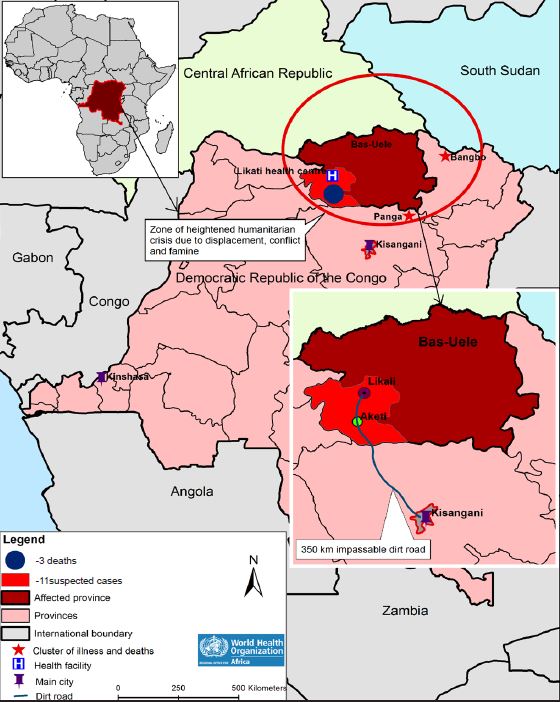
KINSHASA, 12 May. The Minister of Public Health of the Democratic Republic of the Congo (DRC), Dr Oly Ilunga Kalenga, has informed the World Health Organization (WHO) of ?an outbreak of Ebola Virus Disease (EVD)? in Likati health district (Aketi, Bas-U?l? province), more than 1300 kilometres from Kinshasa in the northern DRC, following confirmation of the disease by the National Biomedical Research Institute (INRB), the national reference laboratory. ??Of the five blood specimens taken from suspected cases and analysed at INRB, one has tested positive for Ebola virus (Za?re serotype) using real-time polymerase chain reaction,?? the Minister of Public Health indicated in a letter to the WHO representative in the DRC, and requested ??support from WHO to strengthen the response to this epidemic??. Since 22 April 2017, 9 suspected EVD cases have been reported including 3 deaths in Likati health district, i.e. a case-fatality rate of 33.3%, according to an official assessment on 11 May 2017.

??The WHO Country Office in the DRC is working closely with the national and provincial authorities and with the WHO Regional Office for Africa, WHO headquarters in Geneva and all other partners to facilitate deployment of health workers and protective kits in the field to strengthen epidemiological surveillance and rapidly control the epidemic??, says Dr Yokouid? Allarangar, WHO representative in the DRC. Dr Allarangar also announced that Dr Matshidiso Moeti, WHO Regional Director for Africa, would arrive in Kinshasa this weekend to attend a coordination meeting of the national committee at the Ministry of Health to deal with this emergency and ensure that WHO provides all necessary assistance to the DRC.

WHO has also drawn up a comprehensive logistics plan to meet urgent requirements. ??The first teams of epidemiologists, biologists, and experts in the areas of social mobilization, risk communication and community engagement, and also personnel specializing in water, hygiene and sanitation, are scheduled to reach the affected area today or tomorrow via Kisangani??, the administrative centre of Tshopo (350 kilometres from Buta), Dr Allarangar added. ??The Likati health district is in a remote area, but contact tracing is essential to contain the epidemic in its focus; the DRC can rely on very experienced health workers for this purpose.?? Dr Allarangar also appealed to other partners to work with the country to put in place an appropriately coordinated multisectoral approach. M?decins Sans Fronti?res, the NGO ALIMA, the United Nations Children?s Fund (UNICEF), the Gavi Alliance, the World Food Programme/United Nations Humanitarian Air Service (WFP-UNHAS), and the United Nations Organization Stabilization Mission in the Democratic Republic of the Congo (MONUSCO) are now standing ready to lend their support to the authorities in the DRC.

This confirmed epidemic is centred on the Nambwa health area approximately 130 kilometres from Buta, the administrative centre of Bas-U?l? province, which shares a border with the Central African Republic; it is the eighth EVD epidemic in the DRC since 1976. The most recent recorded epidemic was in August 2014 in Boende region, where the disease was brought under control where it started in Lokolia, now in Tshuapa province.

Media contact:

Eugene Kabambi, +243 817 151 697, kabambie@who.int

http://www.afro.who.int/en/media-ce...602-ebola-in-drc-en/9602-ebola-in-drc-en.html
 
Statement on Ebola in the Democratic Republic of the Congo

Statement

12 May 2017


On 9 May, WHO was informed of a cluster of undiagnosed illness and deaths including haemorrhagic symptoms in Likati Health Zone, Bas Uele Province in the north of the Democratic Republic of the Congo (DRC), bordering Central African Republic.

On 11 May, the Ministry of Health of the Democratic Republic of Congo informed WHO that of 5 laboratory samples tested, 1 tested positive for Ebola virus at the Institut National de Recherche Biom?dicale (INRB) laboratory in Kinshasa. Additional laboratory samples are currently being tested.

Since 22 April, nine suspected cases including 3 deaths have been reported. Six cases are currently hospitalized.

?An investigation team led by the Ministry of Health and supported by WHO and partners has deployed and is expected to reach the affected area in the coming days?, says Dr Peter Salama, WHO Executive Director for Emergencies.

WHO and partners are supporting the Ministry of Health in all aspects of the response, including epidemiological investigation, surveillance, logistics and supplies, communications and community engagement.
 
Dr Oly Ilunga Kalenga, Minister of Public Health, announces an epidemic of Ebola Virus Disease in Likati district, Bas-U?l? Province (northern DRC) following confirmation by the National Biomedical Research Institute.

KINSHASA, 12 May.

The Minister of Public Health of the Democratic Republic of the Congo (DRC), Dr Oly Ilunga Kalenga, has informed the World Health Organization (WHO) of “an outbreak of Ebola Virus Disease (EVD)” in Likati health district (Aketi, Bas-U?l? province), more than 1300 kilometres from Kinshasa in the northern DRC, following confirmation of the disease by the National Biomedical Research Institute (INRB), the national reference laboratory. ‘

‘Of the five blood specimens taken from suspected cases and analysed at INRB, one has tested positive for Ebola virus (Za?re serotype) using real-time polymerase chain reaction,’the Minister of Public Health indicated in a letter to the WHO representative in the DRC, and requested ‘‘support from WHO to strengthen the response to this epidemic’’. Since 22 April 2017, 9 suspected EVD cases have been reported including 3 deaths in Likati health district, i.e. a case-fatality rate of 33.3%, according to an official assessment on 11 May 2017.


‘‘The WHO Country Office in the DRC is working closely with the national and provincial authorities and with the WHO Regional Office for Africa, WHO headquarters in Geneva and all other partners to facilitate deployment of health workers and protective kits in the field to strengthen epidemiological surveillance and rapidly control the epidemic’’, says Dr Yokouid? Allarangar, WHO representative in the DRC. Dr Allarangar also announced that Dr Matshidiso Moeti, WHO Regional Director for Africa, would arrive in Kinshasa this weekend to attend a coordination meeting of the national committee at the Ministry of Health to deal with this emergency and ensure that WHO provides all necessary assistance to the DRC.

WHO has also drawn up a comprehensive logistics plan to meet urgent requirements. ‘‘The first teams of epidemiologists, biologists, and experts in the areas of social mobilization, risk communication and community engagement, and also personnel specializing in water, hygiene and sanitation, are scheduled to reach the affected area today or tomorrow via Kisangani’’, the administrative centre of Tshopo (350 kilometres from Buta), Dr Allarangar added.

‘‘The Likati health district is in a remote area, but contact tracing is essential to contain the epidemic in its focus; the DRC can rely on very experienced health workers for this purpose.’’ Dr Allarangar also appealed to other partners to work with the country to put in place an appropriately coordinated multisectoral approach. M?decins Sans Fronti?res, the NGO ALIMA, the United Nations Children’s Fund (UNICEF), the Gavi Alliance, the World Food Programme/United Nations Humanitarian Air Service (WFP-UNHAS), and the United Nations Organization Stabilization Mission in the Democratic Republic of the Congo (MONUSCO) are now standing ready to lend their support to the authorities in the DRC.


This confirmed epidemic is centred on the Nambwa health area approximately 130 kilometres from Buta, the administrative centre of Bas-U?l? province, which shares a border with the Central African Republic; it is the eighth EVD epidemic in the DRC since 1976. The most recent recorded epidemic was in August 2014 in Boende region, where the disease was brought under control where it started in Lokolia, now in Tshuapa province.
 
[FONT=&quot]
In a televised address, DRC’s health minister, Oly Ilunga Kalenga, warned that the outbreak was a “national health emergency with international significance” but urged people “not to panic”.[/FONT]
[FONT=&quot]“As this is the eighth epidemic [of Ebola] that we are facing as a nation, we should not be rattled,” Kalenga said. “The ministry of health is taking all measures to respond quickly and efficiently to this new outbreak.”[/FONT]

[FONT=&quot]The WHO’s in-country spokesperson, Eugene Kabambi, said regional health workers and protective equipment had already been rolled out to the remote area to contain the virus. A national team of personnel, along with experts and specialists from M?decins Sans Fronti?res, the US Centre for Disease Control, Unicef and WHO, will be following in the next few days.[/FONT]

[FONT=&quot]“The DRC is a big country and the zone affected is quite difficult to access, but it is right on the border with Central African Republic,” said Kabambi. “People are constantly coming and going across the border to visit friends and family, so we are taking very urgent preventative measures to contain the risk.[/FONT]

[FONT=&quot]“We must engage with local communities so they understand that this is a virus unlike any other, it is very contagious and deadly. We are engaging with village heads and community leaders so we can all work together and stop the virus from spreading.”[/FONT]


[FONT=&quot]
[FONT=&quot]Of the three people who have so far died of haemorrhagic fever, only one of them has been confirmed by lab results as having [/FONT]Ebola[FONT=&quot]. He was a man who presented himself with a high fever last month at a local clinic and was told to travel to the nearest hospital for tests.

Kabambi said he died en route and the motorcycle taxi driver who was driving him, as well as another passenger, have also since died of the suspected virus and their deaths were being investigated.[/FONT]
[/FONT]
 
Sat May 13, 2017 | 6:39pm IST

Health experts in Congo identify two more suspected Ebola cases

Health experts have identified two more suspected cases of Ebola in Democratic Republic of Congo, a day after the government declared an outbreak of the disease that has killed one man, the U.N. health agency said on Saturday.

Government and World Health Organization (WHO) officials reached a remote area of Bas-Uele province in northeastern Congo near the border with Central African Republic on Saturday for a field investigation, WHO said.

Experts say to prevent the spread of the virus they must quickly track down, test, isolate and treat suspected cases. They also need to protect health workers and educate the population about hygiene measures.

"The first case and possibly the index case, a 39-year-old male, presented onset of symptoms on 22 April, 2017, and deceased on arrival at the health facility," a WHO statement said.

"Two contacts of this case are being investigated: a person who took care of him during transport to the health care facility, he has since developed similar symptoms, and a moto-taxi driver who transported the patient to the health care facility," it said, adding that the taxi driver had died.

In addition, two more people in the area have been identified as suspected cases in the last 24 hours, bringing the total number of cases to 11, WHO's Congo spokesman Eugene Kabambi told Reuters. Three of them have died of fever.


READ MORE
 
Fullscreen%2Bcapture%2B5122017%2B20628%2BPM.jpg

location of Likati village
thanks to Radio Okapi

Second case of Ebola confirmed in Congo after outbreak of 17 suspected infections


[FONT=&quot]World Health Organisation trying to locate 125 people believed to be linked to cases of the disease[/FONT]


may 15, 2017

[FONT=&quot]A second case of Ebola in the Democratic Republic of Congo has been confirmed by the World Health Organisation (WHO). [/FONT]

[FONT=&quot]This follows a previous outbreak of 17 other suspected cases in the nation. [/FONT]

[FONT=&quot]Officials are trying to locate 125 people who are believed to be linked to cases identified in the remote northeastern province of Bas-Uele in Congo.[/FONT]

[FONT=&quot]Three people have died so far in the 19 suspected and confirmed cases, WHO's Congo spokesman Eugene Kabambi said.[/FONT]
 
HEALTH NEWS | Mon May 15, 2017 | 10:31am EDT

WHO preparing authorization, logistics for Ebola vaccination in Congo if needed

By Kate Kelland | LONDON

The World Health Organization (WHO) said on Monday its experts have not yet decided whether to use newly developed vaccines to try to contain an outbreak of Ebola in Congo, but officials are making preparations just in case.

A second case of Ebola in Democratic Republic of Congo was confirmed by the WHO on Sunday after an outbreak this week of 17 other suspected cases. Three people have so far died among the 19 suspected and confirmed cases.

A spokesman for the Geneva-based U.N. health agency told Reuters the WHO was working with specialists to conduct an epidemiological investigation "to better understand the extent of the current outbreak" and to establish who is at risk of becoming infected with Ebola.
...
http://www.reuters.com/article/us-health-ebola-congo-idUSKCN18B1UM
 
C_3-c7SWsAAYsQm.jpg


Excerpt:

The #Ebola affected locality in NE #DRC is remote & isolated w/ limited transport & communication networks incl 📞 http://goo.gl/bfRmw5

These factors, among to others, impeded the timely transmission of inf on the suspected #Ebola outbreak in #DRCWHO African

The delay to detect & confirm this outbreak may mean that the virus could have spread in the local communities #Ebola #DRC

This therefore calls for a swift, extensive & rapid response to curtail further propagation & mitigate any impact & consequences
#Ebola #DRC

https://twitter.com/WHOAFRO/status/864128865836429313
 
[h=1]Ebola infects hundreds more in DRC[/h] From JEAN KASSONGO in Kinshasa, DRC,KINSHASA, (CAJ News) ? THE Ebola crisis afflicting the Democratic Republic of Congo is worse than initially confirmed after it emerged hundreds of people could be infected.European Union Commissioner for Humanitarian Aid and Crisis Management,Christos Stylianides, who is also the EU Ebola Coordinator,confirmed the escalation.He pointed out last Friday, the first case of Ebola was confirmed in the Central African country.There were 20 suspected cases reported with two confirmed by laboratory tests.?The estimated number of people that could be infected is currently 400,?Stylianides said.To date, there have been three deaths, all at the northern Bas-Ueleprovince where four health areas are affected.?Following the declaration of an Ebola outbreak in the Northeast of theDRC, the EU is fully committed to provide all support necessary,?Stylianides assured.The EU was at the forefront of the response to the Ebola outbreak that claimed over 11 000 in Western Africa in 2013-2016.National authorities, with the support of the World Health Organisation,band the European Commission?s experts in the country as well as international medical NGOs, are making frantic efforts to curb the spread in DRC.?This new outbreak is a stark reminder that we can never let our guard down. Vigilance, early warning, coordination and preparedness are th ebbest tools to prevent further spread of the outbreak,? Stylianides said.

http://cajnewsafrica.com/2017/05/17/ebola-infects-hundreds-more-in-drc/
 
Translation Google

DR Congo - Bas-Uele, Haut-Uele, Ituri & Tshopo
Humanitarian information note no
6 (17/5/2017)

OCHA

Overview of the situation
...
The epidemic of the Ebola virus is reported in the Likati Health Zone in Bas-U?l?.
...
According to the Ministry of Public Health, 21 suspected cases of the Ebola virus, including three deaths
15%) were reported from 22 April to 16 May
in the Nambwa health areas (epicenter of
Muna, Ngayi and Azande in the Likati Health Zone (about 1,300 km north of Kinshasa in the
Province of Bas-U?l?). On 12 May, the Minister of Public Health indicated that a sample was positive
Ebola virus, serotype Zaire by RT-PCR, and requested WHO's support to strengthen the response to this
epidemic. Some actions are being taken to date, including the provision of emergency kits in Nambwa and
Muma, community outreach through a local radio, markets and churches in the
Health of Likati. In the field of water, sanitation and sanitation, chlorine tablets have been distributed
For disinfection of water at the Likati General Reference Hospital and a handwashing device was
put in place. The National Coordinating Committee for Disease Control noted that hospitalization is not
Still organized - patients are monitored on an outpatient basis - and the Ebola Treatment Center (CTE) is under way
of construction. Dispersal of cases, large distances between villages and difficult access, inadequate
Health personnel, etc. Are constraints that this national committee is facing at the moment. For
Recall, the last epidemic of Ebola haemorrhagic fever, which occurred in the former Orientale Province,
Had been reported in the health areas of Isiro and Dungu (current Haut-U?l? province) in 2012. 62 cases
Including 34 deaths between 17 August and 11 October.

https://www.humanitarianresponse.in...ngo-bas-uele-haut-uele-ituri-et-tshopo-note-1
 
UPDATE 1-Tackling Ebola outbreak in remote Congo presents huge challenge - WHO

* Ebola outbreak includes 18 suspected, 2 confirmed cases
* Cases centred in extremely remote northeastern province
* Risk is high nationally, but low globally, WHO says
* Logistics of controlling outbreak highly complex (Changes headline, adds details, quotes, background throughout)
By Kate Kelland, Health and Science Correspondent


...

"As of now, we do not know the full extent of the outbreak, and as we deploy teams over the next few weeks, we will begin to understand... exactly what we're dealing with," Salama told reporters on a telephone briefing.
He said the immediate priority would be to trace the around 400 recorded contacts of the suspected and confirmed cases.

...


"In an area without telecommunications, without road access, without large-scale electrification, this is going to be an enormous challenge," he said.

http://af.reuters.com/article/drcNews/idAFL8N1IK2DQ
 
DRC: Response to The Ebola Virus Disease Outbreak in Bas-Uele

LIKATI: First joint visit of the Minister of Health and the WHO Representative to the epicentre of the Ebola virus disease outbreak.

KINSHASA, 17 May 2017: From 17 to 18 May 2017, Dr Oly Ilunga Kalenga, Minister of Public Health, and Dr Allarangar Yokouid?, WHO Representative in the DRC, will carry out a first visit to assess the Ebola outbreak that has been reported in Nambwa, epicentre of the disease, in the Likati health district, Bas-U?l? Province, located over 1400 km from Kinshasa, to the north of the DRC.

This first visit of health officials, by means of a UNHAS flight negotiated by WHO for a total of 90 hours at the cost of US$ 400 000, will afford the authorities of the Ministry of Health, the Governor of Bas-U?l? Province, the WHO Representative as well as some 12 experts accompanying them ? epidemiologists, logisticians, communicators, psychologists, data managers, etc. ? from WHO, UNICEF and MSF, the opportunity to conduct a rapid assessment of the Ebola virus disease (EVD) outbreak that was officially notified by the authorities on 12 May 2017.

With the deployment of two mobile laboratories of the National Biomedical Research Institute (IRNB) in Nambwa (the epicentre of the outbreak) to facilitate rapid diagnoses on the ground and the presence of a number of experts ? seven logisticians from WHO will be on hand to manage the three logistical bases in three areas, namely Buta, Likati and Nambwa ? WHO and its partners are mounting a powerful response by means of a mechanism intended to coordinate and expedite the response. An Ebola Treatment Centre (ETC) will be set up over the next 48 to 72 hours by MSF with the aim of isolating the patients, providing them with appropriate treatment and limiting the risk of the spread of the deadly Ebola virus.

??We are placing this first field visit under the banner of solidarity with, and compassion for, the population of Likati who are affected by this latest outbreak of the Ebola virus disease in the DRC. We appeal for a greater show of solidarity from the international community to enable the DRC to urgently contain the outbreak, as the country is already facing another humanitarian crisis in its central region [Editor?s note: in Kasa?]?, stated Dr Allarangar Yokouid?, WHO Representative in the DRC.

In Buta, the administrative seat of the province, the delegation will hold discussions with political and administrative authorities, active forces and community and religious leaders in view of generating strong social mobilization. Thereafter, about a dozen persons will be airlifted in a UNHAS helicopter to Likati, located about 100 km from the chief town of the Province.

??The idea is to open up access to the outbreak area, facilitate the safe deployment of teams, equipment and materials for the two mobile laboratories, and to give the officials the opportunity to observe what is actually happening on the ground,? explained Jean-Pierre Veyrenche, a WHO logistician. He stated that similar flights had been scheduled for the coming week with the financial support of WHO, to respond to urgent needs and to ensure the gradual deployment of the various operational partners.

On Monday 15 May, the Minister of Public Health, with the support of partners, produced a national response plan to the outbreak, costed at over US$ 8 million and covering the various areas of intervention, including: (i) coordinating the multisectoral response through the outbreak prevention and control committees, (ii) strengthening surveillance, active case research and contact tracing, (iii) strict enforcement of hygiene and biosafety measures in health facilities and local communities, (iv) medical management of patients and suspected cases, (v) strengthening the diagnostic capacities of the mobile laboratories, (vi) providing significant support for risk communication activities, social mobilization, community engagement and others.

As of 16 May 2017, the updated epidemiological situation presents a combined total of 21 suspected cases with three deaths (case fatality rate of 15%). Nambwa health district notified the greatest number of the earliest cases: 13 in all, with two deaths (case fatality: 16%). Over 40 contacts, spread over four health districts - Azande, Nambwa, Ngayi and Muna ? are being traced with the help of community relay agents to ensure that they do not develop the disease.

Media contact:

Eugene Kabambi, Communication Officer, WHO DRC, kabambie@who.int ; Direct: +243 817 151 697

http://www.afro.who.int/en/media-ce...ebola-virus-disease-outbreak-in-bas-uele.html
 
[h=3]Ebola outbreak situation reports 2017[/h] Ebola Situation report: 18 May 2017
18 May 2017

http://www.afro.who.int/en/ebola/ebola-situation-reports.html

Excerpt:

1. Situation update

WHO continues to support the Ministry of Health in the Democratic Republic of Congo to monitor and respond
to the outbreak of Ebola virus disease (EVD) in Likati Health Zone, Bas Uele Province located in the
north-east of the country.

On 18 May 2017, nine suspected EVD cases were reported in Ngayi (7 cases) and Azande (2 cases) in Likati
Health Zone. The suspected cases are being investigated and will be classified accordingly. As of 18 May
2017, a total of 29 EVD cases [two confirmed, two probable and 25 suspected] have been reported. To date,
three deaths have been reported, giving a case fatality rate of 10%. Most of the cases presented with fever,
vomiting, bloody diarrhoea and other bleeding symptoms and signs. The cases have been reported from
four health areas, namely Nambwa (11 cases and two deaths), Mouma (three cases and one death), Ngayi
(13 cases and no deaths), and Azande (two cases and no deaths). According to available information at this
stage, no healthcare workers have been affected.

Out of the five blood samples analysed at the national reference laboratory, Institut National de Recherche
Biom?dicale (INRB) in Kinshasa, two were confirmed Zaire ebolavirus. At least 416 close contacts have been
registered in Likati Health Zone and are being monitored.

This EVD outbreak in the Democratic Republic of Congo was notified to WHO by the Ministry of Health on 11
May 2017. The cluster of cases and deaths of previously unidentified illness have been reported since late
April 2017. Likati Health Zone shares borders with two provinces in the Democratic Republic of the Congo
and with the Central African Republic (Fig. 1). The affected areas are remote and hard to reach, with limited
communication and transport networks.
...

 
Translation Google

Epidemic of Ebola: the population of Kisangani called to appeasement

20.05.2017, Kisangani, Tshopo

The national health minister, Oly Ilunga Kalenga, from the Nyembwe health zone in Likati, Bas-Uel?, the epicenter of the epidemic of Ebola virus fever, said on Thursday 18 May 2017 to the press of the Tshopo chief town that the situation on the ground stagnates with three (3) recorded cases of death and two (2) cases of positive serological diagnosis.

The minister also asked the population to ignore rumors of new cases of Ebola haemorrhagic fever reported in the Banalia Territory.

This false alert relates to bacterial diarrhea, "the samples taken and sent to the National Institute of Biomedical Research (INRB)" only confirmed "cases of diarrhea suffered by suspected persons," revealed Oly Ilunga .

At this stage, "it is important that the communities observe the rules of hygiene in particular, the regular washing of the hands to prevent this disease", concluded the national minister in charge of Health.

Banalia is a territory of the province of Tshopo located more or less 125 km from Kisangani bordering the province of Bas-Uele.


http://www.mediacongo.net/article-actualite-26671.html
 
Back
Top