• FluTrackers.com Inc. does not provide medical advice. Information on this web site is collected from various internet resources, and the FluTrackers board of directors makes no warranty to the safety, efficacy, correctness or completeness of the information posted on this site by any author or poster. The information collated here is for instructional and/or discussion purposes only and is NOT intended to diagnose or treat any disease, illness, or other medical condition. Every individual reader or poster should seek advice from their personal physician/healthcare practitioner before considering or using any interventions that are discussed on this website. By continuing to access this website you agree to consult your personal physican before using any interventions posted on this website, and you agree to hold harmless FluTrackers.com Inc., the board of directors, the members, and all authors and posters for any effects from use of any medication, supplement, vitamin or other substance, device, intervention, etc. mentioned in posts on this website, or other internet venues referenced in posts on this website.
  • We are not asking for any donations. Do not donate to any entity who says they are raising funds for us.

Deepwater Horizon oil spill disaster- Update on BP's attempt to stop the oil leaks - The Macondo 252 well is now officially DEAD

Pathfinder

Editor, Senior Moderator
  • <SMALL>MAY 3, 2010, 2:23 A.M. ET</SMALL>
<!-- ID: BT-CO-20100503-700843 --><!-- TYPE: T Wire --><!-- DISPLAY-NAME: --><!-- PUBLICATION: Dow Jones Newswires --><!-- DATE: 2010-05-03 02:23 --><!-- COPYRIGHT: Dow Jones & Company, Inc. --><!-- ORIGINAL-ID: --><!-- article start --><!--CODE=PRODUCT SYMBOL=NIBCODE=PRODUCT SYMBOL=AEQCODE=PRODUCT SYMBOL=NIPCODE=PRODUCT SYMBOL=WMMICODE=PRODUCT SYMBOL=NRGCODE=GEOGRAPHIC SYMBOL=LACODE=GEOGRAPHIC SYMBOL=USCODE=GEOGRAPHIC SYMBOL=USSCODE=GEOGRAPHIC SYMBOL=SZCODE=GEOGRAPHIC SYMBOL=ECCODE=GEOGRAPHIC SYMBOL=WEUCODE=GEOGRAPHIC SYMBOL=TXCODE=GEOGRAPHIC SYMBOL=UKCODE=GEOGRAPHIC SYMBOL=EUCODE=GEOGRAPHIC SYMBOL=EUPWCODE=GEOGRAPHIC SYMBOL=NMECODE=MARKET SYMBOL=NNDCODE=MARKET SYMBOL=ENECODE=SUBJECT SYMBOL=DJNCODE=SUBJECT SYMBOL=UKMRCODE=SUBJECT SYMBOL=DJG7CODE=SUBJECT SYMBOL=CNWCODE=SUBJECT SYMBOL=DJFPCODE=SUBJECT SYMBOL=DJIVCODE=SUBJECT SYMBOL=DJGCODE=SUBJECT SYMBOL=ENVCODE=SUBJECT SYMBOL=DJICODE=SUBJECT SYMBOL=DOICODE=SUBJECT SYMBOL=DJQSCODE=SUBJECT SYMBOL=AERCODE=SUBJECT SYMBOL=DJMOCODE=SUBJECT SYMBOL=ENYCODE=SUBJECT SYMBOL=BKGCODE=SUBJECT SYMBOL=DJINCODE=SUBJECT SYMBOL=DJPNCODE=SUBJECT SYMBOL=DJGVCODE=SUBJECT SYMBOL=DJGSCODE=SUBJECT SYMBOL=DJIBCODE=SUBJECT SYMBOL=DPGCODE=SUBJECT SYMBOL=EUCMCODE=SUBJECT SYMBOL=DJPTCODE=SUBJECT SYMBOL=ADRCODE=SUBJECT SYMBOL=DJQACODE=SUBJECT SYMBOL=EWRCODE=SUBJECT SYMBOL=GENCODE=SUBJECT SYMBOL=DJGPCODE=SUBJECT SYMBOL=WERCODE=SUBJECT SYMBOL=NRGCODE=SUBJECT SYMBOL=WEICODE=SUBJECT SYMBOL=ECRCODE=SUBJECT SYMBOL=DJWRCODE=SUBJECT SYMBOL=PETCODE=SUBJECT SYMBOL=WAERCODE=SUBJECT SYMBOL=EGYCODE=SUBJECT SYMBOL=NACMCODE=SUBJECT SYMBOL=CMDICODE=SUBJECT SYMBOL=REFCODE=SUBJECT SYMBOL=CMRCODE=SUBJECT SYMBOL=DJEPCODE=SUBJECT SYMBOL=IPRCODE=SUBJECT SYMBOL=DJEUCODE=SUBJECT SYMBOL=DJRTCODE=SUBJECT SYMBOL=EMRCODE=SUBJECT SYMBOL=FXWCODE=SUBJECT SYMBOL=EMTCODE=SUBJECT SYMBOL=DJAECODE=SUBJECT SYMBOL=DJWICODE=SUBJECT SYMBOL=DJEICODE=SUBJECT SYMBOL=DJENCODE=SUBJECT SYMBOL=WSJCCODE=SUBJECT SYMBOL=APINCODE=SUBJECT SYMBOL=TSYCODE=COMPANY SYMBOL=RIGCODE=COMPANY SYMBOL=BP.LNCODE=COMPANY SYMBOL=BPCODE=INDUSTRY SYMBOL=OIECODE=INDUSTRY SYMBOL=XDJGICODE=INDUSTRY SYMBOL=XNYACODE=INDUSTRY SYMBOL=XGDWCODE=INDUSTRY SYMBOL=OILCODE=INDUSTRY SYMBOL=XSLICODE=INDUSTRY SYMBOL=XGTICODE=INDUSTRY SYMBOL=DRLCODE=INDUSTRY SYMBOL=XFT1CODE=INDUSTRY SYMBOL=XOGTCODE=INDUSTRY SYMBOL=XISLCODE=COMPANY SYMBOL=CH0048265513CODE=COMPANY SYMBOL=GB0007980591CODE=COMPANY SYMBOL=US0556221044-->US Oil Spill Response Team: Plan To Deploy Dome In 6-8 Days


The response team striving to contain the gushing Gulf of Mexico oil well said Monday it plans to deploy a dome to cover the well and siphon off the crude within the next 6-8 days, depending on the weather.

The 125-ton dome--officially known as the Subsea Oil Recovery System--will be set on top of the largest leak, according to a fact sheet issued by the oil spill response group coordinated by the U.S. Coast Guard.
-------------
Officials said the Subsea Oil Recovery System could collect as much as 85% of the oil rising from the sea floor, with the crude moved from the dome via a vertical pipe to the surface where it is processed and stored temporarily on a ship.

However, the officials added the system is untested at the one-mile depth of this well.

Full text:
http://online.wsj.com/article/BT-CO-20100503-700843.html?mod=WSJ_latestheadlines
 
Last edited by a moderator:
Re: US Oil Spill Response Team: Plan To Deploy Dome In 6-8 Days

Re: US Oil Spill Response Team: Plan To Deploy Dome In 6-8 Days

May 03, 2010
LINK: Subsea oil recovery system

FACT SHEET: SUBSEA OIL RECOVERY SYSTEM

The Subsea Oil Recovery System is a large structure that can be placed over the largest leak source in the Transocean Deepwater Horizon Rig. The system is designed to collect hydrocarbons from the well and pump them to a tanker at the surface, where they will be stored and safely shipped ashore. Weather permitting, deployment of the system is planned within the next six to eight days.

How it works

<DIR><DIR>? The system is made up of a 125-ton, 14? x 24? x 40? structure that will be set on top of the largest leak source. This leak is located at the end of the riser, about 600 feet from the wellhead.

? Equipment at the top of the system is connected to a 5,000 foot riser that will convey the hydrocarbons to the surface ship, the Deepwater Enterprise.

? Once in place, oil will flow up into the containment system?s dome to the surface ship.

? Once on the surface ship, the hydrocarbons will be processed and oil will be separated from water and gas. The oil will then be temporarily stored before being offloaded and shipped to a designated oil terminal onshore.

? The Deepwater Enterprise is capable of processing 15,000 barrels of oil per day and storing 139,000 barrels.

? A support barge will also be deployed with a capacity to store 137,000 barrels of oil.

? This system could collect as much as 85% of oil rising from the seafloor.

</DIR></DIR>
How it was developed

<DIR><DIR>? This is the first time this system will be used at this water depth.

? To develop the system, BP quickly located existing structures that had previously been used as coffer dams in shallow water recovery efforts after Hurricane Katrina.

? After Katrina, these structures were lowered over damaged wellheads to allow divers to repair wellheads.

? BP engineers have worked closely with the firm Wild Well Controls, Inc. to convert these structures for use in deep waters.


</DIR></DIR>What?s next


<DIR><DIR>? This system is being fabricated in Louisiana and will be transported to the Deepwater Enterprise.

? Once on site, the system will be lowered to the seabed.

? ROVs will monitor the installation and will complete connections to the riser (tubing).


</DIR></DIR>
? Because of the weight of the structure and the muddy conditions at the sea bottom, "mud flaps" have been added to the sides of the structure. These flaps enable the structure to settle into the sea bottom and complete the enclosure.
...
 
Re: US Oil Spill Response Team: Plan To Deploy Dome In 6-8 Days

Re: US Oil Spill Response Team: Plan To Deploy Dome In 6-8 Days

r1544338086.jpg


<!-- end photoProvider --><cite id="photoTimestamp">Mon May 3, 2:01 PM ET</cite>


<!-- end photo cont -->Welders work on top

Welders work on the top of a portion of the BP subsea oil recovery system chamber at Wild Well Control, Inc. in Port Fourchon, Louisiana May 3, 2010.

snip

http://news.yahoo.com/nphotos/Gulf-...oViewer=/100503/ids_photos_wl/r1544338086.jpg
 
Re: US Oil Spill Response Team: Plan To Deploy Dome In 6-8 Days

Re: US Oil Spill Response Team: Plan To Deploy Dome In 6-8 Days

Officials ready containment dome to bottle up spill
5410spill4.jpg
Credit: AP
Workers at the Wild Well Control company work on a containment chamber that will be used to help contain the oil leaking from the Deepwater Horizon drilling platform in Port Fourchon, La., Monday, May 3, 2010. The chamber will be lowered onto the well and capture the oil that is spilling into the Gulf Of Mexico. (AP Photo/Bill Haber)


by Vicki Smith and Allen Breed
wwltv.com
Posted on May 5, 2010 at 7:09 AM
Updated today at 7:14 AM

NEW ORLEANS -- The best short-term solution to bottling up a disastrous oil spill threatening sealife and livelihoods along the Gulf Coast should be arriving on Wednesday in the form of a specially built giant concrete-and-steel box designed to siphon the oil away.

Crews for contractor Wild Well Control were putting the finishing touches Tuesday on the 100-ton containment dome. A barge at about midday would haul the contraption to the spot 50 miles offshore where a mile-deep gusher from a blown-out undersea well has been spewing at least 210,000 gallons of crude a day into the Gulf for two weeks. BP spokesman John Curry said it would be deployed on the seabed by Thursday.

/.../

http://www.wwltv.com/news/local/Officials-ready-containment-dome-to-bottle-up-spill-92854024.html
 
Re: US Oil Spill Response Team: Plan To Deploy Dome In 6-8 Days

Re: US Oil Spill Response Team: Plan To Deploy Dome In 6-8 Days

Containment box arrives onsite near source of Gulf of Mexico oil spill

By The Associated Press

May 06, 2010, 6:56AM

aptopix-gulf-oil-spill-9220506af40cdbea_large.jpg
Patrick Semansky / The Associated PressThe barge Joe Griffin sails down a channel Wednesday on its way to the Gulf of Mexico carrying a chamber, right, that will be used to help contain oil leaking from the Deepwater Horizon oil drilling platform onto a ship in Port Fourchon, La.

ON THE GULF OF MEXICO (AP) -- A boat carrying a 100-ton concrete-and-steel contraption designed to siphon off the oil fouling the Gulf of Mexico arrived Thursday at the spot in the sea where a blown-out well is spewing hundreds of thousands of gallons a day.

Another boat with a crane plans to start lowering the box to the seafloor later in the day. Engineers hope it will be the best short-term solution to controlling the leak that has only worsened since it began two weeks ago.

A rapid response team planned to head to the Chandeleur Islands off Louisiana's coast Thursday to look into unconfirmed reports that oil from the spill had arrived there, Coast Guard Petty Officer Erik Swanson said.

The boat hauling the specially built containment box and dome structure pushed off Wednesday evening from the Louisiana coast and arrived at the site of the disaster Thursday morning.

The Joe Griffin would meet up with another BP-chartered boat, the Boa Sub C, a Norwegian vessel that will use a crane to lower the contraption to cover the gusher of oil spewing from the seabed -- something that has never been tried before at such depths. BP spokesman Bill Salvin said the drop is expected at about noon on Thursday.

The dome-like top of the structure is designed to act like a funnel and siphon the oil up through 5,000 feet of pipe and onto a tanker at the surface. Oil has been gushing into the Gulf of Mexico at a rate of at least 200,000 gallons a day since an offshore drilling rig exploded and sank last month, killing 11 people.

"We're a little anxious. They're gonna try everything they can. If it don't work, they'll try something else," Capt. Demi Shaffer told The Associated Press aboard his boat just after it set off. The AP is the only news organization with access to the containment effort.

A 12-man crew aboard a supply boat was carrying the precious cargo.

The 280-foot Joe Griffin, owned by Edison Chouest Offshore, also was involved in helping fight the fire that resulted from the oil rig explosion.

The vessel is named for a boat captain who worked with company founder Edison Chouest, when Chouest was still in the shrimping business.

The operator of the oil rig, BP PLC, has tried several high-tech undersea tactics to cap the leak. The containment dome endeavor is unprecedented and engineers are fully aware of the risks.

First, crews need to properly position the four-story structure above the well as it sinks deep into the mud at the bottom of the Gulf with the help of a remote-controlled robotic submarine. A steel pipe will be attached to a tanker at the surface and connected to the top of the dome to move the oil.

"It's very dark down there ... and we will have lights on the (submersibles), and we know exactly where to put this and guide it into place," said David Clarkson, BP's vice president for project execution.

That process presents several challenges because of the frigid water temperature -- about 42 degrees Fahrenheit -- and exceptionally high pressure at those depths. Those conditions could cause the pipe to clog with what are known in the drilling industry as "ice plugs." To combat that problem, crews plan to continuously pump warm water and methanol down the pipe to dissolve the clogging.

They are also worried about volatile cocktail of oil, gas and water when it arrives on the ship above. Engineers believe the liquids can be safely separated without an explosion.

Coast Guard Rear Adm. Mary Landry tried to moderate expectations that the containment box would be a silver bullet.

"I know we are all hoping that this containment system will work, but I want to remind everybody that this containment system is a first of its kind deployed in 5,000 feet of water," Landry said.

Asked to handicap the odds of success, Bob Fryer, a senior executive vice president for BP's Deep Water Angola, offered up this assessment: "This has never been done before. Typically you would put odds on something that has been done before."

/.../
http://www.nola.com/news/gulf-oil-spill/index.ssf/2010/05/containment_box_arrives_onsite.html

 
Re: US Oil Spill Response Team: Plan To Deploy Dome In 6-8 Days

Re: US Oil Spill Response Team: Plan To Deploy Dome In 6-8 Days

AP: Oil fumes delaying lowering containment box

Thursday, May 6, 2010. (AP Photo/Gerald Herbert)
by Associated Press
wwltv.com

Posted on May 6, 2010 at 8:53 PM

ON THE GULF OF MEXICO -- The captain of a boat hauling a box that is designed to capture the oil spewing into the Gulf says the delay in lowering it into the ocean is being caused by oil fumes that could ignite.
Capt. Demi Shaffer tells The Associated Press Thursday night that the crews do not want to be fighting a fire while trying to unload the giant concrete-and-steel box over the blown-out oil well at the bottom of the sea. The AP is the only news organization on board the vessel 50 miles off the coast of Louisiana.

Shaffer says because of the lack of wind to circulate the air, the fumes from the thick oil surrounding the boat were rising to a level that any spark could start a fire. That includes metal on metal.

Crew members are wearing respirators. It was unclear when they would be able to proceed.

http://www.wwltv.com/news/local/AP-Oil-fumes-delaying-lowering-containment-box-93037299.html
 
Re: US Oil Spill Response Team: Plan To Deploy Dome In 6-8 Days

Re: US Oil Spill Response Team: Plan To Deploy Dome In 6-8 Days

Friday, May 7, 2010

Photo Release: Workers lower dome in water


<table style="width: 303px; height: 44px;" align="center" border="0"><tbody><tr><td></td></tr><tr><td>GULF OF MEXICO - Crewmembers aboard the motor vessel Joe Griffin look on as the mobile offshore drilling unit Q4000 lowers a pollution containment chamber May 6, 2010. The chamber was designed to cap the oil discharge that was a result of the Deepwater Horizon incident. U.S. Coast Guard photo by Petty Officer 3rd Class Patrick Kelley. <table style="width: 376px; height: 44px;" align="center" border="0"><tbody><tr><td></td></tr><tr><td><table style="width: 338px; height: 44px;" align="center" border="0"><tbody><tr><td></td></tr><tr><td>
</td></tr></tbody></table>
<table style="width: 489px; height: 44px;" align="center" border="0"><tbody><tr><td></td></tr></tbody></table></td></tr></tbody></table>


:tiphat:http://www.deepwaterhorizonresponse.com/go/doc/2931/541231/
 
Re: US Oil Spill Response Team: Plan To Deploy Dome In 6-8 Days

Re: US Oil Spill Response Team: Plan To Deploy Dome In 6-8 Days

100-ton dome nears spill at bottom of Gulf

by Harry R. Weber and Tamara Lush / Associated Press
wwltv.com
Posted on May 7, 2010 at 5:59 AM
Updated today at 6:25 AM

Excerpts:

Douglas Peake, the first mate of the supply boat that brought the box to the site, confirmed a radio transmission from the nearby vessel lowering the device that said the device would be in position over the well soon.

The transmission said undersea robots were placing buoys around the main oil leak to act as markers to help line up the 40-foot box.

A crane late Thursday lowered the containment vessel designed to collect as much as 85 percent of the oil spewing into the Gulf and funnel it up to a tanker. Eventually the crane would give way to underwater robots that will secure the contraption over the main leak at the bottom, a journey that would take hours.

A steel pipe will be installed between the top of the box and tanker. If all goes well, the whole structure could be operating by Sunday.

----------------------------------------

/.../
Full text at:
http://www.wwltv.com/news/local/100-ton-dome-nears-spill-at-bottom-of-Gulf-93058209.html
 
Last edited by a moderator:
Re: US Oil Spill Response Team: Plan To Deploy Dome In 6-8 Days

Re: US Oil Spill Response Team: Plan To Deploy Dome In 6-8 Days

Box to contain oil leak touches down on Gulf floor

<TABLE><TBODY><TR vAlign=top><TD>
Last Update: 5/07 5:12 pm
</TD></TR></TBODY></TABLE>

ON THE GULF OF MEXICO (AP) - BP lowered a 100-ton concrete-and-steel vault onto a ruptured well in the Gulf of Mexico on Friday, an important step in a delicate and unprecedented attempt to stop most of the gushing crude fouling the sea.

Underwater robots guided the 40-foot-tall box into place. Now that the contraption is on the seafloor, workers will need at least 12 hours to let it settle and make sure it's stable before the robots can hook up a pipe and hose that will funnel the oil up to a tanker.

"It appears to be going exactly as we hoped," BP spokesman Bill Salvin told The Associated Press on Friday afternoon, shortly after the four-story device hit the seafloor. "Still lots of challenges ahead, but this is very good progress."

By Sunday, the box the size of a house could be capturing up to 85 percent of the oil...
/.../

http://www.fox8live.com/news/local/...own-on-Gulf-floor/M2BSJtlNik2DHz7QwBjRvA.cspx
 
Re: US Oil Spill Response Team: Plan To Deploy Dome In 6-8 Days

Re: US Oil Spill Response Team: Plan To Deploy Dome In 6-8 Days

Tricky maneuver: Will containment cap stop the BP oil spill?

Crews are lowering a steel and concrete containment cap over the underwater source of the BP oil spill in the Gulf of Mexico. It's a tricky maneuver, and there's no guarantee it will work.

By Bill Sasser, Correspondent / May 7, 2010
New Orleans

snip

“Out of 40 boats I saw dragging or deploying boom, about three [boom] actually seemed to be containing any oil,” says Mr. Steiner. “This oil is so thoroughly mixed with water that it’s just going right under the booms.”

Getting dome in place very difficult


...

More at:
http://www.csmonitor.com/USA/2010/0507/Tricky-maneuver-Will-containment-cap-stop-the-BP-oil-spill
 
Re: US Oil Spill Response Team: Plan To Deploy Dome In 6-8 Days

Re: US Oil Spill Response Team: Plan To Deploy Dome In 6-8 Days

#13: "“A similar box was tried at the Ixtoc I platform, but they were never able to get it positioned correctly and it never really worked,” says Dr. Milgram, who served as a consultant on the oil spill disaster off Mexico in 1979.

Ultimately the only way it was stopped was by drilling a relief well, which took several months.”"


Any ease less spilling is better than nothing.
If they had got the dome box already prepared before deep drillings, it will deminish the actual damage.

Maybe somobody could drag an explanation why
(of course with any further well usage there implicitely forbidden)
this spilling hole ultimate fast track solution could not be if possible,
some kind of explosive sealing?

instead of the prospected, now "galactical" trimestrial oil leakage,
which represent a collosal irreversible ocean pollution.
 
Re: US Oil Spill Response Team: Plan To Deploy Dome In 6-8 Days

Re: US Oil Spill Response Team: Plan To Deploy Dome In 6-8 Days

http://www.cnn.com/2010/US/05/08/gulf.oil.spill/index.html?hpt=T1

Crews dealt setback in placing containment dome in Gulf oil spill

Biloxi, Mississippi (CNN) -- The effort to place a containment dome over a gushing wellhead was dealt a setback when a large volume of hydrates -- crystals formed when gas combines with water -- accumulated inside of the vessel, BP's chief operating officer said Saturday.

Gas hydrates are lighter than water, and as a result, made the dome buoyant, Doug Suttles said. The crystals also blocked the top of the dome, which would prevent oil from being funneled to a drill ship.

The dome was moved off to the side of the wellhead and is resting on the seabed while crews work to overcome the challenge, Suttles said.
 
Re: US Oil Spill Response Team: Plan To Deploy Dome In 6-8 Days

Re: US Oil Spill Response Team: Plan To Deploy Dome In 6-8 Days

Deep-sea ice crystals stymie Gulf oil leak


May 8, 2010 6:45 PM (42 mins ago) By HARRY R. WEBER and

SARAH LARIMER, AP

(AP Photo/David Quinn)
A crane ship floats in support of a relief platform at the Deep Sea Horizon oil spill site in the Gulf of Mexico, Saturday, May 8, 2010.


ON THE GULF OF MEXICO (Map, News) -

A novel but risky attempt to use a 100-ton steel-and-concrete box to cover a deepwater oil well gushing toxic crude into the Gulf of Mexico was aborted Saturday after ice crystals encased it, an ominous development as thick blobs of tar began washing up on Alabama's white sand beaches.

The setback left the mission to cap the ruptured well in doubt. It had taken about two weeks to build the box and three days to cart it 50 miles out then slowly lower it to the well a mile below the surface, but the frozen depths were too much for it to handle.

Still, BP officials overseeing the cleanup efforts were not giving up just yet on hopes that a containment box - either the one brought there or a larger one being built - could cover the well and be used to capture the oil and funnel it to a tanker at the surface to be carted away. Officials said it would be at least Monday before a decision was made on what next step to take.

"I wouldn't say it's failed yet," BP chief operating officer Doug Suttles said.

"What I would say is what we attempted to do ... didn't work."

/.../
http://www.examiner.com/a-2620073~Deep_sea_ice_crystals_stymie_Gulf_oil_leak_fix.html
 
Re: US Oil Spill Response Team: Plan To Deploy Dome

Re: US Oil Spill Response Team: Plan To Deploy Dome

After Saturday's containment box failure, BP may try again with a smaller version

By The Associated Press

May 09, 2010, 7:19PM

Excerpts:

Among the plans under consideration:

-- Deploying a new, smaller containment box in the hope that it would be less likely to get clogged. Officials said the new box could be in place by midweek.

"We're going to pursue the first option that's available to us and we think it'll be the top hat," the smaller box, BP Chief Operating Officer Doug Suttles said.

-- Cutting the riser pipe, which extends from the mile-deep well, undersea and using larger piping to bring the gushing oil to a drill ship on the surface, a tactic considered difficult and less desirable because it will increase the flow of oil.

-- Shooting mud and concrete directly into the well's blowout preventer, a device that was supposed to shut off the flow of oil after a deadly April 20 oil rig explosion but failed. The technique, known as a "top kill," is supposed to plug up the well and would take two to three weeks.

-- Try again using the containment box that failed to work Saturday after finding a way to keep the crystals from building up.

The engineers appear to be "trying anything people can think of" to stop the leak, said Ed Overton, a Louisiana State University professor of environmental studies.

"Hopefully these are low-risk type of operations," he said. "We don't want to do anything to make it flow more."

--------------------------------------------
BP spokesman Mark Proegler said no decisions have been made on what step the company will take next. A decision could come as early as Monday.

Philip Johnson, a petroleum engineering professor at the University of Alabama, said cutting the riser pipe and slipping a larger pipe over the cut end could conceivably divert the flow of oil to the surface.

"That's a very tempting option," he said. "The risk is when you cut the pipe, the flow is going to increase. ... That's a scary option, but there's still a reasonable chance they could pull this off."

Johnson was less optimistic that a smaller containment box would be less susceptible to being clogged by icelike crystals.

"My suspicion is that it's likely to freeze up anyway," he said. "But I think they should be trying everything they can."

--------------------------------------------
BP officials were not giving up hopes that a containment box -- either the one brought there or another one being built -- could cover the well. Crews planned Sunday to secure the box about 1,600 feet from the massive leak site, much farther away from where it was placed Saturday, according to a daily activity sheet reviewed by The Associated Press.

Full text at:
http://www.nola.com/news/gulf-oil-spill/index.ssf/2010/05/after_saturdays_containment_bo.html
 
Re: US Oil Spill Response Team: Plan To Deploy Dome

Re: US Oil Spill Response Team: Plan To Deploy Dome

Smaller containment dome being lowered toward spill

by Associated Press
wwltv.com
Posted on May 11, 2010 at 9:34 PM
Updated yesterday at 10:21 PM

ON THE GULF OF MEXICO -- A second, smaller oil containment box was lowered into the sea near the blown-out well in the Gulf of Mexico.

The box was being slowly submerged to the seabed Tuesday. But it won't be placed over the spewing well right away. BP spokesman Bill Salvin says engineers want to make sure everything is configured correctly and avoid the same buildup of ice crystals that stymied their first attempt at using a larger box that was about 100 tons.

This box will be connected to a ship on the surface by a pipe-within-a-pipe when it's lowered. Crews plan to pump in heated water and methanol so ice won't build up.

Salvin said undersea robots will position the box over the gusher by Thursday.

More than 4 million gallons of oil have spewed from the well since a drilling rig exploded April 20.

http://www.wwltv.com/news/gulf-oil-...dome-being-lowered-toward-spill-93506694.html
 
Re: US Oil Spill Response Team: Plan To Deploy Dome

Re: US Oil Spill Response Team: Plan To Deploy Dome

'Top hat' reaches Gulf of Mexico floor, BP says

By the CNN Wire Staff<SCRIPT type=text/javascript>cnnAuthor = "By the CNN Wire Staff ";</SCRIPT>
<SCRIPT type=text/javascript>if(location.hostname.indexOf( 'edition.' ) > -1) {document.write('May 12, 2010 -- Updated 1249 GMT (2049 HKT)');} else {document.write('May 12, 2010 8:49 a.m. EDT');}</SCRIPT>May 12, 2010 8:49 a.m. EDTMay 12, 2010 -- Updated 1249 GMT (2049 HKT)

<!--endclickprintinclude--><!-- google_ad_section_end --><!--startclickprintexclude--><!--endclickprintexclude--><!-- google_ad_section_start --><!-- CONTENT --><!--startclickprintinclude--><SCRIPT language=JavaScript type=text/javascript>var clickExpire = "-1";</SCRIPT><!-- REAP --><!--startclickprintexclude--><!--===========IMAGE============-->
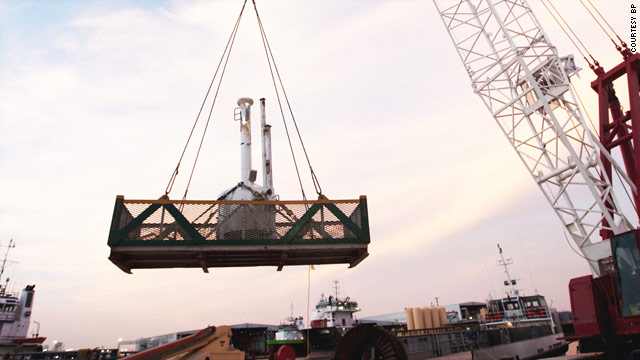
t1larg.dome.02.bp.jpg
<!--===========/IMAGE===========-->
<!--===========CAPTION==========-->BP built the smaller "top hat" dome after a larger vessel developed glitches Saturday.

<!--===========/CAPTION=========--><!--endclickprintexclude--><!-- /REAP --><!-- google_ad_section_end -->
Venice, Louisiana (CNN) -- The "top hat" oil containment device has reached the sea floor in the Gulf of Mexico and should be in position over a leaking well head and operational by the end of the week, BP said Wednesday.

A larger containment vessel was unsuccessful in stopping the flow of oil from the gusher about 5,000 feet underwater. The spill is sending 210,000 gallons of crude into the Gulf of Mexico each day.

The "top hat," a 5-foot-tall, 4-foot-diameter structure, weighs less than 2 tons. The structure was deployed by the drill ship Enterprise.
BP built the smaller dome after a much larger, four-story containment vessel designed to cap the larger of two leaks in the well developed glitches Saturday. Ice-like hydrate crystals formed when gas combined with water and blocked the top of the dome, making it buoyant.

The new device would keep most of the water out at the beginning of the capping process and would allow engineers to pump in methanol to keep the hydrates from forming, said Doug Suttles, BP's chief operating officer for exploration and production. Methanol is a simple alcohol that can be used as an antifreeze.


Secretary of the Interior Ken Salazar said the success of this latest attempt to cap the well could be known in the next few days.

"On this Thursday, we should know whether or not this alternative top hat cofferdam is going to work," Salazar said on CNN's "The Situation Room." "And then the next key date is Saturday, because by Saturday they will have the diagnostics completed through X-rays and gamma rays and pressure ratings to be able to make decisions about what the next steps are."

If attempts to cap the well fail, BP may try to plug the leak by shooting debris -- shredded tires, golf balls and similar objects -- under extremely high pressure into the well's blowout preventer in an attempt to clog it and stop the leak. The blowout preventer has been partially successful in sealing the well, but did not fully close when the rig exploded and sank.

Suttles said BP also is drilling a relief well to try to divert the flow to another pipe.
"That started about a week ago," Suttles said. "That work continues. The well is at about 9,000 feet."
/.../

http://edition.cnn.com/2010/US/05/12/oil.spill.main/
 
Re: US Oil Spill Response Team: Plan To Deploy Dome

Re: US Oil Spill Response Team: Plan To Deploy Dome

Update on Gulf of Mexico Oil Spill Response

Release date: 13 May 2010

BP today provided an update on developments in the response to the MC252 oil well incident in the Gulf of Mexico.
<!--END:Plain Text para-->

<!-- Begin: Links. --><!-- End: Links -->
Subsea Source Control and Containment

<!--END: Addition of header tag for TB07 -->
Subsea efforts continue to focus on, firstly, progressing options to stop the flow of oil from the well through interventions via the blow out preventer (BOP) and, secondly, attempts to contain the flow of oil at source to reduce the amount spreading on the surface. These efforts are being carried out in conjunction with governmental authorities and other industry experts.

Further investigation of the failed BOP, using remotely-operated vehicles and a variety of diagnostic techniques, has increased our understanding of the condition of the BOP and allowed planning to continue for a number of potential interventions, including for a so-called ?top kill? of the well.

This would involve first injecting material of varying densities and sizes (also known as ?junk shot?) into the internal spaces of the BOP to provide a seal, before pumping specialised heavy fluids into the well to prevent further flow up the well. Plans for this option are being developed in preparation for potential application next week.
<!--END:Plain Text para-->

<!-- Begin: Links. --><!-- End: Links -->
Work to deploy a second system designed to contain the oil flow subsea has continued. A small dome or ?top hat? has been taken out to the well site and placed on the seabed in preparation for deployment. Such a system has never been used in water depths of 5,000 feet and its successful operation is not certain. The deployment of this system is expected to be attempted within the next few days.

All of the techniques being attempted or evaluated to contain the flow of oil on the seabed involve significant uncertainties because they have not been tested in these conditions before.

Work on the first relief well, which began on Sunday May 2, continues. It is expected to take some three months to complete. The drilling rig that will drill the second relief well is currently en route to the site, expected to arrive by Friday.

http://www.bp.com/genericarticle.do?categoryId=2012968&contentId=7062086
 
Back
Top