• FluTrackers.com Inc. does not provide medical advice. Information on this web site is collected from various internet resources, and the FluTrackers board of directors makes no warranty to the safety, efficacy, correctness or completeness of the information posted on this site by any author or poster. The information collated here is for instructional and/or discussion purposes only and is NOT intended to diagnose or treat any disease, illness, or other medical condition. Every individual reader or poster should seek advice from their personal physician/healthcare practitioner before considering or using any interventions that are discussed on this website. By continuing to access this website you agree to consult your personal physican before using any interventions posted on this website, and you agree to hold harmless FluTrackers.com Inc., the board of directors, the members, and all authors and posters for any effects from use of any medication, supplement, vitamin or other substance, device, intervention, etc. mentioned in posts on this website, or other internet venues referenced in posts on this website.
  • We are not asking for any donations. Do not donate to any entity who says they are raising funds for us.

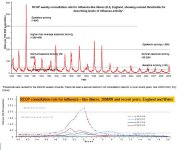
decline of influenza in England

Re: decline of influenza in England

With the threat of a flu pandemic in the future, I think it would be important to examine this chart. What is happening in England to make influenza drop off so greatly after 2000? '98 looks a litttle unusual, too.

319359471.jpg
 
Re: decline of influenza in England

From the first link, a possible explanation for the decline:

This (the reducing trend) may reflect the declining ability of the H3N2 virus to efficiently infect susceptible hosts. Factors influencing this might include mutational changes to the virus structure (especially in domains of the haemagglutinin associated with receptor binding), forced by decades of immunological pressure from the population.

This could result in a gradual decrease in viral fitness and thus a virus that is not able to infect and transmit as efficiently as when first introduced to the population.

If this scenario were true, then we would predict that the H3N2 subtype is making way for another pandemic strain, whether H5N1, or possibly another subtype from a yet unknown source.

From analysis of our data, we would expect that following the introduction of a novel pandemic strain, incidence rates of ILI would peak at extremely high levels during the initial waves of the pandemic, but would then be sustained for a period of approximately 10 years following its introduction.

However, we must not be complacent in the face of the apparent decline of ILI in recent years, it is most likely that this is not a result of our attempts to control the spread of the influenza virus through treatment and prophylaxis; we must remember that this may simply be the calm before the storm.
 
Re: decline of influenza in England

''The calm before the storm'' -- Example of the result of reality obscured by a pre-fabricated conclusion.

H3N2 is far for being a stable viral strain and some experts suspect that would be a ''source'' for some trouble in future rather than a residual strain.

If we are looking for a disaster at any cost, well, we can create all the opportunities to flex data in our favor.

Recent rapid emersion of Brisbane strains of H3 should keep cold our mind.
 
Re: decline of influenza in England

Well, certainly it's their opinion.

What would be another good explanation for the decline? They mentioned prophylactics, such as handwashing, etc, as a possible cause for the decline.

Actually, *if*, not *when* gives a *calm before the storm* feeling to many of us. We're just sitting here waiting for it to happen....
 
Re: decline of influenza in England

flu did hit early this season in the UK, but then it went down
in January

although it was announced as a bad season, it was
still much better than 1999/00


attachment.php
 

Attachments

  • flugb09.jpg
    flugb09.jpg
    55.3 KB · Views: 0
Re: decline of influenza in England

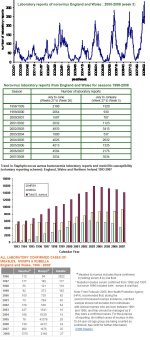
other indectious diseases don't seem to be declining in Englang and Wales,
(see below)
just only influenza-like-illness.
Or maybe the health system changed and people are less likely since
2000 to report ILI to doctors or doctors are less likely to report them to
RCGP or HPG or whatever that is in England.

Maybe someone from the UK can comment.


attachment.php
 

Attachments

  • ukinf1.jpg
    ukinf1.jpg
    185.7 KB · Views: 0
Back
Top