• FluTrackers.com Inc. does not provide medical advice. Information on this web site is collected from various internet resources, and the FluTrackers board of directors makes no warranty to the safety, efficacy, correctness or completeness of the information posted on this site by any author or poster. The information collated here is for instructional and/or discussion purposes only and is NOT intended to diagnose or treat any disease, illness, or other medical condition. Every individual reader or poster should seek advice from their personal physician/healthcare practitioner before considering or using any interventions that are discussed on this website. By continuing to access this website you agree to consult your personal physican before using any interventions posted on this website, and you agree to hold harmless FluTrackers.com Inc., the board of directors, the members, and all authors and posters for any effects from use of any medication, supplement, vitamin or other substance, device, intervention, etc. mentioned in posts on this website, or other internet venues referenced in posts on this website.
  • We are not asking for any donations. Do not donate to any entity who says they are raising funds for us.

Cruise ship - Hantavirus - May 3+ - As of May 22 per WHO: 13 total cases, 3 total deaths - WHO considers the outbreak over (July 2, 2026)

The CDC sent an email notice to attend a media conference one hour before the start. I missed it. Sorry....

Actually 51 minutes advance notice. :(
 
Hantavirus cluster linked to cruise ship travel, Multi-country

13 May 2026

Situation at a glance

This is the third Disease Outbreak News report on the hantavirus cluster, following the notification to the World Health Organization (WHO) on 2 May 2026 of severe respiratory illness cases aboard MV Hondius, a cruise ship. Since the last DON was published on 8 May, two additional confirmed cases were reported from France and Spain. In addition, there is one inconclusive result for a case in the United States of America. All were passengers on the ship. As of 13 May, a total of 11 cases, including three deaths, have been reported (case fatality ratio 27%). Eight cases were laboratory-confirmed for Andes virus (ANDV) infection, two are probable, and one case remains inconclusive and undergoing further testing. Through the International Health Regulations (2005) (IHR) channels, National IHR Focal Points (NFPs) have all been informed and are supporting international contact tracing efforts. WHO has assessed the risk posed by this event to the global population as low and will continue to monitor the epidemiological situation and update the risk assessment as needed.

Description of the situation

On 2 May 2026, WHO received notification from the IHR NFP of the United Kingdom of Great Britain and Northern Ireland (hereafter referred to as the United Kingdom) regarding a cluster of severe acute respiratory illness, including two deaths and one critically ill passenger, aboard the Dutch-flagged cruise ship MV Hondius.

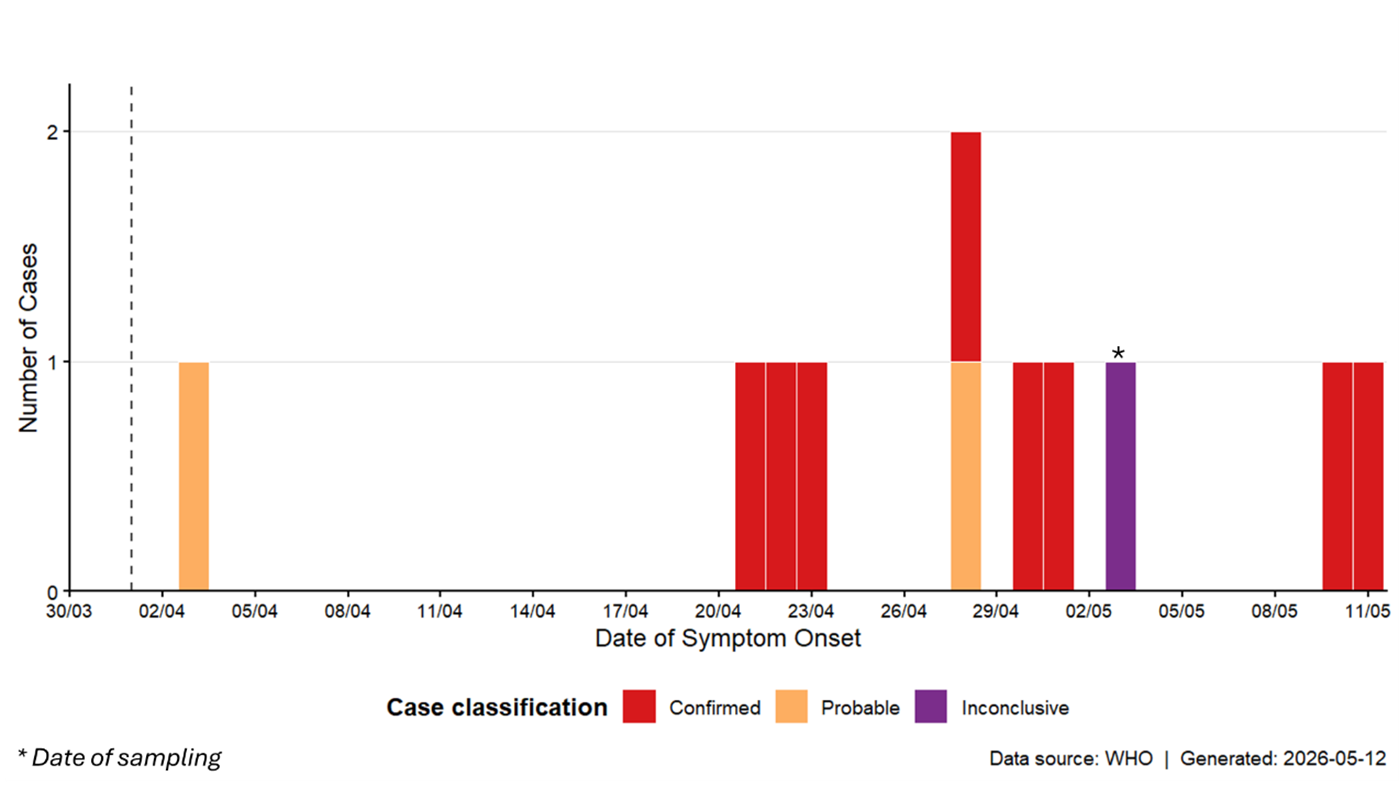
As of 13 May, a total of 11 cases (eight confirmed, one inconclusive and two probable cases), including three deaths (two confirmed and one probable), have been reported. Since the last Disease Outbreak News was published on 8 May, two additional confirmed cases and one inconclusive case have been reported among passengers. These are one confirmed case from France, who became symptomatic during repatriation, one confirmed case from Spain, tested upon arrival following repatriation but currently well and asymptomatic, and one case considered inconclusive. The latter was repatriated to the United States of America, is currently asymptomatic with inconclusive laboratory results (one positive and one negative result from two different laboratories), and is being retested. The individual was sampled due to high-risk exposure to confirmed cases on board. All laboratory-confirmed cases are confirmed for ANDV infection. All were passengers onboard the MV Hondius.

Figure 1. Epidemiological curve of Andes hantavirus cases (n = 11) reported to WHO as of 13 May 2026, 17:00.

Hantavirus outbreak Epi curve - Hantavirus outbreak Epi curve

Based on currently available information, the working hypothesis is that the first case acquired the infection prior to boarding the cruise, through exposure on land. Investigations are ongoing to elucidate the potential circumstances of exposure and the source of the outbreak, in collaboration with authorities in Argentina and Chile. Current evidence suggests subsequent human-to-human transmission onboard the ship. This is also supported by a preliminary analysis of the sequences, which show a close, near-identical sequenced from different cases.[SUP][1][/SUP]


The outbreak is being managed through a coordinated international response, including in-depth epidemiological investigations, case isolation and clinical management, medical evacuations, laboratory testing and international contact tracing, quarantining and monitoring. Recommendations may be updated as additional epidemiological and laboratory evidence, including genetic sequencing data, becomes available.


Follow-up and contact tracing for all contacts of hantavirus cases linked to the cruise ship is ongoing. This includes passengers who disembarked in Saint Helena, United Kingdom, on 24 April; Praia, Cabo Verde, on 6 May; and Tenerife, Spain, on 10 and 11 May. Passengers who travelled on flights who may have had exposure to subsequently confirmed cases have been identified and contacted. Contacts are being monitored by local health authorities in their respective countries.

On 10 May, the ship arrived in the Canary Islands, Spain, where disembarkation began. Passengers and most of the crew were repatriated from the Canary Islands to their respective residence countries or transit points via specially arranged non-commercial flights, with WHO and partners supporting the disembarkation process. The ship left the Canary Islands on 11 May and is sailing to the Netherlands, with 25 crew members remaining on board, along with two Dutch health and care workers to conduct their health monitoring and provide any healthcare that may be necessary.

Epidemiology


Hantavirus cardiopulmonary syndrome (HCPS), also known as hantavirus pulmonary syndrome (HPS), is a zoonotic, viral respiratory disease caused by hantaviruses of the genus Orthohantavirus, family Hantaviridae, order Bunyavirales. More than 20 viral species have been identified within this genus.

Hantaviruses are associated with two major distinct clinical syndromes in humans: HPS predominantly reported in the Americas, and hemorrhagic fever with renal syndrome (HFRS), mainly reported in Europe and Asia. However, human-to-human transmission has only been reported for HPS associated with Andes virus infection. Andes virus is endemic in South America, with confirmed circulation and human cases reported primarily in Argentina and Chile, and additional cases and related strains identified in Uruguay, southern Brazil, and Paraguay.

Human Hantavirus infection is primarily acquired through contact with the urine, faeces, or saliva of infected rodents or by touching contaminated surfaces. Exposure typically occurs during activities such as cleaning buildings with rodent infestations, though it may also occur during routine activities in heavily infested areas. Human cases are most commonly reported in rural settings, such as forests, fields, and farms, where rodents are present, and opportunities for exposure are greater.

HPS is characterized by headache, dizziness, chills, fever, myalgia, and gastrointestinal symptoms, such as nausea, vomiting, diarrhoea, and abdominal pain, followed by sudden onset of respiratory distress and hypotension. Symptoms of HPS typically occur from 1-6 weeks after initial exposure to the virus. However, symptoms may appear as early as one week and as late as eight weeks following exposure.

Hantavirus infections are relatively uncommon globally. In 2025, in the Region of the Americas, eight countries reported HPS, 229 cases and 59 deaths with a CFR of 25.7%.[SUP][2][/SUP] HPS is not reported in other parts of the world. In the European Region, 1885 hantavirus infections causing HFRS were reported in 2023 (0.4 per 100 000), marking the lowest rate observed between 2019 and 2023.[SUP][3][/SUP] In East Asia, particularly China and the Republic of Korea, HFRS continues to record thousands of cases annually, although incidence has declined in recent decades.

The overall CFR for HPS can be as high as 50%. While there are no licensed treatment nor vaccines for hantavirus infections, early supportive care and immediate referral to a facility with a complete ICU can improve survival.

Environmental and ecological factors affecting rodent populations can influence disease trends seasonally. Since hantavirus reservoirs are sylvatic rodents, transmission can occur when people come into contact with rodent habitats.

Although uncommon, limited human‑to‑human transmission of HPS due to Andes virus has been reported in community settings involving close and prolonged contact. Secondary infections among healthcare workers have been previously documented in healthcare facilities, though remain rare. Secondary transmission appears most likely during the early phase of illness, when the virus is more transmissible. Currently, little evidence is available due to the scarcity of hantavirus outbreak related to human-to-human transmission. Public health response


Authorities from States Parties managing cases and/or contacts, WHO, and partners have initiated coordinated response measures, including:
  • Ongoing engagement between WHO and the NFPs of countries managing cases and/or contacts to ensure timely information sharing and coordination of response actions.
  • International contact tracing is ongoing.
  • WHO is requesting regular information sharing and periodic updates from States Parties through IHR channels regarding contact monitoring and the health status of high-risk contacts
  • Crew members still onboard, to take the MV Hondius to the Netherlands, have been advised to practice physical distancing and remain in their cabins where possible, while on the cruise ship.
  • Experts from WHO and the European Centre for Disease Prevention and Control (ECDC) were deployed on board the ship to support epidemiological investigation and provide public health advice before disembarkation in the Canary Islands, Spain.
  • Two Dutch medical doctors boarded the ship in Cabo Verde to conduct health monitoring and provide any health care that may be necessary. One disembarked in Tenerife, while a Dutch nurse boarded, to assist in monitoring and providing any healthcare to the remaining crew members on board.
  • WHO Director-General Dr Tedros Adhanom Ghebreyesus travelled to the Canary Islands on 9 May, along with other experts from WHO, to meet with the national authorities, including ministers, and support the coordination of the operations. He met with the Prime Minister of Spain on 12 May.[SUP][4][/SUP]
  • Epidemiological investigations continue to better define epidemiological links between cases and exposure factors on the ship, as well as to try to understand the potential source of exposure
  • WHO has developed and published specific technical guidance documents to support response to the event, including:
  • NFPs of affected countries have been in contact about passenger and crew information through established IHR channels for those on the ship, as well as on planes where a known case was on board.
  • The NFP of Argentina aided in the reconstruction of the travel itinerary of the first two cases in the Southern Cone subregion of the Americas and assess any potential exposure to hantavirus. They also shared the National Hantavirus Epidemiological Circular: Update epidemiological Surveillance and Management Standards on Hantavirus.
  • WHO supported collaboration across relevant laboratories with prior experience to ensure timely testing, with further analyses ongoing, including serology, molecular diagnostics, sequencing, and metagenomics.
  • Risk communication coordination and support are being provided to ensure sharing of regular, timely and evidence-based information. WHO has activated three-level coordination and is supporting national authorities in implementing risk-based, evidence-informed public health measures in accordance with the provisions of the IHR and related WHO technical guidance documents.
  • WHO regularly convenes expert calls across laboratory, clinical management, epidemiology, and Infection prevention and control (IPC) domains to facilitate timely experience sharing and coordinated expert support.
  • WHO supported the streamlining and development of research protocols on the natural clinical history in collaboration with national partner institutions and planned a hantavirus scientific consultation on medical countermeasures.
WHO risk assessment

WHO currently assesses the public health risk for those who were onboard the cruise ship as moderate, and at the Global level as low for the following reasons:
  • Andes virus has demonstrated limited human-to-human transmission in previous outbreaks, typically occurring among close contacts and within household settings, generally requiring prolonged close exposure. Transmission can be contained through early detection, isolation of cases, clinical management, and contact management. However, the ship environment presented an increased risk due to close living quarters, shared indoor spaces, prolonged exposure, and frequent interpersonal interactions, all of which likely facilitated transmission.
  • The HCPS with hantaviruses in the Americas, including Andes can have a high case fatality ratio, reaching 40-50%, particularly among elderly individuals and those with co-morbidities. The average age of passengers on board the ship was 65 years old.
  • Investigations on the travel history and potential exposures of the first case in the Southern Cone subregion of the Americas are ongoing and suggest possible exposure to rodents during bird watching activities. Viral sequencing analyses are also ongoing and will compare the ANDV strain associated with this outbreak with strains circulating in Argentina and Chile, where the disease is enzootic. The preliminary sequencing analysis for the cases indicates a high degree of genetic similarity—showing no more than one single nucleotide polymorphisms (SNP) difference per individual—strongly indicates that the outbreak likely arose from a single zoonotic spillover event, or from a very small number of closely related spillover events.[SUP][1][/SUP]
  • Additional cases may occur among individuals exposed before implementation of containment measures. However, the current response, including quarantine for those who have left the ship and rapid isolation of any new suspect cases and the monitoring of contacts, is expected to limit the risk of further spread.
  • As there is no specific antiviral treatment for HPS, suspected cases require prompt transfer to an adequately equipped emergency department or intensive care unit, where available, for close monitoring and supportive management to improve chances of recovery. Consequently, for remote areas, rapid transfer to a mainland healthcare facility is required, which may be challenging under the current conditions.
For the general public, including people not exposed on board the ship or through close contact with a confirmed case, the overall probability of infection remains low. Current evidence indicates that transmission occurs through close and prolonged contact, and can be effectively limited through early detection, isolation of cases, and contact tracing.

More detailed epidemiological, clinical and laboratory investigations are required to inform further iterations of this risk assessment.

WHO advice


WHO advises that States Parties involved in this event continue public health coordination and management efforts related to the ship and relevant flights, and in countries where cases and/or contacts are present or will be returning to. Based on information available and ongoing epidemiological, clinical and environmental investigations, and applying the precautionary principle, this includes contact tracing and monitoring, detection, investigation, reporting of suspected cases, laboratory testing of suspected cases, case management, infection prevention and control measures, and clear and transparent communication to affected individuals and the general public.

Outside the context of the ship, high-risk contacts may include intimate partners, household members and persons with prolonged close indoor exposure, healthcare workers with unprotected exposure, and individuals handling contaminated materials or body fluids without appropriate personal protective equipment, outlined in the interim guidance published on 8 May.

Given that infectiousness peaks in the early phase of illness, and that pre-symptomatic transmission cannot be entirely ruled out, as a precautionary principle, WHO recommends active monitoring and home or facility quarantine of high-risk contacts for 42 days following last exposure. Current evidence does not support routine laboratory testing of contacts for outbreak control nor the quarantine of low-risk contacts; low-risk contacts should undertake passive self-monitoring and seek medical evaluation if symptoms occur. Recommendations are dynamic and will be adapted as more evidence emerges.

Contact investigations should use available information sources, including interviews, passenger manifests, seating arrangements and activity logs, to improve completeness of contact identification.

Early recognition of suspected cases, prompt isolation, and consistent adherence to recommended infection prevention and control measures remain essential to protect healthcare personnel, other passengers and crew members.

In healthcare settings:
  • Apply standard precautions* at all times for all patients, including hand hygiene, environmental cleaning, and waste management.
  • Isolate any suspected or confirmed case in a single, well‑ventilated room with doors closed.
  • Implement transmission‑based precautions in addition to standard precautions for suspected or confirmed cases.
  • Ensure health and care workers wear appropriate personal protective equipment (respirators, eye protection, gowns, and gloves).
  • Perform hand hygiene before and after the use of personal protective equipment.
  • Manage waste generated from suspected or confirmed cases as infectious waste.
  • Apply airborne precautions during aerosol‑generating procedures.
When HPS is suspected, patients should be promptly transferred to an emergency department or intensive care unit for close monitoring and supportive management. Initial management should include supportive care with antipyretics and analgesics as needed. For confirmed hantavirus, antibiotics are not routinely indicated. However, before a definitive diagnosis is established (and bacterial infection is a diagnostic possibility), or if secondary bacterial infection is suspected, empiric broad-spectrum antibiotics may be appropriate. Clinical management relies primarily on careful fluid administration, hemodynamic monitoring, and respiratory support. Given the rapid progression of HPS, close monitoring and early transfer to ICU are critical for more severe cases. Mechanical ventilation, judicious fluid management, and vasopressors may be required. For severe cardiopulmonary insufficiency, extracorporeal membrane oxygenation may be lifesaving.[SUP][5][/SUP] In severe cases of renal dysfunction, dialysis may be required.

Although ribavirin has shown efficacy against hantavirus haemorrhagic fever with renal syndrome, it has not demonstrated effectiveness for HPS and is not licensed for either treatment or prophylaxis of hantavirus pulmonary syndrome. At present, there is no specific antiviral treatment approved for HPS; a number of existing drugs have antiviral activity in laboratory studies but not yet demonstrated in human disease.

Public health awareness efforts should focus on improving early detection, ensuring timely treatment, and reducing exposure risks. Preventive measures should address occupational and ecotourism-related exposures, emphasize infection prevention and control measures, and include rodent control strategies. Most routine tourism activities carry little or no risk of exposure to rodents or their excreta.

Risk communication and community engagement (RCCE) interventions should prioritize transparent, timely, and culturally appropriate communication to raise awareness of hantavirus transmission risks. RCCE strategies should support coordinated, timely and aligned evidence-based information to ensure concerned people receive clear, consistent and actionable information, including explanations of the public health measures being implemented. RCCE activities should explicitly address public concerns regarding transmissibility, severity, and international travel, and clarify what actions are and are not necessary for different population groups. Operational measures should integrate RCCE activities throughout all phases of the event. The implementation of integrated environmental management strategies aimed at reducing rodent populations is also recommended.

At this time, WHO does not recommend any changes to routine activities for the general public. People who were on board the affected ship, or who have had close contact with a confirmed case, should follow the specific monitoring and public health advice outlined above. Guidance may be updated as further evidence becomes available.

Based on the current information available on this event, WHO advises against the application of any travel or trade restrictions beyond the restriction of movement of identified high-risk contacts.

*Standard precautions refer to a set of practices that are applied to the care of patients, regardless of the state of infection (suspicion or confirmation), in any place where health services are provided. These practices aim to protect both healthcare professionals and patients and include hand hygiene, use of personal protective equipment, respiratory hygiene and cough etiquette, safe handling of sharps materials, safe injection practices, use of sterile instruments and equipment and cleaning of hospital environments and the environment. Adapted from “Standard precautions for the prevention and control of infections: aide-memoire”- WHO, 2022. Available at https://www.who.int/publications/i/item/WHO-UHL-IHS-IPC-2022.1
...

https://www.who.int/emergencies/disease-outbreak-news/item/2026-DON601
 
The WHO released a DON today saying the inconclusive case had 1 positive test and one negative test and is still inconclusive.
 
Translation Google

image.png - Click image for larger version  Name:	image.png Views:	1 Size:	9.2 KB ID:	1034752


Update to the National Epidemiological Bulletin for week No. 17

This document provides strategic information on the country's epidemiological situation. This edition includes updates on Hantavirus, Pertussis, and Hemolytic Uremic Syndrome (HUS).

May 12, 2026
Regarding the hantavirus outbreak detected on the MV Hondius cruise ship last week, the National Epidemiological Bulletin (BEN) for epidemiological week (EW) 17 of 2026 confirms that, to date, eight cases have been identified on board the vessel (six confirmed and two probable), of which three resulted in death. PCR and genomic sequencing tests performed in reference laboratories in South Africa and Switzerland confirmed that the cases correspond to the Andes strain, which is present in southern Argentina and Chile.

While the ANLIS Malbrán Institute determined that the virus sequence from the cruise ship is highly related to strains detected in 2018 in Neuquén, the origin of the outbreak cannot yet be confirmed, as the case was not in areas endemic for the Andes strain during the period in which the infection is estimated to have occurred. The national health ministry continues to conduct the corresponding epidemiological investigation in coordination with the relevant provincial health authorities and is strengthening international cooperation by sending supplies and technical assistance to the affected countries.

Nationally, the National Epidemiological Surveillance System (BEN) confirms that only one new case of hantavirus was reported in the country in the last two weeks, residing in the province of Buenos Aires (PBA). The total number of cases for the entire 2025-2026 season (from epidemiological week 27 of 2025 to epidemiological week 17 of 2026) is 102 confirmed cases. The Central region accounted for 54% of the cases, primarily in PBA (43 cases). The highest incidence rate corresponds to the Northwest region (0.60 cases per 100,000 inhabitants), where 36 confirmed cases were registered, 83% of which were concentrated in Salta.


...

https://www.argentina.gob.ar/notici...-epidemiologico-nacional-de-la-semana-ndeg-17


The CDC sent an email notice to attend a media conference one hour before the start. I missed it. Sorry....

Actually 51 minutes advance notice. :(

CIDRAP attended.....


CDC: Risk to general public from hantavirus is low


Stephanie Soucheray, MA


May 13, 2026


Today, officials from the Centers for Disease Control and Prevention (CDC) said 100 personnel from the agency are actively working on monitoring passengers from the MV Hondius for hantavirus and are confident in the United States’ ability to control any further spread of the deadly rodent virus.

David Fitter, MD, incident manager for CDC’s hantavirus response, and Brendan Jackson, MD, MPH, CDC team lead in Nebraska, where most of the Americans who were aboard the ship are being monitored, emphasized in a press conference that, unlike COVID-19, hantavirus is a virus that has been studied for decades.

“Transmission from person to person is rare,” said Fitter. “I want to emphasize the risk to the general public is low.”

Today, the outbreak remains at 11 cases, nine of which are confirmed.

Despite assurances, several experts are warning that person-to-person transmission may not be as rare as previously thought, often citing a 2018 outbreak of hantavirus at a birthday party, also in Argentina. That event led to 34 confirmed infections and 11 deaths, all traced to the index patient, who contracted the virus after exposure to rodents.

42-day monitoring period began May 11


Fitter and Jackson gave few details about the Americans who were aboard the ship, only confirming that they are encouraging those housed in a Nebraska containment center to stay there for 42 days, with day 1 being May 11, the day they disembarked.

Fitter also addressed the American who was reported to have had a “mildly positive” hantavirus test earlier this week. He clarified that the test was taken on board and was inclusive. That passenger has identified himself as Stephen Kornfeld, MD, of Oregon, who said he treated sick passengers on the ship. Kornfeld, who is at the Nebraska biocontainment center, reports that he feels “wonderful” and remains without any symptoms of the virus.

The CDC officials also confirmed that the two Americans being monitored at Emory University have also tested negative for the virus.

Neither Fitter nor Jackson would say whether passengers who are testing negative for the virus could, at some point in the next 42 days, quarantine at home.

https://www.cidrap.umn.edu/misc-emerging-topics/cdc-risk-general-public-hantavirus-low
 
Related to posts #178 & 180

image.png - Click image for larger version  Name:	image.png Views:	3 Size:	5.0 KB ID:	1034775


Government > News

Ascension Hantavirus Update

13 May 2026

Government, Press Release

The Ascension Island Government and Georgetown Hospital are continuing to manage the current hantavirus response in line with UK Health Security Agency (UKHSA) and World Health Organization (WHO) public health guidance and advice.

We recognise the community’s concerns over yesterday’s news that a high-risk contact had developed symptoms consistent with hantavirus. The Hospital Team are continuing to monitor the individual, whose temperature came down overnight. Alongside managing the medical response itself, we are also mindful of the anxiety that situations of this nature can create. We would therefore like to provide further clarification regarding the current public health measures in place.

Individuals identified as high-risk contacts are now self-isolating and being closely monitored as a precautionary measure. Individuals assessed as low-risk contacts are not required to self-isolate under current WHO guidance and advice from UKHSA. Instead, those individuals are being monitored for symptoms and have been asked to report any concerns promptly to the medical services.

We are aware of concerns raised by members of the public regarding whether all low-risk contacts should also enter isolation. Based on UKHSA advice, such wider isolation measures are neither necessary nor supported by evidence.

Regarding the family member who travelled to St Helena on Sunday, 10 May 2026, public health specialists have today confirmed that the individual is considered low risk and does not require self-isolation. Public health specialists have advised that the likelihood of transmission in this circumstance is considered almost zero.

The community will be updated as further information becomes available.

Office of the Administrator

13 May 2026​

https://www.ascension.gov.ac/ascension-hantavirus-update
 
Related to Sharon's post #185

Transcript - Update on CDC's Hantavirus Response

Transcript

For immediate release: May 13, 2026

(audio)
Length: 21 minutes 32 seconds

CDC
CDC Media Relations
(404) 639-3286
media@cdc.gov
https://www.cdc.gov/media/

Please Note: This transcript is not edited and may contain errors.

Operator:

Good afternoon and thank you for standing by for the duration of today's call. All listeners are in a listen only mode until the question and answer session. At that time, credentialed members of the media press can press star one to ask a question or star two to withdraw a question. Today's call is being recorded. If you have any objections, you may disconnect at this time. I would now like to introduce Mr. Benjamin Haynes. Thank you, sir. You may begin.

Benjamin Haynes:

Thank you, Shirley. And thank you all for joining us today for CDC's Hantavirus response update. Here to discuss the response is CDC's hantavirus response lead, Dr. David Fitter and CDC's Nebraska team lead, Dr. Brendan Jackson. Both will share brief remarks before we take your questions and at this time I'd like to turn the call over to Dr. Fitter.

Dr. David Fitter:

Thank you, Ben and good afternoon everybody and thank you for joining us. My name is Dr. David Fitter and I'm with the Centers for Disease Control and Prevention and I am the Incident Manager for the hantavirus response here. I want to start by saying hantavirus is a known pathogen. While Andes virus has some distinct characteristics including rare person-to-person transmission, our experts have allowed us to respond effectively while remaining vigilant about its unique features. At this moment I want to emphasize that the risk to the general public is low. Our top priority is both the passengers who are on the ship and American communities. From the earliest stages of this outbreak, CDC has been working in close coordination with state and public health authorities with federal partners including ASPR and the State Department and international health partners, including countries that have been impacted by this. CDC activated our emergency response in Atlanta immediately and has more than 100 staff actively working on this response. Operationally, we've been engaged at every step. As soon as we were notified by the IHR, we responded and connected with international partners and developed guidance for the American passengers in the ship. We provided information about the Andes virus to the passengers on board and also have kept them updated here in the United States through our staff on the ground as well as through calls with them to answer their questions. A CDC team was deployed to the Canary Islands to provide public health expertise on site, including speaking with each individual U.S. citizen about their potential exposure. Two members of that team actually then joined the American passengers on the repatriation flight back to Nebraska. The additional CDC team met the plain when it landed in Nebraska and is conducting assessments and supporting the passengers now that they've returned to the United States. CDC also published a HAN prior to the repatriation of the American citizens. In addition, CDC has posted a toolkit, an FAQ document, current situation overview, and fact sheet on our updated web page. We've held two Hill briefings, and have just completed a call with the governors from the States with repatriated Americans. We've also held daily calls with state health officials. Our role now is to continue our conversations with each passenger about their potential exposure and work with partners to ensure appropriate monitoring. We're sharing real-time information with state and federal partners so decisions are based on the health assessments of each passenger and the best available evidence. CDC currently recommends testing only for people with symptoms. There is a blood test specifically for Andes that has been validated as well as a PCR test for Andes, but it's currently for research use only and not used for patient care yet. And of course, we will continue to work with state and local health departments if needed. We are focusing on delivering safe, respectful care and transparent communication to the individuals who returned and their families. To the American public, please know we are here to protect your health and based on current information the risk to the general population remains low. So far our response has followed our playbook. A swift action across federal, state, and local public health. The systems and partnerships that we've built exist precisely for situations like this. The work isn't always visible. Sharing information with state and local health departments and coordinating guidance and monitoring, but it never stops. It's deliberate. It's coordinated and essential to keep our community safe. I'll now turn it over the call to Dr. Brendan Jackson, who's leading the CDC team in Nebraska.

Dr. Brendan Jackson:

Great, thanks David. My name is Brendan Jackson, and as David said, I'm CDC's team lead in Nebraska, and I'm a medical epidemiologist. So we currently have a dedicated team of CDC health, health professionals deployed here in Nebraska responding. Our team's been working around the clock to ensure the health and safety of everyone involved. We're currently conducting public health assessments on site. These in-depth health assessments include asking each passenger about their exposure to the confirmed cases. And the University of Nebraska team here is conducting regular temperature monitoring, symptoms screening, and general wellness evaluations. This particular virus has a long incubation period, so the monitoring period is 42 days, and the 42 days started with the departure of the ship. So May 11th was the day one. We're here to support the people who have returned from the ship and the excellent Nebraska team here in Omaha. Thank you.

Benjamin Haynes:

Thank you, Dr. Jackson and Dr. Fitter. At this time I'd like to open it up for questions.

Operator:

Thank you. If you are a credentialed member of the media and would like to ask a question during the call, please press star one on your touch tone phone. Press star two to withdraw your question. You may queue up at any time. Our first question comes from Erika Edwards with NBC News. Your line is open, you may ask your question.

Erika Edwards:

Okay, thanks so much for doing this. I was curious whether the passenger who was considered a mildly positive case has been retested back here in the U.S. Was that test, the one that Dr. Fitter mentioned and I'm curious what the turnaround time for those test results are. And also if you could just talk a little bit about the decisions being made about possibility of quarantining at home, any more specifics you have about what those people might be able to do or cannot do if they are determined to be able to quarantine at home. Thank you.

Dr. David Fitter:

The initial test that we received was from abroad and it was inconclusive in its results. So we're in the process of testing currently and we hope to have those results back in a day or so. With regards to home monitoring, we're working very closely with states and jurisdictions as well as with the passengers themselves and other contacts to ensure that they have the information they need. We're taking a conservative approach on this and we really are encouraging people to stay at their homes and work very closely with the state and local health departments to ensure that they are appropriately monitored in that space.

Benjamin Haynes: Next question please.

Operator: Thank you one one moment please for our next question. Question comes from Wale Aliyu from Atlanta News First. Your line is open. You may ask your question.

Wale Aliyu:

Hi, I have two questions. The first, can you hear me okay?

Benjamin Haynes: Yes, please go on.

Wale Aliyu: Okay. First question, can you just elaborate on the couple taken to Emory and just their current conditions?

Dr. David Fitter:

Yes, we don't talk about the specific individuals really to respect the privacy of everybody.

Wale Aliyu:

I figured so totally understandable. The second question I had is I know most reports have said there's very low risk to the general public at this point. What would you say to people who have concerns about the comparison to COVID-19, if you remember some of those early reports also said low risk to the general public.

Dr. David Fitter:

Yeah, this is not a novel virus. This is a known virus and we've seen this in the United States before and we know how to respond to it. And that's what we're doing and we're putting into action all the things that we have in place to ensure that American communities remain safe and healthy. What we really want to do is ensure that we're also communicating about this. We'll continue to update the U.S. about everything that we're doing in multiple ways through our websites and other endeavors like this.

Benjamin Haynes:

Next question, please.

Operator:

Thank you. Our next question then comes from Pien Huang with NPR. Your line is open, you may ask your question.

Pien Huang:

Hi, thanks so much for doing this. I have two questions as well, both about quarantine. So first of all, I'm wondering if any federal or state authorities are currently being used to quarantine any of the people exposed to hantavirus or if it's all voluntary at this point. And secondly, I want to ask about the home quarantine situation because the people's homes don't have isolated negative air pressure rooms. It's hard to guarantee 100% adherence. I'm wondering if that worries you or concerns you at all about the people who are or will be monitoring from home.

Dr. David Fitter:

So currently, there are no state or federal quarantine orders that have been drawn. We're working really closely with all contacts to ensure that they understand what is expected for them to appropriately monitor themselves. But we also want to make sure that they have the right information so that they can understand the situation as best as possible. I can't tell you how much I appreciate our state and health local partners, what they've been doing. They've been doing multiple checks daily to ensure that everything is going well for people. They've been explaining the situation to them as well. I think everybody should be extraordinarily proud of the network of partners, of state and local health partners that we have in the United States. Our goal is to ensure that we're able to follow our monitoring guidelines, but to work with passengers to ensure that they're able to do it. And if they need to do it somewhere else, we will work with them, will work with state and local health departments to ensure that that happens as well. Again, I just really want to reiterate the safety and health of the passengers is critical to us as well as the safety and health of the American communities.

Benjamin Haynes:

Next question please.

Operator:

Thank you. Our next question comes from Maggie Vespa with NBC News, your line is open. You may ask your question.

Maggie Vespa:

Hi there. Yeah. Thank you so much for this. I have two questions. The first is a clarification of my colleagues' question. Did you say that specific to the asymptomatic patients or passengers in quarantine in Nebraska that you are encouraging them to isolate at home or just what can we know about whether they'll be encouraged to stay here during the full six week incubation period?

Dr. David Fitter:

The people that are in Nebraska currently, they have been encouraged that they can, to stay in Nebraska. It is a fantastic facility. We really appreciate the state of Nebraska as well as the University of Nebraska Medical Center for everything they have done. And that is a great place for them to be able to do this, but also as we continue to coordinate the best monitoring for them.

Maggie Vespa:

And there's no version of keeping them here? And I'm using that verbiage really intentionally.

Dr. David Fitter:

Our goal is to continue to work with them for the best possible place for them and we encourage them to be there.

Maggie Vespa: Okay, I really appreciate it. My question prior to needing that clarification, and thank you so much for that. A number of exposures popping up in other states came from residents, according to health officials, who said they were traveling with exposed passengers inadvertently. So my question is, why weren't the exposed cruise ship passengers transported in a way that kept them away from the general public, like on a private plane or something like that?

Dr. Brendan Jackson: I can jump in here. This is Brendan Jackson. So the passengers that are being monitored were on shared flights were passengers were separate from the passengers who were on the ship at the time the outbreak was detected. So they had actually left the ship before the outbreak was detected. All the passengers that were on the ship after that detection phase were transported just several days ago on a private plane directly from the Canary Islands to here in Omaha, Nebraska.

Maggie Vespa: Okay. In other words, if they were inadvertently on the same flight, it would be because those passengers had left early and didn't yet know about the outbreak.

Dr. Brendan Jackson Correct.

Maggie Vespa:

Okay, thank you so much for that. I really appreciate it.

Benjamin Haynes: We're ready for the next question. Could you also remind the reporters how to raise their hand for a question, please?

Operator: Certainly, you can press star one to ask a question. Our next question comes from Michael Erman with Reuters. Your line is open. You may ask your question.

Michael Erman: Hi, this is Mike Irman from Reuters. You know, I just wanted, you know, a little bit of clarification on the passenger and the biocontainment unit in Nebraska. On Monday, the briefing said that that passenger had tested positive. I think mildly positive was the language used. And now you call that test inconclusive. So I'm wondering if you could give us some clarification or understanding why that test is being called inconclusive now instead of positive. And then the other question is, will that passenger remain in the biocontainment unit if they test negative again?

Dr. David Fitter:

Thank you. The test that we initially got, there was a positive and a negative. From our standpoint, we wanted to redo the test to ensure that we had a test that was done here and we had the results. And thus, that's what we are waiting for. We want to make sure that we have the best possible information so that we can help that passenger.

Michael Erman: And if they test negative, will they remain in the Bio Containment Unit or will they be moved to the quarantine unit with the rest of the passengers?

Dr. David Fitter: We're coordinating with the University of Nebraska Medical Center to ensure appropriate disposition.

Benjamin Haynes: Next question please.

Operator:

Thank you. And as question comes from John LaPook with CBS News, your line is open.

John LaPook:

Yeah, hi, thanks a lot. Two questions. First, quick, you say only you're only testing people with symptoms. Why not collect and store blood for research purposes or are you already doing that. And then do you believe you have all the potentially exposed people identified how many are outside of Nebraska and Atlanta and has anybody elected not to stay at home? And finally if you know it, can you tell us the cycle time for that PCR that was sort of inconclusive?

Dr. David Fitter: So I'll start from the top and thank you for the questions. We are recommending that symptomatic people with an exposure risk get tested. However, we're also working with states and partners on ways to better understand the virus, for other testing modalities. We are working very closely with the states and local health departments and the passengers that are home and the contacts that are home. Everybody is working well together to ensure monitoring follows our recommendations.

John LaPook:

And for the PCR? Do we have the actual number on that?

Dr. David Fitter:

We're working to get all the information from the country where that test was run.

John LaPook:

Okay, and we don't know the number of people who are outside of Nebraska and Atlanta?

Dr. David Fitter:

With respect for privacy of all individuals, we're not sharing locations.

Benjamin Haynes:

Next question please.

Operator: Thank you and this question comes from Kevin Stewart with WAGA TV Fox 5 Atlanta. Your mic is open, you may ask your question.

Kevin Stewart:

Good afternoon, regarding the Atlanta passengers. We know yesterday that one of the passengers tested negative. Will that person and the asymptomatic person be clear to leave before the 42 days are up? And also where, what is the status of the two Georgia passengers who got back home last week and are being monitored by the Department of Health here in Georgia?

Dr. David Fitter: So again, with respect for the passengers that are in monitoring right now, I'm not going to go into a lot of details, but we're working very closely with Emory to ensure that they have the appropriate disposition. With regards to Georgia and the contacts that are here, we're working very closely with the state of Georgia health department and the local health departments to ensure that they are appropriately monitored.

Kevin Stewart:

Will they be cleared, they can lead before the 42 days, correct?

Dr. David Fitter:

They'll continue to be monitored.

Kevin Stewart:

But whether that is at Emory or at home.

Dr. David Fitter:

Currently we're working on the appropriate disposition for them.But again, as you can imagine, out of respect for privacy for them, I'm going to stop there.

Kevin Stewart:

Can you confirm they're still at Emory?

Dr. David Fitter: Yes. Benjamin Haynes:

We have time for two more questions, please.

Operator:

Thank you. Our next question actually, we didn't get the name, but from WSB Channel 2, you may ask your question.

Courtney Francisco:

Can you hear me? It's Courtney Francisco. I'm hoping you can tell me -- it went out on May 2[SUP]nd[/SUP]. I need to know how many people are being monitored.

Dr. David Fitter:

At this time, we're not putting out exact numbers. Again, we want to ensure that we are protecting and respecting the privacy of all the individuals.

Benjamin Haynes:

Shirley we'll take one more if they have it.

Operator:

Certainly, one second here. And we have a question from Lila Perry with Baltimore Sun, your line is open you may ask your question.

Lila Perry:

Hi, thanks so much for doing this. Back to the topic of passengers on planes who were inadvertently exposed to people from the cruise ship. You know, when state departments of health are saying that they're monitoring these airline passengers, what does that look like if they're exposed from a distance or for a short time? Are they being monitored in state facilities or asked to stay home and how closely are you advising state partners to be monitoring these people?

Dr. David Fitter:

We're working very closely to ensure that our guidance is consistent across all of the contacts. And for those on the -- that were contacts on the planes, they also would fall into the appropriate category and we're working with state and locals to ensure that those monitoring recommendations are followed very closely. And we're in such close coordination with their state and local health departments, talking with the them daily thus far it is working very well with the systems that they have in place and they're developing their systems themselves to ensure that it follows the guidance that we've put out.

Benjamin Haynes:

Thank you, Dr. Fitter and thank you, Dr. Jackson. At this time we will conclude the call and we appreciate you all joining us for this brief update. Thank you.

Operator:

Thank you and that does conclude today's conference. Thank you for your participation. And at this time you may disconnect your lines.


https://www.cdc.gov/media/releases/2026/transcript-update-on-cdcs-hantavirus-response.html
 
image.png


14 May 2026

Message from Chief Minister Rebecca Cairns-Wicks

I recognise this is an anxious time, particularly for those feeling vulnerable or concerned for loved ones. Please know that your wellbeing remains our absolute priority.

At this time, there are no symptomatic individuals or suspected cases on St Helena. Public Health continues to advise that the risk to the wider community remains very low.

On Ascension, there are currently no confirmed cases, although one high-risk contact has developed symptoms. As a precaution, plans are being progressed for a medical evacuation should this become necessary.

On Tristan da Cunha, one probable case has been identified in an islander who travelled on the MV Hondius. We continue to keep the people of Tristan very much in our thoughts, and we wish the individual a full and speedy recovery.


Our Public Health team continues to implement a well-established prevention and response programme alongside the UK Health Security Agency, supported by additional medical expertise and specialist personnel who arrived over the weekend.

We have much to be grateful for. Our local medical teams acted quickly and responsibly in reporting the unusual cluster of illnesses to international authorities before Hantavirus had been confirmed. This early action enabled vital international preparedness at an early stage.

I would like to thank our Public Health teams, UK partners, and all those working tirelessly behind the scenes across our Territories. Much of this work is unseen, but it is vital to protecting our communities and is being carried out with immense dedication.

Please continue to rely on official updates from St Helena Government and Public Health, and avoid speculation or the sharing of unverified information online.

During periods of uncertainty, words matter, and relying on confirmed facts ensures that decisions and community discussions are guided by the best available scientific and public health advice rather than hearsay. During uncertain times, calm, compassion and responsible communication matter greatly.

As we recently celebrated David Attenborough’s 100th birthday, we are reminded of the importance of humanity, compassion, and our shared responsibility for one another. We are a resilient community that looks after its own, and we will continue to face this challenge together, calmly and responsibly.​

https://www.sainthelena.gov.sh/message-from-chief-minister-rebecca-cairns-wicks/
 
US - CDC media briefing today, May 14, 2026 -


From:
"Media (CDC)" <sohco@CDC.GOV>[
To: <MMWR-MEDIA@LISTSERV.CDC.GOV>
Subject: Update on CDC’s Hantavirus Response Today 2 p.m. EDT
Date: May 14, 2026 12:25 PM​


Media Advisory
Embargoed Until Thursday
May 14, 2026, 2 p.m. EDT
Contact: CDC Media Relations


Update on CDC’s Hantavirus Response

What

CDC will provide an update on its response to hantavirus linked to the M/V Hondius cruise ship.

Who

David Fitter, M.D., Incident Manager for CDC’s hantavirus response

When

Thursday, May 14, 2026, 2 p.m. EDT​


----------------------------------------------------

CAPT David Fitter, MD, is the director of the Division of Global Migration Health in CDC’s National Center for Emerging and Zoonotic Infectious Diseases.


----------------------------------------------------


Rough notes. Please excuse typos:


Moderator - Benjamin Haines

David Fitter opening remarks....

1) We understand hantavirus well,
2) Risk to general public is low,
3) Worked closely with national and international partners,
4) Testting rec only for those who have symptoms,
5) 41 people under monitoring - passengers, people who may have been exposed in travel...some monitoring at home during 42 day monitoring period,
6) Basing response on risk evaluation, partnering with the affected passengers.....not using quarantine powers


Questions:


Did not hear media outlet:
How quickly are results being turned around?
24 hours

New York Times:
How many total are being monitoring? 7 Americans who left before disease discovered?
Known passengers with close contact + flight passengers

Detroit Free Press:
How many peeps have been testedin the US? Inconclusive peeps?
No cases in the US currently.

ABC News:
How many are you tracking? In clinical setting?
We are tracking everything very closely. Working with all passengers...encouraging Nebraska patients to stay there (16).

CBS News:
Asking about total peeps being monitored in the US again?
All people who had any contact with any passengers from cruise.

Politico:
Are states planning for the release of Nebraska patients?
Yes. Working with the states on this.

Atlanta Magazine:
While NE patients being encouraged to stay there, what about the 2 Atlanta patients? Are the 2 patients still in Atlanta?
Working with passengers and states, local govs. Not answering about specific passengers.

AFP:
What about the passengers who left cruise early?
Letting states and localities release test results of passengers.

Omaha World Herald:
What test are you using?
Serology test.


Call over.
 
The time stamp at the top of the post is off because I started this post in my non-public workroom to get ready for the media event. I then edited it to add the notes and move this post to this thread. :)
 
image.png - Click image for larger version  Name:	image.png Views:	5 Size:	7.8 KB ID:	1034811


Speaking Remarks for the Chief Public Health Officer


From: Public Health Agency of Canada

Speech


Hantavirus Technical Briefing
May 14, 2026
11 am EST

Thank you for joining us today.

Before we begin, I want to acknowledge that we are gathered on the unceded traditional territory of the Anishinaabe Algonquin Nation. I would like to take this moment to reflect on the history of Indigenous people and to honour the original stewards of the lands where we live and work.

Situation Update


Since the last technical briefing, the Andes hantavirus outbreak associated with the MV Hondius has continued to evolve. I am pleased to provide you with an update on the situation.

At the outset I want to be clear with Canadians: The overall risk to the general population in Canada in connection with this Andes hantavirus event remains low at this time, but given the severity of this virus, we are taking a precautionary approach to ensure Canadians are protected.

On May 10, four Canadian passengers on the MV Hondius returned to British Columbia. Throughout their journey and upon their arrival, public health precautions and health assessments took place. The individuals were transferred to dedicated lodgings to complete their self-isolation. All four remain asymptomatic and are being actively monitored and supported by local public health authorities.

Public Health Response and Risk Assessment


This outbreak response and the repatriation of passengers from the ship has required an incredible amount of organization and international and domestic collaboration.

Thank you to my counterparts in the provinces and territories, in particular British Columbia public health partners, for supporting the four individuals during their self-isolation period. Also, thank you to Ontario, Alberta and Quebec for their work as key partners in this national approach.

We appreciate the rapid efforts of our federal partners at Global Affairs Canada, the Canadian Armed Forces, Transport Canada, Canada Border Services Agency, and our international partners, in particular the Government of Spain and the World Health Organization, for your collaboration.

Contact Management and Monitoring


We have adapted the 'WHO guidance for public health management of contacts' to the Canadian context and shared it with provincial and territorial public health partners.

While risk assessments conducted on the ship identified all Canadians as low risk, we have taken a precautionary approach and are considering all passengers and crew from the MV Hondius to be high risk contacts, as well as passengers who sat close to one of the cases with hantavirus who was on a flight, until local public health can complete their own risk assessments.

In addition to the four passengers who returned on May 10, there are five other high-risk contacts within Canada who are considered as having been potentially exposed to confirmed cases of Andes hantavirus including:
  • two individuals who were aboard the MV Hondius, but disembarked before the outbreak was first identified and who were on a flight where they may have been potentially exposed to a confirmed case; and
  • three individuals who were potentially exposed to a confirmed Andes hantavirus case on a flight.
These five individuals remain asymptomatic and are being monitored and supported by local public health authorities.

Last Friday, I spoke of an additional person in Canada who, at that time, was considered as potentially having been exposed on a flight. However, based on the assessment by local public health this individual is no longer considered to be a high-risk contact.

In Canada, low risk contacts are individuals who were on a flight with a case of Andes hantavirus but have no known direct or prolonged close interaction.

We were also notified of an additional 26 travellers who were on the flights but deemed by local European public health as being "no risk". Again, as we are taking a precautionary approach in Canada, and have deemed them to be minimal, rather than no risk. Provinces and territories are undertaking the work to contact these 26 individuals to provide them with information and monitor them.


As the situation continues to evolve, the number of individuals for public health follow-up in Canada related to the outbreak of Andes hantavirus may change over time and our response will evolve accordingly.

Provincial and local public health authorities continue to do in depth risk assessments, and the final self-isolation duration may be adjusted as we learn more about the risks involved.

I would also like to flag that we do not have evidence that this virus can spread from asymptomatic people. And so, we are not concerned about contacts of contacts at this time, only individuals who have been exposed to a confirmed or probable case of hantavirus.

All of this has been discussed with my counterparts in the provinces and territories, we are aligned in our approaches and continue active dialogue to support our collective response.

Any contact who displays symptoms will be tested. PHAC's National Microbiology Laboratory stands ready to provide testing, and has been collaborating with provinces, through the Canadian Public Health Laboratory Network, to provide testing capacity and support.

If cases are identified in Canada, PHAC has already worked with provinces and territories to identify healthcare facilities that have the capability to manage hantavirus cases.

International and Domestic Coordination


In addition to monitoring contacts in Canada, the Government of Canada is also working closely with public health authorities, air carriers, and border officials to implement precautionary measures that will prevent all passenger or crew that were aboard the MV Hondius since its April 1, 2026, departure from Argentina from boarding flights to Canada. These measures will be in place until the WHO-recommended 42-day self-isolation period has passed, and will help reduce the risk of the Andes hantavirus being introduced into Canada.

This outbreak underscores the vital importance of maintaining strong international ties. Next week, the 79[SUP]th[/SUP] World Health Assembly takes place in Geneva. This is an opportunity for myself, the Minister of Health and other delegates to reaffirm Canada's commitment to strong global leadership and collaboration on health priorities. While in Geneva, I will be discussing hantavirus with my WHO counterparts and will continue to be involved in the hantavirus response here in Canada and will be supported in Canada by Dr. Natasha Crowcroft, as acting Chief Public Health Officer.

Hantavirus


Cases of person-to-person transmission of Andes hantavirus have been reported, but are rare and generally, require close, prolonged contact with someone who is sick. As such, the Andes hantavirus is very different from COVID-19. But with memories of the height of COVID-19 being very fresh, it makes sense that many Canadians are feeling anxious about this and so I want to be clear that both PHAC and public health authorities globally are consistent that hantavirus is not considered to pose a pandemic risk.

Given the incubation period for the Andes hantavirus, which ranges from one to six weeks, with incubation periods up to eight weeks having been reported, it is possible that additional cases may emerge, particularly related to exposures that occurred before containment measures were implemented.

Conclusion


In closing, I want to reiterate that we have robust processes and procedures in place and further spread of the virus within Canada is not expected, but we are taking this situation very seriously our commitment to the health of Canadians both here and abroad.

We will continue to provide updates on the measures being taken to protect the health of people in Canada.

Again, I want to thank my provincial and territorial colleagues as well as our federal and international partners for their continued support and collaboration.

Thank you. Merci. Miigwetch.


https://www.canada.ca/en/public-hea...arks-for-the-chief-public-health-officer.html
 
image.png - Click image for larger version  Name:	image.png Views:	2 Size:	3.7 KB ID:	1034820


UKHSA update on the hantavirus cruise ship outbreak

Latest information on cases including British nationals.
From: UK Health Security Agency and Foreign, Commonwealth & Development Office
Published 6 May 2026 Last updated 14 May 2026See all updates

image.png - Click image for larger version  Name:	image.png Views:	2 Size:	3.7 KB ID:	1034820


Latest update

Yesterday, UKHSA confirmed that 6 individuals from Arrowe Park had returned home, or to other suitable accommodation, to complete their 45 day isolation period. A further individual is leaving Arrowe Park today, who will complete their 45 day isolation period at home after a clinical and public health assessment confirmed it was safe for them to do so.

Working closely with FCDO and UK overseas territories, UKHSA is also supporting the relocation of 9 asymptomatic people from the UK overseas territories of St Helena and Ascension Island. These people will be brought to the UK to complete their self-isolation as a precautionary measure. This will ensure they can be provided with the best possible support from England’s High Consequence infectious disease network should they become unwell. They are expected to arrive in the UK on Sunday and will be transferred to Arrowe Park where they will be closely monitored and offered all necessary support. The chartered flight will operate under strict infection prevention and control measures and medical checks will be carried out before the flight to ensure passengers are asymptomatic.

One contact, a medic on Ascension Island who developed symptoms, will be medically evacuated to the UK separately for specialist assessment in the UK and they will be cared for at a High Consequence Infectious Disease Unit in the South of England as a highly precautionary measure. Their samples were taken to the UK on 8 May and tested negative. We continue to work closely with the FCDO to provide support to UK Overseas Territories.

Dr William Welfare, Director Health Protection in Regions at UKHSA, said:
UKHSA continues to work with FCDO, DHSC and NHS colleagues on the repatriation of British nationals currently isolating on St Helena and Ascension Island. We expect the flight to land on Sunday, with all individuals then safely transported to Arrowe Park where they will receive clinical assessment testing and follow up.

We would like to thank those who remain in isolation at Arrowe Park, as well as those now self-isolating at home, for their cooperation and we’re pleased to see further people heading home today to continue their self-isolation. Our teams will continue to work closely with all those affected by this outbreak, ensuring everyone has the necessary support in place.

The risk to the general public remains very low.​


​...

https://www.gov.uk/government/news/ukhsa-update-on-the-hantavirus-cruise-ship-outbreak
 
Media Advisory
Embargoed Until Friday
May 15, 2026, 1:30 p.m. EDT
Contact: CDC Media Relations


Update on CDC’s Hantavirus Response

What

CDC will provide an update on its response to hantavirus linked to the M/V Hondius cruise ship.

Who

David Fitter, M.D., Incident Manager for CDC’s hantavirus response

When

Friday, May 15, 2026, 1:30 p.m. EDT​

------------------------------------

Quick notes - please excuse typos.


Moderator: Benjamin Haines

Presenters: David Fitter, M.D and Jay Bhattacharya, MD, PhD ​

1) CDC is monitoring the Ebola outbreak in the DRC,

2) Confirming an Ebola outbreak in Uganda, also working with them,

3) No Andes hantaivirus cases in the US,

4) Following standard outbreak protocols,

5) Sec. of Human Health and White House are monitoring these situations.


Fitter:

1) No Hantavirus cases in the US,

2) Hantavirus well known,

3) Following protocols,

4) Appears to be reading known data about hantaviruses...i.e. testing procedures, etc.


--------------------------------------


Questions:


CNN:
Asking about Ebola outbreak....it is large...is CDC talking about traveler monitoring....when are passengers in NE and Atlanta going home? Can all local health dept follow those guidelines?

Dr. B. - CDC is assisting....learned about it yesterday....working to coordinate...will give them whatever they need....working with MoH....
Working with each passengers re: hantavirus...working with local govs....will support state and local health


NBC:
Timeline of 18 passengers....how long will process take? Are all still asymptomatic?

Dr F. - Working with all patients...trying to find best situation for everyone.


Medscape:
Is CDC conducting regularly the passengers? Or only symptomatic peeps?

Dr. F - Only those with symptoms being tested.


CBS:
Plane passengers....how confident are you that S. Africa plane travelers are hanta free? CDC sending peeps to Africa for Ebola?

Dr. B - Have assessed plane risk...confident in this process. Have country offices in DRC and Uganda....will mobilize there if needed....will get them resources...close collaboration with the health depts.


Guardian US
Testing and lab capacity for Ebola and Hanta in US and globally?

Dr. F - Very prepared for hanta. Good capacity...also will help globally


Channel 6 - Omaha
How much $ for take care of peeps in quarantine? Who is paying for it?

Dr. B - Taxpayers are paying via ASPER.


Did not hear media name:
Anyone in biocontainment?

Dr. F. - We do not comment on individuals.


Time:
Can you share any info on infected passengers...meal sharing..what?

Dr. B - Investigations ongoing. This is a classic Andes outbreak as supported by studies.


End of call.​​
 
MV Hondius passengers land in Australia

MV Hondius passengers today landed at RAAF Base Pearce and started their quarantine in the nearby Bullsbrook Centre for National Resilience. The risk of hantavirus to the Australian population is very low.

Published: 15 May 2026

image.png - Click image for larger version  Name:	image.png Views:	1 Size:	660.0 KB ID:	1034865


All 6 returning passengers are well, and none have tested positive for the virus to date.

To protect both passengers and crew, strict infection prevention and control procedures were in place for the return flight, and everyone travelled in personal protective equipment.

Experts from the National Critical Care and Trauma Response Centre will staff the Bullsbrook centre for the duration of the passengers’ stay.

The full quarantine period will be 42 days (6 weeks) from the day the passengers disembarked the cruise ship. The passengers will spend at least the first 3 weeks of quarantine at the Bullsbrook facility – arrangements for the remainder of the quarantine period are being finalised.

During the quarantine period, staff will monitor passengers, including through daily symptom checks.

Risk to Australians

Australia has strong public health, biosecurity and surveillance systems in place to protect the community.

The current risk of hantavirus infection to people in Australia is very low.

The Andes virus – the type of hantavirus that is affecting the people who were on the cruise ship – is the only hantavirus that is known to spread from person to person. The Andes virus typically spreads through close and extended contact with an infected person, such as between people who live together.

Andes virus infection has been added as a listed human disease under the Biosecurity Act 2015. This means the Australian Government can implement measures to stop its spread, if required.

We will continue to provide updates as circumstances change.​

Learn more

Read more about Andes virus infection, and see our latest situation report.​


https://www.cdc.gov.au/newsroom/news-and-articles/mv-hondius-passengers-land-australia
 
image.png - Click image for larger version  Name:	image.png Views:	4 Size:	24.7 KB ID:	1034869


14 May 2026

Daily Update: Hantavirus Response – 14 May 2026

The St Helena Government (SHG) continues to coordinate with the UK Health Security Agency (UKHSA) and international partners to manage the ongoing response to the hantavirus. Our priority remains the safety of the community through proactive monitoring and clear public information.

Clarity on Hantavirus Testing Capability

Laboratory personnel deployed to St Helena from the UKHSA are currently exploring the feasibility of performing hantavirus testing on-island. It is important to note that testing for this virus involves complex laboratory techniques and is typically performed only in highly specialised facilities; in the United Kingdom, for example, only one such laboratory exists.

Subject to rigorous quality and safety checks, it is hoped that on-island testing will be available by this weekend, though this cannot be guaranteed at this stage. Due to limited supplies, testing will be strictly prioritised for:
  • People with a suspected hantavirus infection (there have been no suspected cases on St Helena to date).
  • Weekly screening of higher-risk contacts (those currently in isolation).
Hantavirus testing will not be available on request. It is also important to clarify that a negative test result will not allow a person to exit isolation early. Instead, the testing is intended to provide the earliest possible warning of infection so that appropriate clinical care can begin immediately.

Upcoming Logistics and Relocations

Following recent risk assessments, a flight for the pre-emptive relocation of a small number of higher-risk individuals is scheduled to arrive on Saturday 16 May and depart on Sunday, 17 May 2026 subject to weather. These individuals, who currently show no signs of illness, are being moved to the UK to complete their isolation period in proximity to specialised medical facilities.

Cruise Ship Visit and Maritime Protocols

The cruise ship Azamara Onward, originally travelling from South Africa, is expected to visit St Helena next Tuesday, 19 May. The visit will proceed as normal, with standard maritime health protocols in effect. This includes the mandatory submission of Maritime Declarations of Health and rigorous screening by local officials. Whilst we are sensitive to public concern, it is important to remember that the hantavirus case was a rare and isolated occurrence.

Territorial Status Update
  • St Helena: Zero confirmed or suspected cases.
  • Tristan da Cunha: One probable case remains stable and is improving.
  • Ascension Island: No confirmed cases. Investigations continue for one high-risk contact who developed symptoms; initial tests were negative. As a precautionary measure, pre-emptive relocation efforts are in progress for this individual to be moved closer to medical care and specialised support.
Support for those self-isolating

The Government has agreed a mechanism to support those individuals who are voluntary self-isolating, the details of the support scheme will be announced by the Chief Minister on Friday.

Public Information

The public are encouraged to tune in to the scheduled radio talks tomorrow, Friday, for further updates from Public Health professionals and are reminded to use official SHG channels for the most accurate information. The updated Q&A can be accessed here: https://www.sainthelena.gov.sh/documents/hantavirus-qa/.

If you had direct contact with the MV Hondius and develop a fever or muscle aches, please call the Hantavirus Screening Line on 25949 immediately for guidance.

#StHelena #PublicHealth #UKHSA #MedicalTesting #MaritimeSafety

www.facebook.com/StHelenaGovt

https://www.sainthelena.gov.sh/daily-update-hantavirus-response-14-may-2026/

--------------------------------------------------------------
image.png - Click image for larger version  Name:	image.png Views:	4 Size:	24.7 KB ID:	1034869


UKHSA update on the hantavirus cruise ship outbreak

Latest information on cases including British nationals.
From: UK Health Security Agency and Foreign, Commonwealth & Development Office
Published 6 May 2026 Last updated 15 May 2026See all updates

image.png - Click image for larger version  Name:	image.png Views:	4 Size:	24.7 KB ID:	1034869


Latest update

The UK government continues to work with the NHS, local authorities and UK Overseas Territories in response to the hantavirus outbreak. UKHSA and NHS staff have been closely monitoring those currently at Arrowe Park and those isolating at home to provide them with all necessary support.

As part of the outbreak response, UKHSA has deployed a rapid response mobile laboratory to the British Overseas Territory of St Helena.

Three members of the UK Public Health Rapid Support Team (UK-PHRST), a partnership between UKHSA and London School of Hygiene & Tropical Medicine, funded with UK aid by the Department of Health and Social Care, have been deployed with the laboratory in response to a request for support from the St Helena Government.

This includes 2 microbiologists who will provide PCR testing for hantavirus on the island, as well as supporting local testing to exclude other conditions. An infection prevention and control (IPC) expert will also support Jamestown General Hospital to prepare and respond to any potential cases, providing IPC assessments and training.

Dr Edmund Newman, Director of the UK Public Health Rapid Support Team, said:
This deployment reflects UKHSA’s commitment to responding rapidly to health threats wherever they emerge and to supporting our international partners in protecting public health globally.

Our teams continue to work closely with all those affected by this outbreak, both in the UK and overseas, to ensure all necessary support is in place. The risk to the general public remains very low.​


Further information on the rapid response mobile laboratory can be found in the recent blog from UKHSA.

https://www.gov.uk/government/news/ukhsa-update-on-the-hantavirus-cruise-ship-outbreak
 
Source: https://arstechnica.com/health/2026...e-positive-outbreak-cases-drop-from-11-to-10/

US hantavirus case was false positive; outbreak cases drop from 11 to 10
WHO announced today that the operation to safely transfer passengers is complete.
Beth Mole – May 15, 2026 5:31 p.m​

In a press briefing Friday, officials for the World Health Organization announced that the case count of the hantavirus outbreak on the cruise ship MV Hondius in the South Atlantic has shrunk from 11 cases to 10 after a previously reported US case was found to be a false positive.

That US case was originally reported by US health officials as “mildly positive,” and the WHO had considered it “inconclusive,” but still counted in the outbreak as a case in the agency’s May 13 outbreak report and in a briefing on May 14.

The inconclusive case was in Dr. Stephen Kornfeld, an American doctor aboard the ship who helped respond to the outbreak after the ship’s doctor became ill. In an interview with CNN earlier this week, Kornfeld explained that he and others on board had taken nasal swabs early in May, before evacuation, and those swabs were sent for PCR testing in the Netherlands. Two labs in the Netherlands processed Kornfeld’s swabs; one lab reported a negative result, and the other reported a faint positive.

Generally, a faint positive result on a PCR test could suggest low levels of virus at the start or end of an infection, or it could simply suggest contamination.​..
 
Netherlands -

image.png

Current information about hantavirus

​​

Find the latest updates on the Andes virus here, following the outbreak aboard the cruise ship m/v Hondius.
15-05-2026 | 10:45

Test results of the passengers of the 2nd and 3rd repatriation flights

The passengers and crew from the cruise ship MV Hondius who were on the 2nd and 3rd repatriation flights have all tested negative for the Andes virus. This means that no Andes virus has been detected in these people.

The 26 individuals arrived at Eindhoven airbase during the night of Monday to Tuesday. They were medically screened and tested by the GGD on site. The samples collected for laboratory testing have been examined by RIVM and Erasmus MC. The test results are negative for all 26 persons.

Andes virus testing is part of the protocol for the early detection of infection. Regardless of the test results, the repatriated Dutch passengers are subject to mandatory self-isolation at home for 6 weeks.

RIVM does not publish any statements about individual results.
12-05-2026 | 15:45

Test results first step in medical screening of repatriated passengers

On Sunday evening 10 May, the first flight with 26 persons including 8 Dutch passengers arrived at Eindhoven Airport. Upon arrival in the Netherlands, these persons were thoroughly medically screened. At the airport, all those involved had samples taken for laboratory testing. The test results were negative. RIVM does not publish any statements about individual results.

The samples collected in the Netherlands have been analysed by both RIVM and the Erasmus MC for additional certainty regarding the results. The tests measure whether someone is or was infected with the Andes virus.

...

https://www.rivm.nl/en/hantavirus/current-information
 
image.png


UKHSA update on the hantavirus cruise ship outbreak

Latest information on cases including British nationals.
From: UK Health Security Agency and Foreign, Commonwealth & Development Office
Published 6 May 2026 Last updated 16 May 2026 — See all updates

image.png


Latest update

The UK government continues to work with the NHS, local authorities and UK Overseas Territories in response to the hantavirus outbreak. UKHSA and NHS staff have been closely monitoring those currently at Arrowe Park and those isolating at home to provide them with all necessary support. A further individual has left Arrowe Park today to complete their 45-day isolation period at home after a clinical and public health assessment confirmed it was safe for them to do so.

A contact from Ascension Island, a medic who developed symptoms, has now safely arrived at the High Consequence Infectious Disease (HCID) unit in Guy’s and St Thomas’ NHS Foundation Trust. They were medically evacuated to the UK separately for specialist assessment, as a highly precautionary measure.

While the individual is not a confirmed case, cases of Hantavirus can rapidly become very unwell and require critical care. As there is no specialist infectious diseases unit on Ascension Island, the decision was made to bring them to the UK to ensure they receive the best possible support at a HCID unit should they become unwell. The individual will undergo further testing and assessment at the unit today.

As updated previously, UKHSA is working closely with FCDO and UK Overseas Territories to support the relocation of 9 asymptomatic contacts from St Helena and Ascension Island. They will be brought to the UK to complete their self-isolation as a highly precautionary measure. This will ensure they can be provided with the best possible support from the NHS’s HCID network should they become unwell.

They are expected to arrive in the UK on Sunday and will be transferred to Arrowe Park where they will be closely monitored and offered all necessary support. The chartered flight will operate under strict infection prevention and control measures and medical checks will be carried out before the flight to ensure passengers are asymptomatic.

Dr William Welfare, Director Health Protection in Regions at UKHSA, said:
We would like to thank those who remain in isolation at Arrowe Park, as well as those now self-isolating at home. We know how difficult and stressful a time this continues to be for all those involved and we are very grateful for their cooperation.

Our teams will continue to work closely with all those affected by this outbreak, ensuring everyone has the necessary support in place.

I am very pleased to hear the contact who developed symptoms on Ascension Island is now safely being cared for at the High Consequence Infectious Diseases unit in Guy’s and St Thomas’ NHS Foundation Trust.

UKHSA continues to work closely with FCDO, DHSC and NHS colleagues to safely bring the British nationals currently isolating on St Helena and Ascension Island to the UK.

The risk to the general public remains very low.​


Further information on the rapid response mobile laboratory can be found in the recent blog from UKHSA.

...

https://www.gov.uk/government/news/ukhsa-update-on-the-hantavirus-cruise-ship-outbreak
 
Back
Top