http://en.wikipedia.org/wiki/2005_dengue_outbreak_in_Singapore
2005 dengue outbreak in Singapore
From Wikipedia, the free encyclopedia
In the 2005 dengue outbreak in Singapore, a significant rise in the number of dengue cases is reported in Singapore, becoming the country's worst health crisis since the 2003 SARS epidemic. In October, there were signs that the dengue outbreak has peaked as the number of weekly cases has reduced and the outbreak was under control by the end of 2005.
<SCRIPT type=text/javascript>//<![CDATA[ if (window.showTocToggle) { var tocShowText = "show"; var tocHideText = "hide"; showTocToggle(); } //]]></SCRIPT>
Status of outbreak


The number of dengue cases per week in 2005. Between 18 June and 29 October, the number of weekly dengue cases exceeded the epidemic threshold of 237.
<TABLE class=wikitable><TBODY><TR><TD colSpan=2>Status (as of December 31, 2005)</TD></TR><TR><TH>Number of cases</TH><TD>13,984</TD></TR><TR><TH>Number of deaths</TH><TD>19</TD></TR></TBODY></TABLE>In 2005, there were a total of 13,984 dengue fever cases and 19 people have died. The outbreak peaked in the months of September and October, when it caused hospitals to cancel some elective surgery due to the need to allocate more beds for dengue patients.
Dengue is transmitted to humans by the mosquito Aedes aegypti. The virus can cause fever, severe headache, joint and muscular pains, vomiting, diarrhea and rashes. There is no commercially ready vaccine for dengue.
Singapore's health-care system is helping to maintain a low fatality rate at 0.1% (2005), which is lower than Southeast Asia's regional average of 0.8% in 2004, according to the World Health Organization.
The National Environment Agency said that the dengue problem may be worsening because of higher temperatures and changes in viral strains. The mean temperature has risen to 28.2 ?C (82.8 ?F) from 27.8 ?C in 2003.
In the second week of September, more than 100 new cases were reported daily and many were admitted to public hospitals.
Health Minister Khaw Boon Wan said that one of the concerns is that more Singaporeans are infected with Dengue Type 3, which is a new strain of the dengue virus.
Some experts, such as Dr Paul Reitner, Professor of Entomology at the Pasteur Institute in France, suggested that Singapore's success in suppressing the dengue has partly contributed to this year sudden increase in dengue cases. The population born over the last two decades has a low herd immunity and therefore more susceptible to the virus. [1]
[edit]
http://www.flutrackers.com/forum/

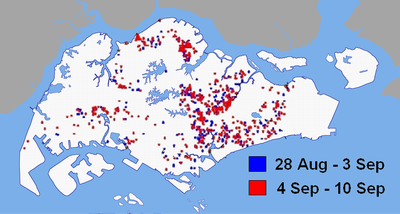
Dengue hotspots: geographical distribution of dengue cases.
2005 dengue outbreak in Singapore
From Wikipedia, the free encyclopedia
In the 2005 dengue outbreak in Singapore, a significant rise in the number of dengue cases is reported in Singapore, becoming the country's worst health crisis since the 2003 SARS epidemic. In October, there were signs that the dengue outbreak has peaked as the number of weekly cases has reduced and the outbreak was under control by the end of 2005.
<SCRIPT type=text/javascript>//<![CDATA[ if (window.showTocToggle) { var tocShowText = "show"; var tocHideText = "hide"; showTocToggle(); } //]]></SCRIPT>
Status of outbreak

The number of dengue cases per week in 2005. Between 18 June and 29 October, the number of weekly dengue cases exceeded the epidemic threshold of 237.
<TABLE class=wikitable><TBODY><TR><TD colSpan=2>Status (as of December 31, 2005)</TD></TR><TR><TH>Number of cases</TH><TD>13,984</TD></TR><TR><TH>Number of deaths</TH><TD>19</TD></TR></TBODY></TABLE>In 2005, there were a total of 13,984 dengue fever cases and 19 people have died. The outbreak peaked in the months of September and October, when it caused hospitals to cancel some elective surgery due to the need to allocate more beds for dengue patients.
Dengue is transmitted to humans by the mosquito Aedes aegypti. The virus can cause fever, severe headache, joint and muscular pains, vomiting, diarrhea and rashes. There is no commercially ready vaccine for dengue.
Singapore's health-care system is helping to maintain a low fatality rate at 0.1% (2005), which is lower than Southeast Asia's regional average of 0.8% in 2004, according to the World Health Organization.
The National Environment Agency said that the dengue problem may be worsening because of higher temperatures and changes in viral strains. The mean temperature has risen to 28.2 ?C (82.8 ?F) from 27.8 ?C in 2003.
In the second week of September, more than 100 new cases were reported daily and many were admitted to public hospitals.
Health Minister Khaw Boon Wan said that one of the concerns is that more Singaporeans are infected with Dengue Type 3, which is a new strain of the dengue virus.
Some experts, such as Dr Paul Reitner, Professor of Entomology at the Pasteur Institute in France, suggested that Singapore's success in suppressing the dengue has partly contributed to this year sudden increase in dengue cases. The population born over the last two decades has a low herd immunity and therefore more susceptible to the virus. [1]
[edit]
http://www.flutrackers.com/forum/

Dengue hotspots: geographical distribution of dengue cases.