
All News
 www.cidrap.umn.edu
All News
Looking for vaccines? Vaccines.gov won’t help
News briefToday at 4:48 p.m.
Chris Dall, MA
Topics
Adult (non-flu) Vaccines
Childhood Vaccines
Influenza Vaccines
With the respiratory virus season ramping up, a federal website that helps people find nearby locations where they can get vaccines remains down.
As initially reported by the Today Show, the Centers for Disease Control and Prevention’s (CDC’s) Vaccines.gov site, which prompts visitors to type in a ZIP code to find nearby pharmacies offering vaccines, is not currently functioning and hasn’t been for at least a few days. When CIDRAP News reporters typed in multiple ZIP codes from different states, they all received the same error message: “Please enter a valid 5-digit ZIP code.”
A note at the top of the page says “The functionality of this website may be impacted while it is being updated.” The Department of Health and Human Services did not respond to an email asking when the website is expected to work again.
The website was initially launched in 2021 amid the nationwide rollout of COVID-19 vaccines to help direct Americans to nearby locations where they could receive shots. While it’s unclear how long the site has been down, Forbes reported similar error messages in December 2025.
An archived version of the website contained links to official vaccine recommendations from the CDC, as well as resource links and an FAQ section. The current version only has the ZIP code search tool.
Other options include VaccineFinder.org, the websites of pharmacy chains like Walgreens or CVS, or your local health department website.
CDC reminds doctors in Southwest to be aware of plague
News briefToday at 4:33 p.m.
Sarah Boden
Topics
Plague
After a young Arizona man died of pneumonic plague last year, a report from Centers for Disease Control and Prevention (CDC) and Arizona scientists yesterday issued a caution to clinicians in areas where plague is endemic. They say to consider it as a possible cause of patients’ severe respiratory and systemic disease if they’ve been exposed to sick animals.
As detailed in a new paper in Morbidity and Mortality Weekly Report, the man who died had occupational exposure to two ill cats, which are especially susceptible to plague.
The animals may have been how he contracted the bacterium Yersinia pestis, which causes plague, as they had "respiratory symptoms and other signs of systemic illness consistent with pneumonic plague.” However, the cats were euthanized before they could be tested.
Y pestis
Plague can take several forms, including pneumonic, which is transmitted through inhalation of respiratory droplets and has a nearly 100% case-fatality rate when untreated. The incubation period—the time from exposure to first symptoms—can be as short as one day.The “young adult male” died eight hours after he was admitted to the hospital, where doctors initially suspected he had hantavirus disease or bacterial pneumonia. Post-mortem testing confirmed Y pestis presence in his blood and lung tissue. It's Arizona’s first pneumonic plague death since 2007.
Credit: CDC
The most common form of plague is not pneumonic, but bubonic, which causes large, swollen lymph nodes called buboes that are very painful.
Plague endemic in Southwest
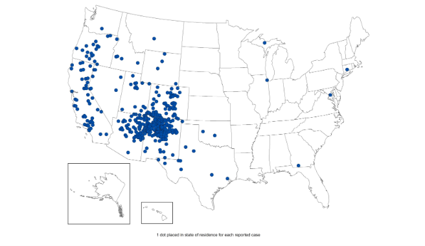
While plague has been infecting humans for millennia, the CDC says it was introduced into the United States in 1900 by rat-infested steamships and that the last urban plague epidemic in the country occurred in Los Angeles from 1924 through 1925.Plague is still found in the western United States, with the CDC showing 502 cases between 1970 and 2023. Over half of these were reported in New Mexico, followed by Colorado and Arizona, which together account for more than a quarter of the remaining infections.
From 2000 through 2023, the CDC reported 122 cases of plague, including 15 fatalities.
Quick takes: Mumps on a football team, sprout and pepper outbreaks, polio cases in 4 nations
News briefToday at 4:03 p.m.
Mary Van Beusekom, MS
Topics
Mumps
Foodborne Disease
E coli
Salmonella
Polio
- San Diego State University’s football team is beset by a 14-case mumps outbreak one day out from its Pac-12 opener against Texas State. While San Diego State officials didn’t identify the team, the San Diego Union-Tribune said it’s the football team. Of the nearly 36 players listed in the Aztecs’ initial availability report this week, 17 were categorized as doubtful or out. Mumps typically causes fever, headache, achy muscles, fatigue, puffy cheeks, and swollen jaws. In response to the outbreak, the university is providing measles, mumps, and rubella (MMR) vaccine boosters to students free of charge.
- Twenty-one more people have tested positive for Shiga toxin–producing Escherichia coli and/or Salmonella Agona, and one more state is affected, in an outbreak linked to alfalfa sprouts, for a total of 76 cases in 16 states from May to September, the US Centers for Disease Control and Prevention (CDC) reported yesterday. Two more people have been hospitalized, for a total of six. Everything Sprouts recalled its alfalfa sprouts and Robust Radish Sprout Mix, the latter of which because it may have been cross-contaminated with the alfalfa sprouts.
- Today, the CDC declared an end to its probe into a multistate outbreak of Salmonella Javiana linked to jalapeno peppers from Sinaloa, Mexico, and distributed by Coast Citrus Distributors. The outbreak sickened 488 people in 34 states and hospitalized 65 people from June through August. Ninety-one percent of people interviewed reported eating at Chipotle Mexican Grill or Qdoba. The Food and Drug Administration has also closed its investigation.
- This week, the Global Polio Eradication Initiative reported eight polio cases in four countries. Afghanistan documented three wild poliovirus type 1 infections, while the Central African Republic noted one case of circulating vaccine-derived poliovirus type 2 (cVDPV2), the Democratic Republic of Congo logged three cVDPV2 infections, and Nigeria reported one circulating vaccine-derived poliovirus type 3 case.