
https://www.cidrap.umn.edu/all-news
Flu continues to ebb in US as pediatric deaths reach 198
News brief
Today at 2:55 p.m.
Jim Wappes
Topics
Influenza, General
COVID-19
Respiratory Syncytial Virus (RSV)
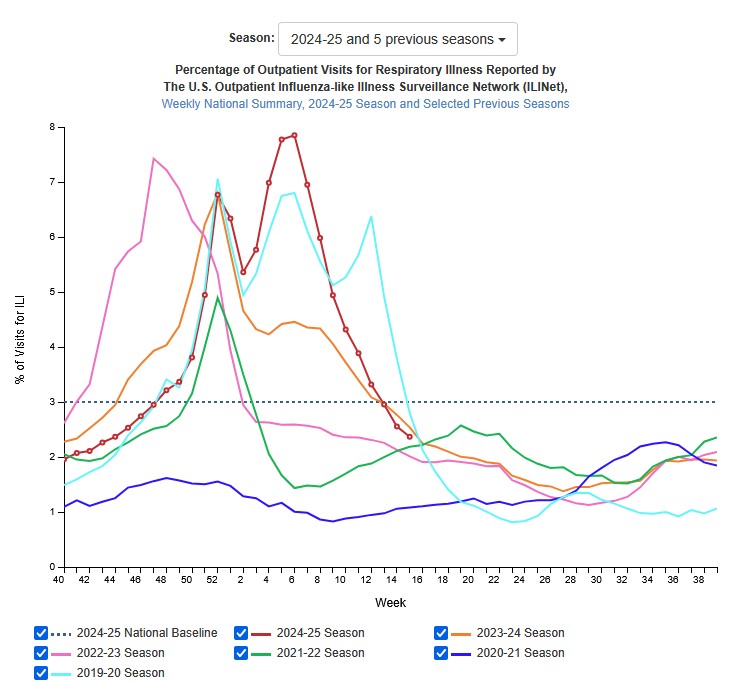
US flu activity declined steadily again last week, with rates of influenza-like illness (ILI) dropping further and staying below baseline levels, but flu-related deaths in children climbed to 198, the Centers for Disease Control and Prevention (CDC) said in its weekly update today.
The percentage of outpatient visits for ILI, or respiratory illness, dipped slightly from 2.5% the previous week to 2.4% last week (see CDC graph at left). The number of patients hospitalized for flu was 4,639, down from 6,448 the week before.
One state, however—New York—reported high ILI activity. The previous week, no US jurisdiction recorded high or very high activity. Two states have moderate activity, down from five the previous week. Test positivity for flu is now at 6.7%, down from 7.6%. Hospitalizations and deaths are both down, but the cumulative hospitalization rate for this season—125.6 patients per 100,000 population—is the highest since the 2010-11 season.
The CDC confirmed 10 new pediatric flu deaths, bringing the season's total to 198. This compares with 207 deaths last flu season. Nine of the new deaths were from influenza A and 1 from influenza B. Of the 8 influenza A cases for which scientists performed subtyping, 5 were caused by the H1N1 strain, and 3 were H3N2.
COVID-19, RSV levels remain low
Meanwhile, COVID-19 levels, already low, continue to ebb, according to CDC data updates today. Wastewater detections last week remained generally low throughout the country. The percentage of overall deaths that were caused by COVID last week stayed steady, at 0.7%, a bit higher than the 0.5% level for flu.
In its update on the three leading respiratory illnesses—flu, COVID, and respiratory syncytial virus (RSV)—the CDC notes that, nationally, flu (6.7%), RSV (2.5%), and COVID-19 (3.4%) test positivity decreased from the previous week. Wastewater levels for influenza A and COVID-19 are low, while for RSV they remain very low.
Carbapenem-resistant Acinetobacter rising in US hospitals
News brief
Today at 2:43 p.m.
Chris Dall, MA
Topics
Antimicrobial Stewardship
A study of US hospital data shows that carbapenem-resistant Acinetobacter baumannii (CRAB) accounted for more than a third of all A baumannii infections from 2018 through 2022 and is increasingly more common, US researchers reported yesterday in BMC Infectious Diseases.
Using clinical and microbiologic data from 314 US hospitals included in the PINC AI Database, researchers examined 7,270 hospitalizations in which one or more A baumannii clinical culture was identified. In addition to assessing the overall and regional incidence of A baumannii and CRAB, the researchers examined hospital discharge destination, 14- and 30-day hospital mortality, total hospital length of stay (LOS), and infection-associated LOS.
Steady increase in CRAB incidence
The overall A baumannii incidence rate was 1.19 cases per 100 hospitalization encounters and 1.33 cases per 100 unique patients. Yearly incidenceincreased slightly from 2018 through 2021, then dropped below 2019 levels in 2022. For CRAB, a total of 2,708 hospital encounters (37%) were identified, with an overall incidence rate of 0.44 cases per 100 hospitalization encounters. Yearly incidence rose from 0.39 per 100 hospitalization encounters in 2018 to 0.53 in 2022. The west south central, east north central, and east south central regions had the highest CRAB incidence rates (0.78, 0.67, and 0.63 cases per 100 hospitalization encounters, respectively).
Patients with CRAB relative to patients with carbapenem-susceptible A baumannii (CSAB) were more likely to die during their hospitalization (20.5% vs. 11.3%, respectively), were more likely to be transferred to another healthcare facility (38.6% vs. 22.4%), and were less likely to be discharged to home (18.0% vs. 47.7%). Patients with CRAB also had significantly higher 14- and 30-day in-hospital mortality rates and significantly longer total and infection-associated hospital LOS relative to patients with CSAB.
"Given the observed incidence rates of CRAB and CSAB in this study and the critical importance of early appropriate therapy, clinicians should consider A. baumannii, especially CRAB, as a potential pathogen in adult hospitalized patients presenting with clinical signs and symptoms of infections," the study authors wrote, adding that strict infection control and routine surveillance might reduce the burden.
Ohio documents first CWD case in Morrow County
News brief
Today at 2:36 p.m.
Mary Van Beusekom, MS
Topics
Chronic Wasting Disease
Ohio's Morrow County is the latest to report a first-time chronic wasting disease (CWD) case, the Ohio Division of Wildlife told the Country Journal.
The rest of the 23 CWD-positive deer harvested by hunters during the 2024-25 hunting season were found in Allen, Hardin, Marion, and Wyandot counties. In total, 5,783 white-tailed deer were tested for the disease, for a positivity rate of 0.4%.
CWD, a neurologic disease that is fatal to deer and other cervids such as elk and and moose, was first identified in a wild deer in Ohio in December 2020 and in captive deer in 2015. The disease is caused by infectious misfolded proteins called prions, which are transmitted among cervids through contact with body fluids or environmental contamination. There is no cure.
Colombia declares public health emergency for deadly yellow fever outbreak
News brief
Today at 2:15 p.m.
Lisa Schnirring
Topics
Yellow Fever
Colombia's health ministry yesterday declared a public health emergency owing to the circulation of yellow fever in several regions of the country.
In a statement, officials said that, since September 2024, the country has recorded 75 cases, 34 of them fatal, for a case-fatality rate of 45.3%. Cases have been reported in nine departments, though most are in Tolima, located in the Andean region in the west central part of the country. The deaths were in eight districts, most of them in Tolima.
The ministry urged all people ages 9 months and older to be vaccinated against yellow fever.
Steady expansion, threat to urban areas
"The outbreak has shown progressive expansion, especially in areas of the Amazon basin, the Magdalena River, and departments such as Meta, in a short period of time," the ministry said. "Furthermore, cases have occurred in territories where they had not been historically reported, such as the municipality of Neira, Caldas, located in the coffee-growing region."
Though urban transmission in Colombia hasn't been reported since 1929, some cases have been detected in populated centers and on the outskirts of cities that have low population densities, highlighting the risk of spread to larger urban areas, the ministry said.
The government took several steps in September to contain the spread, including forming and sending vaccination teams to all affected areas.
In late March, the Pan American Health Organization (PAHO) issued an epidemiologic alert about a rise in yellow fever cases in countries in the Americas, including Bolivia, Brazil, Colombia, and Peru. And earlier this week, the US Centers for Disease Control and Prevention (CDC) issued a level 2 travel notice for yellow fever in South America.
ALL BRIEFS
Flu continues to ebb in US as pediatric deaths reach 198
News brief
Today at 2:55 p.m.
Jim Wappes
Topics
Influenza, General
COVID-19
Respiratory Syncytial Virus (RSV)
US flu activity declined steadily again last week, with rates of influenza-like illness (ILI) dropping further and staying below baseline levels, but flu-related deaths in children climbed to 198, the Centers for Disease Control and Prevention (CDC) said in its weekly update today.
The percentage of outpatient visits for ILI, or respiratory illness, dipped slightly from 2.5% the previous week to 2.4% last week (see CDC graph at left). The number of patients hospitalized for flu was 4,639, down from 6,448 the week before.
One state, however—New York—reported high ILI activity. The previous week, no US jurisdiction recorded high or very high activity. Two states have moderate activity, down from five the previous week. Test positivity for flu is now at 6.7%, down from 7.6%. Hospitalizations and deaths are both down, but the cumulative hospitalization rate for this season—125.6 patients per 100,000 population—is the highest since the 2010-11 season.
The CDC confirmed 10 new pediatric flu deaths, bringing the season's total to 198. This compares with 207 deaths last flu season. Nine of the new deaths were from influenza A and 1 from influenza B. Of the 8 influenza A cases for which scientists performed subtyping, 5 were caused by the H1N1 strain, and 3 were H3N2.
COVID-19, RSV levels remain low
Meanwhile, COVID-19 levels, already low, continue to ebb, according to CDC data updates today. Wastewater detections last week remained generally low throughout the country. The percentage of overall deaths that were caused by COVID last week stayed steady, at 0.7%, a bit higher than the 0.5% level for flu.
In its update on the three leading respiratory illnesses—flu, COVID, and respiratory syncytial virus (RSV)—the CDC notes that, nationally, flu (6.7%), RSV (2.5%), and COVID-19 (3.4%) test positivity decreased from the previous week. Wastewater levels for influenza A and COVID-19 are low, while for RSV they remain very low.
Carbapenem-resistant Acinetobacter rising in US hospitals
News brief
Today at 2:43 p.m.
Chris Dall, MA
Topics
Antimicrobial Stewardship
A study of US hospital data shows that carbapenem-resistant Acinetobacter baumannii (CRAB) accounted for more than a third of all A baumannii infections from 2018 through 2022 and is increasingly more common, US researchers reported yesterday in BMC Infectious Diseases.
Using clinical and microbiologic data from 314 US hospitals included in the PINC AI Database, researchers examined 7,270 hospitalizations in which one or more A baumannii clinical culture was identified. In addition to assessing the overall and regional incidence of A baumannii and CRAB, the researchers examined hospital discharge destination, 14- and 30-day hospital mortality, total hospital length of stay (LOS), and infection-associated LOS.
Steady increase in CRAB incidence
The overall A baumannii incidence rate was 1.19 cases per 100 hospitalization encounters and 1.33 cases per 100 unique patients. Yearly incidenceincreased slightly from 2018 through 2021, then dropped below 2019 levels in 2022. For CRAB, a total of 2,708 hospital encounters (37%) were identified, with an overall incidence rate of 0.44 cases per 100 hospitalization encounters. Yearly incidence rose from 0.39 per 100 hospitalization encounters in 2018 to 0.53 in 2022. The west south central, east north central, and east south central regions had the highest CRAB incidence rates (0.78, 0.67, and 0.63 cases per 100 hospitalization encounters, respectively).
Patients with CRAB relative to patients with carbapenem-susceptible A baumannii (CSAB) were more likely to die during their hospitalization (20.5% vs. 11.3%, respectively), were more likely to be transferred to another healthcare facility (38.6% vs. 22.4%), and were less likely to be discharged to home (18.0% vs. 47.7%). Patients with CRAB also had significantly higher 14- and 30-day in-hospital mortality rates and significantly longer total and infection-associated hospital LOS relative to patients with CSAB.
"Given the observed incidence rates of CRAB and CSAB in this study and the critical importance of early appropriate therapy, clinicians should consider A. baumannii, especially CRAB, as a potential pathogen in adult hospitalized patients presenting with clinical signs and symptoms of infections," the study authors wrote, adding that strict infection control and routine surveillance might reduce the burden.
Ohio documents first CWD case in Morrow County
News brief
Today at 2:36 p.m.
Mary Van Beusekom, MS
Topics
Chronic Wasting Disease
Ohio's Morrow County is the latest to report a first-time chronic wasting disease (CWD) case, the Ohio Division of Wildlife told the Country Journal.
The rest of the 23 CWD-positive deer harvested by hunters during the 2024-25 hunting season were found in Allen, Hardin, Marion, and Wyandot counties. In total, 5,783 white-tailed deer were tested for the disease, for a positivity rate of 0.4%.
CWD, a neurologic disease that is fatal to deer and other cervids such as elk and and moose, was first identified in a wild deer in Ohio in December 2020 and in captive deer in 2015. The disease is caused by infectious misfolded proteins called prions, which are transmitted among cervids through contact with body fluids or environmental contamination. There is no cure.
Colombia declares public health emergency for deadly yellow fever outbreak
News brief
Today at 2:15 p.m.
Lisa Schnirring
Topics
Yellow Fever
Colombia's health ministry yesterday declared a public health emergency owing to the circulation of yellow fever in several regions of the country.
In a statement, officials said that, since September 2024, the country has recorded 75 cases, 34 of them fatal, for a case-fatality rate of 45.3%. Cases have been reported in nine departments, though most are in Tolima, located in the Andean region in the west central part of the country. The deaths were in eight districts, most of them in Tolima.
The ministry urged all people ages 9 months and older to be vaccinated against yellow fever.
Steady expansion, threat to urban areas
"The outbreak has shown progressive expansion, especially in areas of the Amazon basin, the Magdalena River, and departments such as Meta, in a short period of time," the ministry said. "Furthermore, cases have occurred in territories where they had not been historically reported, such as the municipality of Neira, Caldas, located in the coffee-growing region."
Though urban transmission in Colombia hasn't been reported since 1929, some cases have been detected in populated centers and on the outskirts of cities that have low population densities, highlighting the risk of spread to larger urban areas, the ministry said.
The government took several steps in September to contain the spread, including forming and sending vaccination teams to all affected areas.
In late March, the Pan American Health Organization (PAHO) issued an epidemiologic alert about a rise in yellow fever cases in countries in the Americas, including Bolivia, Brazil, Colombia, and Peru. And earlier this week, the US Centers for Disease Control and Prevention (CDC) issued a level 2 travel notice for yellow fever in South America.
ALL BRIEFS