

Shiloh
Editor, Senior Moderator
Source: http://www.cidrap.umn.edu/news-pers...ness-grants-more-public-health-less-hospitals
HHS readiness grants: more for public health, less for hospitals
Filed Under:
Bioterrorism; Business Preparedness; Pandemic Influenza
Robert Roos | News Editor | CIDRAP News
|
Jul 01, 2014
State and local health departments will receive more federal dollars for emergency preparedness this year, while healthcare systems will get less money, the US Department of Health and Human Services (HHS) revealed today.
HHS announced that overall funding for fiscal year 2014 will be about $840 million, or $76 million less than last year's total of $916 million.
The amount includes $611.75 million for the Public Health Emergency Preparedness (PHEP) program, up by $25.75 million from last year's sum of $584 million. The money goes to state, local, territorial, and four metropolitan health departments.
The allocation for the Hospital Preparedness Program (HPP) for fiscal year 2014 is $228.5 million, which is $103.5 million less than last year's $332 million. An official with the Trust for America's Health (TFAH), a nonprofit public health advocacy group, said the change reflects severe cuts enacted in the fiscal 2014 congressional appropriations process.
PHEP vs HPP funding
PHEP funding is intended to improve public health preparedness and response at the state and local level, while HPP grants are designed to support the building of community healthcare coalitions that collaborate on emergency planning and disaster response, according to HHS.
PHEP grants are administered by the Centers for Disease Control and Prevention (CDC); HPP funds are managed by HHS's Office of the Assistant Secretary for Preparedness and Response (ASPR).
"This marks the third year that HPP and PHEP funds are being awarded jointly, encouraging further cooperation between the nation's health care and public health systems, and reducing the administrative burden on grantees," the HHS statement said.
"With aligned HPP and PHEP cooperative agreement programs, communities can conduct more effective joint planning, exercising, and program operations."
The two funding programs were established in the wake of the terrorist attacks of 2001. The annual totals have generally declined over the years.
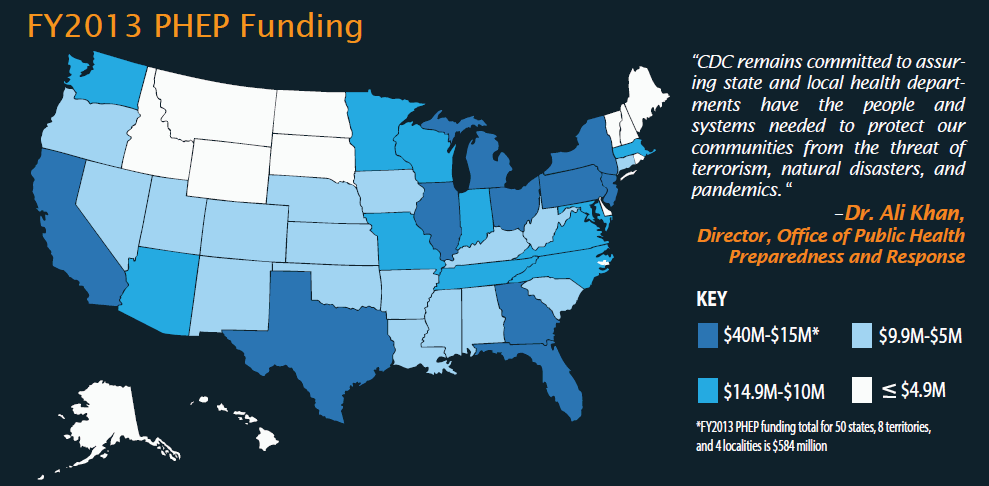
The individual grants include a standard base amount plus an additional sum based on population. HPP state grants range from less than $1 million for several low-population states to $23.3 million for California. For the PHEP program, the state amounts range from about $4.2 million for several small states to $42.4 million for California (see CDC map below).
A blow for hospitals
Laura Segal, TFAH's director of public affairs in Washington, DC, predicted that the big reduction in HPP funding will hurt hospitals' ability to respond to health emergencies.
"With the devastating cuts to HPP in FY14, we will likely see fewer coalitions funded and existing coalitions reduce their ability to prepare effectively," she commented via e-mail. "Americans should expect to see more hospitals overloaded and shut down during a disaster, like during Hurricane Katrina, rather than safely evacuating and continuing operations, like in Joplin, Missouri."
Segal commented that the HPP "enabled a coordinated response" to the Boston Marathon bombings and the fertilizer plant explosion in West, Texas, in 2013. "TFAH thinks there are gaps remaining in our ability to respond to disasters, but we are miles ahead of where we were right after September 11 as a result of PHEP and HPP," she added.
She said HPP has evolved over the years from a program that helped individual hospitals to plan and buy supplies to one focused on building the preparedness capabilities of coalitions of healthcare facilities. The early years of the program helped jump-start individual hospital preparedness, but it was often difficult to demonstrate to policymakers the value of the small grants awarded, she observed.
"There has never been enough money to truly build universal health system preparedness, so the shift to coalitions makes sense to us as a way to leverage limited resources," Segal added. "With the increased focus on coalitions, capabilities and evaluation, we are seeing the benefits of collaboration and accountability."
See also:
Jul 1 HHS announcement
Table of PHEP and HPP grants
Jul 8, 2013, CIDRAP News story on 2013 PHEP and HPP grants
CDC information on funding for state and local health departments
HHS readiness grants: more for public health, less for hospitals
Filed Under:
Bioterrorism; Business Preparedness; Pandemic Influenza
Robert Roos | News Editor | CIDRAP News
|
Jul 01, 2014
State and local health departments will receive more federal dollars for emergency preparedness this year, while healthcare systems will get less money, the US Department of Health and Human Services (HHS) revealed today.
HHS announced that overall funding for fiscal year 2014 will be about $840 million, or $76 million less than last year's total of $916 million.
The amount includes $611.75 million for the Public Health Emergency Preparedness (PHEP) program, up by $25.75 million from last year's sum of $584 million. The money goes to state, local, territorial, and four metropolitan health departments.
The allocation for the Hospital Preparedness Program (HPP) for fiscal year 2014 is $228.5 million, which is $103.5 million less than last year's $332 million. An official with the Trust for America's Health (TFAH), a nonprofit public health advocacy group, said the change reflects severe cuts enacted in the fiscal 2014 congressional appropriations process.
PHEP vs HPP funding
PHEP funding is intended to improve public health preparedness and response at the state and local level, while HPP grants are designed to support the building of community healthcare coalitions that collaborate on emergency planning and disaster response, according to HHS.
PHEP grants are administered by the Centers for Disease Control and Prevention (CDC); HPP funds are managed by HHS's Office of the Assistant Secretary for Preparedness and Response (ASPR).
"This marks the third year that HPP and PHEP funds are being awarded jointly, encouraging further cooperation between the nation's health care and public health systems, and reducing the administrative burden on grantees," the HHS statement said.
"With aligned HPP and PHEP cooperative agreement programs, communities can conduct more effective joint planning, exercising, and program operations."
The two funding programs were established in the wake of the terrorist attacks of 2001. The annual totals have generally declined over the years.
The individual grants include a standard base amount plus an additional sum based on population. HPP state grants range from less than $1 million for several low-population states to $23.3 million for California. For the PHEP program, the state amounts range from about $4.2 million for several small states to $42.4 million for California (see CDC map below).
A blow for hospitals
Laura Segal, TFAH's director of public affairs in Washington, DC, predicted that the big reduction in HPP funding will hurt hospitals' ability to respond to health emergencies.
"With the devastating cuts to HPP in FY14, we will likely see fewer coalitions funded and existing coalitions reduce their ability to prepare effectively," she commented via e-mail. "Americans should expect to see more hospitals overloaded and shut down during a disaster, like during Hurricane Katrina, rather than safely evacuating and continuing operations, like in Joplin, Missouri."
Segal commented that the HPP "enabled a coordinated response" to the Boston Marathon bombings and the fertilizer plant explosion in West, Texas, in 2013. "TFAH thinks there are gaps remaining in our ability to respond to disasters, but we are miles ahead of where we were right after September 11 as a result of PHEP and HPP," she added.
She said HPP has evolved over the years from a program that helped individual hospitals to plan and buy supplies to one focused on building the preparedness capabilities of coalitions of healthcare facilities. The early years of the program helped jump-start individual hospital preparedness, but it was often difficult to demonstrate to policymakers the value of the small grants awarded, she observed.
"There has never been enough money to truly build universal health system preparedness, so the shift to coalitions makes sense to us as a way to leverage limited resources," Segal added. "With the increased focus on coalitions, capabilities and evaluation, we are seeing the benefits of collaboration and accountability."
See also:
Jul 1 HHS announcement
Table of PHEP and HPP grants
Jul 8, 2013, CIDRAP News story on 2013 PHEP and HPP grants
CDC information on funding for state and local health departments