

Shiloh
Editor, Senior Moderator
Source: http://www.cidrap.umn.edu/news-perspective/2014/08/food-safety-scan-aug-01-2014
Food Safety Scan for Aug 01, 2014
Resistant Salmonella in meat, poultry; Foster Farms Salmonella outbreak over
Filed Under:
Foodborne Disease; Antimicrobial Resistance; Salmonella
USDA declines to classify resistant Salmonella as meat adulterant
The US Department of Agriculture (USDA) has turned down a long-pending petition to declare antibiotic-resistant (ABR) Salmonella an adulterant in raw ground meat and poultry, saying there's not enough evidence to support the change.
The petition, filed by the Center for Science in the Public Interest (CSPI) in 2011, covers resistant strains of the Salmonella serotypes Hadar, Heidelberg, Newport, and Typhimurium. If these were deemed adulterants, the USDA would have to test for them and remove contaminated products from the food supply.
The USDA's Food Safety and Inspection Service (FSIS) explained its decision in a letter dated yesterday. As noted in the letter, the FSIS doesn't consider Salmonella an adulterant in ground meat and poultry because ordinary cooking generally kills it.
CSPI argued that ABR Salmonella is legally different from other Salmonella because it results from human action in the form of treating livestock with antibiotics, and that this lowers the bar for classifying it as an adulterant, the FSIS letter notes. But the FSIS responded that ABR Salmonella can exist in animals with no exposure to antibiotics, which it said undermines the distinction.
CSPI also argued that ABR Salmonella is dangerous because proper cooking often fails to heat food enough to kill the pathogen, the letter says. But the FSIS said there is no evidence that ABR strains are more heat-resistant than other strains.
The agency also said more data are needed on the infective dose of different Salmonella strains and whether ABR Salmonella causes more serious illness than susceptible strains.
Caroline Smith DeWaal, CSPI's food safety director, criticized the USDA decision in a statement yesterday.
"USDA's failure to act on antibiotic-resistant strains of Salmonella in the meat supply ignores vital information about the public health risk posed by these pathogens," she said. "Despite numerous examples of outbreaks linked to resistant pathogens, USDA leaves consumers vulnerable to illnesses that carry a much greater risk of hard-to-treat infections leading to hospitalization."
Jul 31 USDA letter
Jul 31 CSPI press release
CDC declares Foster Farms Salmonella chicken outbreak over
The Centers for Disease Control and Prevention (CDC) yesterday declared that a multistate Salmonella outbreak linked to Foster Farms chicken products that began in March 2013 is finally over after sickening at least 634 people.
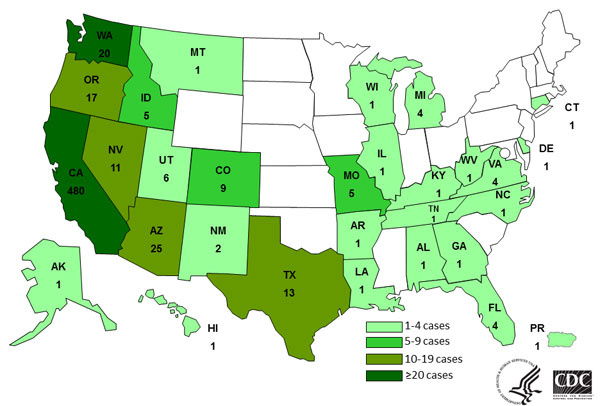
The outbreak total marks a 13-case increase since the CDC's previous update, on Jul 4. Cases have been confirmed in 29 states and Puerto Rico. California reported by far the most cases, 490, followed by Arizona, with 25 (see CDC map below).
Illness-onset dates ranged from Mar 1, 2013, to Jul 11, 2014, and patients' ages varied from younger than 1 to 93 years, with a median of 18 years. Among 528 persons for whom information was available, 200 (38%) were hospitalized.
Fully 15% of case-patients developed blood infections, which is far higher than the typical 5% associated with Salmonella infections, the CDC said. No deaths were reported.
Of 350 patients with available information, 74% said they had eaten chicken prepared at home in the week before developing symptoms. And of those who could recall the brand of chicken, 152 (87%) of 175 said it was Foster Farms or a brand likely produced by Foster Farms, which is located in Livingston, Calif.
Authorities had isolated outbreak strains of Salmonella Heidelberg from patients' homes, and FSIS officials had identified six of the seven outbreak strains on raw chicken samples collected from the three Foster Farms establishments in California.
About a month ago Foster Farms recalled an undetermined amount of its chicken products because of possible Salmonella contamination.
Jul 31 CDC final outbreak notice
Jul 7 CIDRAP News scan on previous CDC update, chicken recall
Food Safety Scan for Aug 01, 2014
Resistant Salmonella in meat, poultry; Foster Farms Salmonella outbreak over
Filed Under:
Foodborne Disease; Antimicrobial Resistance; Salmonella
USDA declines to classify resistant Salmonella as meat adulterant
The US Department of Agriculture (USDA) has turned down a long-pending petition to declare antibiotic-resistant (ABR) Salmonella an adulterant in raw ground meat and poultry, saying there's not enough evidence to support the change.
The petition, filed by the Center for Science in the Public Interest (CSPI) in 2011, covers resistant strains of the Salmonella serotypes Hadar, Heidelberg, Newport, and Typhimurium. If these were deemed adulterants, the USDA would have to test for them and remove contaminated products from the food supply.
The USDA's Food Safety and Inspection Service (FSIS) explained its decision in a letter dated yesterday. As noted in the letter, the FSIS doesn't consider Salmonella an adulterant in ground meat and poultry because ordinary cooking generally kills it.
CSPI argued that ABR Salmonella is legally different from other Salmonella because it results from human action in the form of treating livestock with antibiotics, and that this lowers the bar for classifying it as an adulterant, the FSIS letter notes. But the FSIS responded that ABR Salmonella can exist in animals with no exposure to antibiotics, which it said undermines the distinction.
CSPI also argued that ABR Salmonella is dangerous because proper cooking often fails to heat food enough to kill the pathogen, the letter says. But the FSIS said there is no evidence that ABR strains are more heat-resistant than other strains.
The agency also said more data are needed on the infective dose of different Salmonella strains and whether ABR Salmonella causes more serious illness than susceptible strains.
Caroline Smith DeWaal, CSPI's food safety director, criticized the USDA decision in a statement yesterday.
"USDA's failure to act on antibiotic-resistant strains of Salmonella in the meat supply ignores vital information about the public health risk posed by these pathogens," she said. "Despite numerous examples of outbreaks linked to resistant pathogens, USDA leaves consumers vulnerable to illnesses that carry a much greater risk of hard-to-treat infections leading to hospitalization."
Jul 31 USDA letter
Jul 31 CSPI press release
CDC declares Foster Farms Salmonella chicken outbreak over
The Centers for Disease Control and Prevention (CDC) yesterday declared that a multistate Salmonella outbreak linked to Foster Farms chicken products that began in March 2013 is finally over after sickening at least 634 people.
The outbreak total marks a 13-case increase since the CDC's previous update, on Jul 4. Cases have been confirmed in 29 states and Puerto Rico. California reported by far the most cases, 490, followed by Arizona, with 25 (see CDC map below).
Illness-onset dates ranged from Mar 1, 2013, to Jul 11, 2014, and patients' ages varied from younger than 1 to 93 years, with a median of 18 years. Among 528 persons for whom information was available, 200 (38%) were hospitalized.
Fully 15% of case-patients developed blood infections, which is far higher than the typical 5% associated with Salmonella infections, the CDC said. No deaths were reported.
Of 350 patients with available information, 74% said they had eaten chicken prepared at home in the week before developing symptoms. And of those who could recall the brand of chicken, 152 (87%) of 175 said it was Foster Farms or a brand likely produced by Foster Farms, which is located in Livingston, Calif.
Authorities had isolated outbreak strains of Salmonella Heidelberg from patients' homes, and FSIS officials had identified six of the seven outbreak strains on raw chicken samples collected from the three Foster Farms establishments in California.
About a month ago Foster Farms recalled an undetermined amount of its chicken products because of possible Salmonella contamination.
Jul 31 CDC final outbreak notice
Jul 7 CIDRAP News scan on previous CDC update, chicken recall