Re: Shenzhen confirmed the first case of human infection with H7N9 (Ifeng, December 19 2013)
Re: Shenzhen confirmed the first case of human infection with H7N9 (Ifeng, December 19 2013)
[Source: Ifeng, full page: (
LINK). Automatic translation from Chinese.]
Shenzhen first case of human infection with H7N9 birdflu virus had not close contact with birds
At 02:42 on December 20, 2013 / Source:
New Express
December 10, and the prevention and control of Shenzhen City, Guangdong Province, the joint working group of people infected with H7N9 avian influenza in live bird markets in Shenzhen environment pollution monitoring avian influenza virus in live bird markets were collected 13 specimens of 70 parts of the environment, which , Longgang District, Shenzhen detected two live bird markets three H7N9 avian influenza virus nucleic acid positive, Longgang District 1 from poultry markets cutting boards, two chicken from South Bay Street, Longgang District, three birds Cambridge Meat Market stalls and the stall epilator. Then, yesterday, the Shenzhen confirmed the first case of human infection with H7N9 avian influenza.
Cantonese cases of H7N9 infection
Original title: Shenzhen confirmed the first case of human infection with H7N9
Express reporter Zheng Yanhong Yu Yang Liuzheng Xu Liang Ning correspondent Guangdong Wilson
The patient was a 38-year-old worker, CDC says "there is no history of exposure before the onset of definite people with birds."
Yesterday, the Shenzhen confirmed the first case of human infection with the H7N9 avian influenza. According to the Shenzhen CDC experts said that at present, Shenzhen sporadic human infection with H7N9 occurrence of avian influenza in high risk cases, there may be new cases occur at any time.
Yesterday, Vice Governor Lin Shaochun rate Provincial Health and Family Planning Commission, CDC and Industry Bureau, responsible comrades to Dongguan City, look H7N9 avian flu prevention and control of human infection with the implementation of measures to guide prevention and control work to do next.
135 close contacts does not appear abnormal
Yesterday afternoon, the Shenzhen Municipal Center for Disease Control informed that yesterday, by provinces and expert consultation, diagnosed the first case of human infection with the Shenzhen H7N9 avian influenza. European patients, male, 38 years old, workers, living in Longgang District, South Bay Street.
December 9, patients with cough, fever clinics near their homes to a treatment, no significant improvement;
Dec 12, the South Bay to Shenzhen People's Hospital for treatment and hospitalization;
Dec 13 to severe pneumonia Forwarding Shenzhen People's Hospital treatment;
Dec 17 evening, Shenzhen Center for Disease Control and Prevention lower respiratory tract specimens of human infection of H7N9 avian influenza nucleic acid positive;
Dec 18, by the Guangdong Provincial Disease Prevention and Control Center to review consistent results. 18 pm, the patient was transferred to the Third People's Hospital of Shenzhen to continue treatment, is currently in critical condition.
According to the Shenzhen CDC, the person in charge, after receiving the report, the Shenzhen Center for Disease Control and Prevention urban tissue immediately carry out epidemiological investigations of 135 close contacts to implement medical observation, "
including the colleagues of the factory, during the onset of had close contact with friends in the South Bay admissions of health care workers, patients and hospital ward with the Municipal People's hospital during the health care clinic, "these close contacts No abnormal situation.
But as of yesterday, there is evidence that the patient has not been confirmed with bird closely, "because he
is a worker, living in the electronics factory dormitory, before the onset of a clear no history of contact with poultry man." Shenzhen Center for Disease Control the official said.
Dongguan cases may be associated with Shenzhen
According to the reporter, the evening of December 2, Hong Kong confirmed the first case of human infection of H7N9 cases, the patient was a 36-year-old Indonesian maid, which was November 17 to Shenzhen slaughter chickens cooking. The evening of December 6, Hong Kong again Bulletin, 36-year-old maid after Hong Kong confirmed H7N9 avian influenza infection, and one was diagnosed at the age of 80 long-term elderly in Hong Kong, Shenzhen residence.
December 10, and the prevention and control of Shenzhen City, Guangdong Province, the joint working group of people infected with H7N9 avian influenza in live bird markets in Shenzhen environment pollution monitoring avian influenza virus in live bird markets were collected 13 specimens of 70 parts of the environment, which , Longgang District, Shenzhen detected two live bird markets three H7N9 avian influenza virus nucleic acid positive, Longgang District 1 from poultry markets cutting boards, two chicken from South Bay Street, Longgang District, three birds Cambridge Meat Market stalls and the stall epilator. Then, yesterday, the Shenzhen confirmed the first case of human infection with H7N9 avian influenza.
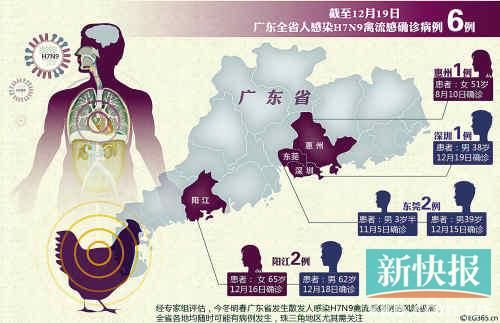
As of yesterday afternoon, the province of human infection of avian influenza H7N9 confirmed cases of six cases, including one case in Shenzhen, Huizhou one case, two cases in Dongguan, Yangjiang two cases. Plus two cases of Hong Kong, Shenzhen and surrounding cities were found in eight cases of human infection with the H7N9 avian influenza. Shenzhen Center for Disease Control, the official pointed out that after the winter weather is getting cold, virus outer environment more active, longer survival time, high risk of occurrence of sporadic human infection with the H7N9 Shenzhen bird flu at any time there may be new cases appears, currently found in people infected with H7N9 bird flu in Hong Kong, Dongguan and Shenzhen case may be associated with.
Spring Festival approaching, some families have to be New Year slaughter chickens at home habit, this is more likely to have the risk of infection. Birds suggest that you stay away from the market, not at home chickens.
- Provincial CDC chief expert, He Jianfeng, director of prevention and control of epidemics
-
-------