Re: China-large suspected meningitis epidemic
#11:
"Equally his matter with DBD, this kind virus was also spread through the mosquitoes bite aedes aegypti.
These mosquitoes could it was known fly in a radius of 200 metre.
This mosquitoes kind could only develop in the area that his height below 1.000 metre from the surface of sea water. (?!)
These mosquitoes precisely developed in the clean environment, not in the dirty environment."
http://en.wikipedia.org/wiki/Aedes_aegypti
<TABLE class="infobox biota" style="PADDING-RIGHT: 2px; PADDING-LEFT: 2px; PADDING-BOTTOM: 2px; WIDTH: 200px; PADDING-TOP: 2px; TEXT-ALIGN: center"><TBODY><TR style="TEXT-ALIGN: center"><TH style="BACKGROUND: #d3d3a4">
Scientific classification</TH></TR><TR style="TEXT-ALIGN: center"><TD><TABLE style="BACKGROUND: none transparent scroll repeat 0% 0%; MARGIN: 0px auto; TEXT-ALIGN: left" cellPadding=2><TBODY><TR vAlign=top><TD>Kingdom:</TD><TD>
Animalia
</TD></TR><TR vAlign=top><TD>Phylum:</TD><TD>
Arthropoda
</TD></TR><TR vAlign=top><TD>Subphylum:</TD><TD>
Hexapoda
</TD></TR><TR vAlign=top><TD>Class:</TD><TD>
Insecta
</TD></TR><TR vAlign=top><TD>Subclass:</TD><TD>
Pterygota
</TD></TR><TR vAlign=top><TD>Infraclass:</TD><TD>
Neoptera
</TD></TR><TR vAlign=top><TD>Superorder:</TD><TD>
Endopterygota
</TD></TR><TR vAlign=top><TD>Order:</TD><TD>
Diptera
</TD></TR><TR vAlign=top><TD>Family:</TD><TD>
Culicidae
</TD></TR><TR vAlign=top><TD>Genus:</TD><TD>
Aedes
</TD></TR><TR vAlign=top><TD>Species:</TD><TD>
A. aegypti
</TD></TR></TBODY></TABLE></TD></TR><TR style="BACKGROUND: #d3d3a4"><TH>
Binomial name</TH></TR><TR style="TEXT-ALIGN: center"><TD>
Aedes aegypti
<SMALL>
(Linnaeus, 1762)</SMALL>
</TD></TR></TBODY></TABLE>
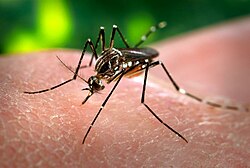
Aedes aegypti, commonly known as the
yellow fever mosquito, is a
mosquito that can spread the
dengue fever,
Chikungunya and
yellow fever viruses, and other diseases as well. The mosquito can be recognized by white markings and a marking of the form of a
lyre on the
thorax, although other mosquitos may have only slightly different patterns.<SUP class="noprint Template-Fact">[
citation needed]</SUP> The mosquito is most frequently found in the
tropics<SUP class=reference id=cite_ref-0>
[1]</SUP>; it has some presence in the
southeastern United States (such as the lower half of
Florida), but it seems to have been competitively displaced by the introduction of
Aedes albopictus<SUP class="noprint Template-Fact">[
citation needed]</SUP>.
<TABLE class=toc id=toc summary=Contents><TBODY><TR><TD>
Contents
[
hide]
</TD></TR></TBODY></TABLE><SCRIPT type=text/javascript>//<![CDATA[ if (window.showTocToggle) { var tocShowText = "show"; var tocHideText = "hide"; showTocToggle(); } //]]></SCRIPT>
[edit] Genomics
The
genome of this species of mosquito was sequenced by a consortium including scientists at the J Craig Venter Institute and the University of Notre Dame, and published in 2007. The effort in sequencing its
DNA was intended to provide new avenues for research into
insecticides and possible genetic modification to prevent the spread of disease. This was the second mosquito species to have its genome sequenced in full (the first was
Anopheles gambiae). The published data included the 1.38 billion
base pairs containing the insect's estimated 15,419
protein encoding genes. The sequence indicates that the species diverged from
Drosophila melanogaster (the common fruit fly) about 250 million years ago, and that
Anopheles gambiae and this species diverged about 150 million years ago.<SUP class=reference id=cite_ref-1>
[2]</SUP><SUP class=reference id=cite_ref-2>
[3]</SUP>
[edit] Spread of disease and prevention

 Larva
Larva of
Aedes aegypti
The
CDC traveler's page on preventing dengue fever suggests using
mosquito repellents that contain
DEET (N, N-diethylmetatoluamide). It also explains the following:
- Although it may feed at any time, the mosquito bites humans only between a few hours after dawn until an hour or so after sunset.
- The mosquito's preferred breeding areas are in areas of stagnant water, such as flower vases, uncovered barrels, buckets, and discarded tires, but the most dangerous areas are wet shower floors and toilet tanks, as they allow the mosquitos to breed right in the residence. Research has shown that certain chemicals emanating from bacteria in water containers stimulate the female mosquitoes to lay their eggs. They are particularly motivated to lay eggs in water containers that have just the right amounts of specific fatty acids associated with bacteria involved in the degradation of leaves and other organic matter in water. The chemicals associated with the microbial stew are far more stimulating to discerning female mosquitoes than plain water, for example, or filtered water in which the bacteria once lived.<SUP class=reference id=cite_ref-3>[4]</SUP>
[edit] References
- <LI id=cite_note-0>^ <CITE style="FONT-STYLE: normal">Womack, M. (1993). "The yellow fever mosquito, Aedes aegypti.". Wing Beats 5 (4): 4.</CITE> <LI id=cite_note-1>^ Heather Kowalski (2007-05-17). "Scientists at J. Craig Venter Institute Publish Draft Genome Sequence from Aedes aegypti, Mosquito Responsible for Yellow Fever, Dengue Fever". J. Craig Venter Institute. <LI id=cite_note-2>^ {{Nene V, Wortman JR, Lawson D, Haas B, Kodira C, Tu ZJ, Loftus B, Xi Z, Megy K, Grabherr M, Ren Q, Zdobnov EM, Lobo NF, Campbell KS, Brown SE, Bonaldo MF, Zhu J, Sinkins SP, Hogenkamp DG, Amedeo P, Arensburger P, Atkinson PW, Bidwell S, Biedler J, Birney E, Bruggner RV, Costas J, Coy MR, Crabtree J, Crawford M, Debruyn B, Decaprio D, Eiglmeier K, Eisenstadt E, El-Dorry H, Gelbart WM, Gomes SL, Hammond M, Hannick LI, Hogan JR, Holmes MH, Jaffe D, Johnston JS, Kennedy RC, Koo H, Kravitz S, Kriventseva EV, Kulp D, Labutti K, Lee E, Li S, Lovin DD, Mao C, Mauceli E, Menck CF, Miller JR, Montgomery P, Mori A, Nascimento AL, Naveira HF, Nusbaum C, O'leary S, Orvis J, Pertea M, Quesneville H, Reidenbach KR, Rogers YH, Roth CW, Schneider JR, Schatz M, Shumway M, Stanke M, Stinson EO, Tubio JM, Vanzee JP, Verjovski-Almeida S, Werner D, White O, Wyder S, Zeng Q, Zhao Q, Zhao Y, Hill CA, Raikhel AS, Soares MB, Knudson DL, Lee NH, Galagan J, Salzberg SL, Paulsen IT, Dimopoulos G, Collins FH, Birren B, Fraser-Liggett CM, Severson DW (2007) Genome sequence of Aedes aegypti, a major arbovirus vector. Science 316:1718-23.}}
- ^ Lay Your Eggs Here Newswise, Retrieved on July 8, 2008.
[edit] External links
 Wikispecies
 has information related to:
Aedes aegypti

has media related to:
Aedes aegypti
<!-- NewPP limit reportPreprocessor node count: 1013/1000000Post-expand include size: 9832/2048000 bytesTemplate argument size: 2572/2048000 bytesExpensive parser function count: 2/500--><!-- Saved in parser cache with key enwiki

cache:idhash:2236780-0!1!0!default!!en!2 and timestamp 20080721072443 -->Retrieved from "
http://en.wikipedia.org/wiki/Aedes_aegypti"
___________
Maybe are both Aedes - the Albopictus also.
___________
http://creatures.ifas.ufl.edu/aquatic/asian_tiger.htm
<CENTER>
</CENTER><HR>
common name: Asian tiger mosquito
scientific name: Aedes albopictus (Skuse) (Insecta: Diptera: Culicidae)
Introduction - Distribution - Description - Life Cycle - Medical Significance - Surveillance and Management of Aedes albopictus - Selected References
Introduction
The Asian tiger mosquito,
Aedes albopictus (Skuse), was first documented in the United States in Texas in 1985 (Sprenger and Wuithiranyagool 1986). A year later, the Asian tiger mosquito was found in Florida at a tire dump site near Jacksonville (O'Meara 1997). Since that time, this species has spread rapidly throughout the eastern states, including all of Florida's 67 counties (O'Meara 1997). The arrival of
Aedes albopictus has been correlated with the decline in the abundance and distribution of the
yellow fever mosquito,
Aedes aegypti (Linnaeus). There are a number of possible explanations for the competitive exclusion of
Ae. aegypti by
Ae. albopictus. The decline is likely due to a combination of (a) sterility of offspring from interspecific matings; (b) reduced fitness of
Ae. aegypti from parasites brought in with
Ae. albopictus and; (c) superiority of
Ae. albopictus in larval resource competition (Lounibos 2002). The distribution of
Ae. aegypti currently is limited to the southeastern quadrant of the U.S., and small areas in New York and Arizona (Darsie and Ward 2005).
Aedes albopictus is a competent vector of many viruses including dengue fever (CDC 2001) and Eastern equine encephalitis virus (Mitchell et al. 1992). Its life cycle is closely associated with human habitat, and it breeds in containers with standing water, often tires or other containers. It is a daytime feeder and can be found in shady areas where it rests in shrubs near the ground (Koehler and Castner 1997).
Aedes albopictus feeding peaks in the early morning and late afternoon; it is an opportunistic and aggressive biter with a wide host range including man, domestic and wild animals (Hawley 1988).
 adult Distribution
The distribution of
Aedes albopictus is subtropical, with a temperate distribution in North America, and in the United States has expanded rapidly over the past few years. This species was first documented in Texas in 1985 and is currently established in 866 counties in 26 states (CDC 2001).
 US distribution
The worldwide distribution includes most of Asia and covers tropical and subtropical regions worldwide with introductions into the Caribbean (Morbidity and Mortality Weekly Report 1989). Endemic to Asia and the Pacific islands, the range has greatly expanded to include North and South America, Africa and Europe (O'Meara 1997).
Description
Adult
Aedes albopictus are easily recognized by the bold black shiny scales and distinct silver white scales on the palpus and tarsi (Hawley 1988). The scutum (back) is black with a distinguishing white stripe down the center beginning at the dorsal surface of the head and continuing along the thorax. It is a medium-sized mosquito (approximately 2.0 to 10.0 mm, males are on average 20% smaller than females). Differences in morphology between male and female include the antennae of the male are plumous and mouthparts are modified for nectar feeding. The abdominal tergites are covered in dark scales. Legs are black with white basal scales on each tarsal segment. The abdomen narrows into a point characteristic of the genus
Aedes. Field identification is very easy because of these distinct features.
 adult - lateral view
 adult with white dorsal stripe
For a pictorial key (that includes the larval, pupal and adult stage for many common Florida mosquitoes) to identify
Ae. albopictus and other mosquitoes of Florida, see:
http://fmel.ifas.ufl.edu/Key/index.htm.
Life Cycle
Aedes albopictus overwinter in the egg stage in temperate climates (Lyon and Berry 2000) but are active throughout the year in tropical and subtropical habitats. Eggs are laid singly on the sides of water-holding containers such as tires, animal watering dishes, birdbaths, flowerpots and natural holes in vegetation (Hawley 1988). They are black and oval with a length of 0.5 mm. Eggs can withstand desiccation up to one year. Larval emergence occurs after rainfall raises the water level in the containers. The eggs may require several submersions before hatching (Hawley 1988). Additionally, oxygen (O<SUB>2</SUB>) tension greatly affects egg hatch (Hawley 1988). A number of studies have shown low O<SUB>2</SUB> tension stimulates the hatching of
Aedes albopictus eggs and is a more important factor than flooding or temperature on inducing egg hatch (Hawley 1988). Development is temperature dependent, but the larvae usually pupate after five to ten days and the pupal stage lasts two days (Hawley 1988). Larvae, also called wigglers, are active feeders. They feed on fine particulate organic matter in the water. The larvae use a breathing siphon to acquire oxygen and must periodically come to the surface to do so. The larvae develop through four instars prior to pupation. Unlike many other insects, the pupae of mosquitoes are active and short-lived. They do not feed but can move about.
For more information see the Public Health Pesticide Applicator Training Manual - Mosquitoes, at
http://vector.ifas.ufl.edu/chapter_03.htm.
 larva
larva
 pupa Medical Significance
Aedes albopictus
pupa Medical Significance
Aedes albopictus is known to be a competent laboratory vector of more than 30 viruses. Of these 30 only a few are known to affect humans; they are eastern equine encephalitis (EEE), Cache Valley virus, dengue, St. Louis and LaCrosse encephalitis viruses (CDC 2001, Hawley 1988). Despite being featured as the ferocious tiger mosquito (ABC news 2001) it has not been found to be a significant health concern and is in fact a less efficient vector than other
Aedes mosquitoes.
Aedes albopictus has been implicated in the transmission of dengue, but this is not a major vector.
Aedes aegypti is the most competent vector of dengue virus (Gulber 1998). The Asian tiger mosquito is considered a maintenance vector and occasionally is involved with dengue transmission in Asia (CDC 2001). Dengue virus was isolated from collections of
Ae. albopictus in Mexico after an epidemic (Lounibos 2002). Despite occasional viral isolations, there is no evidence that this mosquito is a public health threat in the United States. There is one isolated incidence in Polk County, Florida where
Ae. albopictus was implicated in the transmission of eastern equine encephalitis in 1991 (Moore and Mitchell 1997). More recently there was an isolation of La Crosse virus found in field collected
Ae. albopictus in North Carolina (Gerhardt et al. 2001). The implications of these findings are that this mosquito should be monitored for disease activity, but at this time should not be considered a public health threat.
Surveillance and Management of Aedes albopictus
After entering the United States almost twenty years ago,
Aedes albopictus has spread throughout much of the eastern states. The mosquito was most likely transported along highways and other major roadways in shipments of used tires imported from other countries for retreading. On January 1988, the U.S. Public Health Service required all used tires entering the U.S. from known endemic countries be dry, clean and treated with fumigants (Moore and Mitchell 1997). Surveillance for
Ae. albopictus was initiated in 1986 and this species continues to be monitored by public health agencies (Morbidity and Mortality Weekly Report 1989).
Management of adult populations is more complicated than for other species due to insecticide tolerance to malathion, temephos and bediocarb (Morbidity and Mortality Weekly Report 1987). In many suburban areas, complaints to health departments are more frequently due to
Ae. albopictus than in former years when
Ae. aegypti was the most commonly reported nuisance mosquito (Morbidity and Mortality Weekly Report 1989). Source reduction is an effective way for people in the community to manage the populations of many mosquitoes, especially container breeding species such as the Asian tiger. The removal of mosquito breeding habitat can be an effective method for mosquito control (Dame and Fasulo 2003).
Eliminate any standing water on the property, change pet watering dishes, overflow dishes for potted plants, and bird bath water frequently. Do not allow water to accumulate in tires, flower pots, buckets, rain barrels, gutters etc. Use personal protection to avoid mosquito bites. Long sleeves and insect repellent such as DEET will reduce exposure to bites. The Asian tiger mosquito is a day biter with feeding peaks early morning and late afternoon, so by limiting outdoor activities during crepuscular periods (dawn and dusk) when mosquitoes are generally most active, bites can be avoided.
Mosquito Management publications
Use and Application of DEET Repellent Selected References
- ABC news. 2001. Ferocious tiger mosquito invades the United States. July 30.
- Centers for Disease Control. (2001). Information on Aedes albopictus. Arboviral Encephalitides. http://www.cdc.gov/ncidod/dvbid/arbor/albopic_new.htm (21 January 2004).
- Centers for Disease Control. 1986. Epidemiologic notes and reports Aedes albopictus Introduction --Texas. Morbidity and Mortality Weekly Report 35:141-2.
- Centers for Disease Control. 1987. Current trends update: Aedes albopictus Infestation --United States. Morbidity and Mortality Weekly Report 36:769-773.
- Centers for Disease Control. 1989. Update: Aedes albopictus infestation --United States, Mexico. Morbidity and Mortality Weekly Report 38:440, 445-446.
- Cutwa MM, O'Meara GF. (Unknown). An identification guide to the common mosquitoes of Florida. http://fmel.ifas.ufl.edu/Key/index.htm (28 January 2004).
- Dame D, Fasulo TR. (2003). Mosquitoes. Public Health Pesticide Applicator Training Manual. http://vector.ifas.ufl.edu/ (21 January 2004).
- Darsie RF, Ward RA. 2005. Identification and Geographical Distribution of the Mosquitoes of North America, North of Mexico. University of Florida Press, Gainesville, FL. 300 pp.
- Fasulo TR, Dame DA. (2002). Mosquitoes 1 and Mosquitoes 2. Bug Tutorials. University of Florida/IFAS. CD-ROM. SW 160.
- Fasulo TR, Kern W, Koehler PG, Short DE. (2005). Pests In and Around the Home. Version 2.0. University of Florida/IFAS. CD-ROM. SW 126.
- Gerhardt RR, Gottfried KL, Apperson CS, Davis BC, Erwin PC, Smith AB, Panella NA, Powell EE, Nasci RS. 2001. First isolation of La Crosse Virus from naturally infected Aedes albopictus. Emerging Infectious Diseases 7:807-811.
- Gubler DJ. 1998. Dengue and dengue hemorrhagic fever. Clinical Microbiology Reviews 480-496.
- Hawley WA. 1988. The biology of Aedes albopictus. Journal of the American Mosquito Control Association. Supplement #1 1-40.
- Koehler PG, Castner JL. (1997). Blood sucking insects. EDIS. http://edis.ifas.ufl.edu/IN019 (21 January 2004).
- Lounibos PL. 2002. Invasions by insect vectors of human disease. Annual Review of Entomology 47:233-266.
- Lyon WF, Berry RL. 1991. Asian tiger mosquito. Ohio State University Extension Fact Sheet HYG-2148-98.
- Mitchell CJ, Niebylski ML, Smith GC, Karabatsos N, Martin D, Mutebi JP, Craig GB Jr, Mahler MJ.1992. Isolation of eastern equine encephalitis virus from Aedes albopictus in Florida. Science 257:526-527.
- Moore CG, Francy, DB, Eliason DA, Monath TP. 1988. Aedes albopictus in the United States: rapid spread of a potential disease vector. Journal of the American Mosquito Control Association 4:35-61.
- Moore CG, Mitchell CJ. 1997. Aedes albopictus in the United States: ten-year presence and public health implications. Emerging Infectious Diseases 3:329-334.
- O'Meara GF. (1997). The Asian tiger mosquito in Florida. EDIS. http://edis.ifas.ufl.edu/MG339 (21 January 2004).
- Sprenger D, Wuithiranyagool T. 1986. The discovery and distribution of Aedes albopictus in Harris County, Texas. Journal of the American Mosquito Control Association 2:217-219
<HR>
Authors:
Leslie Rios, and
James E. Maruniak, University of Florida
Photographs and Images: Michele M. Cutwa and James L. Castner, University of Florida; James Gathany, and the
Center for Disease Control Public Health Image Library
Project Coordinator:
Thomas R. Fasulo, University of Florida
Publication Number: EENY-319
Publication Date: April 2004. Latest revision: May 2008.
Copyright 2004-2008
University of Florida
Featured Creatures
Department of Entomology and Nematology
Division of Plant Industry
Electronic Data Information Source


