

sharon sanders
Editor-in-Chief & President
China CDC reveals the 81 super-spreading incident in Jilin No.1: 3 training sessions for 74 elderly people
2021-02-17 19:28 Reporter: Dai Xuan Editor: Bai Shuang
The article pointed out that the epidemic situation in Tonghua City was detected early and developed rapidly. The epidemic situation is directly related to L, and there is an obvious intergenerational transmission relationship.
Beijing News (Reporter Dai Xuan) Recently, CDC disclosed the spread of the new crown epidemic in Heilongjiang and Jilin. In January this year, there was a super-spreading incident in Tonghua, Jilin. An infected person held 3 trainings within 2 days, during which 81 people were infected. The research team analyzed that the Tonghua epidemic was directly related to the infected person. The infected person was judged to be a close contact. When he was on the K350 train, he was in the same compartment as the first two cases of asymptomatic infection in Changchun. The two had visited relatives in Wangkui.
3 training sessions were held in 2 days, 74 participants were infected
Recently, China CDC published an article titled "Epidemic Report: Super Transmission Incident of New Crown among the Elderly-Jilin" in its weekly newspaper, revealing the secret of the "1 Chuan 81" super transmission incident in Tonghua, Jilin.
As of January 31, 2021, Tonghua City has reported 310 cases, all from Dongchang District, 140 cases are related to the same case, and an infected person code-named L is defined as a super spreader.
According to the report, L is a male, 44 years old, a product promotion lecturer. He travels frequently. He has taken trains such as Z174, K1383, and K350. He arrived in Tonghua on January 9 and conducted three training activities in the following two days.
The reporter retrieved the official epidemic information released by Jilin Province. An infected person was consistent with the above information. The man was a native of Hulan District, Harbin City, Heilongjiang Province. He was an individual marketing staff. Harbin West Railway Station, Heilongjiang Shuangcheng Castle, Changchun Railway Station, Huanghe Road Passenger Transport Station, and Fanjiatun Town, Gongzhuling City, etc., were trained and taught in Yuansheng Quality Life Workshop from January 10 to 11. Reported as an asymptomatic infection on January 12.
L's 3 training lectures in Tonghua City were held at the same location. A total of 97 people attended. Most of the participants have retired. The median age is 72 (60-87). As of January 31, 74 participants (76%) tested positive for the new coronavirus nucleic acid, and the incidence rates of the three lectures were 90% (36/40), 90% (28/31) and 38% (10/26). ).
The classroom where L is training is about 30 square meters, with doors and windows closed; each training lasts about 2.5 hours. In the three training sessions, L did not wear a mask.
In addition to the training, L also infected at least 7 contacts, including 5 employees at the training place, restaurant employees where L had eaten, and guests near L’s hotel room. As of January 31, L has directly infected 81 close contacts (first-generation cases).
These infected close contacts continued to cause the virus to spread during eating, participating in other lectures, shopping, playing mahjong and other activities. More than 30 people were infected during this period and continued to spread. According to the article, in Tonghua Dongchang, L indirectly infected at least 60 close contacts (second and third generation cases).
How is L infected? Once on train K350, imported cases from Heilongjiang appeared in the same carriage
So, where was L infected?
According to the official report, L was judged to be a close contact before he was positive. Related information is mentioned in another article published by China Disease Control, "Epidemic Report: New Crown Transmission on K350 Trains-Jilin and Heilongjiang".
On January 10, 2021, the first asymptomatic infection was found in Changchun City, Jilin Province. It was a couple (Suihua A, male, 58 years old; Suihua B, female, 57 years old) who set off from Suihua on January 5. Covid-19 was found to be positive during active testing. They took the K350 train from Suihua to Changchun on January 5th. Subsequently, the disease control department launched an epidemiological investigation on the close contacts of the K350 train and other passengers.
In the relevant screening on January 12, it was found that 3 passengers were asymptomatic infected. One of them was a 44-year-old male who lived in Tonghua City and was in Tonghua from January 10 to 11, 2021. The city organized vocational training, and 4 trainees were quickly confirmed to be infected. The information was consistent with L and the official information on infected persons released by Jilin.
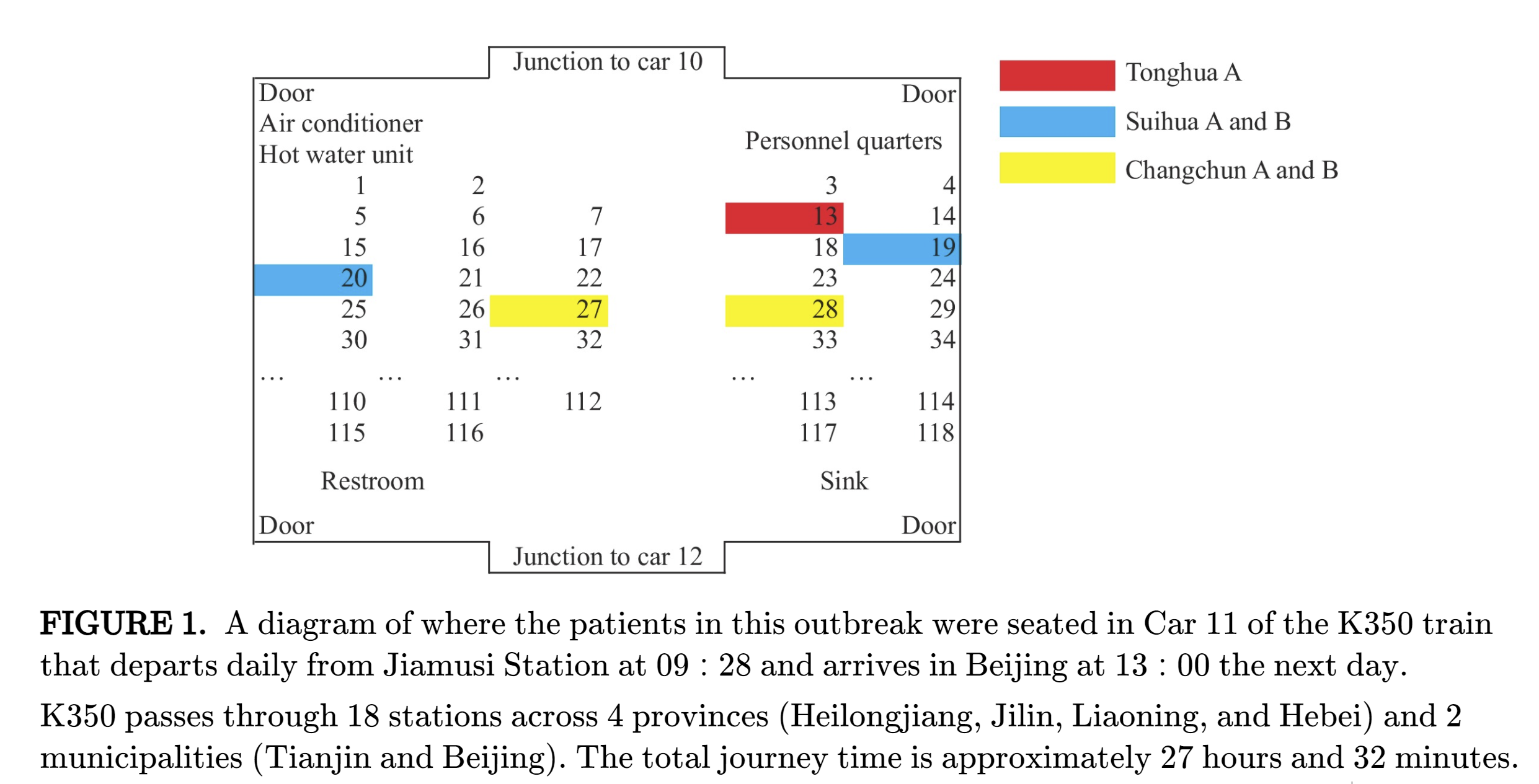
Seat map of 5 infected persons in 11 carriages of K350 train. Picture from the paper
According to the information attached to the article, on the K350 train, the five infected persons were sitting in the same carriage in 11 carriages and were relatively close. The seat next to L is Suihua A. The seats for 5 people are not directly adjacent, but the number of rows is four rows.
Suihua A and B board the K350 from Suihua Station at about 14:30, and get off at Changchun Station at 20:00. L get on K350 from Heilongjiang Nancha Station at about 11:20, and get off at Harbin West Station at 16:30. There are also two infected persons who boarded K350 from Harbin West Station in Heilongjiang Province at about 16:30 and got off at Changchun Station at 20:00. The three people have overlapped time in the carriage.
The author believes that Suihua A and B may have been infected during previous visits to relatives in Suihua. According to the official information notified by Jilin Province, the two were defined as "imported from Wangkui County, Suihua City, Heilongjiang Province."
The two arrived in Suihua on December 29, 2020, and attended a banquet of about 20 people, including an index patient in Wangkui County (index patient, referring to an outbreak that met the case definition and was the first to be discovered and reported) Case)'s father. The next day, they attended a wedding of about 190 people and ate with their younger brother and younger sister at Suihua A’s uncle’s house. The younger brother and sister were diagnosed on January 12 and January 11, 2021, respectively. They were both Qiqihar and Yi Index case in Spring City. On January 3, Suihua A and B developed dizziness and drowsiness. They drank a cup of ginger tea but did not seek medical attention. The symptoms subsided on January 10.
Researchers analyzed that although the K350 train is equipped with air conditioning, the cold in winter may cause poor ventilation. When the source of infection is close, prolonged exposure may occur.
As of January 13, there were 10 cases of K350-related infections in Jilin Province.
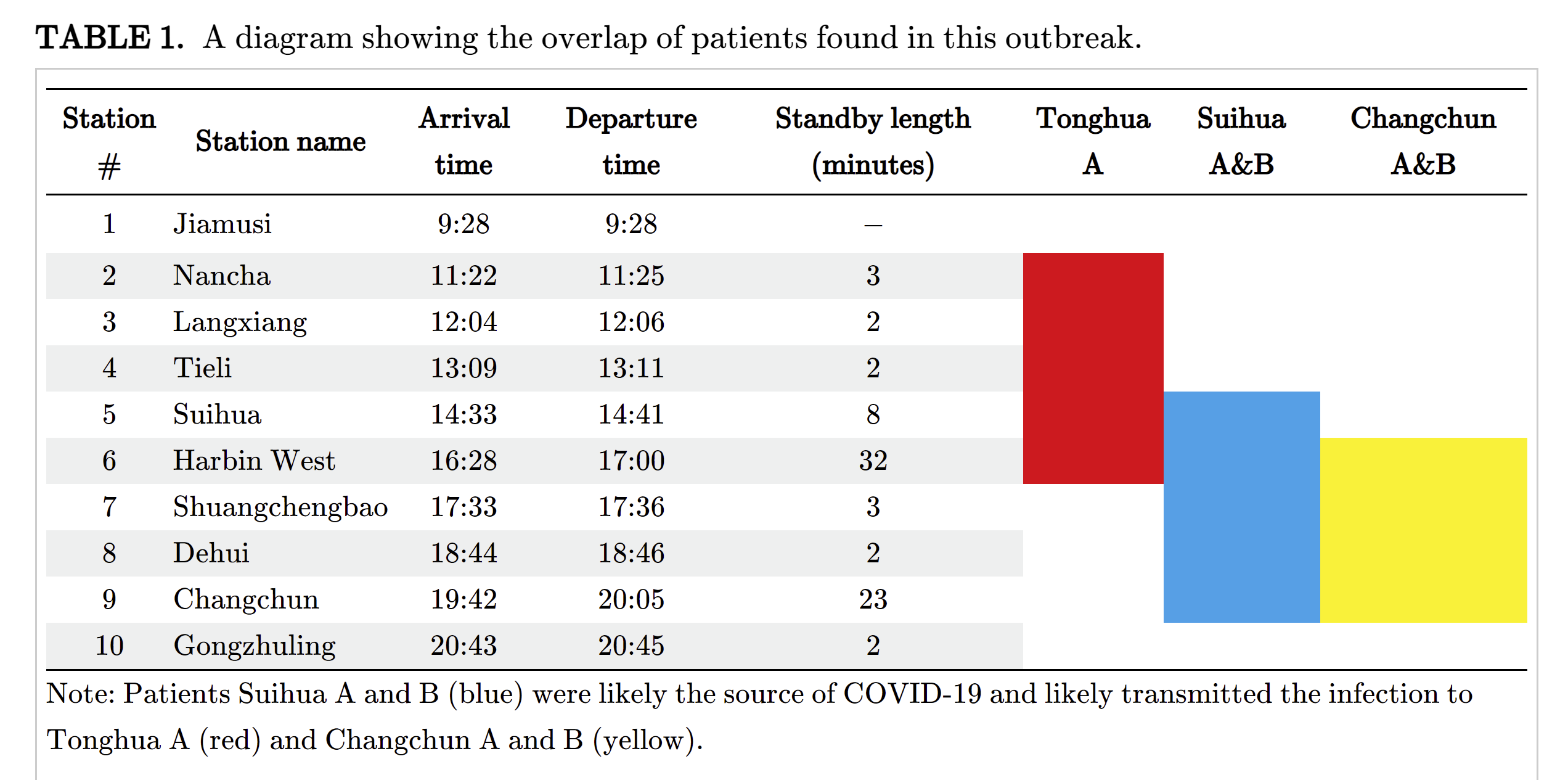
Timetable for 5 passengers on the K350 train. Picture from the paper
Tonghua epidemic is directly related to L
So, what is the relationship between L and the Tonghua epidemic?
The article pointed out that the epidemic situation in Tonghua City was detected early and developed rapidly. The epidemic situation is directly related to L, and there is an obvious intergenerational transmission relationship.
On January 10, the Jilin Provincial Center for Disease Control and Prevention performed genetic sequencing on the first batch of viruses isolated from swab samples of imported cases in Wangkui, and submitted the data to the China Center for Disease Control and Prevention. On January 16, the Jilin Provincial Center for Disease Control and Prevention provided the China Centers for Disease Control and Prevention with a second batch of 11 samples (including L samples) for gene sequencing analysis. The sequences of the two batches are highly homologous and belong to the same delivery chain.
Since the participants in the training are all elderly people, the proportion of severe and critical cases in this outbreak is high. In the entire Tonghua epidemic, most of the cases are also retired elderly people. As of the end of January, a total of 47 severe and critical cases have been reported, accounting for 15.2% of the total number of cases, of which one 87-year-old man died on January 25.
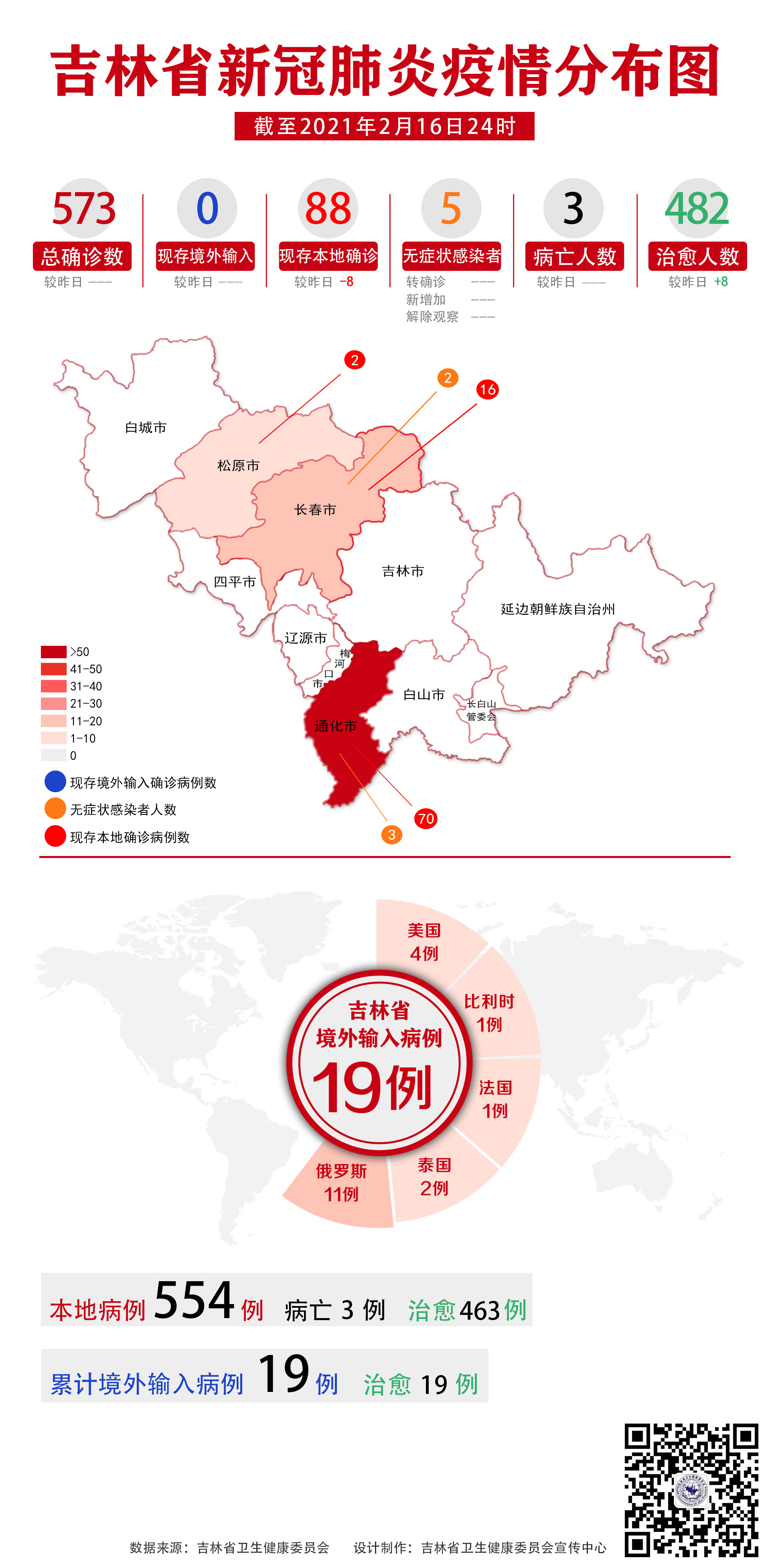
As of yesterday, the distribution map of Jilin's epidemic situation shows that there are 73 infected people in Tonghua City. Photo/Jilin Provincial Health Commission
Focus: How to promote this super spread?
Feng Zijian, deputy director of CDC, once analyzed the super-spreaders. Super spreader means that the number of second-generation patients caused by an infected person significantly exceeds the basic number of transmissions. In the new crown epidemic, the phenomenon of super spread is more prominent. According to international professional indicators, 10% of new crown infected persons may act as super spread The role of the person. In the process of the outbreak, super spreaders cannot be identified in advance, and can only analyze the environment of the prone places after the fact and take more prevention and control measures.
The article points out that there are three main contributing factors to the Tonghua epidemic. First of all, L’s training time may coincide with the most infectious time. On January 10, he went to the pharmacy to buy medicine due to muscle pain. This shows that he may be in the early stage of the disease at that time, which is considered to be the most infectious. Secondly, many elderly people participated in the training, the median age is 72 years old, and the training duration is long, and the venue is small; in addition, when 30 people are crowded in a 30 square meter space, L and many participants also Did not wear a mask.
The article also analyzes that in winter, retirees living in the north have a relatively fixed and routine life. Participating in training is an attractive activity. Therefore, the virus can easily spread widely. Local governments should strengthen infection control, reduce unnecessary large-scale indoor gatherings in winter, strengthen health education for the elderly, and effectively carry out personal protection.
https://www.bjnews.com.cn/detail/161356086715631.html
2021-02-17 19:28 Reporter: Dai Xuan Editor: Bai Shuang
The article pointed out that the epidemic situation in Tonghua City was detected early and developed rapidly. The epidemic situation is directly related to L, and there is an obvious intergenerational transmission relationship.
Beijing News (Reporter Dai Xuan) Recently, CDC disclosed the spread of the new crown epidemic in Heilongjiang and Jilin. In January this year, there was a super-spreading incident in Tonghua, Jilin. An infected person held 3 trainings within 2 days, during which 81 people were infected. The research team analyzed that the Tonghua epidemic was directly related to the infected person. The infected person was judged to be a close contact. When he was on the K350 train, he was in the same compartment as the first two cases of asymptomatic infection in Changchun. The two had visited relatives in Wangkui.
3 training sessions were held in 2 days, 74 participants were infected
Recently, China CDC published an article titled "Epidemic Report: Super Transmission Incident of New Crown among the Elderly-Jilin" in its weekly newspaper, revealing the secret of the "1 Chuan 81" super transmission incident in Tonghua, Jilin.
As of January 31, 2021, Tonghua City has reported 310 cases, all from Dongchang District, 140 cases are related to the same case, and an infected person code-named L is defined as a super spreader.
According to the report, L is a male, 44 years old, a product promotion lecturer. He travels frequently. He has taken trains such as Z174, K1383, and K350. He arrived in Tonghua on January 9 and conducted three training activities in the following two days.
The reporter retrieved the official epidemic information released by Jilin Province. An infected person was consistent with the above information. The man was a native of Hulan District, Harbin City, Heilongjiang Province. He was an individual marketing staff. Harbin West Railway Station, Heilongjiang Shuangcheng Castle, Changchun Railway Station, Huanghe Road Passenger Transport Station, and Fanjiatun Town, Gongzhuling City, etc., were trained and taught in Yuansheng Quality Life Workshop from January 10 to 11. Reported as an asymptomatic infection on January 12.
L's 3 training lectures in Tonghua City were held at the same location. A total of 97 people attended. Most of the participants have retired. The median age is 72 (60-87). As of January 31, 74 participants (76%) tested positive for the new coronavirus nucleic acid, and the incidence rates of the three lectures were 90% (36/40), 90% (28/31) and 38% (10/26). ).
The classroom where L is training is about 30 square meters, with doors and windows closed; each training lasts about 2.5 hours. In the three training sessions, L did not wear a mask.
In addition to the training, L also infected at least 7 contacts, including 5 employees at the training place, restaurant employees where L had eaten, and guests near L’s hotel room. As of January 31, L has directly infected 81 close contacts (first-generation cases).
These infected close contacts continued to cause the virus to spread during eating, participating in other lectures, shopping, playing mahjong and other activities. More than 30 people were infected during this period and continued to spread. According to the article, in Tonghua Dongchang, L indirectly infected at least 60 close contacts (second and third generation cases).
How is L infected? Once on train K350, imported cases from Heilongjiang appeared in the same carriage
So, where was L infected?
According to the official report, L was judged to be a close contact before he was positive. Related information is mentioned in another article published by China Disease Control, "Epidemic Report: New Crown Transmission on K350 Trains-Jilin and Heilongjiang".
On January 10, 2021, the first asymptomatic infection was found in Changchun City, Jilin Province. It was a couple (Suihua A, male, 58 years old; Suihua B, female, 57 years old) who set off from Suihua on January 5. Covid-19 was found to be positive during active testing. They took the K350 train from Suihua to Changchun on January 5th. Subsequently, the disease control department launched an epidemiological investigation on the close contacts of the K350 train and other passengers.
In the relevant screening on January 12, it was found that 3 passengers were asymptomatic infected. One of them was a 44-year-old male who lived in Tonghua City and was in Tonghua from January 10 to 11, 2021. The city organized vocational training, and 4 trainees were quickly confirmed to be infected. The information was consistent with L and the official information on infected persons released by Jilin.
Seat map of 5 infected persons in 11 carriages of K350 train. Picture from the paper
According to the information attached to the article, on the K350 train, the five infected persons were sitting in the same carriage in 11 carriages and were relatively close. The seat next to L is Suihua A. The seats for 5 people are not directly adjacent, but the number of rows is four rows.
Suihua A and B board the K350 from Suihua Station at about 14:30, and get off at Changchun Station at 20:00. L get on K350 from Heilongjiang Nancha Station at about 11:20, and get off at Harbin West Station at 16:30. There are also two infected persons who boarded K350 from Harbin West Station in Heilongjiang Province at about 16:30 and got off at Changchun Station at 20:00. The three people have overlapped time in the carriage.
The author believes that Suihua A and B may have been infected during previous visits to relatives in Suihua. According to the official information notified by Jilin Province, the two were defined as "imported from Wangkui County, Suihua City, Heilongjiang Province."
The two arrived in Suihua on December 29, 2020, and attended a banquet of about 20 people, including an index patient in Wangkui County (index patient, referring to an outbreak that met the case definition and was the first to be discovered and reported) Case)'s father. The next day, they attended a wedding of about 190 people and ate with their younger brother and younger sister at Suihua A’s uncle’s house. The younger brother and sister were diagnosed on January 12 and January 11, 2021, respectively. They were both Qiqihar and Yi Index case in Spring City. On January 3, Suihua A and B developed dizziness and drowsiness. They drank a cup of ginger tea but did not seek medical attention. The symptoms subsided on January 10.
Researchers analyzed that although the K350 train is equipped with air conditioning, the cold in winter may cause poor ventilation. When the source of infection is close, prolonged exposure may occur.
As of January 13, there were 10 cases of K350-related infections in Jilin Province.
Timetable for 5 passengers on the K350 train. Picture from the paper
Tonghua epidemic is directly related to L
So, what is the relationship between L and the Tonghua epidemic?
The article pointed out that the epidemic situation in Tonghua City was detected early and developed rapidly. The epidemic situation is directly related to L, and there is an obvious intergenerational transmission relationship.
On January 10, the Jilin Provincial Center for Disease Control and Prevention performed genetic sequencing on the first batch of viruses isolated from swab samples of imported cases in Wangkui, and submitted the data to the China Center for Disease Control and Prevention. On January 16, the Jilin Provincial Center for Disease Control and Prevention provided the China Centers for Disease Control and Prevention with a second batch of 11 samples (including L samples) for gene sequencing analysis. The sequences of the two batches are highly homologous and belong to the same delivery chain.
Since the participants in the training are all elderly people, the proportion of severe and critical cases in this outbreak is high. In the entire Tonghua epidemic, most of the cases are also retired elderly people. As of the end of January, a total of 47 severe and critical cases have been reported, accounting for 15.2% of the total number of cases, of which one 87-year-old man died on January 25.
As of yesterday, the distribution map of Jilin's epidemic situation shows that there are 73 infected people in Tonghua City. Photo/Jilin Provincial Health Commission
Focus: How to promote this super spread?
Feng Zijian, deputy director of CDC, once analyzed the super-spreaders. Super spreader means that the number of second-generation patients caused by an infected person significantly exceeds the basic number of transmissions. In the new crown epidemic, the phenomenon of super spread is more prominent. According to international professional indicators, 10% of new crown infected persons may act as super spread The role of the person. In the process of the outbreak, super spreaders cannot be identified in advance, and can only analyze the environment of the prone places after the fact and take more prevention and control measures.
The article points out that there are three main contributing factors to the Tonghua epidemic. First of all, L’s training time may coincide with the most infectious time. On January 10, he went to the pharmacy to buy medicine due to muscle pain. This shows that he may be in the early stage of the disease at that time, which is considered to be the most infectious. Secondly, many elderly people participated in the training, the median age is 72 years old, and the training duration is long, and the venue is small; in addition, when 30 people are crowded in a 30 square meter space, L and many participants also Did not wear a mask.
The article also analyzes that in winter, retirees living in the north have a relatively fixed and routine life. Participating in training is an attractive activity. Therefore, the virus can easily spread widely. Local governments should strengthen infection control, reduce unnecessary large-scale indoor gatherings in winter, strengthen health education for the elderly, and effectively carry out personal protection.
https://www.bjnews.com.cn/detail/161356086715631.html