
• FluTrackers.com Inc. does not provide medical advice. Information on this web site is collected from various internet resources, and the FluTrackers board of directors makes no warranty to the safety, efficacy, correctness or completeness of the information posted on this site by any author or poster. The information collated here is for instructional and/or discussion purposes only and is NOT intended to diagnose or treat any disease, illness, or other medical condition. Every individual reader or poster should seek advice from their personal physician/healthcare practitioner before considering or using any interventions that are discussed on this website. By continuing to access this website you agree to consult your personal physican before using any interventions posted on this website, and you agree to hold harmless FluTrackers.com Inc., the board of directors, the members, and all authors and posters for any effects from use of any medication, supplement, vitamin or other substance, device, intervention, etc. mentioned in posts on this website, or other internet venues referenced in posts on this website.
  • We are not asking for any donations. Do not donate to any entity who says they are raising funds for us.

Chart - WHO Disease Outbreak Reports - H5N1

Laidback Al

Well-known member
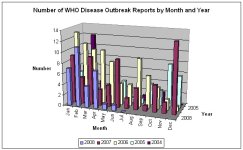
Since 2004, WHO has posted online about 247 Disease Outbreak Reports on human cases with H5N1. The graph below shows the distribution of the number of these reports by month and by year. The years are in ascending order from back to front with 2004 in the rear to 2008 in the front.

Of significance in this graph is that, on average between 2004 and 2007, WHO has 3.5 H5N1 reports in the month of May, 4.25 in the month of June, and 1.75 in the month of July. In 2008, WHO has only had 1 report in May, 1 report in June and, so far in July, no reports, even though at least one individual in Indonesia has been reported in the news media as positive for H5N1. H5N1 is a reportable disease according to IHR.

Because we have no reason to believe that H5N1 has attenuated in its ability to infect humans, there must be some other non-virological reason why human H5N1 cases are not being reported by WHO.
WHO Disease Outbreak Graph 20080729.jpg
 
Re: Chart - WHO Disease Outbreak Reports - H5N1

I presume this is your plot, Al. If you replot the data so that the 'year' begins in August, the bimodal pattern that emerges makes sense.
 
Re: Chart - WHO Disease Outbreak Reports - H5N1

I assume we're talking about written outbreak reports, detailing who, what ,where, etc - not just tallies of cases.

If so, I don't understand why the timing and frequency of WHO outbreak reporting is important. What does this graph tell us?

We often see CDC outbreak reports months, if not years, after the event, despite the fact that the disease is "reportable".

Normal administrative matters greatly affect newsletters, website updates, and other communication methods. Key people take holidays, get sick, get project re-direction, must be trained. WHO is not a media service, after all.

How is the date of the report relevant when describing the epidemiology of the disease? Isn't the date of the infection the most important for describing the outbreak and especially for contact tracing?

J.
 
Re: Chart - WHO Disease Outbreak Reports - H5N1

The WHO is a media service.
It is meant to be the collator - and publisher - of the worlds health data and IHR(2005) signatories are obliged to report under agreed circumstances. They - the nation state signatories - all signed up but refused to accept any form of sanction should they not honour this gentlemans agreement. As nation states seldom behave like gentlemen they are predictably honouring the bits they feel like and ignoring the rest. As they were careful not to write in any form of sanction the DG of the WHO is left with the options of 'name and shame' which will probably cause less disclosure or just keep asking nicely and continue to be ignored.
 
Re: Chart - WHO Disease Outbreak Reports - H5N1

Sorry, I would still disagree that WHO is a media service.

It is a public health bureacracy operating at the global level. Communications is one department/function of the organization, but it's not the primary purpose, like BBC, Asociation Press, etc. Depeninding on the relative urgency of the issue, and the social marketing / health promotion issues involved, timely communications may be necessary. On the other hand, as an epidemiology organization, input information must always be received in a timely way - but that is still not a media service, which implies a primary function immediately publicizing received information.

If the graph under discussion seeks to proxy the timeliness of input information to WHO, then it's informative. But I'd hope there might be some other info about the difference between incidence and reporting to WHO by country.

Now, is FT a media service or another public health organization operating at the global level?

_______________
http://www.who.int/employment/strategic/en/index.html

Who are we & what do we do?
WHO Strategic Directions
The Corporate Strategy focuses WHO?s work on four interrelated strategic directions.

Strategic Direction 1: reducing excess mortality, morbidity and disability.
Strategic Direction 2: promoting healthy lifestyles and reducing risk factors to human health.
Strategic Direction 3: developing health systems that equitably improve health outcomes, respond to people?s legitimate demands, and are financially fair.
Strategic Direction 4: framing an enabling policy and creating an institutional environment for the health sector, and promoting an effective health dimension to social, economic, environmental and development policy.
WHO Core Functions
In carrying out its activities WHO focuses on the following six core functions:

Articulating consistent, ethical and evidence-based policy and advocacy positions;
Managing information by assessing trends and comparing performance; setting the agenda for, and stimulating, researchs and development;
Catalysing change through technical and policy support, in ways that stimulate cooperation and action and help to build sustainable national and intercountry capacity;
Negotiating and sustaning national and global partnerships;
Setting, validating, monitoring and pursuing the proper implementation of norms and standards;
Stimulating the development and testing of new technologies, tools and guidelines.

{emphasis added re: communication items]
 
Re: Chart - WHO Disease Outbreak Reports - H5N1

I agree it is certainly not its core function and it is not like AP or the BBC. It should not be out looking for stories but it should be collating, analysing and publishing data forwarded to it by its members. My beef is not with the WHO but with the states that left it unable to do its job. It has a mandate and terms of reference and it is these that are wrong. The IHR is a promise that is being broken and the WHO is powerless to enforce it,
 
Re: Chart - WHO Disease Outbreak Reports - H5N1

My beef is not with the WHO but with the states that left it unable to do its job.

I agree. Compiling global epi information is critical, and states must cooperate for the well being of everyone.

But is the graph the best evidence of this failure by the states? I don't think so.

Perhaps WHO should be publishing reports about compliance, wait times or variances of critical information by state.

Or entities that are "Friends of WHO" should be analysing and creating such a reports, if possible.

J.
 
Last edited by a moderator:
Re: Chart - WHO Disease Outbreak Reports - H5N1

I posted the graph to spur discussion about the issues of transparency and notification. WHO Disease Outbreak News and the Situation Updates are clearly considered by governments and multinational corporations as the final official word on the status of H5N1 human infections and, correspondingly, they are a proxy measure of the threat of a pandemic.

It is only because of the news analysts here at FluTrackers, and other flu sites, that we are aware of the fact that some nations are not complying with IHRs about reporting H5N1.

While WHO may be powerless to enforce timely reporting compliance, it could at least make a public statement to that effect. WHO could also point out that the threat of a pandemic has not subsided simply because we have had only a few officially reported human H5N1 cases over the past several months.
 
Back
Top