

gsgs
Registered User
http://quizlet.com/15669054/virology-bms2012-flash-cards/
Negative-Strand RNA-unsegmented-enveloped-replicate in cytoplasm-long filamentous morphology, Filovirus
ss-RNA , What kind of genome does Ebola have?
1967 , When was Marburg virus found?
1976 , When was Ebola found?
-zaire-sudan-cote d'ivoire-reston[-bundibugyo] , What are the four [five] types of Ebola?
50-90% , Ebola mortality:
-incubation of 3-16 days-non-specific flu like-diarrhoea&vomiting-macropapular rash (50%,day7)
-Severe bleeding-major organ failure (1-2 weeks) , Ebola symptoms:
Heammoragic fever , Ebola causes:
-fluid replacement-serum injection-barrier nursing , Ebola treatment:
enveloped , Ebola is enveloped or non-enveloped?
helical , Ebola nucleocapsid
-L protein-NP-VP30-VP35 , What is associated with Ebola genome?
Receptor mediated endocytosis , Ebola enters the cell by?
-budding -VP24, VP40 and matrix protein binding Ebola exits the cell by_, using_
-VP40 and GPs , Ebola virus like particles contain:
-Vesicular stomatitis virus -Ebola Gp-GFP labeled G protein , Ebola pseudo-type viruses are made with:
pantropic , Filoviruses are:
macrophages, monocytes &dendritic cells (later endothelial cells) , Ebola initially infects
TNF alpha, IFN gamma , Cytokines released in ebola
IFN alpha, IFN beta , cytokines not released in ebola
Inappropriate coagulation , What type of coagulopathies occur in Ebola
-CD8 Tcells-high T cell count-10^7 genome per ml serum-detectable abs-low NO , A good response to Ebola
-low CD8 Tcells-low T cells-10^10 genome per ml serum-high NO , A bad response to Ebola
-------------------------------------------------------------------
several groups have confirmed that Axl/Gas6, as well as other phosphatidylserine receptors,
facilitate entry of dengue, West Nile, and Ebola viruses.
Virus binding by viral envelope phosphatidylserine
http://www.ncbi.nlm.nih.gov/pubmed/24478428
-----------------------------------------------------------------------------
Recombinant lentogenic Newcastle disease virus expressing Ebola virus GP infects cells
independently of exogenous trypsin and uses macropinocytosis as the major pathway for cell entry.
-------------------------------------------------------------------------
Lectin-dependent enhancement of Ebola virus infection via soluble and transmembrane
C-type lectin receptors. [gof ?]
-----------------------------------------------------------------------
A mutation in the Ebola virus envelope glycoprotein restricts viral entry in a host species-
and cell-type-specific manner.
---------------------------------------------------------------------
Ebola virus enters host cells by macropinocytosis and clathrin-mediated endocytosis.
----------------------------------------------------------------------
The Ebola virus glycoprotein mediates entry via a non-classical dynamin-dependent
macropinocytic pathway.
----------------------------------------------------------------------
Zaire Ebola virus (EBOV) is a zoonotic pathogen that causes severe hemorrhagic fever in humans.
A single viral glycoprotein (GP) mediates viral attachment and entry.
GP mutant, GP-F88A, which is defective for entry into a variety of human cell types, including
antigen-presenting cells (APCs), such as macrophages and dendritic cells, can mediate viral
entry into mouse CD11b(+) APCs. Like that of wild-type GP (GP-wt), GP-F88A-mediated entry occurs via a
macropinocytosis-related pathway and requires endosomal cysteine proteases and an intact
fusion peptide. Several additional hydrophobic residues lie in close proximity to GP-F88,
including L111, I113, L122, and F225. GP mutants in which these residues are mutated
to alanine displayed preferential and often impaired entry into several cell types, although
not in a species-specific manner.
===========================================
https://en.wikipedia.org/wiki/Pinocytosis
https://en.wikipedia.org/wiki/Macropinosome
https://www.ncbi.nlm.nih.gov/pmc/articles/PMC2940741/
https://en.wikipedia.org/wiki/Endocytosis
[macro-]pinocytosis : no receptors involved
[clathryn mediated] endocytosis : receptors (flu-HAs alpha 2-3,alpha 2-6 and such)
we have A82V in the glycoprotein as compared to previous outbreaks
http://virologytidbits.blogspot.de/2014/08/ebola-role-of-glycoprotein-in-viral.html
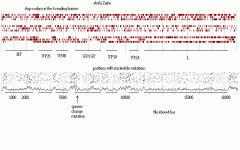
[Attached Images ebow1.GIF (4.8 KB, 2 views) --> replaced with ebow4.gif, see below]
Negative-Strand RNA-unsegmented-enveloped-replicate in cytoplasm-long filamentous morphology, Filovirus
ss-RNA , What kind of genome does Ebola have?
1967 , When was Marburg virus found?
1976 , When was Ebola found?
-zaire-sudan-cote d'ivoire-reston[-bundibugyo] , What are the four [five] types of Ebola?
50-90% , Ebola mortality:
-incubation of 3-16 days-non-specific flu like-diarrhoea&vomiting-macropapular rash (50%,day7)
-Severe bleeding-major organ failure (1-2 weeks) , Ebola symptoms:
Heammoragic fever , Ebola causes:
-fluid replacement-serum injection-barrier nursing , Ebola treatment:
enveloped , Ebola is enveloped or non-enveloped?
helical , Ebola nucleocapsid
-L protein-NP-VP30-VP35 , What is associated with Ebola genome?
Receptor mediated endocytosis , Ebola enters the cell by?
-budding -VP24, VP40 and matrix protein binding Ebola exits the cell by_, using_
-VP40 and GPs , Ebola virus like particles contain:
-Vesicular stomatitis virus -Ebola Gp-GFP labeled G protein , Ebola pseudo-type viruses are made with:
pantropic , Filoviruses are:
macrophages, monocytes &dendritic cells (later endothelial cells) , Ebola initially infects
TNF alpha, IFN gamma , Cytokines released in ebola
IFN alpha, IFN beta , cytokines not released in ebola
Inappropriate coagulation , What type of coagulopathies occur in Ebola
-CD8 Tcells-high T cell count-10^7 genome per ml serum-detectable abs-low NO , A good response to Ebola
-low CD8 Tcells-low T cells-10^10 genome per ml serum-high NO , A bad response to Ebola
-------------------------------------------------------------------
several groups have confirmed that Axl/Gas6, as well as other phosphatidylserine receptors,
facilitate entry of dengue, West Nile, and Ebola viruses.
Virus binding by viral envelope phosphatidylserine
http://www.ncbi.nlm.nih.gov/pubmed/24478428
-----------------------------------------------------------------------------
Recombinant lentogenic Newcastle disease virus expressing Ebola virus GP infects cells
independently of exogenous trypsin and uses macropinocytosis as the major pathway for cell entry.
-------------------------------------------------------------------------
Lectin-dependent enhancement of Ebola virus infection via soluble and transmembrane
C-type lectin receptors. [gof ?]
-----------------------------------------------------------------------
A mutation in the Ebola virus envelope glycoprotein restricts viral entry in a host species-
and cell-type-specific manner.
---------------------------------------------------------------------
Ebola virus enters host cells by macropinocytosis and clathrin-mediated endocytosis.
----------------------------------------------------------------------
The Ebola virus glycoprotein mediates entry via a non-classical dynamin-dependent
macropinocytic pathway.
----------------------------------------------------------------------
Zaire Ebola virus (EBOV) is a zoonotic pathogen that causes severe hemorrhagic fever in humans.
A single viral glycoprotein (GP) mediates viral attachment and entry.
GP mutant, GP-F88A, which is defective for entry into a variety of human cell types, including
antigen-presenting cells (APCs), such as macrophages and dendritic cells, can mediate viral
entry into mouse CD11b(+) APCs. Like that of wild-type GP (GP-wt), GP-F88A-mediated entry occurs via a
macropinocytosis-related pathway and requires endosomal cysteine proteases and an intact
fusion peptide. Several additional hydrophobic residues lie in close proximity to GP-F88,
including L111, I113, L122, and F225. GP mutants in which these residues are mutated
to alanine displayed preferential and often impaired entry into several cell types, although
not in a species-specific manner.
===========================================
https://en.wikipedia.org/wiki/Pinocytosis
https://en.wikipedia.org/wiki/Macropinosome
https://www.ncbi.nlm.nih.gov/pmc/articles/PMC2940741/
https://en.wikipedia.org/wiki/Endocytosis
[macro-]pinocytosis : no receptors involved
[clathryn mediated] endocytosis : receptors (flu-HAs alpha 2-3,alpha 2-6 and such)
we have A82V in the glycoprotein as compared to previous outbreaks
Code:
   00000000000000000000000000000000000000000000000000000000000000000000
   00000022222222222333333333333333333333333333444444444444444444455556
   03446814668999999111111333344556677777788889011122334444555778902457
   37675296023156789045789136729596835678924898514729050136357453937426
   --------------------------------------------------------------------
   VVSDSVRSIATWKNLTRAGPNISENNEMASKTLTPQPPTTPTHIGADAPPLTSASLQYEASTTVITDF
>  .....A..RT........RA...G.T....E...LR..IP....ETAT....GTLP.H.....A.I..
>  .....A...T........RA...G.T....E...LR..IP....ETAT....GTLP.H.....A....
>  .....A...T........RA...G.T....E...L....P....ETAT....GTLP.H.....A....
>e .....A...T........RA...G.T....E...L....P....ETAT....GTLP.H.....A....
>  .....A...T........RA...G.T....E...L....P....ETAT....GTLP.H.....A....
>  .....AK..T........RA...G.T....E.P.L....P....ETAT....GTLP.H.T...A....
>  .....AK..T........RA...G.T....E.P.L....P....ETAT....GTLP.H.T...A....
>  .....AK..T........RA...G.T....E.P.L....P....ETAT....GTLP.H.T...A....
>  .....A...T........RA...G.T....E...L....P....ETAT....GTLP.H.....A....
>  .....A...T........RA...G.T....E........P....ET......GTLP.H....AA....
>  .....A...T........RA...G.T....E........P....ET......GTLP.H....AA....
>  .....A...T........RA...G.T....E........P....ET......GTLP.H....AA....
>  ...X.A...T........RA...G.T....E........P....ET......GTLP.H....AA....
>  ...E.A...T........RA...G.T....E........P....ET....P.GTLP.H....AA....
>  ..N..A...T.......V.A...G.T....E.....SL.P....ET..S.P..TFP.H.....A..N.
>  .....A...T.......V.A...G.T....E.....SL.P....ET..S.P..TFP.H.....A....
>  .....A...T.......V.A...G.T....E.....SL.P....ET..S.P..TFP.H.....A....
>  .....A...T.......V.A...G.T....E.....SL.P....ET..S.P..TFP.H.....A.I..
>  .....A...T.......V.A...G.T....E.....SL.P....ET..S.P..TFP.H.....A.I..
>  .....A...T.......V.A...G.T....E.....SL.P....ET..S.P..TFP.H.....A.I..
>  .....A...T.......V.A...G.T....E.....SL.P....ET..S.P..TFP.H.....A.I..
>  .....A...T.......V.A...G.T....E.....SL.P....ET..S.P..TFP.H.....A.I..
>  .....A...T.......V.A...G.T....E.....SL.P....ET..S.P..TFP.H.....A.I..
>  .....A...T.......V.A...G.T....E.....SL.P....ET..S.P..TFP.H.....A.I..
>  .....A...T.......V.A...G.T....E.....SL.P....ET..S.P..TFP.H.....A....
>  ....PA.P.T.......V.A...G.T....E.....SL.P....ET..S.P..TFP.H.....A....
>  .....A.............A.L.K.T.V..E........P..YTET...HP....PPH.....A....
>  .....A.............A.L.K.T.V..E........P..YTET...HP....PPH.....A....
>  .....A.............A.L.K.T.V..E........P..YTET...HP....PPH.....A....
>  .....A.............A.L.K.T.V..E........P..YTET...HP....PPH.....A....
>  .....A.............A.L.K.T.V..E........P..YTET...HP....PPH.....A....
>  .....A.............A.L.K.T.V..E........P..YTET...HP....PPH.....A....
>  .....A.............A.L.K.T.V..E........P..YTET...HP....PPH.....A....
>  .....A.............A.L.K.T.V..E........P..YTET...HP....PPH.....A....
>  .....A.............A.L.K.T.V..E........P..YTET...HP....PPH.....A....

>  .....A..............................................................
>  ....................................................................
...
>  ....................................................................
>  .....A..............................................................
>  .....A.....R........................................................

>  I....A.............AD...YT...NEI....S..PQ...ET....PI...P....GA.A....
>  I....A.......TSLG..AD...YT...NEI....S..PQ...ET....PI...P..X.GA.A....
>  II...A......NTSLG..AD...YSG..NEIF...S..PQ...ET....PI...P....GA.A....
>  II...A.......TSLG..AD...YTG..NEIF...S..PQRA.ET....PI...P....G..A....
>  I....A....A..TSLG..AD...YT...NEI....S..PQ...ET....PI...P....G..A....
>  I....A.......TSLG..AD...YT..TNEI.A..S..PQ...ET....PI...P....G..AT...
>  I....A.......TSLG..AD.G.YT..TNEI....S..PQ...ET....PI...P....G..A...L
>  ....................................................................
   00000000000000000000000000000000000000000000000000000000000000000000
   00000022222222222333333333333333333333333333444444444444444444455556
   03446814668999999111111333344556677777788889011122334444555778902457
   37675296023156789045789136729596835678924898514729050136357453937426
   --------------------------------------------------------------------
   VVSDSVRSIATWKNLTRAGPNISENNEMASKTLTPQPPTTPTHIGADAPPLTSASLQYEASTTVITDF
http://virologytidbits.blogspot.de/2014/08/ebola-role-of-glycoprotein-in-viral.html
[Attached Images ebow1.GIF (4.8 KB, 2 views) --> replaced with ebow4.gif, see below]
Attachments
Last edited:


