

Michael Coston
Editor, Senior Moderator
CDC Update On Candida Auris - March 2017
#12,350
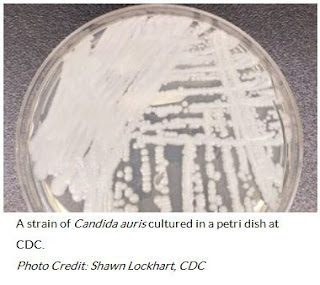
Last summer the CDC issued a Clinical Alert to U.S. Healthcare facilities about the Global Emergence of Invasive Infections Caused by the Multidrug-Resistant Yeast Candida auris.
While still rare, we've seen an increasing number of cases (and hospital clusters) reported internationally, generally involving bloodstream infections, wound infections or otitis.
In the eight months since that report the CDC has recorded an additional 46 cases - mostly from New York State - and all in patients with underlying medical problems staying in health care facilities.
What's New?
Candida auris is an emerging fungus that presents a serious global health threat. Healthcare facilities in several countries have reported that C. auris has caused severe illness in hospitalized patients. Some strains of Candida auris are resistant to all three major classes of antifungal drugs. This type of multidrug resistance has not been seen before in other species of Candida. Also of concern, C. auris can persist on surfaces in healthcare environments and spread between patients in healthcare facilities, unlike most other Candida species. CDC has
developed Interim Recommendations to help prevent the spread of C. auris.
C. auris is difficult to identify with standard laboratory methods and can be misidentified in labs without specific technology. CDC encourages all U.S. laboratory staff who identify C. auris strains to notify their state or local public health authorities and CDC at candidaauris@cdc.gov.
Find answers to frequently asked questions about C. auris on our questions and answers pageand in the Candida auris: Interim Recommendations.
CDC is working with state and local health departments to identify and investigate cases of C. auris. The following map displays where C. auris cases have been identified in the United States as of March 16, 2017. This map will be updated monthly. 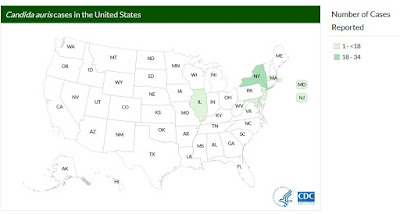
For a bit more on this emerging health threat, you may wish to revisit mSphere: Comparative Pathogenicity of UK Isolates of the Emerging Candida auris.
http://afludiary.blogspot.com/2017/03/cdc-update-on-candida-auris-march-2017.html

#12,350
Last summer the CDC issued a Clinical Alert to U.S. Healthcare facilities about the Global Emergence of Invasive Infections Caused by the Multidrug-Resistant Yeast Candida auris.
C. auris - an emerging fungal pathogen - was first isolated about 8 years ago in Japan, found in the discharge from the patient's external ear (hence the name `auris') - although retrospective analysis has traced this fungal infection back over 20 years.
A week later we saw a release from the UK's PHE On The Emergence Of Candida auris In The UK,where they detailed a large (and ongoing since April 2015) nosocomial outbreak at an adult critical care unit in England.While still rare, we've seen an increasing number of cases (and hospital clusters) reported internationally, generally involving bloodstream infections, wound infections or otitis.
Unlike most systemic Candida infections, which usually arise when a previously colonized person is weakened from illness or infirmity, this strain appears to have a propensity for nosocomial transmission.
When you add in that: - C. auris infections have a high fatality rate
- The strain appears to be resistant to multiple classes of anti-fungals
- And it can be difficult for labs to differentiate between Candida strains
In the eight months since that report the CDC has recorded an additional 46 cases - mostly from New York State - and all in patients with underlying medical problems staying in health care facilities.
While this jump may indicate increased incidence of the infection, it may also be the product of improved surveillance and reporting.
The CDC update for March Follows: What's New?
- March 16, 2017: case count update
- March 16, 2017: Updated recommendation for when C. auris should be suspected
Candida auris is an emerging fungus that presents a serious global health threat. Healthcare facilities in several countries have reported that C. auris has caused severe illness in hospitalized patients. Some strains of Candida auris are resistant to all three major classes of antifungal drugs. This type of multidrug resistance has not been seen before in other species of Candida.
developed Interim Recommendations to help prevent the spread of C. auris.
C. auris is difficult to identify with standard laboratory methods and can be misidentified in labs without specific technology. CDC encourages all U.S. laboratory staff who identify C. auris strains to notify their state or local public health authorities and CDC at candidaauris@cdc.gov.
Find answers to frequently asked questions about C. auris on our questions and answers pageand in the Candida auris: Interim Recommendations.
CDC is working with state and local health departments to identify and investigate cases of C. auris. The following map displays where C. auris cases have been identified in the United States as of March 16, 2017. This map will be updated monthly.
For a bit more on this emerging health threat, you may wish to revisit mSphere: Comparative Pathogenicity of UK Isolates of the Emerging Candida auris.
http://afludiary.blogspot.com/2017/03/cdc-update-on-candida-auris-march-2017.html