

Pathfinder
Editor, Senior Moderator
Risk of Exposure
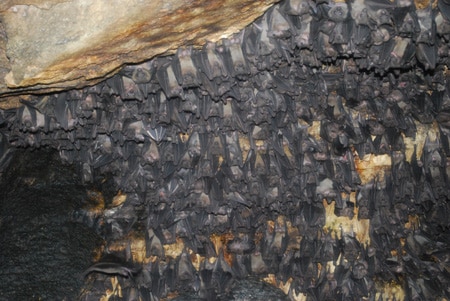
Egyptian rousette bats (Rousettus aegyptiacus)
People may be at risk of exposure to marburgviruses if they have contact with:
Exposure risk can be higher for those travelers visiting endemic regions in Africa who have contact with bats, especially Egyptian rousette bats, or enter caves or mines inhabited by bats.
Related Information
Last Reviewed: April 19, 2023
Source: Centers for Disease Control and Prevention, National Center for Emerging and Zoonotic Infectious Diseases (NCEZID), Division of High-Consequence Pathogens and Pathology (DHCPP), Viral Special Pathogens Branch (VSPB)
https://www.cdc.gov/vhf/marburg/exposure/index.html
Egyptian rousette bats (Rousettus aegyptiacus)
People may be at risk of exposure to marburgviruses if they have contact with:
- Egyptian rousette bats (Rousettus aegyptiacus – the reservoir host), or their urine and/or excretions;
- People sick with Marburg virus disease (MVD); or
- Non-human primates infected with a Marburgvirus
Exposure risk can be higher for those travelers visiting endemic regions in Africa who have contact with bats, especially Egyptian rousette bats, or enter caves or mines inhabited by bats.
Related Information
Last Reviewed: April 19, 2023
Source: Centers for Disease Control and Prevention, National Center for Emerging and Zoonotic Infectious Diseases (NCEZID), Division of High-Consequence Pathogens and Pathology (DHCPP), Viral Special Pathogens Branch (VSPB)
https://www.cdc.gov/vhf/marburg/exposure/index.html