• FluTrackers.com Inc. does not provide medical advice. Information on this web site is collected from various internet resources, and the FluTrackers board of directors makes no warranty to the safety, efficacy, correctness or completeness of the information posted on this site by any author or poster. The information collated here is for instructional and/or discussion purposes only and is NOT intended to diagnose or treat any disease, illness, or other medical condition. Every individual reader or poster should seek advice from their personal physician/healthcare practitioner before considering or using any interventions that are discussed on this website. By continuing to access this website you agree to consult your personal physican before using any interventions posted on this website, and you agree to hold harmless FluTrackers.com Inc., the board of directors, the members, and all authors and posters for any effects from use of any medication, supplement, vitamin or other substance, device, intervention, etc. mentioned in posts on this website, or other internet venues referenced in posts on this website.
  • We are not asking for any donations. Do not donate to any entity who says they are raising funds for us.

CDC - Laboratory Testing and Results from the Fungal Meningitis Outbreak; Updated as of March 11, 2013

Pathfinder

Editor, Senior Moderator
Hat tip Catbird


Laboratory Testing and Results from the Outbreak

October 31, 2012 6:00 PM EDT
CDC laboratory-confirmed results found on this page are from three New England Compounding Center (NECC) preservative-free methylprednisolone acetate (MPA) lots recalled on September 26, 2012.(1)
lab_testing_results_clip_image001.jpg

CDC scientist examines microscopic slides showing Exserohilum rostratum (on screen) during the multistate meningitis outbreak.


CDC's Fungus Reference Laboratory has the capacity and technology to examine fungal isolates under the microscope and to confirm their identification using DNA sequencing methods.
  • For the multistate outbreak, the fungus laboratory is working with the Clinical and Environmental Microbiology Branch, Division of Healthcare Quality Promotion, to detect and identify other microbial pathogens. In addition, the Infectious Diseases Pathology Branch, Division of High-Consequence Pathogens and Pathology, is examining tissues from biopsies and autopsy materials.
  • CDC and the states are testing tissue and fluid samples from patients with probable or confirmed fungal infection. CDC scientists are looking to see if the samples contain fungi and other microbial pathogens, and if so, what type.
  • In addition, FDA and CDC are testing vials of NECC preservative-free MPA to see if they contain fungi and other microbial pathogens and if so, what type.
CDC Laboratory Results

As of October 22, 2012, Exserohilum rostratum has been found in clinical specimens for all but two of the 54 patients with CDC laboratory-confirmed fungal meningitis who meet the confirmed case definition.(2)
Tests at CDC and FDA laboratories on the preservative-free MPA vials have confirmed the presence of the same fungus, Exserohilum rostratum, in unopened vials from two of the three recalled lots.(1) Testing on the third lot of preservative-free MPA is ongoing. These laboratory test results strengthen the link between preservative-free MPA vials and the outbreak.
The fungi found in both patients and in recalled vials are common in the environment but were not recognized as a cause of meningitis before this outbreak.

Exserohilum rostratum


Aspergillus fumigatus

<!--
Cladosporium</div></div></div>
<div align="center"><div align="center"><div align="center">-->
Cladosporium

Human Tissue and Fluid Samples

Date updated: October 22, 2012
<TABLE style="WIDTH: 460px" summary="This table displays CDC Laboratory-Confirmed Cases of Human Infection*2 Associated with Recalled Lots of Preservative-Free MPA."><CAPTION align=left>Table 1. CDC Laboratory-Confirmed Cases of Human Infection(4) </CAPTION><THEAD><TR><TH style="BACKGROUND-COLOR: rgb(153,204,153)" colSpan=3>CDC Laboratory-Confirmed Cases of Human Infection
Associated with Recalled Lots of Preservative-Free MPA


</TH></TR><TR><TH style="BACKGROUND-COLOR: rgb(255,255,255)" width=131 scope=col>Exserohilum
rostratum


</TH><TH style="BACKGROUND-COLOR: rgb(255,255,255)" width=157 scope=col>Aspergillus fumigatus (3)</TH><TH style="BACKGROUND-COLOR: rgb(255,255,255)" width=146 scope=col>Cladosporium</TH></TR></THEAD><TBODY><TR style="HEIGHT: 1.5em"><TD width=131 align=center>52</TD><TD width=157 align=center>1</TD><TD width=146 align=center>1</TD></TR></TBODY></TABLE>
These numbers do not reflect all cases of fungal meningitis or joint infections because laboratory methods used to detect fungus are not highly sensitive. Many patients with potential fungal infections will have a negative laboratory result (2, 4).


Product Samples: Three Lots of Preservative-Free MPA

Date updated: October 22, 2012


CDC and FDA laboratories are in close communication about identifying the organisms in unopened preservative-free MPA vials.
  • As of October 22, CDC laboratories have confirmed the presence of Exserohilum rostratum in lots #08102012@51 BUD 2/6/2013 and #06292012@26 BUD 12/26/2012. This fungus is the same genus and species as the one found in laboratory-confirmed cases of human infection.
  • CDC also identified non-human pathogens Rhodotorula laryngis and Rhizopus stolonifer in lot #08102012@51, BUD 2/6/2013; and Rhodotorula laryngis in lot #06292012@26, BUD 12/26/2012.
    • The fungi Rhodotorula laryngis and Rhizopus stolonifer are not known to cause disease in humans; they cannot grow at human body temperature.
<TABLE style="WIDTH: 605px" summary="This table displays CDC Laboratory-Confirmed Cases of Human Infection*2 Associated with Recalled Lots of Preservative-Free MPA."><CAPTION align=left>Table 2. CDC Laboratory-Confirmed Organisms From Product Samples </CAPTION><THEAD><TR><TH style="BACKGROUND-COLOR: rgb(153,204,153)" colSpan=3>CDC Laboratory-Confirmed Organisms From Product Samples
Associated with Recalled Lots of Preservative-Free MPA


</TH></TR><TR><TH style="BACKGROUND-COLOR: rgb(255,255,255)" scope=col>Product(s)</TH><TH style="BACKGROUND-COLOR: rgb(255,255,255)" scope=col>Fungi Isolated</TH><TH style="BACKGROUND-COLOR: rgb(255,255,255)" scope=col>Description</TH></TR></THEAD><TBODY><TR><TD align=left>MPA (PF) Lot #06292012@26
Beyond Use Date 12/26/2012
MPA (PF) Lot #08102012@51
Beyond Use Date 2/6/2013


</TD><TD align=center>Exserohilum rostratum</TD><TD align=center>Known to cause human disease</TD></TR><TR><TD align=left>MPA (PF) Lot #06292012@26
Beyond Use Date 12/26/2012
MPA (PF) Lot #08102012@51
Beyond Use Date 2/6/2013


</TD><TD align=center>Rhodotorula laryngis</TD><TD align=center>Not known to cause human disease</TD></TR><TR><TD align=left>MPA (PF) Lot #08102012@51
Beyond Use Date 2/6/2013


</TD><TD align=center>Rhizopus stolonifer</TD><TD align=center>Not known to cause human disease</TD></TR></TBODY></TABLE>


.../
http://www.cdc.gov/hai/outbreaks/laboratory/lab_testing_results.html
 
Re: CDC - Laboratory Testing and Results from the Fungal Meningitis Outbreak

Re: CDC - Laboratory Testing and Results from the Fungal Meningitis Outbreak

Excerpt from today's update (NOTE: Edited for formatting):

Multistate Fungal Meningitis Outbreak Investigation


Laboratory Testing and Results from the Outbreak​


November 15, 2012 11:00 AM EDT​

CDC laboratory-confirmed results found on this page are from three New England Compounding Center (NECC) preservative-free methylprednisolone acetate (MPA) lots recalled on September 26, 2012. *1


CDC Laboratory Results

As of November 15, 2012, the predominant fungus identified in patients and confirmed in the CDC laboratory continues to be Exserohilum rostratum. One patient, the index case, had a laboratory-confirmed Aspergillus fumigatus infection. These fungi are common in the environment; fungal infections are not transmitted from person to person.

Tests at CDC and FDA laboratories on the preservative-free MPA vials have confirmed the presence of the same fungus, Exserohilum rostratum, in unopened vials from two of the three recalled lots. 1 Testing on the third lot of preservative-free MPA is ongoing. These laboratory test results strengthen the link between preservative-free MPA vials and the outbreak.

The fungi found in both patients and in recalled vials are common in the environment but were not recognized as a cause of meningitis before this outbreak.

Human Tissue and Fluid Samples *2 3 4
Date updated: November 15, 2012

Exserohilum rostratum, a black mold found in the environment, continues to be the predominant fungal species recovered through laboratory testing of clinical specimens. One patient, the index case, was found to be infected with Aspergillus fumigatus. One patient has a laboratory-confirmed fungal knee infection.

Numbers reported do not reflect all cases of fungal meningitis or joint infections because laboratory methods used to detect fungus are not highly sensitive (they detect less than 100% of true infections). Many patients with potential fungal infections will have a negative laboratory result. *2, 3


Fungus:
photo-exserihilum-85px.jpg


Number of Exserohilum rostratum Identified: 84

Fungus Description: Exserohilum is a common mold found in soil and on plants, especially grasses, and thrives in warm and humid climates. Exserohilum rarely causes infections for people. Exserohilum rostratum has been recognized as a human pathogen. More>>

In addition to the 84 cases of Exserohilum rostratum and 1 Aspergillus fumigatus, a variety of other fungi have also been identified in clinical specimens from eight case-patients: 2 other Aspergillus spp, 2 Cladosporium spp, 1 Bipolaris species, 1 Aureobasidium species, 1 coelomycete fungus, and 1 Stachybotrys chartarum. Additionally, four case-patients had histopathologic evidence of fungi in specimens evaluated at hospital laboratories. The clinical significance of fungi other than Exserohilum rostratum and Aspergillus fumigatus is not known at this time.


1 Three NECC MPA (PF) 80mg/ml lots recalled on September 26, 2012
  • MPA (PF) 80 mg/ml Injection, Lot #05212012@68, Beyond Use Date 11/17/2012
  • MPA (PF) 80 mg/ml Injection, Lot #06292012@26, Beyond Use Date 12/26/2012
  • MPA (PF) 80 mg/ml Injection, Lot #08102012@51, Beyond Use Date 2/6/2013

2 Establishing a definitive diagnosis of fungal meningitis caused by molds is challenging because of the low sensitivity of culture and microscopic examination.

3 CDC has conducted laboratory testing to compare the Aspergillus fumigatus strain isolated from the case-patient in Tennessee with the strain isolated from the heart transplant patient in Massachusetts who was exposed to NECC-cardioplegia solution that was recalled on October 6, 2012. These two strains did not match and were shown to be different from each other, providing evidence against a common source of Aspergillus fumigatus for the Tennessee patient who was exposed to the NECC preservative-free MPA and the Massachusetts patient who was exposed to the NECC-cardioplegia solution

4 A negative fungal polymerase chain reaction (PCR) test from a lumbar-puncture diagnostic specimen does not rule out fungal infection. Active fungal infection may be present even when these tests are negative. We do not expect that growth in culture results or PCR tests will definitively identify all fungal pathogens in all cases, and infection with multiple fungi is possible. In treating patients with presumed fungal infection associated with this outbreak, CDC recommends following its treatment guidance even in cases in which testing fails to reveal one or more fungal pathogens. Early initiation and prolonged continuation of therapy may improve clinical outcome. Therefore, therapy should not be withheld or discontinued in the absence of laboratory confirmation in such patients (See Wijeyaratne and Harshalal, Aspergillus meningitis in Sri Lanka).
 
Last edited:
Re: CDC - Laboratory Testing and Results from the Fungal Meningitis Outbreak

Re: CDC - Laboratory Testing and Results from the Fungal Meningitis Outbreak

Multistate Fungal Meningitis Outbreak Investigation​

November 15, 2012 12:30 PM EDT​

The Centers for Disease Control and Prevention (CDC), in collaboration with state and local health departments and the Food and Drug Administration (FDA), is investigating a multistate outbreak of fungal meningitis and other infections among patients who received contaminated preservative-free MPA steroid injections from NECC.

Little information is known about the disease and pathogenesis caused by Exserohilum, the predominant pathogen associated with this outbreak. Evaluating tissue specimens from patients will not only aid in diagnosis but also provide informative insight about how this fungus is causing disease and can guide treatment and management recommendations.

This page highlights pathological findings for the Multistate Fungal Meningitis Outbreak Investigation.


Microscopic Gallery​


Disease Caused by Fungus in Brain Tissue


microscopic-tissue-1-tn.jpg

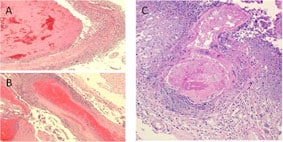
Major histopathologic findings in clinical cases of meningitis show evidence of necrotizing, suppurative vasculitis with thrombosis (A and B). These findings are seen in many cases involving a branch of the basilar artery (C), which are consistent with the clinical findings.


Fungus in Tissue Surrounding the Spinal Cord

microscopic-tissue-4-tn.jpg

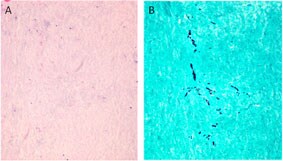
Arachnoiditis is a complication present in some of the patients. In tissue obtained adjacent to the affected site, dense collagen-rich soft tissue with no inflammatory infiltrate (A) is seen. Fungal hyphae are seen in this tissue by silver stain (GMS) with modified oxidation times (B).


Disease Caused by Fungus in Brain Tissue


microscopic-tissue-2-tn.jpg

Another finding in the basilar artery is necrosis (A) and giant cell arteritis (B).


Fungus in a Hip Joint

microscopic-tissue-5-tn.jpg

In patients with arthritis, fibrin and necrotic debris are seen in affected joints (A). Although rare, immunohistochemistry facilitates the focal detection of hyphae (B) in these areas (red staining).


Fungus in Brain Tissue

microscopic-tissue-3-tn.jpg

Fungal hyphae (black) can be visualized with silver stain within vessel walls (A) and in area of necrosis in basilar artery (B). Using a polyfungal immunohistochemistry reagent, fungal hyphae (red) is also seen in the purulent exudate in spinal meningitis (C).
 
Last edited:
Re: CDC - Laboratory Testing and Results from the Fungal Meningitis Outbreak

Re: CDC - Laboratory Testing and Results from the Fungal Meningitis Outbreak

Update from CDC on contaminants identified in additional NECC products. For a list of the products with lot number and specific contaminants identified, see our thread: FDA - Multistate outbreak of fungal meningitis and other infections - Bacterial and/or fungal contaminants identified in additional NECC products


CDC: Laboratory Testing and Results​


Date updated: November 30, 2012

"CDC and FDA have identified bacterial and/or fungal contamination in unopened vials of betamethasone, cardioplegia, and triamcinolone solutions distributed and recalled from NECC. These include bacteria known as Bacillus, and fungal species including Aspergillus tubingensis, Aspergillus fumigatus, Cladosporium species, and Penicillium species. Although rare, some of the identified Bacillus species can be human pathogens. Some of the fungal organisms identified, particularly Aspergillus fumigatus, are known to cause disease in humans. It is not known how product contamination with these organisms could affect patients clinically. See CDC's Advice for Clinicians below."
 
Last edited:
Re: CDC - Laboratory Testing and Results from the Fungal Meningitis Outbreak

Re: CDC - Laboratory Testing and Results from the Fungal Meningitis Outbreak

Updated info, current as of March 11, on lab testing and results. Excerpts from:

Laboratory Testing and Results from the Outbreak


CDC Laboratory Results
Human Tissue and Fluid Samples 2, 3, 4

CDC and State health laboratories are testing tissue and fluid samples from patients with probable or confirmed fungal infection. CDC scientists are using DNA-based methods and other advanced testing to determine whether the samples contain fungi and other microbial pathogens, and if so, what type.

As of March 11, 2013, Exserohilum rostratum has been identified in 151 case-patients and continues to be the predominant fungal infection in this outbreak. One patient, the index case, was infected with Aspergillus fumigatus, and 22 additional species were identified: Aspergillus species (4 cases), Cladosporium spp. (6), Alternaria sp. (4), Bipolaris sp. (1), Chaetomium sp. (1), coelomycete fungus (1), Epicoccum nigrum (1), Paecilomyces (1), Penicillium sp. (1), Scopulariopsis brevicaulis (1), and Stachybotrys chartarum (1).

Early in the outbreak, patient specimens were primarily cerebrospinal fluid and fluid from joints (knee, etc.). Recently, fluids from epidural abscesses (accumulations of pus around the spine) and tissues have been the focus of laboratory testing.

The numbers reported here do not reflect all cases of fungal meningitis, joint infections, and epidural abscesses because laboratory methods are not sensitive enough to detect all positive samples. Many patients with potential fungal infections will have a negative laboratory result. 2, 3


Table 1. CDC Laboratory Identification of Exserohilum rostratum from 151 Case-Patients*

Source:Cerebrospinal Fluid
Number of E. rostratum Identified:82

Source:Tissue
Number of E. rostratum Identified:46

Source:Joint fluids
Number of E. rostratum Identified:4

Source:Other specimens
Number of E. rostratum Identified:2

Source:Cultured Isolates?
Number of E. rostratum Identified:49

* Multiple specimens were received from some case-patients
? Fungal cultures isolated from human specimens that were received from State Health Department laboratories.


Antifungal Susceptibility Testing 5

Fifty isolates of Exserohilum rostratum were cultured from patient specimens and tested for their susceptibility to a variety of antifungal drugs. Susceptibility to amphotericin B was determined using the Epsilometer test (Etest) method according to the manufacturer?s instructions [Photo 1]. Susceptibility to voriconazole, posaconazole, itraconazole, fluconazole, and the investigational drug isavuconazole was tested by broth microdilution according to methods defined by the Clinical and Laboratory Standards Institute (CLSI) (M38-A2) 5. Exserohilum rostratum drug susceptibility results are shown in Table 2 below.

(NOTE from Cb: See charted results of susceptibility testing here: Table 2: CDC Antifungal Susceptibility Testing)


CDC's PCR test for detection of fungal DNA


CDC's fungal PCR test at a glance

Limit of detection: 1 picogram DNA per ml
Diagnostic sensitivity of PCR: 29%
Diagnostic sensitivity of fungal culture: 14%
Diagnostic specificity of PCR: 100%

CDC has developed a novel test using PCR and DNA sequencing to detect fungal DNA in cerebrospinal fluid (CSF), other body fluids, and tissues from patients in this outbreak. To assess the performance of this PCR test, CDC tested 627 samples from 413 case-patients. The main results of the validation study are as follows:

The PCR test detected Exserohilum rostratum DNA in 123 samples from 114 case-patients (28% of the 413 case-patients for whom samples were available). The test also detected Cladosporium sp. DNA in one case-patient.
PCR was more sensitive than culture. Of 139 case-patients who had a specimen tested by both PCR and culture, E. rostratum DNA was detected by PCR in 41 (29%) but was only recovered from culture in 19 (14%). In total, 33% of case-patients had fungi detected in specimens by either culture or PCR.
There were no false-positive PCR results (100% specificity). Among 136 specimens from patients who did not meet the case definition, all were negative.

The full results of the study performed to validate this PCR test are available here. The results suggest that the test is a useful tool to quickly detect fungi in body fluids and tissues, and it can detect fungal DNA in specimens that may not have shown any fungus in culture.

However, PCR for fungal detection is still a research test that has not been cleared or approved by the FDA and should not be used for diagnosis, treatment, or assessment of patient health or management. In addition, for both PCR and culture, a negative result does not rule out infection.


Product Samples: Three Lots of Preservative-Free MPA

Tests at CDC and FDA laboratories on the preservative-free MPA vials have confirmed the presence of Exserohilum rostratum in unopened vials from two of the three recalled lots. 1 These laboratory test results strengthen the link between preservative-free MPA vials and the outbreak.

The types of fungi found in patient specimens and in the recalled MPA vials are common in the environment, but were not known to cause meningitis prior to this outbreak.

As of October 22, CDC laboratories have confirmed the presence of Exserohilum rostratum [JPG] in lots #08102012@51 BUD 2/6/2013 and #06292012@26 BUD 12/26/2012. This fungus is the same genus and species as the one found in laboratory-confirmed cases of human infection.
As of January 22, 2013, CDC laboratories have recovered Cladosporium cladosporioides in one unopened vial from lot#0812012@51 sent from the state of Tennessee. This fungus has also been recovered from five patient isolates sent to CDC for confirmation, and from one CSF sample sent to CDC for testing.
As of February 8, 2013, CDC laboratories confirmed the presence of Exserohilum rostratum, Bacillus subtilis and Bacillus pumilus in one unopened vial of lot 08102012@51 that was cultured locally in Idaho and submitted to CDC through the Idaho state public health laboratory. The Bacillus organisms are bacteria.
As of February 8, 2013, CDC laboratories reconfirmed Paecilomyces formosus from 20 unopened vials and Exserohilum rostratum from one unopened vial, both from lot 05212012@68 cultured and identified at the Wadsworth Center New York State public health laboratory.
CDC also identified non-human pathogens Rhodotorula laryngis and Rhizopus stolonifer in lot #08102012@51, BUD 2/6/2013; and Rhodotorula laryngis in lot #06292012@26, BUD 12/26/2012. The fungi Rhodotorula laryngis and Rhizopus stolonifer are not known to cause disease in humans; they cannot grow at human body temperature.

(NOTE from Cb: See charted list here: Table 3. CDC Laboratory-Confirmed Organisms From Recalled Lots of Preservative-Free MPA)


1 Three NECC MPA (PF) 80mg/ml lots recalled on September 26, 2012
MPA (PF) 80 mg/ml Injection, Lot #05212012@68, Beyond Use Date 11/17/2012
MPA (PF) 80 mg/ml Injection, Lot #06292012@26, Beyond Use Date 12/26/2012
MPA (PF) 80 mg/ml Injection, Lot #08102012@51, Beyond Use Date 2/6/2013

2 Establishing a definitive diagnosis of fungal meningitis caused by molds is challenging because of the low sensitivity of culture and microscopic examination.

3 CDC has conducted laboratory testing to compare the Aspergillus fumigatus strain isolated from the case-patient in Tennessee with the strain isolated from the heart transplant patient in Massachusetts who was exposed to NECC-cardioplegia solution that was recalled on October 6, 2012. These two strains did not match and were shown to be different from each other, providing evidence against a common source of Aspergillus fumigatus for the Tennessee patient who was exposed to the NECC preservative-free MPA and the Massachusetts patient who was exposed to the NECC-cardioplegia solution

4 A negative fungal polymerase chain reaction (PCR) test from a lumbar-puncture diagnostic specimen does not rule out fungal infection. Active fungal infection may be present even when these tests are negative. We do not expect that growth in culture results or PCR tests will definitively identify all fungal pathogens in all cases, and infection with multiple fungi is possible. In treating patients with presumed fungal infection associated with this outbreak, CDC recommends following its treatment guidance even in cases in which testing fails to reveal one or more fungal pathogens. Early initiation and prolonged continuation of therapy may improve clinical outcome. Therefore, therapy should not be withheld or discontinued in the absence of laboratory confirmation in such patients (See Wijeyaratne and Harshalal, Aspergillus meningitis in Sri Lanka).

5 Clinical and Laboratory Standards Institute (CLSI). 2008. Reference Method for Broth Dilution Antifungal Susceptibility Testing of Filamentous Fungi; Approved Standard ? Second Edition. CLSI Document M38-A2. Wayne, PA: Clinical and Laboratory Standards Institute.
 
Back
Top