Mary Wilson
Well-known member
Updated Sept. 18, 2020
COVID-19 most commonly spreads
How easily a virus spreads from person to person can vary. Airborne viruses, including COVID-19, are among the most contagious and easily spread. Some viruses are highly contagious, like measles, while other viruses do not spread as easily. The virus that causes COVID-19 appears to spread more efficiently than influenza, but not as efficiently as measles, which is highly contagious. In general, the more closely a person with COVID-19 interacts with others and the longer that interaction, the higher the risk of COVID-19 spread.
Spread between animals and people
The best way to prevent illness is to avoid being exposed to this virus. You can take steps to slow the spread.
More Information
ASL Video Series: How does COVID-19 Spread?
Top of Page
Last Updated Sept. 18, 2020
https://www.cdc.gov/coronavirus/2019...d-spreads.html
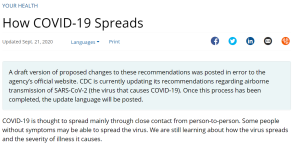
COVID-19 most commonly spreads
- Between people who are in close contact with one another (within about 6 feet).
- Through respiratory droplets or small particles, such as those in aerosols, produced when an infected person coughs, sneezes, sings, talks, or breathes.
- These particles can be inhaled into the nose, mouth, airways, and lungs and cause infection. This is thought to be the main way the virus spreads.
- It is possible that COVID-19 may spread through the droplets and airborne particles that are formed when a person who has COVID-19 coughs, sneezes, sings, talks, or breathes. There is growing evidence that droplets and airborne particles can remain suspended in the air and be breathed in by others, and travel distances beyond 6 feet (for example, during choir practice, in restaurants, or in fitness classes). In general, indoor environments without good ventilation increase this risk.
How easily a virus spreads from person to person can vary. Airborne viruses, including COVID-19, are among the most contagious and easily spread. Some viruses are highly contagious, like measles, while other viruses do not spread as easily. The virus that causes COVID-19 appears to spread more efficiently than influenza, but not as efficiently as measles, which is highly contagious. In general, the more closely a person with COVID-19 interacts with others and the longer that interaction, the higher the risk of COVID-19 spread.
Spread between animals and people
- At this time, the risk of COVID-19 spreading from animals to people is considered to be low. Learn about COVID-19 and pets and other animals.
- It appears that the virus that causes COVID-19 can spread from people to animals in some situations. CDC is aware of a small number of pets worldwide, including cats and dogs, reported to be infected with the virus that causes COVID-19, mostly after close contact with people with COVID-19. Learn what you should do if you have pets.
The best way to prevent illness is to avoid being exposed to this virus. You can take steps to slow the spread.
- Stay at least 6 feet away from others, whenever possible. This is very important in preventing the spread of COVID-19.
- Pandemics can be stressful. During times of increased physical distancing, it is still important to maintain social connections and care for your mental health.
- Cover your mouth and nose with a mask when around others. Masks should not replace other prevention measures.
- Wash your hands often with soap and water. If soap and water are not available, use a hand sanitizer that contains at least 60% alcohol.
- Stay home and isolate from others when sick.
- Use air purifiers to help reduce airborne germs in indoor spaces.
- Routinely clean and disinfect frequently touched surfaces.
More Information
ASL Video Series: How does COVID-19 Spread?
Top of Page
Last Updated Sept. 18, 2020
https://www.cdc.gov/coronavirus/2019...d-spreads.html
Last edited by a moderator: