

Michael Coston
Editor, Senior Moderator
CDC FluView #37: 2 Additional Novel Flu Infections (H3N2v) in Minnesota
#18,307
While we wait for the next shoe to drop on HPAI H5, since 2010 we've seen more than 500 scattered reports of infection with swine variant influenza viruses (H1N1v, H1N2v & H3N2v) around the nation, often associated with agricultural exhibits at county and state fairs.
A month ago (week 33) we saw 2 Novel Flu Infections (H1N1v in Ohio & H1N2v in Pennsylvania) and two weeks prior to that, a Novel H3N2v Infection Reported From Colorado.
Swine variant influenza infections are indistinguishable from seasonal flu without highly specialized testing, which means many cases likely go undetected (see CID Journal: Estimates Of Human Infection From H3N2v (Jul 2011-Apr 2012)).
Today, the CDC is reporting two more cases - this time from Minnesota - both with H3N2v, and both linked to the same county fair, although without contact with one another. One of the patients was involved in a household illness where one family member tested positive for COVID, which muddies somewhat the investigation.
Today's update follows, after which I'll have a bit more on swine variant influenza.
Novel Influenza A Virus
Two human infections with novel influenza A viruses were reported by the Minnesota Department of Health. The patients were each infected with an influenza A(H3N2) variant (A(H3N2)v) virus.
Both patients are <18 years of age, sought healthcare during the week ending September 7, 2024 (Week 36), were not hospitalized, and have recovered from their illnesses. An investigation by state public health officials found that both patients, who are not contacts with one another, attended the same agricultural fair prior to their illness onset, where the first child had indirect swine contact and the second child had direct swine contact.
During the investigation into the first patient, public health officials identified a separate, and likely unrelated illness had occurred in the household. The day after attending the agricultural fair, all household members developed symptoms. One household member of the first patient was tested and was positive for SARS-CoV-2. All household members, including the case, recovered from their illness. Subsequently, the case patient developed new symptoms and tested positive for influenza A, which was further identified as A(H3N2)v. Other household members remained well. During the investigation into the second case, no illness was identified among contacts. No human-to-human transmission of influenza A(H3N2)v associated with either case was identified.
Including these reports, nine variant influenza virus cases have been reported during the 2023-2024 season (four A(H1N2)v, four A(H3N2)v, and one A(H1N1)v virus).
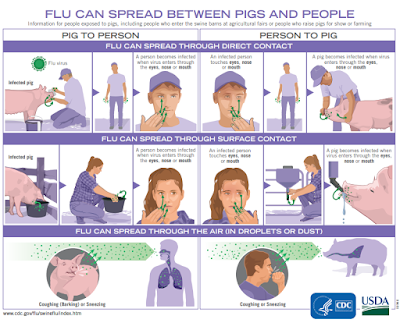
When an influenza virus that normally circulates in swine (but not people) is detected in a person, it is called a "variant" influenza virus. Most human infections with variant influenza viruses occur following exposure to swine, but human-to-human transmission can occur. It is important to note that in most cases, variant influenza viruses have not shown the ability to spread easily and sustainably from person to person.
Fourteen cases of human infection with influenza A (H5) virus have also been reported in the United States during the 2023-2024 season, for a total of 23 novel influenza A virus cases reported this season. Four of these influenza A (H5) virus infections occurred in individuals working with dairy cows, nine in individuals associated with poultry depopulation and disposal, and one in an individual with an unknown source of exposure. An ongoing outbreak of H5N1 continues in domestic dairy cows and poultry, and monitoring for additional human cases is ongoing.
While most fairs have requirements the screening and barring of `sick pigs' from exhibition, over the years we've learned that many pigs may be infected asymptomatically (see EID Journal: Flu In Healthy-Looking Pigs and Transmission Of Swine H3N2 To Humans At Agricultural Exhibits - Michigan & Ohio 2016).
Although the public health risks are considered low, the CDC advises those who are at higher risk of serious flu complications (including children under 5, adults over 65, pregnant women, and those with certain chronic medical conditions), to avoid pigs and the swine barn altogether.

Last year the CDC held a webinar for clinicians on recognizing, treating, and reporting zoonotic influenza cases in the community (see COCA Call : What Providers Need to Know about Zoonotic Influenza), which remains available on their website.
https://afludiary.blogspot.com/2024/09/cdc-fluview-37-2-additional-novel-flu.html
#18,307
While we wait for the next shoe to drop on HPAI H5, since 2010 we've seen more than 500 scattered reports of infection with swine variant influenza viruses (H1N1v, H1N2v & H3N2v) around the nation, often associated with agricultural exhibits at county and state fairs.
A month ago (week 33) we saw 2 Novel Flu Infections (H1N1v in Ohio & H1N2v in Pennsylvania) and two weeks prior to that, a Novel H3N2v Infection Reported From Colorado.
Swine variant influenza infections are indistinguishable from seasonal flu without highly specialized testing, which means many cases likely go undetected (see CID Journal: Estimates Of Human Infection From H3N2v (Jul 2011-Apr 2012)).
Today, the CDC is reporting two more cases - this time from Minnesota - both with H3N2v, and both linked to the same county fair, although without contact with one another. One of the patients was involved in a household illness where one family member tested positive for COVID, which muddies somewhat the investigation.
Today's update follows, after which I'll have a bit more on swine variant influenza.
Novel Influenza A Virus
Two human infections with novel influenza A viruses were reported by the Minnesota Department of Health. The patients were each infected with an influenza A(H3N2) variant (A(H3N2)v) virus.
Both patients are <18 years of age, sought healthcare during the week ending September 7, 2024 (Week 36), were not hospitalized, and have recovered from their illnesses. An investigation by state public health officials found that both patients, who are not contacts with one another, attended the same agricultural fair prior to their illness onset, where the first child had indirect swine contact and the second child had direct swine contact.
During the investigation into the first patient, public health officials identified a separate, and likely unrelated illness had occurred in the household. The day after attending the agricultural fair, all household members developed symptoms. One household member of the first patient was tested and was positive for SARS-CoV-2. All household members, including the case, recovered from their illness. Subsequently, the case patient developed new symptoms and tested positive for influenza A, which was further identified as A(H3N2)v. Other household members remained well. During the investigation into the second case, no illness was identified among contacts. No human-to-human transmission of influenza A(H3N2)v associated with either case was identified.
Including these reports, nine variant influenza virus cases have been reported during the 2023-2024 season (four A(H1N2)v, four A(H3N2)v, and one A(H1N1)v virus).
When an influenza virus that normally circulates in swine (but not people) is detected in a person, it is called a "variant" influenza virus. Most human infections with variant influenza viruses occur following exposure to swine, but human-to-human transmission can occur. It is important to note that in most cases, variant influenza viruses have not shown the ability to spread easily and sustainably from person to person.
Fourteen cases of human infection with influenza A (H5) virus have also been reported in the United States during the 2023-2024 season, for a total of 23 novel influenza A virus cases reported this season. Four of these influenza A (H5) virus infections occurred in individuals working with dairy cows, nine in individuals associated with poultry depopulation and disposal, and one in an individual with an unknown source of exposure. An ongoing outbreak of H5N1 continues in domestic dairy cows and poultry, and monitoring for additional human cases is ongoing.
Additional information on influenza in swine, variant influenza virus infection in humans, and guidance to interact safely with swine can be found at Swine Flu.
Additional information regarding human infections with novel influenza A viruses:
Additional information regarding human infections with novel influenza A viruses:
While most fairs have requirements the screening and barring of `sick pigs' from exhibition, over the years we've learned that many pigs may be infected asymptomatically (see EID Journal: Flu In Healthy-Looking Pigs and Transmission Of Swine H3N2 To Humans At Agricultural Exhibits - Michigan & Ohio 2016).
Although the public health risks are considered low, the CDC advises those who are at higher risk of serious flu complications (including children under 5, adults over 65, pregnant women, and those with certain chronic medical conditions), to avoid pigs and the swine barn altogether.
Last year the CDC held a webinar for clinicians on recognizing, treating, and reporting zoonotic influenza cases in the community (see COCA Call : What Providers Need to Know about Zoonotic Influenza), which remains available on their website.
https://afludiary.blogspot.com/2024/09/cdc-fluview-37-2-additional-novel-flu.html