

Michael Coston
Editor, Senior Moderator
CDC EID Journal: Locally Acquired Human Infection with Swine-Origin Influenza A(H3N2) Variant Virus, Australia, 2018
[TABLE="class: tr-caption-container tr_bq, align: center, cellpadding: 0, cellspacing: 0"]
[TR]
[TD]
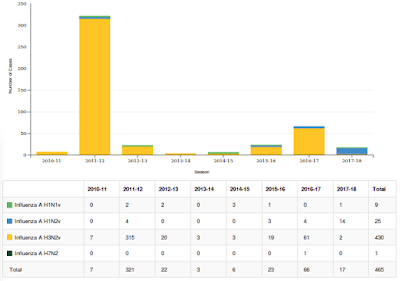 [/TD]
[/TD]
[/TR]
[TR]
[TD="class: tr-caption"]Swine Variant Human Cases : 2010-2018 - Credit CDC[/TD]
[/TR]
[/TABLE]
#14,492
Although we've enjoyed a remarkably small number of human swine variant flu (H1N1v, H1N2v, H3N2v) infections this summer, over the past 15 years more than 460 cases have been confirmed in the United States, with 2/3rds of those reported in 2012.
Nevertheless, we do see occasional cases reported:
All of which brings us to a dispatch, published this week in the EID Journal, that looks at this first reported Australian swine variant case, and echos some of the same concerns voiced in last summer's JVI study.
I've only posted some excerpts, so follow the link to read dispatch in its entirety.
https://afludiary.blogspot.com/2019/...red-human.html
[TABLE="class: tr-caption-container tr_bq, align: center, cellpadding: 0, cellspacing: 0"]
[TR]
[TD]
[/TR]
[TR]
[TD="class: tr-caption"]Swine Variant Human Cases : 2010-2018 - Credit CDC[/TD]
[/TR]
[/TABLE]
#14,492
Although we've enjoyed a remarkably small number of human swine variant flu (H1N1v, H1N2v, H3N2v) infections this summer, over the past 15 years more than 460 cases have been confirmed in the United States, with 2/3rds of those reported in 2012.
Hundreds, perhaps thousands, of other cases have almost certainly escaped detection as most cases are mild to moderate, and relatively few people are tested for novel viruses (see CID Journal: Estimates Of Human Infection From H3N2v (Jul 2011-Apr 2012).
While the United States has the highest reported number of cases, there is little reason to suspect that cases aren't occurring - unnoticed - around the globe. Surveillance is spotty at best, and identifying cases is often a matter of luck.
Nevertheless, we do see occasional cases reported:
J.O.I. : A Human Infection with a Novel Reassortant H3N2 Swine Virus in China
Eurosurveillance: Swine Origin H1N1 Infection Leading To Severe Illness - Italy, 2016,
Three years ago Chen Hualan - director of China's National Avian Influenza Reference Laboratory - gave an interview to Xinhua where she pegged the EA (Eurasian Avian-like) H1N1 swine virus (EAH1N1) as having perhaps the greatest pandemic potential of any of the novel viruses in circulation.Eurosurveillance: Swine Origin H1N1 Infection Leading To Severe Illness - Italy, 2016,
So we watch these swine-origin reassortant viruses closely, looking for signs that they might be following the same path as the 2009 H1N1 `swine flu' pandemic virus.
In the summer of 2018, in JVI: Divergent Human Origin influenza Viruses Detected In Australian Swine Populations,we looked at a report describing genetic remnants of much older human flu strains still circulating in geographically isolated swine populations in Australia. Lineages going back roughly 50 years (to H3N2 in 1968), which show unexpectedly little antigenic drift over time.
The authors went on to suggest that `. . . . isolated swine populations can act as ‘antigenic archives’ of human influenza, raising the risk of re-emergence in humans when sufficient susceptible populations arise.'
Last February, the WHO reported the first known human swine-variant infection from Australia.
Influenza A(H3N2)v activity from 25 September 2018 to 17 February 2019
A human case of A(H3N2)v influenza virus infection was detected in Australia during routine screening of influenza positive samples. The case was a 15-year-old female with likely exposure at a livestock exhibition. This is the first documented case of a variant influenza virus human infection in Australia.
Antigenic and genetic characteristics of influenza A(H3N2)v viruses
Phylogenetic analyses of the HA and NA genes of the Australian virus, A/South Australia/85/2018, showed that it grouped with A(H3N2) swine influenza viruses detected in Australia and Asia, which were likely derived from seasonal A(H3N2) viruses that circulated in the late 1990s. The six internal genes of A/South Australia/85/2018 were derived from A(H1N1)pdm09 viruses circulating in pigs. Antigenic characterization of this virus is pending.
A human case of A(H3N2)v influenza virus infection was detected in Australia during routine screening of influenza positive samples. The case was a 15-year-old female with likely exposure at a livestock exhibition. This is the first documented case of a variant influenza virus human infection in Australia.
Antigenic and genetic characteristics of influenza A(H3N2)v viruses
Phylogenetic analyses of the HA and NA genes of the Australian virus, A/South Australia/85/2018, showed that it grouped with A(H3N2) swine influenza viruses detected in Australia and Asia, which were likely derived from seasonal A(H3N2) viruses that circulated in the late 1990s. The six internal genes of A/South Australia/85/2018 were derived from A(H1N1)pdm09 viruses circulating in pigs. Antigenic characterization of this virus is pending.
All of which brings us to a dispatch, published this week in the EID Journal, that looks at this first reported Australian swine variant case, and echos some of the same concerns voiced in last summer's JVI study.
I've only posted some excerpts, so follow the link to read dispatch in its entirety.
Dispatch
Locally Acquired Human Infection with Swine-Origin Influenza A(H3N2) Variant Virus, Australia, 2018
Yi-Mo Deng, Frank Y.K. Wong, Natalie Spirason, Matthew Kaye, Rebecca Beazley, Miguel Grau, Songhua Shan, Vittoria Stevens, Kanta Subbarao, Sheena Sullivan, Ian G. Barr, and Vijaykrishna Dhanasekaran
Abstract
In 2018, a 15-year-old female adolescent in Australia was infected with swine influenza A(H3N2) variant virus. The virus contained hemagglutinin and neuraminidase genes derived from 1990s-like human seasonal viruses and internal protein genes from influenza A(H1N1)pdm09 virus, highlighting the potential risk that swine influenza A virus poses to human health in Australia.
Long-term circulation of influenza A viruses (IAVs) among swine poses a public health threat. The 2009 pandemic was caused by a reassortant swine influenza A(H1N1) virus with genes that originated from human and avian IAVs that had circulated among swine for several years (1,2).
Since then, globally enhanced influenza surveillance among swine has indicated continuous introduction of human seasonal influenza viruses into swine, followed by reassortment with influenza A viruses endemic in swine (IAV-S) and persistence of many lineages in swine for several decades (3).
Although IAV-S are normally limited to transmission among swine, since 2010, a total of 430 cases of human infection with swine-origin influenza A(H3N2) variant viruses (H3N2v) have been detected in the United States (4), primarily in young persons exposed to swine at agricultural fairs. Most patients had self-limited influenza-like illness (5). Recent data also suggest that IAV-S have been endemic to Australia for many decades, including viruses that were originally derived from human H3N2 viruses as early as 1968, pre-2009 seasonal H1N1 viruses, and influenza A(H1N1)pdm09 (pH1N1) viruses (6).
(SNIP)
Yi-Mo Deng, Frank Y.K. Wong, Natalie Spirason, Matthew Kaye, Rebecca Beazley, Miguel Grau, Songhua Shan, Vittoria Stevens, Kanta Subbarao, Sheena Sullivan, Ian G. Barr, and Vijaykrishna Dhanasekaran
Abstract
In 2018, a 15-year-old female adolescent in Australia was infected with swine influenza A(H3N2) variant virus. The virus contained hemagglutinin and neuraminidase genes derived from 1990s-like human seasonal viruses and internal protein genes from influenza A(H1N1)pdm09 virus, highlighting the potential risk that swine influenza A virus poses to human health in Australia.
Long-term circulation of influenza A viruses (IAVs) among swine poses a public health threat. The 2009 pandemic was caused by a reassortant swine influenza A(H1N1) virus with genes that originated from human and avian IAVs that had circulated among swine for several years (1,2).
Since then, globally enhanced influenza surveillance among swine has indicated continuous introduction of human seasonal influenza viruses into swine, followed by reassortment with influenza A viruses endemic in swine (IAV-S) and persistence of many lineages in swine for several decades (3).
Although IAV-S are normally limited to transmission among swine, since 2010, a total of 430 cases of human infection with swine-origin influenza A(H3N2) variant viruses (H3N2v) have been detected in the United States (4), primarily in young persons exposed to swine at agricultural fairs. Most patients had self-limited influenza-like illness (5). Recent data also suggest that IAV-S have been endemic to Australia for many decades, including viruses that were originally derived from human H3N2 viruses as early as 1968, pre-2009 seasonal H1N1 viruses, and influenza A(H1N1)pdm09 (pH1N1) viruses (6).
(SNIP)
Conclusions
A comparison of divergence times between the IAV-S segments from Australia showed that reassortment of endemic viruses with introduced human lineages had been continual (Appendix Figure 3), thereby potentially maintaining sustained transmission on individual swine farms. The risk for emergence of A/South Australia/85/2018-like viruses in humans is potentially high because all 6 internal protein genes are derived from human-adapted pH1N1 virus.
A comparison of divergence times between the IAV-S segments from Australia showed that reassortment of endemic viruses with introduced human lineages had been continual (Appendix Figure 3), thereby potentially maintaining sustained transmission on individual swine farms. The risk for emergence of A/South Australia/85/2018-like viruses in humans is potentially high because all 6 internal protein genes are derived from human-adapted pH1N1 virus.
The human-origin HA and NA genes of A/South Australia/85/2018 were widely circulating in the human population 20–25 years ago. Hence, children probably have little or no immunity to the HA/NA of this virus, making them more susceptible to infection with this virus subtype, as in the case reported here and in children infected with swine H3N2v virus in the United States (12–14).
The genomic and antigenic properties and epidemiologic characteristics of zoonotic IAV-S are useful for identifying the potential risk for emergence and spread into the human population. These data also enable better identification of potential nationally relevant mitigation strategies, including measures such as public awareness programs and influenza vaccination of swine herds to eliminate sustained transmission of influenza virus in swine populations (15).
Our study highlights the risk to the general human population in Australia for infection with IAV-S and the need for more vigilant surveillance of swine and persons who are in close contact with swine to enable early detection and characterization of zoonotic influenza infections.
Dr. Deng leads the molecular biology group at the WHO Collaborating Centre for Reference and Research on Influenza, Melbourne, Australia. Her primary research interest is the use of novel sequencing and analysis methods to infer the epidemiology and mechanisms of evolution of zoonotic and human influenza viruses.
https://afludiary.blogspot.com/2019/...red-human.html