

Pathfinder
Editor, Senior Moderator
Bird Flu Virus Infections in Humans
Español | Other Languages
Print
Information about the latest developments around avian influenza A(H5N1) is available at Bird Flu Current Situation Summary.
On This Page
Infected birds shed avian influenza viruses through their saliva, mucous and feces. Other animals infected with avian influenza viruses may have virus present in respiratory secretions, different organs, blood, or in other body fluids, including animal milk. Human infections with avian influenza viruses can happen when virus gets into a person’s eyes, nose or mouth, or is inhaled. This can happen when virus is in the air (in droplets, small aerosol particles, or possibly dust) and deposits on the mucus membranes of the eyes or a person breathes it in, or possibly when a person touches something contaminated by viruses and then touches their mouth, eyes or nose.
Avian influenza viruses have been detected in many other species. Avoid contact with surfaces that appear to be contaminated with animal feces, raw milk, litter, or materials contaminated by birds or other animals with suspected or confirmed avian influenza virus infection. CDC has information about precautions to take with wild birds, poultry and other animals.
CDC has guidance for specific groups of people with exposure to poultry and other potentially infected animals, including poultry or dairy workers, for example, and people responding to bird flu outbreaks. Additional information is available at Information for People Exposed to Birds Infected with Avian Influenza Viruses of Public Health Concern.
In late March 2024, a human case of influenza A(H5N1) virus infection was identified after exposure to dairy cattle presumably infected with bird flu. Some bird flu infections of people have been identified in which the source of infection was unknown.
The spread of bird flu viruses from one infected person to a close contact is very rare, and when it has happened, it has only spread to a few people. However, because of the possibility that bird flu viruses could change and gain the ability to spread easily between people, monitoring for human infection and person-to-person spread is extremely important for public health.
Spread of Bird Flu Viruses Between Animals and People
Prevention and Antiviral Treatment of Bird Flu in People
Examples of Possible Human to Human Transmission
Reported Human Infections with Bird Flu
What To Know About Bird Flu
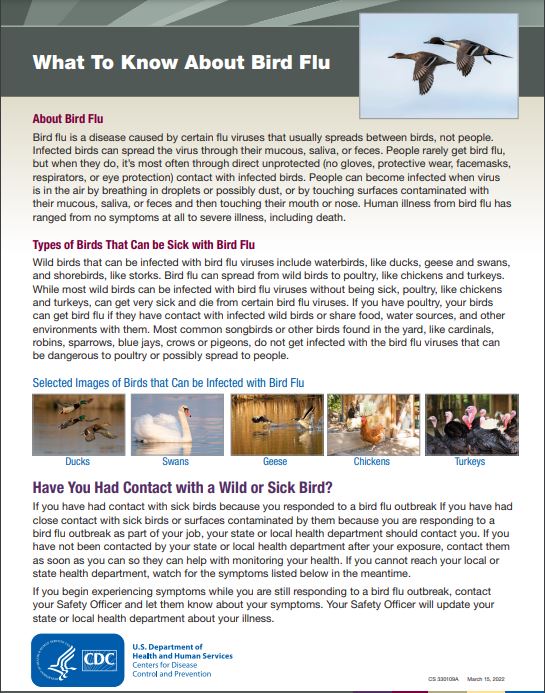
What To Know About Bird Flu [154 KB, 2 pages]
Spanish [267 KB, 2 pages]
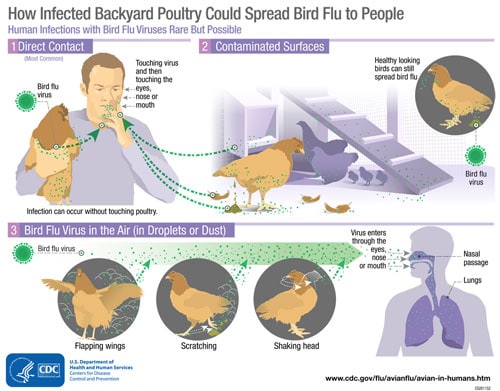
Avian Influenza Transmission Infographic [555 KB, 2 pages]
Spanish [531 KB, 2 pages]
Simplified Chinese [581 KB, 2 pages]
Signs and Symptoms of Avian Influenza A Virus Infections in Humans
The reported signs and symptoms of bird flu virus infections in humans have ranged from no symptoms or mild illness [such as eye redness (conjunctivitis) or mild flu-like upper respiratory symptoms], to severe (such as pneumonia requiring hospitalization) and included fever (temperature of 100ºF [37.8ºC] or greater) or feeling feverish*, cough, sore throat, runny or stuff nose, muscle or body aches, headaches, fatigue, and shortness of breath or difficulty breathing. Less common signs and symptoms include diarrhea, nausea, vomiting, or seizures.
*Fever may not always be present
Detecting Bird Flu Avian Influenza A Virus Infection in Humans
Bird flu virus infection in people cannot be diagnosed by clinical signs and symptoms alone; laboratory testing is needed. Bird flu virus infection is usually diagnosed by collecting a swab from the upper respiratory tract (nose or throat) of the sick person. Testing is more accurate when the swab is collected during the first few days of illness.
For critically ill patients, collection and testing of lower respiratory tract specimens also may lead to diagnosis of bird flu virus infection. However, for some patients who are no longer very sick or who have fully recovered, it may be difficult to detect bird flu virus in a specimen.
CDC has posted guidance for clinicians and public health professionals in the United States on appropriate testing, specimen collection, and processing of samples from patients who might be infected with avian influenza A viruses.
Last Reviewed: April 11, 2024
Source: Centers for Disease Control and Prevention, National Center for Immunization and Respiratory Diseases (NCIRD)
https://www.cdc.gov/flu/avianflu/avian-in-humans.htm
Español | Other Languages
Information about the latest developments around avian influenza A(H5N1) is available at Bird Flu Current Situation Summary.
On This Page
- Signs and Symptoms of Avian Influenza A Virus Infections in Humans
- Detecting Bird Flu Avian Influenza A Virus Infection in Humans
Infected birds shed avian influenza viruses through their saliva, mucous and feces. Other animals infected with avian influenza viruses may have virus present in respiratory secretions, different organs, blood, or in other body fluids, including animal milk. Human infections with avian influenza viruses can happen when virus gets into a person’s eyes, nose or mouth, or is inhaled. This can happen when virus is in the air (in droplets, small aerosol particles, or possibly dust) and deposits on the mucus membranes of the eyes or a person breathes it in, or possibly when a person touches something contaminated by viruses and then touches their mouth, eyes or nose.
Avian influenza viruses have been detected in many other species. Avoid contact with surfaces that appear to be contaminated with animal feces, raw milk, litter, or materials contaminated by birds or other animals with suspected or confirmed avian influenza virus infection. CDC has information about precautions to take with wild birds, poultry and other animals.
CDC has guidance for specific groups of people with exposure to poultry and other potentially infected animals, including poultry or dairy workers, for example, and people responding to bird flu outbreaks. Additional information is available at Information for People Exposed to Birds Infected with Avian Influenza Viruses of Public Health Concern.
In late March 2024, a human case of influenza A(H5N1) virus infection was identified after exposure to dairy cattle presumably infected with bird flu. Some bird flu infections of people have been identified in which the source of infection was unknown.
The spread of bird flu viruses from one infected person to a close contact is very rare, and when it has happened, it has only spread to a few people. However, because of the possibility that bird flu viruses could change and gain the ability to spread easily between people, monitoring for human infection and person-to-person spread is extremely important for public health.
Spread of Bird Flu Viruses Between Animals and People
Prevention and Antiviral Treatment of Bird Flu in People
Examples of Possible Human to Human Transmission
Reported Human Infections with Bird Flu
What To Know About Bird Flu
What To Know About Bird Flu [154 KB, 2 pages]
Spanish [267 KB, 2 pages]
Avian Influenza Transmission Infographic [555 KB, 2 pages]
Spanish [531 KB, 2 pages]
Simplified Chinese [581 KB, 2 pages]
Signs and Symptoms of Avian Influenza A Virus Infections in Humans
The reported signs and symptoms of bird flu virus infections in humans have ranged from no symptoms or mild illness [such as eye redness (conjunctivitis) or mild flu-like upper respiratory symptoms], to severe (such as pneumonia requiring hospitalization) and included fever (temperature of 100ºF [37.8ºC] or greater) or feeling feverish*, cough, sore throat, runny or stuff nose, muscle or body aches, headaches, fatigue, and shortness of breath or difficulty breathing. Less common signs and symptoms include diarrhea, nausea, vomiting, or seizures.
*Fever may not always be present
Detecting Bird Flu Avian Influenza A Virus Infection in Humans
Bird flu virus infection in people cannot be diagnosed by clinical signs and symptoms alone; laboratory testing is needed. Bird flu virus infection is usually diagnosed by collecting a swab from the upper respiratory tract (nose or throat) of the sick person. Testing is more accurate when the swab is collected during the first few days of illness.
For critically ill patients, collection and testing of lower respiratory tract specimens also may lead to diagnosis of bird flu virus infection. However, for some patients who are no longer very sick or who have fully recovered, it may be difficult to detect bird flu virus in a specimen.
CDC has posted guidance for clinicians and public health professionals in the United States on appropriate testing, specimen collection, and processing of samples from patients who might be infected with avian influenza A viruses.
Last Reviewed: April 11, 2024
Source: Centers for Disease Control and Prevention, National Center for Immunization and Respiratory Diseases (NCIRD)
https://www.cdc.gov/flu/avianflu/avian-in-humans.htm