• FluTrackers.com Inc. does not provide medical advice. Information on this web site is collected from various internet resources, and the FluTrackers board of directors makes no warranty to the safety, efficacy, correctness or completeness of the information posted on this site by any author or poster. The information collated here is for instructional and/or discussion purposes only and is NOT intended to diagnose or treat any disease, illness, or other medical condition. Every individual reader or poster should seek advice from their personal physician/healthcare practitioner before considering or using any interventions that are discussed on this website. By continuing to access this website you agree to consult your personal physican before using any interventions posted on this website, and you agree to hold harmless FluTrackers.com Inc., the board of directors, the members, and all authors and posters for any effects from use of any medication, supplement, vitamin or other substance, device, intervention, etc. mentioned in posts on this website, or other internet venues referenced in posts on this website.
  • We are not asking for any donations. Do not donate to any entity who says they are raising funds for us.

CDC: Acute Flacid Myelitis 2018-2025

Shiloh

Editor, Senior Moderator
Source: https://www.cdc.gov/acute-flaccid-myelitis/afm-surveillance.html


AFM Investigation


At a Glance
  • CDC is concerned about AFM, a serious condition that causes weakness in the arms or legs.
  • From August 2014 through August 2018, CDC has received information on a total of 362 cases of AFM across the US; most of the cases continue to occur in children.
  • Even with an increase in cases since 2014, AFM remains a very rare condition. Less than one in a million people in the United States get AFM each year.
  • It’s always important to practice disease prevention steps, such as staying up-to-date on vaccines, washing your hands, and protecting yourself from mosquito bites.

Acute flaccid myelitis (AFM) is a rare condition. It affects a person’s nervous system, specifically the spinal cord. AFM or neurologic conditions like it have a variety of causes such as viruses, environmental toxins, and genetic disorders.
Since August 2014, CDC has seen an increased number of people across the United States with AFM. We have not confirmed the cause for the majority of these cases. CDC has been actively investigating these AFM cases, and we continue to receive information about suspected AFM cases.
afm-cases-reported.png

Updated October 5, 2018
^ Confirmed AFM cases that CDC has been made aware of as of September 30, 2018 with onset of the condition through September 30, 2018. The case counts are subject to change.
* The data shown from August 2014 to July 2015 are based on the AFM investigation case definition: onset of acute limb weakness on or after August 1, 2014, and a magnetic resonance image (MRI) showing a spinal cord lesion largely restricted to gray matter in a patient age ≤21 years.
† The data shown from August 2015 to present are based on the AFM case definition adopted by the Council of State and Territorial Epidemiologists (CSTE): acute onset of focal limb weakness and an MRI showing spinal cord lesion largely restricted to gray matter and spanning one or more spinal segments, regardless of age.
For more information, visit the Case Definitions page.

Top of Page
What This Graph Shows

The graph shows the number of AFM cases confirmed by CDC as of September 30, 2018, with onset of the condition through September 30, 2018.
  • So far in 2018, there are 38 confirmed cases of AFM. (Note: The cases occurred in 16 states across the U.S.)
  • In 2017, CDC received information for 33 confirmed cases of AFM. (Note: The cases occurred in 16 states across the U.S.)
  • In 2016, 149 people were confirmed to have AFM. (Note: The cases occurred in 39 states across the U.S. and DC)
  • In 2015, 22 people were confirmed to have AFM. (Note: The cases occurred in 17 states across the U.S.)
  • From August to December 2014, 120 people were confirmed to have AFM. (Note: The cases occurred in 34 states across the U.S.)
  • The case counts represent only those cases for which information has been sent to and confirmed by CDC.
It is currently difficult to interpret trends of the AFM data. Collecting information about suspected AFM cases is relatively new, and it is voluntary for most states to send this information to CDC. There may initially be more variability in the AFM data from year to year making it difficult to interpret or compare case counts between years.
We defer to the states to release additional information on cases as they choose.
Number of confirmed AFM cases by year of illness onset, 2014-2018*
[TABLE="class: opt-in table table-bordered"]
[TR]
[/TR]
[TR]
[TD="class: text-center"]2014 (Aug-Dec)[/TD]
[TD="class: text-center"]120[/TD]
[TD="class: text-center"]34[/TD]
[/TR]
[TR]
[TD="class: text-center"]2015[/TD]
[TD="class: text-center"]22[/TD]
[TD="class: text-center"]17[/TD]
[/TR]
[TR]
[TD="class: text-center"]2016[/TD]
[TD="class: text-center"]149[/TD]
[TD="class: text-center"]39 (includes DC)[/TD]
[/TR]
[TR]
[TD="class: text-center"]2017[/TD]
[TD="class: text-center"]33[/TD]
[TD="class: text-center"]16[/TD]
[/TR]
[TR]
[TD="class: text-center"]2018 (Jan-Sept)[/TD]
[TD="class: text-center"]38[/TD]
[TD="class: text-center"]16[/TD]
[/TR]
[/TABLE]
*The case counts are subject to change.

What We Know

Since 2014, CDC has learned the following about the AFM cases:
  • Most patients are children.
  • The patients’ symptoms have been most similar to complications of infection with certain viruses, including poliovirus, non-polio enteroviruses, adenoviruses, and West Nile virus.
    • Enteroviruses most commonly cause mild illness. They can also cause neurologic illness, such as meningitis, encephalitis, and AFM, but these are rare.
  • CDC has tested many different specimens from AFM patients for a wide range of pathogens (germs) that can cause AFM. To date, no pathogen (germ) has been consistently detected in the patients’ spinal fluid; a pathogen detected in the spinal fluid would be good evidence to indicate the cause of AFM since this condition affects the spinal cord.
  • The increase in AFM cases in 2014 coincided with a national outbreak of severe respiratory illness among people caused by enterovirus D68 (EV-D68). Among the people confirmed with AFM, CDC did not consistently detect EV-D68 in every patient. During 2015, CDC did not receive information about large EV-D68 outbreaks in the United States, and laboratories reported only limited EV-D68 detections to CDC’s National Enterovirus Surveillance System (NESS). During 2016, CDC was informed of a few localized clusters in the United States. Learn more about EV-D68.
Top of Page
What We Don’t Know

Among the people who were diagnosed with AFM since August 2014:
  • The cause of most of the AFM cases remains unknown.
  • We don’t know what caused the increase in AFM cases starting in 2014.
  • We have not yet determined who is at higher risk for developing AFM, or the reasons why they may be at higher risk.
  • We do not yet know the long-term effects of AFM. We know that some patients diagnosed with AFM have recovered quickly, and some continue to have paralysis and require ongoing care.
See prevention for information about how to protect your family from viruses that may cause AFM.
Top of Page
What CDC Is Doing

CDC is actively investigating AFM cases and monitoring disease activity. We are working closely with healthcare providers and state and local health departments to increase awareness for AFM. We are encouraging healthcare providers to recognize and report suspected cases of AFM to their health departments, and for health departments to send this information to CDC to help us understand the nationwide burden of AFM. CDC is also actively looking for risk factors and possible causes of this condition.
CDC activities include:
  • urging healthcare providers to be vigilant for AFM among their patients, and to send information about suspected cases to their health departments
  • verifying clinical information of suspected AFM cases submitted by health departments, and working with health departments and neurologists to classify cases using a case definition adopted by the Council of State and Territorial Epidemiologists (CSTE)
  • testing specimens, including stool, blood, and cerebrospinal fluid, from suspected AFM cases
  • working with healthcare providers, experts, and state and local health departments to investigate and better understand the AFM cases, including potential causes and how often the condition occurs
  • providing new and updated information to healthcare providers, health departments, policymakers, the public, and partners in various formats, such as scientific journals and meetings, and CDC’s AFM website and social media
  • using multiple research methods to further explore the potential association of AFM with possible causes as well as risk factors for AFM. This includes collaborating with experts to review MRI scans of people from the past 10 years to determine how many AFM cases occurred before 2014, updating treatment and management protocols, and engaging with several academic centers to conduct active surveillance simultaneously for both AFM and respiratory viruses.
For more information, see
Top of Page
 
Source: https://www.cdc.gov/acute-flaccid-myelitis/afm-surveillance.html
[h=2]AFM Cases in the U.S.[/h] So far in 2018, there are 106 confirmed cases of AFM in 29 states. These 106 confirmed cases are among the total of 273 reports that CDC received of patients under investigation (PUIs).
  • In 2017, CDC received information for 33 confirmed cases of AFM in 16 states.
  • In 2016, CDC received information for 149 confirmed cases of AFM in 39 states and DC.
  • In 2015, CDC received information for 22 confirmed cases of AFM in 17 states.
  • From August to December 2014, CDC received information for 120 people confirmed cases of AFM in 34 states.
The case counts represent only those cases for which information has been sent to and confirmed by CDC.

Source: https://www.cdc.gov/acute-flaccid-myelitis/afm-cases.html
[h=1]AFM Confirmed U.S. Cases[/h]

Language: English (US)


Recommend on Facebook Tweet


afm-cases-reported.png

^ Confirmed AFM cases that CDC has been made aware of as of November 16, 2018 with onset of the condition through October 31, 2018. The case counts are subject to change.
* The data shown from August 2014 to July 2015 are based on the AFM investigation case definition: onset of acute limb weakness on or after August 1, 2014, and a magnetic resonance image (MRI) showing a spinal cord lesion largely restricted to gray matter in a patient age ≤21 years.
? The data shown from August 2015 to present are based on the AFM case definition adopted by the Council of State and Territorial Epidemiologists (CSTE): acute onset of focal limb weakness and an MRI showing spinal cord lesion largely restricted to gray matter and spanning one or more spinal segments, regardless of age.
For more information, visit the Case Definitions page.

Top of Page
[h=2]What This Graph Shows[/h] The graph shows the number of AFM cases confirmed by CDC as of November 16, 2018, with onset of the condition through October 31, 2018.
  • So far in 2018, there are 106 confirmed cases of AFM. (Note: The cases occurred in 29 states across the U.S.)
    Note: These 106 confirmed cases are among the total of 273 reports that CDC received of patients under investigation (PUIs). CDC recently received increased reports for PUIs with onset of symptoms in August, September, and October. CDC and state and local health departments are still investigating some of these PUIs. With enhanced efforts working with local and state health departments and hospitals, we were able to gather information on PUIs and confirm a number of these cases faster. CDC is now providing the number of patients still under investigation so people can better anticipate increases in confirmed cases over the coming months.
  • In 2017, CDC received information for 33 confirmed cases of AFM. (Note: The cases occurred in 16 states across the U.S.)
  • In 2016, 149 people were confirmed to have AFM. (Note: The cases occurred in 39 states across the U.S. and DC)
  • In 2015, 22 people were confirmed to have AFM. (Note: The cases occurred in 17 states across the U.S.)
  • From August to December 2014, 120 people were confirmed to have AFM. (Note: The cases occurred in 34 states across the U.S.)
  • The case counts represent only those cases for which information has been sent to and confirmed by CDC.
It is currently difficult to interpret trends of the AFM data. Collecting information about patients under investigation (PUIs) for AFM is relatively new. There may initially be more variability in the AFM data from year to year making it difficult to interpret or compare case counts between years.
We defer to the states to release additional information on cases as they choose.
Top of Page
 
Source: https://www.cdc.gov/acute-flaccid-myelitis/afm-surveillance.html
[h=2]AFM Cases in the U.S.[/h] So far in 2018, there are 116 confirmed cases of AFM in 31 states. These 116 confirmed cases are among the total of 286 reports that CDC received of patients under investigation (PUIs).
  • In 2017, CDC received information for 33 confirmed cases of AFM in 16 states.
  • In 2016, CDC received information for 149 confirmed cases of AFM in 39 states and DC.
  • In 2015, CDC received information for 22 confirmed cases of AFM in 17 states.
  • From August to December 2014, CDC received information for 120 people confirmed cases of AFM in 34 states.
The case counts represent only those cases for which information has been sent to and confirmed by CDC.
See graph that shows AFM cases by year.
afm-state-map.png
 
Source: https://www.cdc.gov/acute-flaccid-myelitis/afm-surveillance.html
[h=2]AFM Cases in the U.S.[/h] So far in 2018, there are 158 confirmed cases of AFM in 36 states. These 158 confirmed cases are among the total of 311 reports that CDC received of patients under investigation (PUIs). CDC and state and local health departments are still investigating some of these PUIs.
  • In 2017, CDC received information for 35 confirmed cases of AFM in 16 states.
  • In 2016, CDC received information for 149 confirmed cases of AFM in 39 states and DC.
  • In 2015, CDC received information for 22 confirmed cases of AFM in 17 states.
  • From August to December 2014, CDC received information for 120 people confirmed cases of AFM in 34 states.
The case counts represent only those cases for which information has been sent to and confirmed by CDC.
See graph that shows AFM cases by year.
afm-state-map.png
 
Source: https://www.cdc.gov/acute-flaccid-myelitis/afm-surveillance.html
[h=2]AFM Cases in the U.S.[/h] So far in 2018, there are 165 confirmed cases of AFM in 36 states. These 165 confirmed cases are among the total of 320 reports that CDC received of patients under investigation (PUIs). CDC and state and local health departments are still investigating some of these PUIs.
  • In 2017, CDC received information for 35 confirmed cases of AFM in 16 states.
  • In 2016, CDC received information for 149 confirmed cases of AFM in 39 states and DC.
  • In 2015, CDC received information for 22 confirmed cases of AFM in 17 states.
  • From August to December 2014, CDC received information for 120 people confirmed cases of AFM in 34 states.
The case counts represent only those cases for which information has been sent to and confirmed by CDC.
See graph that shows AFM cases by year.
afm-state-map.png
 
Source: https://www.cdc.gov/acute-flaccid-myelitis/afm-surveillance.html
[h=2]AFM Cases in the U.S.[/h] So far in 2018, there are 182 confirmed cases of AFM in 39 states. These 182 confirmed cases are among the total of 336 reports that CDC received of patients under investigation (PUIs). CDC and state and local health departments are still investigating some of these PUIs.
  • In 2017, CDC received information for 35 confirmed cases of AFM in 16 states.
  • In 2016, CDC received information for 149 confirmed cases of AFM in 39 states and DC.
  • In 2015, CDC received information for 22 confirmed cases of AFM in 17 states.
  • From August to December 2014, CDC received information for 120 people confirmed cases of AFM in 34 states.
The case counts represent only those cases for which information has been sent to and confirmed by CDC.
See graph that shows AFM cases by year.
afm-state-map.png
 
Source: https://www.cdc.gov/acute-flaccid-myelitis/afm-surveillance.html
[h=2]AFM Cases in the U.S.[/h]
So far in 2018, there are 193 confirmed cases of AFM in 39 states. These 193 confirmed cases are among the total of 349 reports that CDC received of patients under investigation (PUIs). CDC and state and local health departments are still investigating some of these PUIs.
  • In 2017, CDC received information for 35 confirmed cases of AFM in 16 states.
  • In 2016, CDC received information for 149 confirmed cases of AFM in 39 states and DC.
  • In 2015, CDC received information for 22 confirmed cases of AFM in 17 states.
  • From August to December 2014, CDC received information for 120 people confirmed cases of AFM in 34 states.
The case counts represent only those cases for which information has been sent to and confirmed by CDC.
See graph that shows AFM cases by year.


afm-state-map.png
 
Source: https://www.cdc.gov/acute-flaccid-myelitis/afm-surveillance.html

AFM Cases in the U.S.
So far in 2018, there are 196 confirmed cases of AFM in 39 states. These 196 confirmed cases are among the total of 357 reports that CDC received of patients under investigation (PUIs). CDC and state and local health departments are still investigating some of these PUIs.
  • In 2017, CDC received information for 35 confirmed cases of AFM in 16 states.
  • In 2016, CDC received information for 149 confirmed cases of AFM in 39 states and DC.
  • In 2015, CDC received information for 22 confirmed cases of AFM in 17 states.
  • From August to December 2014, CDC received information for 120 people confirmed cases of AFM in 34 states.
The case counts represent only those cases for which information has been sent to and confirmed by CDC.
See graph that shows AFM cases by year.


afm-state-map.png
 
Source: https://www.cdc.gov/acute-flaccid-myelitis/afm-surveillance.html#cases
[h=2]AFM Cases in the U.S.[/h]
Note: Due to a decline in reports of patients under investigation (PUIs) for AFM, CDC will be updating the case counts bi-weekly starting January 21, 2019.
So far in 2018, there are 201 confirmed cases of AFM in 40 states. These 201 confirmed cases are among the total of 364 reports of PUIs. CDC and state and local health departments are still investigating some of these PUIs.
  • In 2017, CDC received information for 35 confirmed cases of AFM in 16 states.
  • In 2016, CDC received information for 149 confirmed cases of AFM in 39 states and DC.
  • In 2015, CDC received information for 22 confirmed cases of AFM in 17 states.
  • From August to December 2014, CDC received information for 120 people confirmed cases of AFM in 34 states.
The case counts represent only those cases for which information has been sent to and confirmed by CDC.
See graph that shows AFM cases by year.


afm-state-map.png
 
Source: https://www.cdc.gov/acute-flaccid-myelitis/afm-surveillance.html
[h=2]AFM Cases in the U.S.[/h]
Note: Due to a decline in reports of patients under investigation (PUIs) for AFM, CDC will be updating the case counts bi-weekly starting January 21, 2019.
So far in 2019, there have been 7 reports of PUIs, one of which has been confirmed (from North Carolina). In 2018, there are 210 confirmed cases of AFM in 40 states. These 210 confirmed cases are among the total of 367 reports of PUIs. CDC and state and local health departments are still investigating some of the PUIs.
  • In 2017, CDC received information for 35 confirmed cases of AFM in 16 states.
  • In 2016, CDC received information for 149 confirmed cases of AFM in 39 states and DC.
  • In 2015, CDC received information for 22 confirmed cases of AFM in 17 states.
  • From August to December 2014, CDC received information for 120 people confirmed cases of AFM in 34 states.
The case counts represent only those cases for which information has been sent to and confirmed by CDC.
See graph that shows AFM cases by year.


afm-state-map.png
 
Source: https://www.cdc.gov/acute-flaccid-myelitis/afm-surveillance.html
[h=2]AFM Cases in the U.S.[/h] Note: Due to a decline in reports of patients under investigation (PUIs) for AFM, CDC will be updating the case counts bi-weekly starting January 21, 2019.
So far in 2019, there have been 11 reports of PUIs, one of which has been confirmed (from North Carolina). In 2018, there are 215 confirmed cases of AFM in 40 states. These 215 confirmed cases are among the total of 371 reports of PUIs. CDC and state and local health departments are still investigating some of the PUIs. CDC is not aware of any deaths in confirmed AFM cases with illness onsets in 2018 or 2019. We have learned of deaths in cases confirmed in previous years. We ask that health departments send information about every death of an AFM case to CDC.
  • In 2017, CDC received information for 35 confirmed cases of AFM in 16 states.
  • In 2016, CDC received information for 149 confirmed cases of AFM in 39 states and DC.
  • In 2015, CDC received information for 22 confirmed cases of AFM in 17 states.
  • From August to December 2014, CDC received information for 120 peopleExternal confirmed cases of AFM in 34 states.
The case counts represent only those cases for which information has been sent to and confirmed by CDC.
See graph that shows AFM cases by year.


afm-state-map.png

State Case Counts
 
Source: https://www.cdc.gov/acute-flaccid-myelitis/afm-surveillance.html
[h=2]AFM Cases in the U.S.[/h] Note: Due to a decline in reports of patients under investigation (PUIs) for AFM, CDC will be updating the case counts monthly starting March 4, 2019.
So far in 2019, there have been two confirmed cases (from NC and UT) out of 15 reports of PUIs. In 2018, there have been 223 confirmed cases of AFM in 41 states. These 223 confirmed cases are among the total of 374 reports of PUIs. Most of the 2018 PUIs have been classified, but CDC and state and local health departments are still investigating some of the PUIs. CDC is not aware of any deaths in confirmed AFM cases with illness onsets in 2018 or 2019. We have learned of deaths in cases confirmed in previous years. We ask that health departments send information about every death of an AFM case to CDC.
  • In 2017, CDC received information for 35 confirmed cases of AFM in 16 states.
  • In 2016, CDC received information for 149 confirmed cases of AFM in 39 states and DC.
  • In 2015, CDC received information for 22 confirmed cases of AFM in 17 states.
  • From August to December 2014, CDC received information for 120 peopleExternal confirmed cases of AFM in 34 states.
The case counts represent only those cases for which information has been sent to and confirmed by CDC.
See graph that shows AFM cases by year.


afm-state-map.png


State Case Counts
 
Source: https://www.nbcnews.com/health/kids...tween-enterovirus-d68-polio-condition-n988556

New report finds possible link between enterovirus D68 and polio-like condition
Spike in infections of both respiratory virus and reports of acute flaccid myelitis in children reported in 2018.
March 28, 2019, 5:03 PM EDT
By Linda Carroll

The link between a respiratory virus called enterovirus D68 and a polio-like illness has been bolstered by new research showing a spike in both the virus and reports of acute flaccid myelitis in children in 2018, a new government report suggests.

The report released Thursday by the Centers for Disease Control and Prevention reinforces previous research that the virus strikes every other year and in the late summer and early fall.

In 2018, 358 of 2,579 tested patients were positive for EV-D68. In the same year, the CDC confirmed 223 cases of the polio-like illness, acute flaccid myelitis. That compares to 2017, when researchers found the virus in two out of 2,433 patients with acute respiratory illness who were tested.

The average age of patients who tested positive for EV-D68 was 3. Almost 60 percent of patients with EV-D68 were male, according to the CDC.

The new report came from a network which tracks acute respiratory illness among children and teens under the age of 18 at seven U.S. medical centers: Cincinnati; Houston; Kansas City, Mo.; Nashville; Pittsburgh; Rochester, N.Y.; and Seattle.

This spike in cases in 2018 suggests there will be fewer infections with EV-D68 and fewer cases of AFM in 2019, Dr. Matthew Elrick, pediatric neurologist and AFM expert at the Johns Hopkins School of Medicine told NBC News. ?But just because it?s been every other year so far that doesn?t mean it will continue to be exactly every other year."...
 
Source: https://www.cdc.gov/acute-flaccid-myelitis/afm-surveillance.html
[h=2]AFM Cases in the U.S.[/h] Note: Due to a decline in reports of patients under investigation (PUIs) for AFM, CDC will be updating the case counts monthly starting March 4, 2019.
So far in 2019, there have been four confirmed cases (from NE, NC, UT, and WV) out of 25 reports of PUIs. In 2018, there have been 228 confirmed cases of AFM in 41 states. These 228 confirmed cases are among the total of 378 reports of PUIs. Most of the 2018 PUIs have been classified, but CDC and state and local health departments are still investigating some of the PUIs. CDC is not aware of any deaths in confirmed AFM cases with illness onsets in 2018 or 2019. We have learned of deaths in cases confirmed in previous years. We ask that health departments send information about every death of an AFM case to CDC.
  • In 2017, CDC received information for 35 confirmed cases of AFM in 16 states.
  • In 2016, CDC received information for 149 confirmed cases of AFM in 39 states and DC.
  • In 2015, CDC received information for 22 confirmed cases of AFM in 17 states.
  • From August to December 2014, CDC received information for 120 peopleExternal confirmed cases of AFM in 34 states.
The case counts represent only those cases for which information has been sent to and confirmed by CDC.
See graph that shows AFM cases by year.


afm-state-map.png


State Case Counts
 
Source: https://www.cdc.gov/acute-flaccid-myelitis/afm-surveillance.html
[h=2]AFM Cases in the U.S.[/h] Note: Due to a decline in reports of patients under investigation (PUIs) for AFM, CDC will be updating the case counts monthly starting March 4, 2019.
So far in 2019, there have been nine confirmed cases (from CA (3 cases), MD, NE, NC, TX, UT, and WV) out of 46 reports of PUIs. In 2018, there have been 232 confirmed cases of AFM in 41 states. These 232 confirmed cases are among the total of 381 reports of PUIs. Most of the 2018 PUIs have been classified, but CDC and state and local health departments are still investigating some of the PUIs. CDC is not aware of any deaths in confirmed AFM cases with illness onsets in 2018 or 2019. We have learned of deaths in cases confirmed in previous years. We ask that health departments send information about every death of an AFM case to CDC.
  • In 2017, CDC received information for 35 confirmed cases of AFM in 16 states.
  • In 2016, CDC received information for 149 confirmed cases of AFM in 39 states and DC.
  • In 2015, CDC received information for 22 confirmed cases of AFM in 17 states.
  • From August to December 2014, CDC received information for 120 peopleexternal icon confirmed cases of AFM in 34 states.
The case counts represent only those cases for which information has been sent to and confirmed by CDC.
See graph that shows AFM cases by year.


afm-state-map.png


*Confirmed AFM cases as of May 31, 2019. Patients under investigation are still being classified, and the case counts are subject to change. One of the confirmed cases is a foreign resident (based on the country of usual residence) and therefore not included in the state map.
State Case Counts
 
Source: https://www.cdc.gov/acute-flaccid-my...ses-in-us.html
AFM Cases in U.S.

On This Page
Confirmed AFM cases that CDC has been made aware of as of June 28, 2019 with onset of the condition through May 31, 2019.


There are 11 confirmed cases so far in 2019 (from CA (4 cases), MD, NE, NC, PA, TX, UT, and WV) out of 57 reports of PUIs.
CDC is not aware of any deaths in confirmed AFM cases with illness onsets in 2018 or 2019. We have learned of deaths in cases confirmed in previous years. We ask that health departments send information about every death of an AFM case to CDC.


2018 Cases
  • There have been 233 confirmed cases of AFM in 41 states in 2018.
    • Note: These 233 confirmed cases are among the total of 382 reports that CDC received of patients under investigation (PUIs).
    • Most patients under investigation have been classified, but CDC and state and local health departments are still investigating some of the PUIs.

2018 Cases by State

afm-state-map.png
*Confirmed AFM cases as of June 28, 2019. Patients under investigation are still being classified, and the case counts are subject to change. One of the confirmed cases is a foreign resident (based on the country of usual residence) and therefore not included in the state map.
State Case Counts


We defer to the states to release additional information on cases as they choose.


Cases by Year^

There have been 570 confirmed cases since CDC began tracking AFM in August of 2014.


CDC has been thoroughly investigating the AFM cases that have occurred since 2014, when we first noted a large number of cases being reported. We have seen increases in AFM cases, mostly in young children, every two years since 2014.

[TABLE="class: table table-bordered"]
[TR="bgcolor: #ebf5f6"]
[TD]Year[/TD]
[TD]Confirmed Cases[/TD]
[TD]States with Confirmed Cases[/TD]
[/TR]
[TR]
[TD]2019[/TD]
[TD]11[/TD]
[TD]8[/TD]
[/TR]
[TR]
[TD]2018[/TD]
[TD]233[/TD]
[TD]41[/TD]
[/TR]
[TR]
[TD]2017[/TD]
[TD]35[/TD]
[TD]16[/TD]
[/TR]
[TR]
[TD]2016[/TD]
[TD]149[/TD]
[TD]39 (and DC)[/TD]
[/TR]
[TR]
[TD]2015[/TD]
[TD]22[/TD]
[TD]17[/TD]
[/TR]
[TR]
[TD]2014 (Aug-Dec)[/TD]
[TD]120[/TD]
[TD]34[/TD]
[/TR]
[/TABLE]
^ The case counts represent only those cases for which information has been sent to and confirmed by CDC. Case counts are preliminary and subject to change


Cases by Month, 2014-2019

Most patients had onset of AFM between August and October, with increases in AFM cases every two years since 2014. At this same time of year, many viruses commonly circulate, including enteroviruses, and will be temporally associated with AFM.
The graph shows the number of AFM cases confirmed by CDC as of June 28, 2019, with onset of the condition through May 31, 2019.
afm-cases-reported.png
^ Confirmed AFM cases that CDC has been made aware of as of June 28, 2019 with onset of the condition through May 31, 2019. The case counts are subject to change.
* The data shown from August 2014 to July 2015 are based on the AFM investigation case definition: onset of acute limb weakness on or after August 1, 2014, and a magnetic resonance image (MRI) showing a spinal cord lesion largely restricted to gray matter in a patient age ≤21 years.
† The data shown from August 2015 to present are based on the AFM case definition adopted by the Council of State and Territorial Epidemiologists (CSTE): acute onset of focal limb weakness and an MRI showing spinal cord lesion largely restricted to gray matter and spanning one or more spinal segments, regardless of age.
For more information, visit the Case Definitions page.
It is currently difficult to interpret trends of the AFM data. Collecting information about PUIs for AFM is relatively new. There may initially be more variability in the AFM data from year to year, making it difficult to interpret or compare case counts between years.
 
Source: https://www.cdc.gov/acute-flaccid-myelitis/cases-in-us.html

There are 13 confirmed cases so far in 2019 (from CA (5 cases), MD, NE, NC, PA, TX (2 cases), UT, and WV) out of 76 reports of PUIs.

afm-state-map.png
*Confirmed AFM cases as of August 2, 2019. Patients under investigation are still being classified, and the case counts are subject to change. One of the confirmed cases is a foreign resident (based on the country of usual residence) and therefore not included in the state map.
 
Source: https://www.cdc.gov/acute-flaccid-myelitis/cases-in-us.html
[h=1]AFM Cases in U.S.[/h]
Espa?ol (Spanish)
On This Page
There are 22 confirmed cases so far in 2019 (CA [8 cases], GA, MD [3 cases], NC [2 cases], NE, PA, TX [4 cases], UT, WV) out of 102 reports of PUIs.
No deaths were reported during the acute illness of patients with confirmed AFM who had limb weakness onset in 2018; however, there were two reports of patients confirmed with AFM in 2018 who had expired months after limb weakness onset. We have also learned of deaths in cases confirmed in previous years.


[h=2]2018 Cases[/h]
  • There have been 236 confirmed cases of AFM in 41 states in 2018.
    • Note: These 236 confirmed cases are among the total of 385 reports that CDC received of patients under investigation (PUIs).
    • Most patients under investigation have been classified, but CDC and state and local health departments are still investigating some of the PUIs.

[h=2]2018 Cases by State[/h]
afm-state-map.png
State Case Counts
 
Source: https://www.cdc.gov/acute-flaccid-myelitis/cases-in-us.html [h=1]AFM Cases in U.S.[/h]
Espa?ol (Spanish)
On This Page
There are 32 confirmed cases so far in 2019 out of 115 reports of patients under investigation (PUIs).
No deaths were reported during the acute illness of patients with confirmed AFM who had limb weakness onset in 2018; however, there were two reports of patients confirmed with AFM in 2018 who died months after limb weakness onset. We have also learned of deaths in cases confirmed in previous years.


[h=2]2018 Cases[/h]
  • There have been 237 confirmed cases of AFM in 41 states in 2018.
    • Note: These 237 confirmed cases are among the total of 386 reports that CDC received of PUIs. CDC, state, and local health departments are still investigating some of the PUIs.

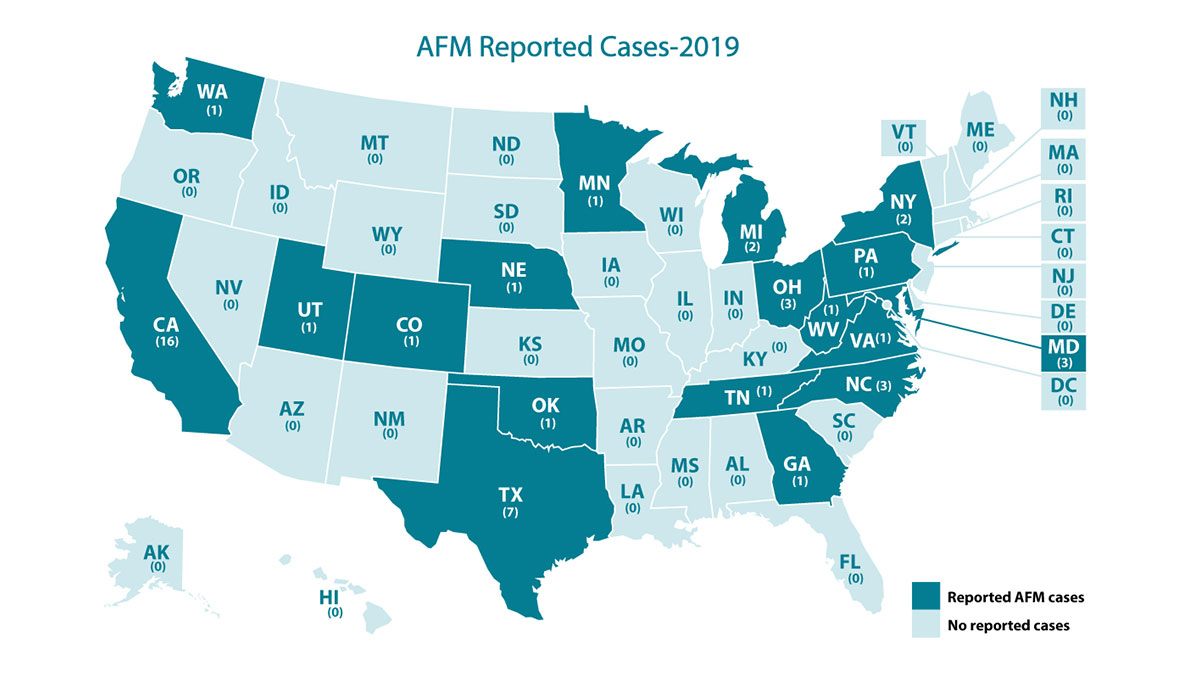
[h=2]Annual AFM Cases by State[/h]


afm-cases-reporting-2019.jpg
*Confirmed AFM cases as of November 26, 2019. Patients under investigation are still being classified, and the case counts are subject to change.
 
Source: https://www.cdc.gov/acute-flaccid-myelitis/cases-in-us.html [h=1]AFM Cases and Outbreaks[/h]
Espa?ol (Spanish)
On This Page
There are 33 confirmed cases in 2019 out of 131 reports of patients under investigation (PUIs). CDC, state, and local health departments are still investigating some of the PUIs.
There have been 603 confirmed cases since CDC began tracking AFM in August of 2014. CDC has been thoroughly investigating cases since that time. We have seen increases in AFM cases, mostly in young children, every two years.
No deaths were reported during the acute illness of patients with confirmed AFM who had limb weakness onset in 2018 and 2019; however, there were two reports of patients confirmed with AFM in 2018 who died months after limb weakness onset. We have also learned of deaths in cases confirmed in previous years.


[h=2]Annual AFM Cases by State[/h] Annual maps represent only cases for whom information was sent to and confirmed by CDC as of January 2, 2020. Patients under investigation are still being classified, and the case counts are subject to change.


afm-cases-reporting-2019.jpg
In 2019, there were 33 total confirmed cases in 16 states.
 
Back
Top