• FluTrackers.com Inc. does not provide medical advice. Information on this web site is collected from various internet resources, and the FluTrackers board of directors makes no warranty to the safety, efficacy, correctness or completeness of the information posted on this site by any author or poster. The information collated here is for instructional and/or discussion purposes only and is NOT intended to diagnose or treat any disease, illness, or other medical condition. Every individual reader or poster should seek advice from their personal physician/healthcare practitioner before considering or using any interventions that are discussed on this website. By continuing to access this website you agree to consult your personal physican before using any interventions posted on this website, and you agree to hold harmless FluTrackers.com Inc., the board of directors, the members, and all authors and posters for any effects from use of any medication, supplement, vitamin or other substance, device, intervention, etc. mentioned in posts on this website, or other internet venues referenced in posts on this website.
  • We are not asking for any donations. Do not donate to any entity who says they are raising funds for us.

Cameroon - Cholera outbreak 2021- 2023

Source: https://www.who.int/emergencies/disease-outbreak-news/item/2022-DON374


Cholera - Cameroon

16 May 2022


Outbreak at a glance

Cameroon is among several countries in West and Central Africa experiencing recurrent cholera outbreaks. Between 29 October 2021 and 30 April 2022, a total of 6652 suspected cases including 134 deaths (case fatality ratio 2%) have been reported.

Several risk factors can be attributed to the ongoing cholera outbreaks in Cameroon, including wide circulation of Vibrio cholerae in the country, limited access to safe drinking water in some areas, a seasonal pattern of cholera occurrence and inadequate WASH conditions.

Description of the outbreak

Cameroon has been reporting suspected cases of cholera since the beginning of 2021. The outbreak was declared by health authorities on 29 October 2021 and has been ongoing since then. As of 30 April 2022, 6652 suspected cases of cholera including 134 deaths (CFR 2%) have been reported from six regions - the South-West (4617 cases, 77 deaths), Littoral (1704 cases, 51 deaths), South (183 cases, two deaths), Central (125 cases, four deaths), North (15 cases, no death) and Far North (eight cases, no death) regions. Of the 6652 suspected cases, 5960 cases (90%) including 93 deaths (69%) have been reported in 2022. Between 29 October 2021 and 30 April 2022, a total of 1008 stool samples were tested from all six regions and 40 % (403) were confirmed positive for Vibrio cholerae O1 by culture.

Although the cholera outbreak started in late October, the number of weekly suspected cases increased from less than 200 in week nine of 2022 (ending 6 March) to 1262 in week 12 (ending 27 March). The overall CFR reported so far in 2022 (CFR 2%) is lower than CFR reported in 2021 (CFR 3.6%), however, it remains higher than the CFR of 1% expected during a cholera outbreak when timely treatment is available. Furthermore, the Central and Littoral regions continue to report high CFRs (CFR 2.9% and 3%, respectively).

While two regions, Central and South-West, reported cases of cholera in 2021, there has been a geographical expansion of the outbreak to five regions (Central, Littoral, North, South, South-West) since March 2022.

As of 30 April, the South-West region continues to be the most affected region with 4617 cases (69%) including 77 deaths (CFR 1.6%), of which 4069 cases (88%) were reported in 2022. Littoral is the second most affected region with 1704 (26%) cases and 51 deaths (CFR 3%), including 1684 (99%) cases reported in 2022.
Figure-1: Epi curve of cholera cases by date of symptom onset and outcome, Cholera, from 29 October to 30 April (n=6652)

Note: SE corresponds to Epidemiological week. Also, SE 41 to SE 52 corresponds to 2021 while SE1 to SE17 to 2022.
*CEN: Central region; LIT: Littoral region; EN: Far North region; NO: North region; SU: South region and SW: South-West region.
Figure 2: Distribution of cholera cases in Cameroon, from 29 October 2021 to 30 April (n=6552)Epidemiology of Cholera
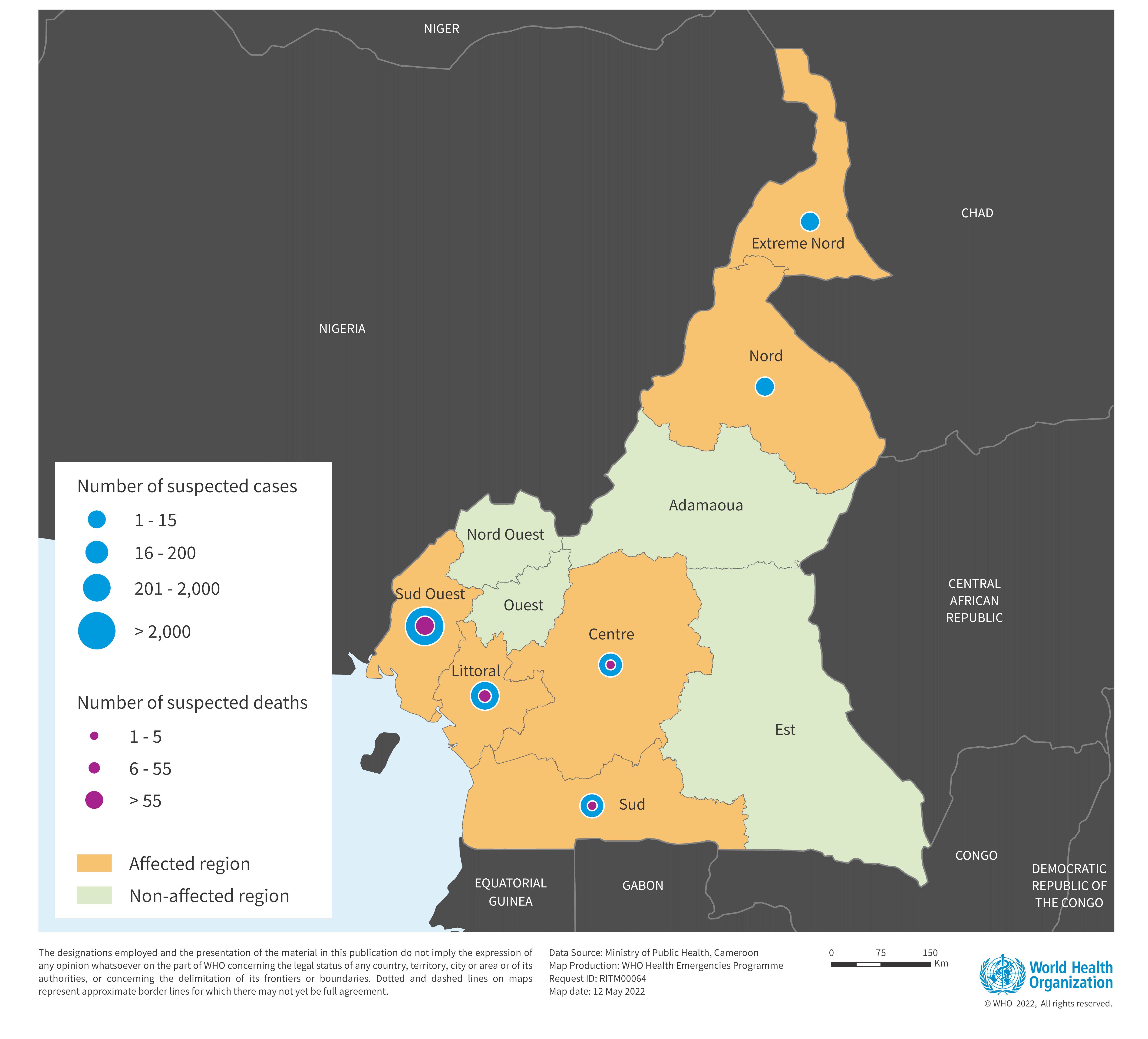
Epidemiology of Cholera
Cholera is an acute enteric infection caused by ingesting the bacteria Vibrio cholerae present in contaminated water or food. It is mainly linked to insufficient access to safe drinking water and inadequate sanitation. It is an extremely virulent disease that can cause severe acute watery diarrhoea resulting in high morbidity and mortality, and can spread rapidly, depending on the frequency of exposure, the exposed population and the setting. Cholera affects both children and adults and can be fatal if untreated.


The incubation period is between 12 hours and five days after ingestion of contaminated food or water. Most people infected with V. cholerae do not develop any symptoms, although the bacteria are present in their faeces for 1-10 days after infection and are shed back into the environment, potentially infecting other people. Among people who develop symptoms, the majority have mild or moderate symptoms, while a minority develop acute watery diarrhoea with severe dehydration. Cholera is an easily treatable disease. Most people can be treated successfully through prompt administration of oral rehydration solution (ORS).

Cholera can be endemic or epidemic. A cholera-endemic area is an area where confirmed cholera cases were detected during the last three years with evidence of local transmission (cases are not imported from elsewhere). A cholera epidemic can occur in both endemic countries and in non-endemic countries.

The consequences of a humanitarian crisis – such as disruption of water and sanitation systems, or the displacement of populations to inadequate and overcrowded camps – can increase the risk of cholera transmission, should the bacteria be present or introduced. Uninfected dead bodies have never been reported as the source of epidemics.

A multifaceted approach including a combination of surveillance, water, sanitation and hygiene, social mobilization, treatment, and oral cholera vaccines is essential to control cholera outbreaks and to reduce deaths.


Public health response

WHO has deployed teams of experts to support the response and is providing technical, logistical and financial support to the government. In addition,
  • The national incident management system is conducting regular coordination meetings with partners at the central and regional levels to support district teams.
  • A response plan was developed by the Ministry of Health and includes response partners.
  • Cholera kits have been provided to aid the response.
  • Advocacy meetings continue to be conducted with local and international partners.
  • Response teams were deployed to major outbreak sites to support the response activities and conduct investigations.
  • From 18 to 23 February, the first round of an oral cholera vaccine (OCV) campaign was organized in four health districts in South-West region. This campaign targeted 204 800 people with 85.5% administrative coverage. The vaccination campaign was extended to 11 more districts in the Littoral, South and the South-West Regions from 8 to 12 April 2022, targeting 842 086 people with an administrative coverage of 89%. This was combined with WASH interventions including distribution of water purification tablets (Aquatabs).
  • Mass chemoprophylaxis with OCV was performed in a prison region where a cholera outbreak was reported in late March.
  • Surveillance activities have been strengthened for active case finding and patient referrals in affected districts.
  • Decontamination of outbreak sites and households of confirmed cases have been conducted.
  • Community members and leaders were trained on hand washing, purification of water and disinfection of homes and public spaces.

WHO risk assessment

Cameroon is among several countries in West and Central Africa experiencing recurrent cholera outbreaks. Several risk factors including circulation of Vibrio cholerae especially in the North, Littoral, Central, and South-West regions, limited access to safe drinking water in some areas including in the capital city of Yaoundé, as well as cultural practices that contribute to unsafe WASH conditions exist in the country. There is a seasonal pattern of cholera occurrence in Cameroon that varies by region. In South-West and Littoral, currently the most affected regions, cholera is most often reported during the rainy season (November - April) or the transition between the rainy and the dry season. In the Central region, cholera is more frequently reported during the rainy season that occurs in May-June and October-November. The ongoing rainy season may increase the likelihood of further transmission in the country.

In addition, some affected areas of the country are insecure which further reduces the access to services making outbreak response more complex.

The cholera outbreak began surging in late October 2021, deteriorated further in March 2022 with the South-West region reporting 70% of cases. Limited geographic accessibility of some areas, security constraints, and suboptimal communication networks lead to irregular epidemiological updates and potential underreporting of cases. Additionally, high population movement of Internally Displaced Persons (IDPs), weak health system, insufficient human resources, poor knowledge of treatment protocols and low risk communication for cholera continue to pose challenges.

Furthermore, in the northern areas, Cameroon is bordered by Adamawa, Borno and Taraba states of Nigeria and there is frequent and substantial cross border movement posing a risk of transmission. There is also a risk of further international spread especially to the Republic of Chad which borders both Nigeria and Cameroon.

The country is conducting cholera vaccination which should help contain the outbreak, however, additional efforts supplemented by other interventions including access to adequate treatment and clean water are needed in order to control the outbreak.


WHO advice

WHO recommends improving access to clean water and sanitation, good waste management, food safety practices and hygienic practices to prevent the transmission of cholera. Oral cholera vaccines should be used in combination with improvements in water and sanitation to control cholera outbreaks and for prevention in areas known to be high risk for cholera.
Strengthening surveillance, especially at the community level, is advised. Appropriate case management, including improving access to care, should be implemented in outbreak-affected areas to reduce mortality. There is a need to ensure that countries are ready to quickly detect and respond to this cholera outbreak to reduce the risk of spread to new areas. Setting up oral rehydration points (ORPs) in communities is also critical to provide early management through oral rehydration, screening and referral of patients. As the outbreak is occurring in border areas where there is significant cross border movement, WHO encourages the respective countries to ensure cooperation and regular information sharing.
International travel or trade: WHO does not recommend any restriction on travel and trade to and from Cameroon based on the information available on the current outbreak...
 
WEEKLY BULLETIN ON OUTBREAKS
AND OTHER EMERGENCIES

Week 21: 16 – 22 May 2022
Data as reported by: 17:00; 22 May 2022

...
All events currently being monitored by WHO AFRO
...

Cameroon Cholera Grade 2

Date notified to WCO 1-Jan-21
Start of reporting period 25-Oct-21
End of reporting period 23-May-2022

Total cases 7 287
Cases Confirmed 413
Deaths 140
CFR 1.9%


From 25 Oct 2021 to 13 May 2022, a total of 7 287 suspected cases of cholera including 413 confirmed by culture and 140 deaths (CFR 1.9%) have been reported in Cameroon, from South-West (4 979 cases, 80 deaths; CFR 1.6%), Littoral (1 967 cases, 53 deaths; CFR 2.7%), South (182 cases, two deaths; CFR 1.1%), Centre (125 cases, four deaths; CFR 3.2%), Far-North (8 cases, no death), and North (26 cases, one death; CFR 3.8%) regions. The outbreak is currently active in three regions (Littoral, North and South-West) and 11 districts, out of the 30 that have already reported a suspected cholera case since October 2021.

https://apps.who.int/iris/bitstream/handle/10665/354552/OEW21-1622052022.pdf

https://www.afro.who.int/countries/...d-emergencies-bulletin-week-21-16-22-may-2022
 
Source: https://www.barrons.com/news/resurgence-of-cholera-kills-150-people-in-cameroon-01655144707?tesla=y


Resurgence Of Cholera Kills 150 People In Cameroon
By AFP - Agence France Presse
June 13, 2022

More than 150 people have died during a resurgence of cholera in Cameroon over the last eight months, the United Nations said on Monday.

"The health ministry registered 8,241 cases and 154 deaths," to the end of May, the United Nations Office for the Coordination of Humanitarian Affairs (OCHA) said.

Seven of the West African nation's 10 regions have reported cholera cases.

The worst-hit is the English-speaking Southwest with 5,628 cases and 90 deaths, followed by the Littoral with 2,208 cases and 58 deaths, OCHA said...
 
Translation Google

Cameroon: the cholera epidemic claims its first victims in the East region

19 Jul 2022 by Martin Atcha

The first cases of the cholera epidemic have been reported in the East region of Cameroon.

Until then spared, the Eastern region recorded its first cases of cholera. According to Radio Balafon, which quotes a press release from Grégoire Mvongo, governor of the East, three suspected cases including one death have been reported in the health district of Abong-Mbang, department of Haut-Nyong.

These are cases from the same family residing in the village of Mampang, a locality in the commune of Doumé. In order to contain the epidemic in this part of the country long spared, the administrative authorities of the region have activated the health alert system.

For his part, the Regional Public Health Delegate instructed all health district heads to strengthen epidemiological surveillance at all levels and in all reporting platforms, and to intensify community awareness on preventive measures. cholera, says the media.

The Southwest and Littoral regions are the most affected by this epidemic which continues to spread. Seven regions are now affected with more than 164 dead.

https://actucameroun.com/2022/07/19...es-premieres-victimes-dans-la-region-de-lest/
 
WEEKLY BULLETIN ON OUTBREAKS
AND OTHER EMERGENCIES

Week 32: 1 - 7 August 2022
Data as reported by: 17:00; 7 August 2022

...
All events currently being monitored by WHO AFRO
...
Cameroon Cholera Grade 2

Date notified to WCO 1-Jan-21
Start of reporting period 25-Oct-21
End of reporting period 3-Aug-22

Total cases 10 348
Cases Confirmed 904
Deaths 200
CFR 1.9%


Between 25 July and 3 August, 172 new suspected cases of cholera including three deaths have been reported from four active Regions (Centre, East, Littoral and West). As of 3 August 2022, 10 348 suspected cases including 200 deaths (CFR 1.9%) have been reported since October 2021, from eight Regions and 48 Districts of which 27 remain active. South-West (6 010 cases) and Littoral (3 581 cases) Regions have reported majority of cases. Of note, it has been 18 days without a case
notified in South-West.

https://apps.who.int/iris/bitstream/handle/10665/361525/OEW32-0107082022.pdf?sequence=1&isAllowed=y
 
Source: https://news.cgtn.com/news/2022-10-...oon-s-Far-North-region-1efrJDwDmkE/index.html

Africa 07:19, 19-Oct-2022
Cholera outbreak kills 10 in Cameroon's Far North region
CGTN

Authorities in Cameroon's Far North region on Tuesday declared an outbreak of cholera after recording at least 10 deaths arising from the disease.

A total of 113 suspected cases of cholera had been recorded as of Monday, the official media outlet CRTV reported, quoting the region's Governor Midjiyawa Bakari as saying. Bakari made the disclosure during a crisis meeting held Tuesday in Maroua, the region's capital...
 
Translation Google

Cholera: the Far North on alert, as the number of deaths increases

RELEASED ON TUESDAY, 25 OCTOBER 2022 12:40

The governor of the Far North, Midjiyawa Bakari (photo), convened a crisis meeting on October 17 in Maroua to deal with a new outbreak of cholera raging in the region. The administrative authority attributed this resurgence of the disease to poor local sanitation and invited all the forces to take the necessary measures to stop the spread of the epidemic.

He asked the mayors to revitalize the public awareness campaign on hygiene and sanitation measures. The regional delegation of Public Health has been instructed to strengthen epidemiological surveillance, while the regional delegation of Water and Energy must quickly make drinking water available to residents and coordinate services sanitation to avoid the transmission of the cholera vibrio. According to local health authorities, this new cholera epidemic has been raging since the beginning of the current month and is imported from neighboring Nigeria.

At least 176 cases have already been recorded, including 11 deaths. The Regional Public Health Delegate, Dr. Hamadou Bava Boubakary, said that 9 deaths have been recorded in the community, notably in Magdémé in the Mora health district in the Mayo-Sava department, reports Cameroon Tribune .in its current edition. The other two deaths, he said, were recorded at the Minawao refugee camp health center in Mokolo health district, Mayo-Tsanaga department. The United Nations High Commissioner for Refugees (UNHCR) said on Thursday October 19 that three deaths had been recorded in the camp. The UN agency then indicated that efforts are also underway to urgently intensify existing awareness campaigns on cholera and good hygiene practices in Minawao.

https://www.stopblablacam.com/socie...-alerte-alors-que-le-nombre-de-morts-augmente
 
Translation Google

Cholera epidemic: Peril on the Minawao camp

Mimi Mefo Info by Mimi Mefo Info November 1, 2022

The Minawao camp is located in the mayo tsanaga department. The camp is more than 75,000 refugees today.

Appeared only a few weeks ago, cholera is claiming many victims there, even if we note a reduction in the number of cases with the strong monitoring team set up by the Cameroonian State and the UNHCR, the High Commission of Nations united for refugees. If the authorities avoid giving current figures, we know that 8 to 10 people die every night, according to a source on site. Enough for the UNHCR to say “concerned” about the situation. As a reminder, as of October 19, 39 people were already infected for three deaths.

“Sector 1 is affected and the Minawaou camp has 4 sectors. So here our fight is that the other three sectors are spared from this critical situation. Imagine, if it happens that the other sectors are contaminated, I assure you that it would be the worst thing that the refugee camp will record with the loss of human lives” underlines Tchobwe Wawe the head of the Minawaou health area. .

The response has been organized since the appearance of the first case detected in sector 1 of the camp

“We are raising awareness in households to call on the population to wash their hands, to follow hygiene rules. These are among other things what we do in the community,” says Abdouraman Madou, volunteer for awareness.

Emergency measures are multiplying by the public authorities to control the situation at a time when the care center continues to receive cholera patients.

“It's not just the Minawaou camp that is in danger, even the ZAMAÏ community must now be careful. The public authorities must for the moment prohibit the exit of the refugees from the camp. However, the problem is that these same refugees go to Nigeria and come back. This is sloppiness in my opinion and here are the consequences.

There are deaths but not to demoralize the others, the communication remains closed and it is not good in my opinion” according to a traditional chief on condition of anonymity.

In the communities, volunteers have been appointed to go door to door, raising awareness of the danger of this disease, which has also enabled us to play a major role. The example of dating who is limited in order to control the situation. For now, a safety belt has been put in place to filter the entrances and exits of the Camp.

Mimi Mefo Info French (MMIF)

https://mimimefoinfos.com/epidemie-de-cholera-peril-sur-le-camp-de-minawao/
 
Translation Google

Cameroon: Cholera strikes the capital Yaoundé, 88 cases and 5 deaths recorded

- Health teams are hard at work to prevent the spread of the epidemic.

ekip | 20.04.2023 - Update: 20.04.2023

cameroon
AA / Yaoundé / Peter Kum

The capital of Cameroon, Yaoundé, has been hit "for four weeks" by the cholera epidemic, announced Wednesday evening, in a press release, the Ministry of Health.

"As of April 19, the epidemiological situation shows 88 people with notified cases and five deaths for a case fatality rate of 5.68%," said the same source, adding that the epidemic is currently in six health districts of the capital. Cameroonian.

The Cameroonian Minister of Public Health, Dr Manaouda Malachie, told Anadolu that faced with the situation, "health teams are hard at work to stem this epidemic, but more to prevent its spread to other regions" from country.

Still according to Manaouda Malachie, "the surveillance system has been put on alert" at the level of the Ministry of Public Health as well as in the Center region of which Yaoundé is the capital.
Health teams were mobilized "for sensitization and disinfestation of affected households and communities".

Cameroon has been suffering from a Cholera epidemic since October 2021. Of the ten regions of the country, in January 2023, four are still active: the Centre, the Littoral, the West and the Far North according to Médecins Sans Frontières (MSF ).

Cholera is an acute intestinal infection caused by bacteria found in dirty, stagnant water. It is therefore essential, in parallel with caring for the sick, to provide access to drinking water and hygiene.

Cholera causes acute watery diarrhea and can kill within hours if left untreated.

The Ministry of Health therefore calls on Cameroonians “to be vigilant and to observe the rules of hygiene”.

Since October 2021, the country has recorded 15,220 infections and 306 deaths, with a case fatality rate of 2% as of February 7, according to the Center for the Coordination of Public Health Emergency Operations (CCOUSP).

https://www.aa.com.tr/fr/afrique/cam...C3%A9s/2877450
 
Translation Google

Cholera epidemic spreads in South West Cameroon, one death recorded

Cameroun Actuel
August 26, 2023

A cholera outbreak continues to spread in the South West region of Cameroon, where three new cases have been confirmed in Buea and Tiko. According to information from CRTV, two of the patients were able to be treated and have now been discharged from the hospital, but unfortunately the third patient did not survive.

Faced with this situation, the health authorities are calling on the population to respect the usual hygiene rules in order to prevent the spread of the disease. With this in mind, a vaccination campaign was organized in 34 health districts in the Center region, where cholera had already appeared last March.

Since the start of this epidemic, more than 4,095 positive cases have been recorded in the Center region, with a total of 169 deaths and a fatality rate estimated at 3.92%. These alarming figures underline the importance of taking preventive measures to stem the spread of cholera.

Cholera is an acute diarrheal disease caused by ingesting water or food contaminated with the bacterium Vibrio cholerae. Symptoms include severe diarrhea, vomiting and rapid dehydration, which can lead to death if the correct treatment is not given quickly.

Health authorities are working closely with international organizations and local partners to contain the outbreak and provide medical care to those affected. Emergency measures have been taken to improve access to drinking water and adequate sanitation facilities in the affected areas.

It is essential that the population remain vigilant and follow the recommendations of the health authorities to prevent the spread of cholera. Following basic hygiene rules, such as washing your hands regularly, drinking clean water and cooking food well, can help prevent illness.


https://camerounactuel.com/lepidemi...le-sud-ouest-du-cameroun-un-deces-enregistre/
 
Translation Google

Cholera has killed 481 people in Cameroon in 2 years

Oct 18, 2023by Erel Djene

According to a recent report from the UN Office for the Coordination of Humanitarian Affairs (OCHA), since the start of the epidemic in October 2021, more than 20,000 people have been affected, of whom 481 have unfortunately lost their lives.

The report highlights a significant increase in cases since March 2023 in the Central region, which is now considered the new epicenter of the epidemic. Between August 9 and 23, 2023, 228 new cases of cholera, including 6 deaths, were reported in the Center, Littoral, West and South-West regions. It should be noted that these figures could be underestimated, as many people prefer to avoid hospitals for treatment.

The report identifies several factors contributing to the recurrence of the cholera epidemic in the country. First of all, limited access to drinking water in certain areas as well as poor water, hygiene and sanitation conditions favor the spread of the disease. In addition, low vaccination coverage, population movements, insufficient infrastructure and health personnel, as well as the limited implementation of preventive measures by the population are all challenges to be met.

In addition to the Central region, the Littoral, South, West and South-West regions are also affected by the cholera epidemic. It is therefore essential to put in place prevention and awareness measures throughout the country.

The government carried out a vaccination campaign against cholera between August 16 and August 20. This campaign targeted 34 health districts in the Central region. The vaccine was available to anyone aged at least one year, including pregnant and breastfeeding women. Dr. Brice Essomba Edzoa, regional coordinator of the Center's expanded vaccination program, highlighted the importance of this initiative in reaching 95% of the civilian population, estimated at more than 1.8 million people.


https://actucameroun.com/2023/10/18/le-cholera-a-tue-481-personnes-au-cameroun-en-2-ans/
 
Translation Google

Cholera: more than seven million people vaccinated since 2022

November 20, 2023

Cholera: more than seven million people vaccinated since 2022

Yaoundé – In 21 months, more than seven million people have benefited from reactive vaccination against cholera in Cameroon, from January 2022 to October 2023.

This figure was revealed in Seoul, South Korea, during the tenth meeting of the Global Task Force on Cholera Control (GTFCC). Held from October 11 to 13, 2023, the meeting discussed concrete actions to be implemented to meet current challenges. Also on the menu, research progress and priorities in cholera vaccination for the months to come.

Cameroon has been in a cholera epidemic since October 2021, with currently three active regions (Center, Littoral and South-West), 19 active health districts, 21,1822 cumulative cases reported and 506 deaths (case fatality rate 2.39%) .

The spread of the epidemic is also favored by the insecurity which prevails to varying degrees in four of the ten regions of Cameroon, causing the displacement of many people to large cities such as Yaoundé and Douala.

Living in makeshift shelters, an unsanitary environment and promiscuous situations, they are faced with risk factors for water-borne diseases such as cholera: overpopulation, insufficient hygiene and sanitation, inadequate drinking water supply, insufficient latrines in certain localities. , etc.
Hence cases of significant contamination in these large cities, with the epicenter of Yaoundé, the capital, which benefited from a response vaccination campaign against cholera in August 2023 with the support of the WHO, the UNICEF, GAVI...

1.8 million doses of oral cholera vaccine received in June 2023, were administered on this occasion in the Central region alone and precisely in the 11 most affected health districts including the city ​​Yaoundé.

The summary of data and lessons learned from cholera response vaccination campaigns since 2022, highlights that Cameroon has vaccinated 7,255,833 people out of 7,626,691 doses of Oral cholera vaccine (OCV), i.e. coverage of 94, 64%.

The participants of the 10th annual meeting of the working group (representatives of countries experiencing epidemics, members of the GTFCC, research institutions, donors, vaccine manufacturers, development partners) committed at the end of the meeting in Seoul, to collaborate on issues related to the production, distribution and administration of the OCV.

The working sessions reviewed and revised key guidance documents.

Doctor Nicole Mbarga presented on behalf of WHO Cameroon the situational analysis of the areas to be vaccinated for preventive campaigns while awaiting the allocation of preventive vaccines. Dr Jeudi Debnet, deputy director of immunization at the Ministry of Public Health, reiterated Cameroon's availability to work with all partners engaged in the fight against cholera.

On the sidelines of the work, meeting participants visited the Eubiologics laboratories, manufacturing Euvichol vaccine used during cholera vaccination campaigns.


https://www.afro.who.int/fr/countri...t-millions-de-personnes-vaccinees-depuis-2022
​​
 
Back
Top
