• FluTrackers.com Inc. does not provide medical advice. Information on this web site is collected from various internet resources, and the FluTrackers board of directors makes no warranty to the safety, efficacy, correctness or completeness of the information posted on this site by any author or poster. The information collated here is for instructional and/or discussion purposes only and is NOT intended to diagnose or treat any disease, illness, or other medical condition. Every individual reader or poster should seek advice from their personal physician/healthcare practitioner before considering or using any interventions that are discussed on this website. By continuing to access this website you agree to consult your personal physican before using any interventions posted on this website, and you agree to hold harmless FluTrackers.com Inc., the board of directors, the members, and all authors and posters for any effects from use of any medication, supplement, vitamin or other substance, device, intervention, etc. mentioned in posts on this website, or other internet venues referenced in posts on this website.
  • We are not asking for any donations. Do not donate to any entity who says they are raising funds for us.

Cambodia - 74 pediatric cases of unknown disease- - 56 deaths - fever, respiratory and neurological symptoms - Enterovirus EV71 identified

Re: Cambodia - 74 pediatric cases of unknown disease- - 56 deaths - fever, respiratory and neurological symptoms - Enterovirus EV71 identified

MASK
health-fitness_01_temp-1341904609-4ffbd6e1-620x348.jpg
:tiphat:http://www.timesofmalta.com/article.../Virus-linked-to-mystery-child-disease.427938
 
Re: Cambodia - 74 pediatric cases of unknown disease- - 56 deaths - fever, respiratory and neurological symptoms - Enterovirus EV71 identified

<INS style="POSITION: relative; PADDING-BOTTOM: 0px; MARGIN: 0px; PADDING-LEFT: 0px; WIDTH: 468px; PADDING-RIGHT: 0px; DISPLAY: inline-table; HEIGHT: 15px; VISIBILITY: visible; PADDING-TOP: 0px"><INS style="POSITION: relative; PADDING-BOTTOM: 0px; MARGIN: 0px; PADDING-LEFT: 0px; WIDTH: 468px; PADDING-RIGHT: 0px; DISPLAY: block; HEIGHT: 15px; VISIBILITY: visible; PADDING-TOP: 0px" id=aswift_0_anchor>Thailand -Disease warning for schools</INS></INS>
The Nation July 10, 2012 5:47 pm
Thailand-The Public Health Ministry on Tueday instructed schools and nurseries nationwide to close if they find that students in five classes or more have contracted hand, foot and mouth disease.


The move follows reports that at least 64 children in Cambodia died after being infected with enterovirus 71, know to cause the disease, since April this year.
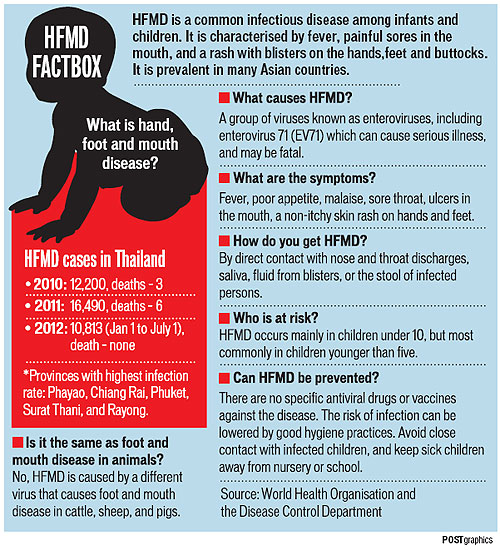
In Thailand, about 10,813 children are believed to have caught the disease during the most recent outbreak but there were no reports of any fatalities.
Disease Control Department director general Dr Pornthep Siriwanarangsan said the strain of hand, foot and mouth disease currently spreading in the country is not a virulent one.
It is recommended that children with fever, blister-like lesions on the tongue, gums and inside of the cheeks, and a pimple-like rash on the hands and feet be taken to a clinic for treatment.
About 20,000 nurseries have been told to suspend classes if they find that two or more children have been infected with the virus. School who find infected students in five classes have been told to close.:tiphat: http://www.nationmultimedia.com/national/Disease-warning-for-schools-30185866.html
 
Re: Cambodia - 74 pediatric cases of unknown disease- - 56 deaths - fever, respiratory and neurological symptoms - Enterovirus EV71 identified

'No need to panic,' Cambodia says on virus
PHNOM PENH, Cambodia ? Officials of a Cambodian hospital slammed the World Health Organization (WHO) for creating ?unnecessary panic? about a previously unidentified disease that has so far killed over 60 children here.

?There?s no need to panic,? Dr Denis Laurent, Biologist and Deputy Director of the Kantha Bopha Children?s Hospital (KBCH) in Phnom Penh told Rappler. Laurent is the assistant of Dr Beat Richner, the founder and head of KBCH who was the first to sound the alarm about the disease.
The WHO has alerted neighboring countries including the Philippines about an "unknown disease" that had killed 52 children in Cambodia.
The Pasteur Institute in Phnom Penh earlier announced that it discovered Enterovirus Type 71 in about two-thirds of patients. The virus is the ?perfect explanation? :magnify:for the deaths, according to the institute?s virology unit head Philippe Buchy who was cited by Bloomberg.
While the Enterovirus 71 was indeed found in a majority of the fatal cases, there are still questions left unanswered, Richner said in a statement released Sunday..

?Unfortunately, WHO gave a declaration on July 2 to [a news agency] without being clear on the facts being presented on June 29 in the Ministry Of Health by Kantha Bopha to all the [health] officials,? Richener said. ?WHO was telling the whole world: new mystery killer disease in Cambodia! This was causing unnecessary panic in Cambodia.?

pjcana-cambodia-07102012-1.JPG
LONG LINE. Parents and children are hoping to avail of free medical treatment. Photo by Paul John Cana

Richener added that the issue is ?not alarming."

?In June, 75,799 sick children were treated in our outpatient stations, 16,517 severely sick children were hospitalized, among them 5,534 severe cases of the hemorrhagic dengue fever. Only 34 cases with this??new? disease were hospitalized:confused:. This declaration by WHO?was neither professional nor necessary, but causing panic for nothing.?
...According to Laurent, no new fatalities from the disease have been reported since the latest statement issued by the hospital Sunday... :tiphat:http://www.rappler.com/world/8364-no-need-to-panic,-cambodia-says-on-virus
 
Re: Cambodia - 74 pediatric cases of unknown disease- - 56 deaths - fever, respiratory and neurological symptoms - Enterovirus EV71 identified

I wonder if testing for Sibu97 was done?

EV71 or Adenovirus? Hypothesis Arising from Two Epidemics Spanning 1997/98
by
T.G. Yap, MBBS (Singapore), PhD (Illinois),
Clinical Sciences Section,
International Medical University,
Bukit Jalil, Kuala Lumpur.
[snip]
Summary

I have summarized key points of clinical, epidemiological, virological and molecular data from published literature on the two HFMD-associated fatal epidemics that had ravaged both young children in both Malaysia and Taiwan. By way of forming hypotheses, I have attempted to reenact the common features of the 1997 Malaysian and 1998 Taiwan epidemics into events involving a single virus with emerging pathogenicity.

Hypothesis II postulating EV71 as the main culprit virus is argued to be untenable because of differing phylogenetic origins of the isolated EV71 from patients of the three territories (Sarawak, Peninsular Malaysia and Taiwan). Furthermore, the gross proportion of the Taiwanese lightly infected HFMD : serious HFMD : fatal cases were estimated to be 1.48 million : 327 : 78; while the comparable approximate proportion of the Sarawak cases were 10,000 : ? : 34. Such disproportionately small number of fatalities (when compared with the Sarawakian estimate) as well as other examined anomalous features of the Taiwan epidemic could be better explained by presuming an undiscovered fatal pathogen in the midst of gargantuan epidemic of light HFMD caused by EV71 and other enteroviruses.

The bulk of the the virological and molecular evidence supporting the Hypothesis III was published in a singular paper in Lancet by Cardosa and colleagues in September 1999. The evidence pointed towards a new subgenus B adenovirus named temporarily Sibu97 as the main culprit virus in the Sarawak outbreak, perhaps interacting with enteroviruses. The pervasive influence of the "EV71 paradigm" and the fastidious nature of the new adenovirus could have accounted for failure of virus laboratories outside of Sarawak?s UNIMAS to culture and characterize it. All the cumulative evidence were consistent with the hypothesis that Sibu97 or its close relatives was the undiscovered lethal pathogen in both the Taiwan and Peninisular Malaysian outbreaks.

In the Discussion, I further argue that adenovirus-associated "myocardial akinesia" is scientifically a more plausible mechanism of death than the EV71-associated rhombencephalitis and "neurogenic pulmonary edema". The possibility of two viruses interacting with each other through their co-evolution with human genomes, especially in immune evasion, in order to achieve common pathogenicity is raised.
 
Re: Cambodia - 74 pediatric cases of unknown disease- - 56 deaths - fever, respiratory and neurological symptoms - Enterovirus EV71 identified

[Source: European Centre for Disease Prevention and Control, full page: (LINK).]


Cambodia: fatal illness in children now linked to enterovirus 71


10 Jul 2012 / ECDC


The Cambodian Ministry of Health and the World Health Organization (WHO) are currently investigating a number of cases an undiagnosed illness that has resulted in the deaths of several children in Cambodia in the past 2 months. According to the WHO, the latest laboratory results indicate that ?a significant proportion of the samples tested positive for Enterovirus 71 (EV-71), which causes hand foot and mouth disease?.

Although the laboratory samples were not available for all the cases, as a number of children died before appropriate samples could be taken, a significant proportion of those where specimens were available tested positive for EV-71.

This virus has been known to cause severe disease with complications. Samples tested negative for influenza A(H5N1) (?bird flu?) other influenza viruses, SARS and Nipah viruses.

In their latest update, the authorities revised the number of hospitalised children believed to be affected by the illness between April and 5 July 2012 to a total of 59. Out of these, 52 have died. The majority of the cases reported are in children under 3 years of age.

The WHO, supported by the Pasteur Institute of Cambodia and the U.S. Centers for Disease Control and Prevention, is assisting the Cambodian Ministry of Health with early warning surveillance data, laboratory and field investigations.

Further investigations are ongoing, including the correlation between the laboratory and epidemiological information. ECDC will continue to monitor the situation.


Read more

Related Links
-
------
 
Re: Cambodia - 74 pediatric cases of unknown disease- - 56 deaths - fever, respiratory and neurological symptoms - Enterovirus EV71 identified

Source: http://online.wsj.com/article/SB10001424052702303567704577518312828428088.html


ASIA NEWS
Updated July 10, 2012, 10:58 a.m. ET

Authorities Walk Fine Line With Cambodia Virus
By PATRICK BARTA

As Cambodian authorities grapple with a disease outbreak that has killed more than 50 children, they're also struggling with another issue: how to best manage interest from the outside world without triggering alarm.

The issue bubbled to the surface earlier this week when Beat Richner, a well-known doctor in Cambodia and founder of the Kantha Bopha Children's Hospitals where the disease was first reported, complained that international health authorities moved too quickly to sound the alarm, risking a panic before they had all the facts...
 
Re: Cambodia - 74 pediatric cases of unknown disease- - 56 deaths - fever, respiratory and neurological symptoms - Enterovirus EV71 identified

:tiphat: crofsblogs

'Cambodian infection is encephalitis type, not HFMD'


MANILA, Philippines - The World Health Organization (WHO) and the Department of Health (DOH) reported today that the disease that struck and killed Cambodian children in the last few months was of the encephalitis type and not the hand foot and mouth disease (HFMD) they earlier reported.

The health agencies maintained, however, that the new strain discovered is linked to the Enterovirus-71 (EV-71), which causes different diseases of varying intensities.

EV-71 may also cause HFMD as well as acute respiratory disease, acute flaccid paralysis (polio-like), and the deadly brainstem encephalitis.

Encephalitis is an acute inflammation of the brain.

?Affected Cambodian children generally presented with fever followed by rapid respiratory deterioration and impaired consciousness. Death occurred 24 hours from hospital confinement,? DOH said.

..


http://www.abs-cbnnews.com/nation/07/10/12/cambodian-infection-encephalitis-type-not-hfmd?
 
Re: Cambodia - 74 pediatric cases of unknown disease- - 56 deaths - fever, respiratory and neurological symptoms - Enterovirus EV71 identified

Tight watch against enterovirus
Tuesday, 10 July 2012 20:48


Philippines
AIRPORT quarantine authorities are spraying incoming airplanes,:confused: either with connecting flight or direct from Cambodia, with disinfectants in a bid to control or prevent the entry of the deadly virus traced to have killed 61 children in Cambodia this past week....
.....On Tuesday the officials sprayed three Cebu Pacific flights from Saigon, one Philippine Airlines flight, also from Saigon, one Kuwait Airways which made a stopover in Bangkok and a Thai Airways from the Thai capital.
:tiphat:http://businessmirror.com.ph/home/nation/29754-tight-watch-against-enterovirus


As part of the airport’s precautionary measures, quarantine officers assigned to each incoming flight spray “Coopex” germ disinfectants on aircraft cabins to extinguish the virus.:tiphat:http://manilastandardtoday.com/www2/2012/07/11/health-airports-alerted-to-enterovirus-71/
 
Re: Cambodia - 74 pediatric cases of unknown disease- - 56 deaths - fever, respiratory and neurological symptoms - Enterovirus EV71 identified

Other than the rules of the International Health Regulation - that activates alert response when an undiagnosed / unexplained condition hits a number of individuals closely related in time and space with no pathogen or transmission mode known - it is hard to explain a such move by the WHO and other health agencies relating to this specific Cambodia outbreak.

In the meantime, enteroviral outbreaks with sustained health care impact are active elsewhere, in Romania for example (ECDC), even though media coverage is absent or negligible.

Perhaps Cambodia under scrutiny because of the recurrent isolated cases of human H5N1 avian influenza virus infection or for a number of emerging or re-emerging infectious diseases.

(IOH)
 
Re: Cambodia - 74 pediatric cases of unknown disease- - 56 deaths - fever, respiratory and neurological symptoms - Enterovirus EV71 identified

CNN’s Sanjay Gupta Talks To Mediaite About Mystery Illness Claiming Lives In Cambodia

Video
by Alex Alvarez | 3:04 pm, July 10th, 2012

CNN’s Sanjay Gupta is in Cambodia this week, covering a perplexing illness that, to date, has taken the lives of over 50 young children. Gupta, a neurosurgeon, has been talking with local doctors and officials from the World Health Organization in an effort to determine what, exactly, has caused these children to succumb and perish so quickly. Eleven hour time difference be damned, Gupta graciously made time to speak with us about his report and what he’s been able to learn so far.
According to Dr. Gupta, the illness appears to be some combination of an enterovirus (Type 71, specifically) and a second, “mystery” component still being investigated. He explained that these issues manifest in children who “arrived with mild symptoms, were treated and given medicine — bad medicine, or medicine that was inappropriate or wrong.” The issue of patients being given medicine that is incorrect, old, diluted or counterfeit is a widespread one, he noted, and one that poses a real and fatal threat across third world countries and the United States alike....:tiphat:http://www.mediaite.com/tv/cnns-san...d&utm_campaign=Feed:+mediaite/ClHj+(Mediaite)
 
Re: Cambodia - 74 pediatric cases of unknown disease- - 56 deaths - fever, respiratory and neurological symptoms - Enterovirus EV71 identified

Could very well be an "all of the above": virulent form of virus, delay in treatment, inappropriate use of steroids, bacterial contamination in medicines, dengue co-infections, etc. And I'm not 100% sure we will get an exact answer. As Emily's post above indicates, there have been large clusters of deaths elsehwere in the world blamed on EV71 in the past could decades.

http://blogs.discovermagazine.com/8...ease-may-have-a-name-but-why-is-it-so-lethal/

Mysterious Cambodian Disease May Have a Name. But Why Is It So Lethal?

Last week, the World Health Organization reported that an unknown respiratory disease was killing children in Cambodia at terrifying rates. The latest word is that of the 59 kids admitted to hospitals with the disease since April, 52 have died.

Mara Hvistendahl at ScienceInsider has corresponded with the team of virologists in Phnom Penh who are working to identify the illness, and while the diagnosis isn’t certain, they say that they’ve found signs of Enterovirus 71 in cerebrospinal fluid from 15 patients. Enterovirus 71 is one of the causes of hand, foot, and mouth disease, a usually benign childhood infection that causes a rash, vomiting, and other symptoms. The disease is very common and usually clears up in a week or so, and, as with most viral infections, has no cure to speak of.

A small proportion of patients with hand, foot, and mouth disease (not to be confused, incidentally, with foot and mouth disease, a livestock infection) do develop neurological complications that can put them in the hospital and even kill them. But, as Hvistendahl points out, the statistics in the Cambodian outbreak are a little odd. Cambodia is a small country, about 15 million people, and for this many kids to be developing complications and dying of them, a truly large chunk of the population would have to be infected. To put that in perspective, neighboring Vietnam, which had an outbreak of the disease earlier this year, has more than 86 million people and reported only 20 deaths.

Health officials don’t know how many people in Cambodia have the disease, nor do the virologists know whether there’s anything unusual about this strain of Enterovirus 71. It’s on their list to find out, though, as they culture more samples and prepare to sequence the strain’s genome.
 
Re: Cambodia - 74 pediatric cases of unknown disease- - 56 deaths - fever, respiratory and neurological symptoms - Enterovirus EV71 identified

<TABLE class=contentpaneopen><TBODY><TR><TD class=contentheading width="100%">Research Continues Into Mystery Disease in Cambodia </TD><TD class=buttonheading width="100%" align=right>http://www.plenglish.com//index2.php?option=com_content&do_pdf=1&id=524596</TD><TD class=buttonheading width="100%" align=right>http://www.plenglish.com//index2.php?option=com_content&task=view&id=524596&pop=1&page=0&Itemid=1</TD><TD class=buttonheading width="100%" align=right>http://www.plenglish.com//index2.php?option=com_content&task=emailform&id=524596&itemid=1</TD></TR></TBODY></TABLE><TABLE class=contentpaneopen><TBODY><TR><TD class=createdate vAlign=top colSpan=2></TD></TR><TR><TD vAlign=top colSpan=2></TD></TR><TR><TD vAlign=top colSpan=2>10 de julio de 2012, 15:20

Phnom Penh, July 10
(Prensa Latina) Specialized physicians are continuing their tireless efforts today to identify a rare disease that has killed at least 61 children under three years of age in Cambodia.


Virologists at the Pasteur Institute, involved in the investigation, dismissed for now that it has anything to do with Enterovirus 71 (EV71), associated with brucellosis, as a cause of the sudden outbreak of severe fever and respiratory and neurological problems detected in the Kantha Bopha Children's Hospital in this capital.

However, they are considering the possibility that since brucellosis is endemic in neighboring Indochinese countries, they may be dealing with a mutation of the virus.

According to doctor Nima Asgari, epidemiologist from the World Health Organization (WHO), the research is helping make the situation less mysterious, but clinical manifestations continue to be closely watched.

Although 15 of the 24 blood samples analyzed by Pasteur Institute showed the presence of EV71, Asgari noted that these results require further research in the coming days.

According to Pieter Van Maaren, from WHO, it has not been easy to diagnose, but a travelers alert is currently considered unnecessary.

Authorities from Hong Kong did issue an alert, as it is part of a major air route with Phnom Penh.

Cambodian Health Minister, Mam Bunheng, called on families to carry out good hygienic practices and take minors to the hospital in case of any symptom, because delays cause infections and neurological, cardiovascular, and respiratory complications as well as encephalitis.
</TD></TR></TBODY></TABLE><TABLE class=contentpaneopen><TBODY><TR><TD class=contentheading width="100%">:tiphat:http://www.plenglish.com/index.php?option=com_content&task=view&id=524596&Itemid=1</TD><TD class=buttonheading width="100%" align=right>http://www.plenglish.com//index2.php?option=com_content&do_pdf=1&id=524596</TD><TD class=buttonheading width="100%" align=right>http://www.plenglish.com//index2.php?option=com_content&task=view&id=524596&pop=1&page=0&Itemid=1</TD><TD class=buttonheading width="100%" align=right>http://www.plenglish.com//index2.php?option=com_content&task=emailform&id=524596&itemid=1</TD></TR></TBODY></TABLE><TABLE class=contentpaneopen><TBODY><TR><TD class=createdate vAlign=top colSpan=2></TD></TR><TR><TD vAlign=top colSpan=2></TD></TR><TR><TD vAlign=top colSpan=2>


</TD></TR></TBODY></TABLE>
 
Re: Cambodia - 74 pediatric cases of unknown disease- - 56 deaths - fever, respiratory and neurological symptoms - Enterovirus EV71 identified

Mainland baby, young girl treated for deadly virus

<!-- Two mainland children - a five-year- old girl from Guangxi and a 39-day-old baby boy from Shenzhen - are being treated at Hong Kong hospitals for a severe form of enterovirus infection, the Centre for Health Protection said last night.

//-->
Mary Ann Benitez

Wednesday, July 11, 2012

Two mainland children - a five-year- old girl from Guangxi and a 39-day-old baby boy from Shenzhen - are being treated at Hong Kong hospitals for a severe form of enterovirus infection, the Centre for Health Protection said last night.

It is the third and fourth such case of the infection this year and comes days after Cambodia announced that Enterovirus71 was....

The clinical diagnosis was meningitis due to EV infection, with her cerebrospinal fluid specimen testing positive for the virus. Her condition is stable.
The girl's older twin brothers, aged seven, also had symptoms and sought medical help. Other family members did not have any symptoms.
The baby boy lives in Shenzhen and had fever on July 4. He was brought to Hong Kong for treatment the next day and admitted to Prince of Wales Hospital in Sha Tin.
He no longer has fever and was stable last night.
:magnify:His cerebrospinal fluid specimen tested positive for EV while his rectal swab tested positive for the Coxsackie virus. Both viruses cause hand, foot and mouth disease, so called because of characteristic rashes...
The specific strain of EV for both children has not yet been typed, but most likely could be EV71, which experts and the CHP have said "is more likely associated with severe medical complications and even death." ...

:tiphat:http://www.thestandard.com.hk/news_...3&sid=36991720&con_type=1&d_str=20120711&fc=2
 
Re: Cambodia - 74 pediatric cases of unknown disease- - 56 deaths - fever, respiratory and neurological symptoms - Enterovirus EV71 identified

<TABLE class=contentpaneopen><TBODY><TR><TD class=contentheading width="100%">Research Continues Into Mystery Disease in Cambodia </TD><TD class=buttonheading width="100%" align=right>http://www.plenglish.com//index2.php?option=com_content&do_pdf=1&id=524596</TD><TD class=buttonheading width="100%" align=right>http://www.plenglish.com//index2.php?option=com_content&task=view&id=524596&pop=1&page=0&Itemid=1</TD><TD class=buttonheading width="100%" align=right>http://www.plenglish.com//index2.php?option=com_content&task=emailform&id=524596&itemid=1</TD></TR></TBODY></TABLE><TABLE class=contentpaneopen><TBODY><TR><TD class=createdate vAlign=top colSpan=2></TD></TR><TR><TD vAlign=top colSpan=2></TD></TR><TR><TD vAlign=top colSpan=2>10 de julio de 2012, 15:20

Phnom Penh, July 10
(Prensa Latina) Specialized physicians are continuing their tireless efforts today to identify a rare disease that has killed at least 61 children under three years of age in Cambodia.


Virologists at the Pasteur Institute, involved in the investigation, dismissed for now that it has anything to do with Enterovirus 71 (EV71), associated with brucellosis, as a cause of the sudden outbreak of severe fever and respiratory and neurological problems detected in the Kantha Bopha Children's Hospital in this capital.

However, they are considering the possibility that since brucellosis is endemic in neighboring Indochinese countries, they may be dealing with a mutation of the virus.

According to doctor Nima Asgari, epidemiologist from the World Health Organization (WHO), the research is helping make the situation less mysterious, but clinical manifestations continue to be closely watched.

Although 15 of the 24 blood samples analyzed by Pasteur Institute showed the presence of EV71, Asgari noted that these results require further research in the coming days.

According to Pieter Van Maaren, from WHO, it has not been easy to diagnose, but a travelers alert is currently considered unnecessary.

Authorities from Hong Kong did issue an alert, as it is part of a major air route with Phnom Penh.

Cambodian Health Minister, Mam Bunheng, called on families to carry out good hygienic practices and take minors to the hospital in case of any symptom, because delays cause infections and neurological, cardiovascular, and respiratory complications as well as encephalitis.
</TD></TR></TBODY></TABLE><TABLE class=contentpaneopen><TBODY><TR><TD class=contentheading width="100%">:tiphat:http://www.plenglish.com/index.php?option=com_content&task=view&id=524596&Itemid=1</TD><TD class=buttonheading width="100%" align=right>http://www.plenglish.com//index2.php?option=com_content&do_pdf=1&id=524596</TD><TD class=buttonheading width="100%" align=right>http://www.plenglish.com//index2.php?option=com_content&task=view&id=524596&pop=1&page=0&Itemid=1</TD><TD class=buttonheading width="100%" align=right>http://www.plenglish.com//index2.php?option=com_content&task=emailform&id=524596&itemid=1</TD></TR></TBODY></TABLE><TABLE class=contentpaneopen><TBODY><TR><TD class=createdate vAlign=top colSpan=2></TD></TR><TR><TD vAlign=top colSpan=2></TD></TR><TR><TD vAlign=top colSpan=2>


</TD></TR></TBODY></TABLE>

And that is a really bad article, resulting from several translation errors. It is from Prensa Latina, which publishes in Spanish originally, but that is their English language version. Brucellosis has nothing to do with this outbreak or with EV71. I think the source of the error involves mistaking HFMD, which is caused by EV71, for FMD, which is an animal disease, and then mistaking FMD for brucellosis, as the two diseases affect the same animals. Even that is a bit of a stretch as FMD is a virus, and brucellosis is bacterial. I can't find the Spanish version, but it wouldn't surprise me if it errantly used the phrase "fiebre aftosa" or "aftosa humana" which is an incorrect term for HFMD (it really refers to FMD). I also like the "delays cause infections" translation near the end of the article.

Of course, neither FMD or brucellosis are endemic in neighboring countries, nor have anything to do with this outbreak.

Update: The Spanish original is here:

http://www.prensa-latina.cu/index.php?option=com_content&task=view&id=524377&Itemid=5

and it makes just as little sense in Spanish as Treyfish's article does in English, so the translation errors likely occurred from English (in Cambodia) to Spanish (in Cuba), and not in the translation from the Spanish article to the English one.
 
Re: Cambodia - 74 pediatric cases of unknown disease- - 56 deaths - fever, respiratory and neurological symptoms - Enterovirus EV71 identified

Positive for 2 diff strains. How common is that?
 
Re: Cambodia - 74 pediatric cases of unknown disease- - 56 deaths - fever, respiratory and neurological symptoms - Enterovirus EV71 identified

:D
And that is a really bad article, resulting from several translation errors. It is from Prensa Latina, which publishes in Spanish originally, but that is their English language version. Brucellosis has nothing to do with this outbreak or with EV71. I think the source of the error involves mistaking HFMD, which is caused by EV71, for FMD, which is an animal disease, and then mistaking FMD for brucellosis, as the two diseases affect the same animals. Even that is a bit of a stretch as FMD is a virus, and brucellosis is bacterial. I can't find the Spanish version, but it wouldn't surprise me if it errantly used the phrase "fiebre aftosa" or "aftosa humana" which is an incorrect term for HFMD (it really refers to FMD). I also like the "delays cause infections" translation near the end of the article.

Of course, neither FMD or brucellosis are endemic in neighboring countries, nor have anything to do with this outbreak.

Update: The Spanish original is here:

http://www.prensa-latina.cu/index.php?option=com_content&task=view&id=524377&Itemid=5

and it makes just as little sense in Spanish as Treyfish's article does in English, so the translation errors likely occurred from English (in Cambodia) to Spanish (in Cuba), and not in the translation from the Spanish article to the English one.
:tiphat::cool:
 
Re: Cambodia - 74 pediatric cases of unknown disease- - 56 deaths - fever, respiratory and neurological symptoms - Enterovirus EV71 identified

HFMD in Thailand is under control, says deputy minister

Hand, foot, and mouth disease (HFMD) in Thailand is under control thanks to measures put in place to prevent a virulent strain from spreading to Thailand from Cambodia, Deputy Public Health Minister Surawit Khonsomboon said yesterday.
405489.jpg

Extraordinary surveillance measures were being implemented to keep Enterovirus Type 71 (EV-71), a strain of HFMD that has claimed the lives of more than 60 children in Cambodia, from spreading to Thailand, Dr Surawit said.
Parents are being advised to encourage their children to wash their hands often and avoid taking them to crowded places, Dr Surawit said.
If parents suspect an infection they should immediately take their children to a doctor to reduce the risk of complications of the disease which can affect victims' brains, lungs, and hearts, he said.
Authorities have sent a communicable disease control unit to the Chong Jom-Osamach border crossing in tambon Dan of Kap Choeng district of Surin to screen Cambodian parents and their children for HFMD virus strains.
Any Cambodian travellers suspected of carrying the virus would be quarantined, the Surin provincial health office said.

Meanwhile, parents of 16 Cambodian children attending a pre-school child centre in Ban Dan in the same border district of Surin were asked to take their children back to Osamach in Cambodia.
Sirichai Tantiratananon, president of tambon Ban Dan administration organisation, said it was a temporary measure to prevent the children infecting their Thai peers.
Satawas Sinprasitkul, director of Kap Choeng district hospital, said no Cambodian patients with EV-71 has been admitted to his hospital since the virus was found across the border three months ago.
Dr Apichart Rodsom, chief of the provincial health office in Kanchanaburi, said four new HFMD cases in children aged three to five which were reported this week were not the EV-71 strain.

EV-71 is one of two pathogens commonly found in infected Thai patients, but it was a virulent form of the virus that was detected in recent Thai cases, the permanent secretary for public health, Dr Paijit Warachit, said. The other type of HFMD virus commonly found in Thailand is Coxsackie A 16, he said.:tiphat:http://www.bangkokpost.com/news/loca...eputy-minister
 
Re: Cambodia - 74 pediatric cases of unknown disease- - 56 deaths - fever, respiratory and neurological symptoms - Enterovirus EV71 identified

The border medical quarantine, block "unknown disease" in Vietnam , Wednesday, 11/07/2012 (GMT +7)

On 10-7, Department of Preventive Medicine (Ministry of Health) dispatch center requests the international medical quarantine center of preventive medicine are quarantine border activity immediately deploy the following activities: close monitoring for people on entry, especially for objects suspected carrier of infectious diseases through gate examination and medical treatment facilities for entry, examination and isolation of cases suspected infectious disease.

Close coordination with the forces at the gate function of the inspection and supervision of imported animals and animal products across the border. Said request was made while in Cambodia division occurs without defined disease causes 74 cases and hospitalized treatment, including 56 deaths... :tiphat:http://www.nhandan.com.vn/cmlink/nh...n-gi-i-ng-n-ch-n-b-nh-l-vao-vi-t-nam-1.357278
 
Re: Cambodia - 74 pediatric cases of unknown disease- - 56 deaths - fever, respiratory and neurological symptoms - Enterovirus EV71 identified

http://www.medpagetoday.com/InfectiousDisease/GeneralInfectiousDisease/33698

'Mystery' Illness Likely Not Only in Cambodia
By Michael Smith, North American Correspondent, MedPage Today
Published: July 10, 2012
Take Posttest

The illness suspected of killing several dozen children in Cambodia is no stranger to the region, according to the CDC.

Some 40,000 cases of hand, foot, and mouth disease caused by enterovirus-71 have been reported since the start of the year in neighboring Vietnam, the CDC reported on its website, and other countries have been affected in recent years.

In fact, large outbreaks "occur frequently in some countries in Asia," the agency said in an advice to travellers that was released May 25. Affected countries have included China, Japan, Singapore, and Australia, as well as Vietnam.

But the question that is currently preoccupying investigators is why the disease appears to be so severe in the relatively small outbreak in Cambodia, a CDC spokesman told MedPage Today.

According to the World Health Organization, the outbreak killed 52 of 59 affected children, but Phnom Penh pediatrician Beat Richner, MD, who first called attention to the outbreak, reported 66 cases, with just two survivors.

Either way, the case fatality rate is markedly higher than health officials have seen in Vietnam, where just 20 deaths in 10 provinces have been reported.

Hand, foot, and mouth disease associated with enterovirus-71 can be mild, but a rapidly fatal syndrome of brainstem encephalitis combined with neurogenic pulmonary edema was identified in 1999.

That seems to match Richner's description of the symptoms seen in his Kantha Bopha children's hospitals: encephalitis followed by "total destruction" of the alveoli, which is the main cause of death.

But in most outbreaks that fatal syndrome has been relatively rare. The CDC spokesman said the agency is working with Cambodian officials and the WHO both to pin down the cause of the deaths and to investigate why so many are fatal.

Although samples were not taken from all of the affected children, the WHO reported that a "significant proportion" of available samples tested positive for enterovirus-71

The Cambodian cases began showing up in April at the Kantha Bopha hospital in Phnom Penh, a regional pediatric center, with what the WHO called a "common syndrome of fever, respiratory and neurological signs."

They ranged in age from 3 months to 11 years, but most were younger than 3 years old.

Hand, foot, and mouth disease is contagious, although it usually leads to mild, self-limiting disease with few complications. Common symptoms include fever, sores in the mouth, and a rash with blisters on hands, feet, and buttocks.

It is usually a result of infection with coxsackievirus A16, but enterovirus-71 can also cause the illness.

[snip]

 
Back
Top Bottom