

Commonground
Senior Moderator
[Emphasis is mine]
California Department of Public Health
Health Advisory
Healthcare Providers
Influenza Update: Vaccinate, Test, and Administer Influenza Antivirals
1/5/2026
Key Messages
Background
Seasonal influenza activity in California is increasing with influenza A(H3N2) comprising the majority of currently circulating specimens. A newly emerged virus strain, H3N2 subclade K, is circulating globally and is now present in California. This strain is antigenically drifted from the H3N2 component of the 2025–26 seasonal influenza vaccine formulation and has been associated with earlier waves of influenza outbreaks in Canada, Japan, and the UK.
During the most recent national reporting week (influenza week 51), 97% of influenza viruses reported by US public health laboratories were influenza A, and of the A viruses that were subtyped, 92% were A(H3N2) and 8% were influenza A(H1N1)pdm09. Of the A(H3N2) viruses collected this season that underwent addition genetic characterization at CDC, 89% belonged to subclade K.
At this time, the World Health Organization reports there is no sign of increased disease severity associated with subclade K based on current epidemiological data. Historically, H3N2 viruses have been linked to more influenza-associated hospitalizations and deaths in older adults, especially those 65 or older.
Early UK estimates of 2025-26 influenza vaccine effectiveness (VE) against hospitalization were ~70–75% in children and ~30–40% in adults, consistent with historical ranges despite H3N2 subclade K antigenic drift and suggesting that influenza vaccination remains an effective tool in preventing influenza-related hospitalizations this season. However, VE in the U.S. may differ since the UK's vaccination program is based predominantly on live attenuated and cell-based vaccines rather than egg-based vaccines, which are more commonly used in the United States.
In California, early estimates of 2025-26 influenza VE against laboratory-confirmed influenza infection are ~30-40% against influenza A and influenza B. All VE estimates are based on data from October 1 through December 29, 2025, and are subject to change as the season progresses.
Short term forecasts suggest that influenza hospital admissions will continue to increase in California over the next four weeks. Preliminary scenario modeling projects a lower peak burden of influenza hospitalization than the 2024-25 season. However, these projections may change as information about this season emerges, including subclade K related factors.
CDPH has received the first report of a California pediatric influenza-associated fatality for this winter respiratory virus season. Young children are at higher risk of severe complications from influenza, especially if they have underlying medical conditions. Nationally, eight pediatric influenza-associated fatalities have been reported to CDC this season.
As California's respiratory virus activity begins to rise this season, clinicians are urged to recommend vaccination, timely testing, and treatment, especially in high-risk groups.
Recommendations
Administer the 2025-26 Influenza Vaccine
Recommend the 2025-26 influenza vaccine to everyone 6 months and older who has no contraindications and has not yet received a dose of the seasonal influenza vaccine. Vaccination remains the primary tool to prevent severe influenza outcomes. It can also help reduce absences from work, school and extracurricular activities, and provides protection for the most vulnerable.
Children aged 6 months through 8 years receiving influenza vaccine for the first time, with only one prior dose, or with unknown vaccination history, should receive two doses of influenza vaccine, at least 4 weeks apart. For adults 65 years and older, high-dose, recombinant, or adjuvanted influenza vaccines are preferentially recommended. A new option this season is shipment of LAIV to the home for administration by self or caregiver.
Influenza vaccine is also recommended for healthcare workers and other people who live with or care for people at higher risk of influenza complications. For the most current information on respiratory virus immunizations, see CDPH's Public Health for All page.
Conduct Molecular Respiratory Virus Testing
Test for seasonal influenza in patients with respiratory illness. Because respiratory symptoms can indicate multiple viral and bacterial etiologies, diagnostic testing for influenza and other respiratory pathogens can guide clinical management, antimicrobial treatment when appropriate, and infection prevention and control measures.
Rapid molecular tests are recommended over rapid antigen tests due to their higher sensitivities to detect influenza viruses in respiratory specimens. However, at-home combined influenza/COVID-19 tests can be used when available. A positive result from an at-home antigen test is likely to be a true positive. If negative, consider in-clinic testing if indicated. For hospitalized patients, use RT-PCR and other influenza molecular tests to confirm diagnosis and guide timely treatment.
Arrange for subtyping of patients with confirmed influenza A who are severely ill or hospitalized, prioritizing patients in ICUs, to monitor for novel influenza. Work with laboratory partners to forward specimens that are positive for influenza A but are unsubtypable to public health laboratories for further testing.
Start Antivirals Immediately for Suspected Influenza in High-Risk Patients
Treatment with influenza antivirals decreases the risk of serious illness and hospitalization in those at higher risk for severe disease. Starting antiviral treatment within 12 hours of symptom onset can shorten illness by approximately 3 days compared to starting treatment at 36-48 hours.
Evaluate and treat eligible symptomatic patients as soon as possible (ideally at point of care and within the first 24 hours). Influenza antivirals are recommended in hospitalized patients, patients at higher risk for severe disease, and patients who may transmit the virus to high-risk contacts.
Do not delay treatment while waiting for test results if influenza is suspected. Treat immediately with oseltamivir or single-dose baloxavir based on recommendations for use; consider in-clinic administration where possible.
[SUP]†[/SUP] Clinical trials demonstrated that one dose of baloxavir is effective at reducing influenza hospitalization risk, symptom duration, hospitalization duration, and household transmission. Baloxavir has fewer side effects than oseltamivir, which is taken twice a day for 5 days, and greater clinical efficacy in influenza B illness. While the upfront cost of baloxavir is higher than that of oseltamivir, modeling studies indicate that it is cost-effective compared with oseltamivir. However, baloxavir has been associated with treatment-emergent antiviral resistance. In addition, baloxavir is not recommended for those under 5 years of age, pregnant or ≤2 week postpartum individuals, breast-feeding individuals, immunocompromised patients, or hospitalized or severe cases; oseltamivir is first line treatment in such patients.
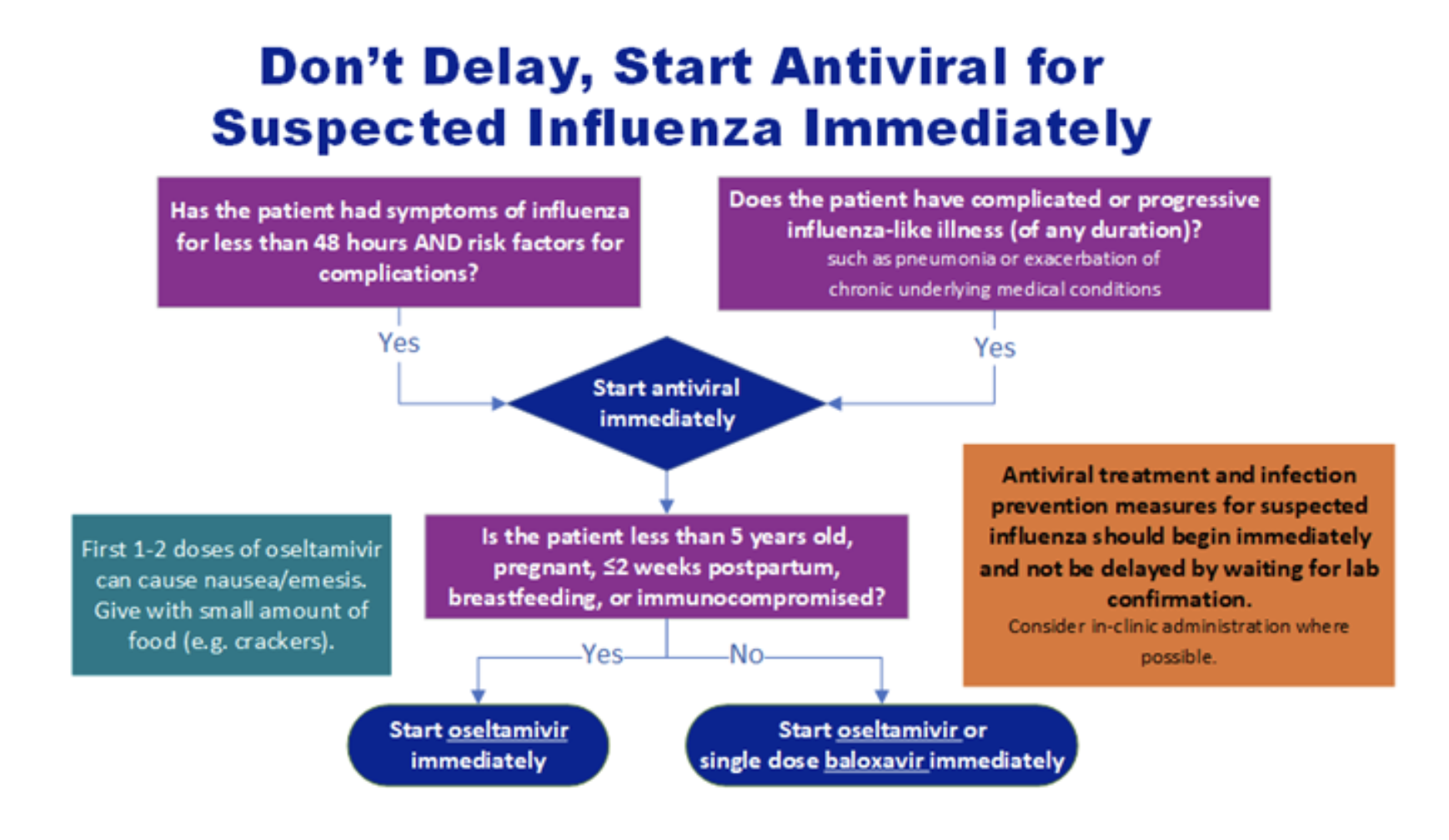
Below is a clinical flow chart for outpatient healthcare providers showing decision points when to start oseltamivir or baloxavir antivirals for suspected or confirmed influenza cases.
https://www.cdph.ca.gov/Programs/OPA/Pages/CAHAN/Influenza-Update.aspx#
California Department of Public Health
Health Advisory
Healthcare Providers
Influenza Update: Vaccinate, Test, and Administer Influenza Antivirals
1/5/2026
Key Messages
- Influenza cases and hospital admissions are increasing in California. A newly emerged influenza A virus strain, H3N2 subclade K, is circulating globally, including in California. The majority of influenza A specimens subtyped in California are H3N2. Current influenza vaccines are still expected to offer protection against severe disease.
- Administer 2025-26 influenza vaccine to anyone 6 months of age and older who has not yet received it.
- Test symptomatic patients as quickly as possible. Use rapid molecular (nucleic acid amplification detection) tests for outpatients, and RT-PCR and other influenza molecular tests for hospitalized patients to confirm diagnosis and guide timely treatment. Influenza A positive hospitalized patients, especially those in the ICU, should have specimens sent for subtyping.
- Initiate antiviral treatment without delay and ideally at point of care. Do not delay treatment while waiting for test results if influenza is suspected in high-risk patients. Treat immediately with oseltamivir or single-dose baloxavir based on recommendations for use. Treatment with influenza antivirals decreases the risk of serious illness and hospitalization in those at higher risk for severe disease.
- Stay aware of respiratory virus activity in your community by visiting the CDPH Respiratory Virus Dashboard this
Background
Seasonal influenza activity in California is increasing with influenza A(H3N2) comprising the majority of currently circulating specimens. A newly emerged virus strain, H3N2 subclade K, is circulating globally and is now present in California. This strain is antigenically drifted from the H3N2 component of the 2025–26 seasonal influenza vaccine formulation and has been associated with earlier waves of influenza outbreaks in Canada, Japan, and the UK.
During the most recent national reporting week (influenza week 51), 97% of influenza viruses reported by US public health laboratories were influenza A, and of the A viruses that were subtyped, 92% were A(H3N2) and 8% were influenza A(H1N1)pdm09. Of the A(H3N2) viruses collected this season that underwent addition genetic characterization at CDC, 89% belonged to subclade K.
At this time, the World Health Organization reports there is no sign of increased disease severity associated with subclade K based on current epidemiological data. Historically, H3N2 viruses have been linked to more influenza-associated hospitalizations and deaths in older adults, especially those 65 or older.
Early UK estimates of 2025-26 influenza vaccine effectiveness (VE) against hospitalization were ~70–75% in children and ~30–40% in adults, consistent with historical ranges despite H3N2 subclade K antigenic drift and suggesting that influenza vaccination remains an effective tool in preventing influenza-related hospitalizations this season. However, VE in the U.S. may differ since the UK's vaccination program is based predominantly on live attenuated and cell-based vaccines rather than egg-based vaccines, which are more commonly used in the United States.
In California, early estimates of 2025-26 influenza VE against laboratory-confirmed influenza infection are ~30-40% against influenza A and influenza B. All VE estimates are based on data from October 1 through December 29, 2025, and are subject to change as the season progresses.
Short term forecasts suggest that influenza hospital admissions will continue to increase in California over the next four weeks. Preliminary scenario modeling projects a lower peak burden of influenza hospitalization than the 2024-25 season. However, these projections may change as information about this season emerges, including subclade K related factors.
CDPH has received the first report of a California pediatric influenza-associated fatality for this winter respiratory virus season. Young children are at higher risk of severe complications from influenza, especially if they have underlying medical conditions. Nationally, eight pediatric influenza-associated fatalities have been reported to CDC this season.
As California's respiratory virus activity begins to rise this season, clinicians are urged to recommend vaccination, timely testing, and treatment, especially in high-risk groups.
Recommendations
Administer the 2025-26 Influenza Vaccine
Recommend the 2025-26 influenza vaccine to everyone 6 months and older who has no contraindications and has not yet received a dose of the seasonal influenza vaccine. Vaccination remains the primary tool to prevent severe influenza outcomes. It can also help reduce absences from work, school and extracurricular activities, and provides protection for the most vulnerable.
Children aged 6 months through 8 years receiving influenza vaccine for the first time, with only one prior dose, or with unknown vaccination history, should receive two doses of influenza vaccine, at least 4 weeks apart. For adults 65 years and older, high-dose, recombinant, or adjuvanted influenza vaccines are preferentially recommended. A new option this season is shipment of LAIV to the home for administration by self or caregiver.
Influenza vaccine is also recommended for healthcare workers and other people who live with or care for people at higher risk of influenza complications. For the most current information on respiratory virus immunizations, see CDPH's Public Health for All page.
Conduct Molecular Respiratory Virus Testing
Test for seasonal influenza in patients with respiratory illness. Because respiratory symptoms can indicate multiple viral and bacterial etiologies, diagnostic testing for influenza and other respiratory pathogens can guide clinical management, antimicrobial treatment when appropriate, and infection prevention and control measures.
Rapid molecular tests are recommended over rapid antigen tests due to their higher sensitivities to detect influenza viruses in respiratory specimens. However, at-home combined influenza/COVID-19 tests can be used when available. A positive result from an at-home antigen test is likely to be a true positive. If negative, consider in-clinic testing if indicated. For hospitalized patients, use RT-PCR and other influenza molecular tests to confirm diagnosis and guide timely treatment.
Arrange for subtyping of patients with confirmed influenza A who are severely ill or hospitalized, prioritizing patients in ICUs, to monitor for novel influenza. Work with laboratory partners to forward specimens that are positive for influenza A but are unsubtypable to public health laboratories for further testing.
Start Antivirals Immediately for Suspected Influenza in High-Risk Patients
Treatment with influenza antivirals decreases the risk of serious illness and hospitalization in those at higher risk for severe disease. Starting antiviral treatment within 12 hours of symptom onset can shorten illness by approximately 3 days compared to starting treatment at 36-48 hours.
Evaluate and treat eligible symptomatic patients as soon as possible (ideally at point of care and within the first 24 hours). Influenza antivirals are recommended in hospitalized patients, patients at higher risk for severe disease, and patients who may transmit the virus to high-risk contacts.
Do not delay treatment while waiting for test results if influenza is suspected. Treat immediately with oseltamivir or single-dose baloxavir based on recommendations for use; consider in-clinic administration where possible.
- Outpatients with increased risk for severe disease: oseltamivir* or baloxavir[SUP]†[/SUP], as soon as possible and within 48 hours of symptom onset
- Patients with progressive or severe disease (such as pneumonia or exacerbation of chronic underlying medical conditions): oseltamivir, regardless of time since onset
- Hospitalized patients: oseltamivir, as soon as possible
[SUP]†[/SUP] Clinical trials demonstrated that one dose of baloxavir is effective at reducing influenza hospitalization risk, symptom duration, hospitalization duration, and household transmission. Baloxavir has fewer side effects than oseltamivir, which is taken twice a day for 5 days, and greater clinical efficacy in influenza B illness. While the upfront cost of baloxavir is higher than that of oseltamivir, modeling studies indicate that it is cost-effective compared with oseltamivir. However, baloxavir has been associated with treatment-emergent antiviral resistance. In addition, baloxavir is not recommended for those under 5 years of age, pregnant or ≤2 week postpartum individuals, breast-feeding individuals, immunocompromised patients, or hospitalized or severe cases; oseltamivir is first line treatment in such patients.
Below is a clinical flow chart for outpatient healthcare providers showing decision points when to start oseltamivir or baloxavir antivirals for suspected or confirmed influenza cases.
https://www.cdph.ca.gov/Programs/OPA/Pages/CAHAN/Influenza-Update.aspx#