• FluTrackers.com Inc. does not provide medical advice. Information on this web site is collected from various internet resources, and the FluTrackers board of directors makes no warranty to the safety, efficacy, correctness or completeness of the information posted on this site by any author or poster. The information collated here is for instructional and/or discussion purposes only and is NOT intended to diagnose or treat any disease, illness, or other medical condition. Every individual reader or poster should seek advice from their personal physician/healthcare practitioner before considering or using any interventions that are discussed on this website. By continuing to access this website you agree to consult your personal physican before using any interventions posted on this website, and you agree to hold harmless FluTrackers.com Inc., the board of directors, the members, and all authors and posters for any effects from use of any medication, supplement, vitamin or other substance, device, intervention, etc. mentioned in posts on this website, or other internet venues referenced in posts on this website.
  • We are not asking for any donations. Do not donate to any entity who says they are raising funds for us.

California 2010-2011 Season: Weeks 40-27 FINAL REPORT

Re: California 2010-2011 Season: Weeks 40-44

Re: California 2010-2011 Season: Weeks 40-44

Week 43: Sporadic
? CDPH received no reports of cases of laboratory-confirmed influenza that were admitted to the ICU or died.
? Reports of influenza-like illness (ILI) from sentinel providers and the percentage of Kaiser Permanente hospitalizations for pneumonia and influenza (P&I) remained low. The ILI activity this week in California was ?minimal?.
? The proportion of specimens tested by the Respiratory Laboratory Network (RLN) and the Sentinel Laboratories that were positive for respiratory syncytial virus (RSV) increased.
? Among 41 specimens tested by PCR statewide by the RLN, six were positive for influenza A and one for influenza B.
? As of October 30, 2010, no antiviral resistance testing has been performed by the Viral and Rickettsial Disease Laboratory (VRDL)

Week 44: Sporadic
? California Department of Public Health (CDPH) received no reports of cases
of laboratory-confirmed influenza that were admitted to the ICU or died. Since week 40, the beginning of the 2010-11 influenza season, one non-fatal adult case has been reported.
? Reports of influenza-like illness (ILI) from sentinel providers increased this week compared to the previous week. The ILI activity this week in California was ?minimal?.
? The percentage of Kaiser Permanente hospitalizations for pneumonia and influenza (P&I) remained low.
? Among 69 specimens tested by PCR statewide by the Respiratory Laboratory Network (RLN), 3 were positive for influenza A and 4 for influenza B. Of note, all positive specimens were submitted by San Diego County.
? The proportion of specimens tested by the RLN and the Sentinel Laboratories that were positive for respiratory syncytial virus (RSV) remained steady following a rise in week 43.
http://www.cdph.ca.gov/data/statistics/Pages/CISPDataArchive.aspx

 
Re: California 2010-2011 Season: Weeks 40-45

Re: California 2010-2011 Season: Weeks 40-45

Week 45: Sporadic

• In Week 45, the California Department of Public Health (CDPH) received one report of a laboratory-confirmed influenza patient who was admitted to the ICU and tested positive for influenza A(H3). Since Week 40, the start of this reporting year, two non-fatal adult cases have been reported.
• Reports of influenza-like illness (ILI) from sentinel providers decreased this week compared to the previous week. The ILI activity this week in California was “minimal.”
• The percentage of Kaiser Permanente hospitalizations for pneumonia and influenza (P&I) remained low, though there was a slight increase in northern California.
• Among 55 specimens tested by PCR statewide by the Respiratory Laboratory Network (RLN), three were positive for influenza B. All positive specimens were submitted by San Diego County.
• The proportion of specimens that were positive for respiratory syncytial virus (RSV) increased slightly among sentinel laboratories (8.0%, compared to 6.4% in Week 44).
http://www.cdph.ca.gov/HealthInfo/discond/Pages/Influenza(Flu).aspx
http://www.cdph.ca.gov/data/statistics/Pages/CISPDataArchive.aspx
 
Re: California 2010-2011 Season: Weeks 40-47

Re: California 2010-2011 Season: Weeks 40-47

Weeks 46,47: Sporadic
? In Weeks 46 and 47 combined, the California Department of Public Health (CDPH) received two reports of laboratory-confirmed influenza patients who were admitted to the ICU and tested positive for influenza B. Since Week 40, the start of this reporting year, four non-fatal cases have been reported; two have been in pediatric patients.
? Reports of influenza-like illness (ILI) from sentinel providers saw an overall increase in Weeks 46 and 47 compared to Week 45. The ILI activity in California for both weeks remained ?minimal.?
? The percentage of Kaiser Permanente hospitalizations for pneumonia and influenza (P&I) increased in both northern and southern California during this reporting period.
? Among 101 specimens tested by PCR statewide by the Respiratory Laboratory Network (RLN), nine were positive for influenza, including influenza A/H3 (2), A/2009 H1N1 (1), and B (6). The majority of the positive specimens were submitted from southern California.
? The proportion of specimens that were positive for respiratory syncytial virus (RSV) continued to increase among sentinel laboratories (9.5% and 11.1% in Weeks 46 and 47 respectively, compared to 8.2% in Week 45).
http://www.cdph.ca.gov/data/statistics/Pages/CISPDataArchive.aspx
 
Re: California 2010-2011 Season: Weeks 40-48

Re: California 2010-2011 Season: Weeks 40-48

Week 48: Sporadic
? In Week 48, the California Department of Public Health (CDPH) received three reports of
laboratory-confirmed influenza among patients under 65 years of age who were admitted to
the ICU. Since Week 40, the start of this reporting year, seven non-fatal severe cases
(defined as ICU admission or death) have been reported; four have been in pediatric patients
under 18 years of age.
? Reports of influenza-like illness (ILI) from sentinel providers decreased in Week 48 compared
to previous weeks. The ILI activity in California for Week 48 remained ?minimal.?
? The percentage of Kaiser Permanente hospitalizations for pneumonia and influenza (P&I)
increased slightly in southern California during this reporting period.
? Among 23 specimens tested by PCR statewide by the Respiratory Laboratory Network (RLN)
during Week 48, none were positive for influenza.
? The proportion of specimens that were positive for respiratory syncytial virus (RSV) continued
to increase among sentinel laboratories (13.6% in Week 48, compared to 11.1% in Week 47).
http://www.cdph.ca.gov/data/statistics/Pages/CISPDataArchive.aspx
 
Re: California 2010-2011 Season: Weeks 40-49

Re: California 2010-2011 Season: Weeks 40-49

Week 49: Sporadic
In Week 49, the California Department of Public Health (CDPH) received three reports of laboratory-confirmed influenza among patients under 65 years of age who were admitted to the ICU.
? ILI decreased
? The percentage of Kaiser Permanente hospitalizations for pneumonia and influenza (P&I) increased in northern California during this reporting period, while remaining level in southern California.
? Among 70 specimens tested by polymerase chain reaction (PCR) statewide by the Respiratory Laboratory Network (RLN) during Week 49, 12 were positive for influenza; five were influenza A (H3) and seven were influenza B. All positive specimens were from southern California.
? The proportion of specimens that were positive for respiratory syncytial virus (RSV) increased substantially among sentinel laboratories (20.1% in Week 49, compared to 12.5% in Week 48).
http://www.cdph.ca.gov/data/statistics/Pages/CISPDataArchive.aspx
 
Re: California 2010-2011 Season: Weeks 40-52

Re: California 2010-2011 Season: Weeks 40-52

Week 52: Sporadic
A low number of sentinel providers reported during the holiday period (76 compared to an average in previous weeks of 120).
? ILI decreased; activity remained ?minimal?
? P&I increased in both northern and southern California
? 27.3% were positive for influenza; 21 (14%) were influenza A and 20 (13%) were influenza B. The influenza A specimens were subtyped as H3 (14) and 2009 H1N1 (7). The majority of positive specimens were from Orange and San Diego counties.
? RSV continued to increase substantially (44% positive). The percentage of RSV detections in Week 52 exceeds the range of percentages seen for RSV at the same time in previous years.
http://www.cdph.ca.gov/HealthInfo/discond/Pages/Influenza(Flu).aspx
 
Re: California 2010-2011 Season: Weeks 40-1

Re: California 2010-2011 Season: Weeks 40-1

Week 1: Local Activity; minimal
ILI decreased by 1.1% in Week 1 compared to the previous week; however a low number of sentinel providers reported in Week 1 (78 compared to an
average of 120 in previous weeks).

25.5% positive for influenza by PCR (The majority of positive specimens were from Orange and San Diego counties)

The percentage of influenza detections in sentinel laboratories increased in Week 1 (7.9%) compared to the previous week (5.4%).
http://www.cdph.ca.gov/HealthInfo/discond/Pages/Influenza(Flu).aspx
 
Re: California 2010-2011 Season: Weeks 40-2

Re: California 2010-2011 Season: Weeks 40-2

Week 2: Local; minimal

Of 122 specimens tested by polymerase chain reaction (PCR) statewide by the Respiratory Laboratory Network (RLN) during Week 2, 70 (57.4%) were positive for influenza; 48 (68.6%) were influenza A and 22 (31.4%) were influenza B. The influenza A specimens were subtyped as H3 (27 specimens) and 2009 H1N1 (21 specimens). The majority of positive specimens were from Los Angeles and Orange counties.

The percentage of influenza detections in sentinel laboratories increased during Week 2; 214 (11.3%) of 1,886 specimens tested were positive, compared to 172 (7.8%) of 2,194 specimens tested during the previous week.

During Week 2, the proportion of specimens tested statewide that were positive for respiratory syncytial virus (RSV) remained level; 721 (37.8%) of 1,908 specimens tested were positive, compared to 845 (37.9%) of 2,231 specimens tested during the previous week. Overall RSV activity remains high; the percentage of RSV detections in Week 2 exceeds the range of percentages seen for RSV at the same time in previous years.
http://www.cdph.ca.gov/HealthInfo/discond/Pages/Influenza(Flu).aspx
 
Re: California 2010-2011 Season: Weeks 40-3 (Regional)

Re: California 2010-2011 Season: Weeks 40-3 (Regional)

Week 3: Regional, low
ILI: 4.2%

PCR statewide by the Respiratory Laboratory Network: 37.1% were positive for influenza; 63.8% were influenza A and 36.2% were influenza B. While influenza A (H3) was the predominant influenza A subtype identified during the early part of the season, increasing numbers of influenza A (2009 H1N1) specimens have been identified in recent weeks. An increasing number of specimens from northern California have been positive.

Influenza detections in sentinel laboratories: 16.0% were positive

RSV: 37.2%; the percentage of RSV detections in Week 3 exceeds the range of percentages seen for RSV at the same time in previous years.
http://www.cdph.ca.gov/HealthInfo/discond/Pages/Influenza(Flu).aspx
 
Re: California 2010-2011 Season: Weeks 40-4 (Regional)

Re: California 2010-2011 Season: Weeks 40-4 (Regional)

Week 4: Regional, low activity
ILI: 2.8%

Tested by PCR statewide by the Respiratory Laboratory Network (RLN) during Week 4: 47.2% were positive for influenza; of these 71.7% were influenza A and 28.3% were influenza B. Of the 42 influenza A specimens that have been subtyped, 57.1% were subtyped as A (H3) and 42.9% were subtyped as A (2009 H1N1). The percentage of influenza detections in northern California has increased in recent weeks.

The percentage of influenza detections in sentinel laboratories increased slightly during Week 4; 16.6% tested were positive. Of 11 influenza A (2009 H1N1) specimens and 32 influenza A (H3N2) specimens tested by the CDPH Viral and Rickettsial Disease Laboratory (CDPH-VRDL), no neuraminidase inhibitor resistance has been found.

RSV: 32.8% Overall RSV activity remains.
http://www.cdph.ca.gov/HealthInfo/discond/Pages/Influenza(Flu).aspx
 
Re: California 2010-2011 Season: Weeks 40-5 (Regional)

Re: California 2010-2011 Season: Weeks 40-5 (Regional)

Week 5: Regional, low activity
ILI: 2.7%
54.3% positive specimens for influenza (majority A/2009 H1N1) RLN
RSV: 30.6%
http://www.cdph.ca.gov/HealthInfo/discond/Pages/Influenza(Flu).aspx

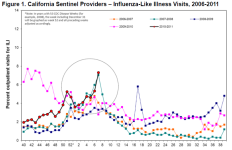
NOTE: No information on deaths. Additionally, ILI showed decrease in week 4 report, only to have increased in week 5 report; week 3 report said decrease, only to show increase in later reports. Consequently, not sure one can rely on ILI in current week to reflect what is currently happening, since all data is not in. Look at graph of ILI of previous week's in current week. Trend is upward.
http://www.cdph.ca.gov/programs/dcdc/Documents/FluReport_Ending20110205_Web_Final.pdf
http://www.cdph.ca.gov/data/statistics/Pages/CISPDataArchive.aspx
 
Re: California 2010-2011 Season: Weeks 40-6 (Widespread)

Re: California 2010-2011 Season: Weeks 40-6 (Widespread)

Week 7: Widespread
%ILI - 7.3%
% Positive Specimens - 57% with 70% Influenza A and about half of those H3N2 and half pH1N1 (pH1N1 increasing)
RSV still decreasing

http://www.cdph.ca.gov/programs/dcdc/Documents/FluReport_20110219_Web_Final.pdf

%ILI is nearly as high as that seen at the height of the Pandemic with still only about one-third of positive specimens being pH1N1.

Week 7 CA ILI.png
 
Back
Top