• FluTrackers.com Inc. does not provide medical advice. Information on this web site is collected from various internet resources, and the FluTrackers board of directors makes no warranty to the safety, efficacy, correctness or completeness of the information posted on this site by any author or poster. The information collated here is for instructional and/or discussion purposes only and is NOT intended to diagnose or treat any disease, illness, or other medical condition. Every individual reader or poster should seek advice from their personal physician/healthcare practitioner before considering or using any interventions that are discussed on this website. By continuing to access this website you agree to consult your personal physican before using any interventions posted on this website, and you agree to hold harmless FluTrackers.com Inc., the board of directors, the members, and all authors and posters for any effects from use of any medication, supplement, vitamin or other substance, device, intervention, etc. mentioned in posts on this website, or other internet venues referenced in posts on this website.
  • We are not asking for any donations. Do not donate to any entity who says they are raising funds for us.

Bird flu vaccine possible within three months of outbreak: WHO

Laidback Al

Well-known member
Bird flu vaccine possible within three months of outbreak: WHO <!-- END HEADLINE -->
<!-- BEGIN STORY BODY -->
2 hours, 15 minutes ago

The World Health Organisation said that a vaccine against the human strain of the H5N1 influenza virus could be produced within three months of an outbreak.

Speaking after a two-day meeting of experts, meeting chair Ian Gust told journalists the rate of progress over the past 15 months into a vaccine that could prevent human-to-human transmission was "probably unprecedented."

In a best case scenario, manufacturers could be able to produce a vaccine within three months of a pandemic, he said.

However, "under those circumstances everything has to work perfectly, and as you can imagine, there are plenty of hiccups along the way," for example if the first outbreak were to occur in a remote location, he cautioned.

"There would be a delay until it was identified, there would be a delay until a team was sent there to investigate it, there would be a delay in bringing the sample out ... so you can see that there would be some delays along the way," Gust said.

Gust, who is also a professor of microbiology at the University of Melbourne in Australia, said that several manufacturers had already submitted licensing dossiers to regulatory authorities in the US, EU and Australia.

"If those dossiers are satisfactory, that means that at any point of time ... those manufacturers could immediately switch over to making pandemic vaccine using the strain which was causing the pandemic and produce it in very significant quantities," he said.

Sixteen manufacturers from 10 countries are currently developing prototype pandemic influenza vaccines against the H5N1 avian influenza virus, the WHO said.

More than 40 clinical trials have been completed or are ongoing, with some focused on children and the elderly.

The global health body nevertheless cautioned that the world still lacks the production capacity to meet global demand.

"Current capacity is estimated at less than 400 million doses per year of trivalent seasonal influenza vaccine," it said.

However, Gust said that some manufacturers were looking at using a half or even a quarter of a regular dose in their vaccine, which would increase capacity significantly.

"If you were to extrapolate with the ability to use half a dose, then theoretically you should be able to make a substantial amount of vaccine -- hundreds and hundreds of millions of doses," he said.

http://news.yahoo.com/s/afp/2007021...u&printer=1;_ylt=AnPSyWD03SAZYKIJE4WH8D2KOrgF
 
Last edited by a moderator:
Re: Bird flu vaccine possible within three months of outbreak: WHO

The global health body nevertheless cautioned that the world still lacks the production capacity to meet global demand.

"Current capacity is estimated at less than 400 million doses per year of trivalent seasonal influenza vaccine," it said.

However, Gust said that some manufacturers were looking at using a half or even a quarter of a regular dose in their vaccine, which would increase capacity significantly.

Everything I've read last year said that effective vaccines against H5N1 required HIGHER doses, so the last statement here is purely conjecture if not outright disinformation. Bottom line is still the same...6 to 12 months to create and manufacture a vaccine, and even then less than one out of 15 people worldwide will be able to get vaccinated during the first year of a pandemic due to production limitations. Vaccine-producing countries will hoard vaccine for their own populations. Third world countries will get none.

Of course, we can all go pick the latest wonderberries and keep our fingers crossed.
 
Re: Bird flu vaccine possible within three months of outbreak: WHO

That three months seems to be only the manufacturing process - leaving out all the months of prep work.

Don't know where the got the lower dose information. Perhaps the reporter misinterpreted information about adjuvants.

.
 
Re: Bird flu vaccine possible within three months of outbreak: WHO

"In a best case scenario manufacturers could be able to produce a vaccine within three months of a pandemic, he said."


They might be able to produce a vaccine within 3 months, but for how many? Millions? Billions? In only 90 days? And will it be safe and effective at 1/2 dosage? 1/4 dosage?
 
Re: Bird flu vaccine possible within three months of outbreak: WHO

In earlier threads about vaccine production, it was noted that current vaccine production requires about 1 million "special" eggs per day, but pandemic quantites would require 20 times that amount.

So we also need to factor in the time (& hens) to produce the extra eggs.

There a good write up on the production process in the original post at this thread:
http://www.flutrackers.com/forum/showthread.php?p=61759&highlight=vaccine+production#post61759

.
 
Re: Bird flu vaccine possible within three months of outbreak: WHO

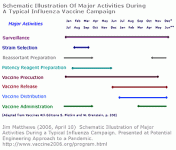
Note in the chart below the number of months it takes to produce the vaccine for normal flu. So how long will it take to produce a pandemic quantity?

schematic_llustration_thumb.gif
source: http://www.ifpma.org/Influenza/index.aspx?26

.
 
Re: Bird flu vaccine possible within three months of outbreak: WHO

Great chart. Of course, they can produce something? in 90 days.

It would take years to produce a pandemic quantity.

6 billion x 2 doses even with adjuvent? = 12 billion doses?

By that time which strain (or clade) are you producing?

The new technologies that are being developed are not available yet. Hopefully these will shorten the time frame required.
 
Re: Bird flu vaccine possible within three months of outbreak: WHO

If we take the best case egg-based system and the 2 doses per person, that's 500 million doses / 2 / 11 months = 22.7 million people per month GLOBALLY.:( :( :(

.
 
Re: Bird flu vaccine possible within three months of outbreak: WHO

Great chart. Of course, they can produce something? in 90 days.

It would take years to produce a pandemic quantity.

6 billion x 2 doses even with adjuvent? = 12 billion doses?

By that time which strain (or clade) are you producing?

The new technologies that are being developed are not available yet. Hopefully these will shorten the time frame required.


Sharon raises an important point re which strain you are producing for.
It is a basic tenet of natural selection that the best adapted organism to its niche survives & thrives. As things stand the circulating strains are bird flus and so adapted to their avian hosts, in the advent of a pandemic case zero in humans the virus will be basically avian but with reasonably efficient h2h transmission. Let us assume the WHO declares the pandemic underway and takes case zero samples and distributes them to vax manufactures. What happens next? Vax goes into production but the virus will go into a period of very rapid change. It is now a human virus and is under intense selective pressure to adapt to its new host, it is faced with a new environment. Where before HA proteins adapted to bind to a 2,3 sialic acid in a birds gut would be selected for now a 2,6 adapted forms will be favoured. Likewise changes in NA that survive the Tamiflu blanket and across all the viral genes adaptations to changes in ph, body temperature, new host polymerases, host immune system etc. will cause selective pressure across the board and the sequence drift will cause far more rapid change than we have seen to date or experience in seasonal flu; which vax manufactures update annually. The new question becomes how well matched will the vaccine based on case zero’s H5N1 be to the dominant strain by the time it gets injected? I suspect it will be necessary to replace the vax strain every 2 or 3 months. The short term bad news is we may see a spike in virulence as the same virus has suddenly acquired the ability to efficiently reach and enter human cells but over time it should come into some form of balance with its new host at a lower level of virulence and greater herd immunity. The question that taxes us all is just how much damage it will do before that point is reached.
 
Re: Bird flu vaccine possible within three months of outbreak: WHO

Bird-Flu Vaccine Is a Fact;
Need for It Is Questionable


[FONT=times new roman,times,serif][FONT=times new roman,times,serif]By NICHOLAS ZAMISKA
February 16, 2007; Page B1

[/FONT]
[/FONT]
A vaccine for avian influenza is at hand. Now regulators and companies are weighing whether to make it widely available before any outbreak occurs.


To date, the H5N1 virus that causes the flu has passed only occasionally from birds to humans. The possibility of a mutation of the virus causing a large-scale, highly lethal outbreak among humans motivated big pharmaceutical companies such as GlaxoSmithKline PLC and Sanofi-Aventis SA to develop vaccines. The Food and Drug Administration hasn't approved any of them yet; indeed, the vaccine has yet to get an endorsement from any regulatory agency for use before a pandemic, but some governments already are stockpiling supplies.


The existence of a bird-flu vaccine raises a number of questions. Will it be effective against a mutation of H5N1? If so, should it be administered only after a pandemic is indicated?


MK-AI563A_VACCI_20070215195629.gif
The unknowns haven't deterred pharmaceutical companies who saw the potential demand for a vaccine last year, when fears of a bird-flu pandemic sent people around the world rushing to buy up supplies of Roche Holding AG's antiviral drug Tamiflu to treat the disease. An effective vaccine could be just as important as Tamiflu, if not more important, in saving a person from avian influenza.


Sanofi has been besieged by requests for its vaccine. "We have calls from people saying, 'Can I buy it? Can I buy it?' " says Alain Bernal, a spokesman for Sanofi Pasteur, the vaccine unit of Sanofi-Aventis of France.


Given that the threat of a pandemic is hypothetical at this stage, experts say it wouldn't make sense to cut corners on a normal regulatory process. They also point out that production capacity is needed to make vaccines for seasonal influenza, which poses a more immediate threat.


At Sanofi, Mr. Bernal says making bird-flu vaccine for a potential threat would cut into the company's production capacity for vaccines for seasonal flu, which kills about 36,000 people annually in the U.S. alone. By contrast, the H5N1 strain of bird flu, the one that worries health authorities most, has infected at least 273 people world-wide, killing 166 of them, mostly in Asia, since the virus re-emerged in late 2003, according to the WHO.


Mr. Bernal says global vaccine-production capacity for seasonal influenza already is limited to an estimated 350 million doses a year, of which Sanofi Pasteur produces about half. "The real public-health need today is for seasonal flu," he says. "You either produce [vaccines for] seasonal flu or H5N1." As a result, the H5N1 vaccine "is not a vaccine that we want to sell to the public," Mr. Bernal says. "We don't have a marketing strategy for this product." A committee of outside advisers to the FDA is scheduled to meet Feb. 27 to make recommendations on the safety and effectiveness of Sanofi's H5N1 vaccine.


In addition, the current H5N1 vaccines seem to require a high dose to offer protection, making production issues worse, says Anthony Fauci, director of the U.S. National Institute of Allergy and Infectious Diseases, which has been working with vaccine makers on an antidote for a government stockpile. "It's not going to be something you're going to see on the shelf for sure," Dr. Fauci says. "It will likely be strictly controlled."


The current vaccines are based on strains of the H5N1 bird-flu virus from recent years; should the virus mutate, as it would need to do to spread among humans, it isn't clear that it would fully protect people.


Still, some experts think the current vaccine probably would protect against severe illness and death, even if the victim still got sick. Governments are proceeding on that assumption, and millions of doses have been produced.


The U.S. has purchased from Sanofi enough vaccine for at least three million to four million people, according to Dr. Fauci. The U.S. government is currently negotiating to purchase more vaccine, he says, with the ultimate goal of securing enough to protect 20 million people. Still, Dr. Fauci adds, the U.S. isn't considering vaccinating people pre-emptively with the product currently available.


GlaxoSmithKline received approval from European drug regulators in December for one of its H5N1 vaccines, but only for use in the event of a pandemic, according to Alice Hunt, a spokeswoman in London for the company. Last month, the British drug company submitted another application for an H5N1 vaccine that could be used in advance of a pandemic.


Jean-Pierre Garnier, Glaxo's chief executive, said recently that the vaccine could prove effective against mutations of H5N1. He also said Switzerland has bought one vaccine dose per capita.


CSL Ltd., an Australian pharmaceutical company, announced last month that it had produced a safe, effective vaccine against H5N1. Australia's drug watchdog will soon review the company's application. CSL has no plans to market a version of the vaccine for general use, according to Rachel David, the company's spokeswoman.


Medical-products maker Baxter International Inc., of Deerfield, Ill., is testing its H5N1 vaccine and has signed a deal with the British government to produce two million doses for a stockpile. The company hasn't yet submitted it for approval to the FDA in the U.S.


Whether Baxter will ever market the vaccine directly to consumers is an open question, according to Deborah Spak, a spokeswoman for the company.


"We are still under clinical evaluation and years away from receiving the approvals needed for commercialization," Ms. Spak says, adding that the company hasn't built sales of a bird-flu vaccine to consumers into any of its financial projections.


Some companies do say they see commercial potential in the vaccine. In November, the Swiss drug giant Novartis AG submitted its H5N1 vaccine to the European Medicines Agency in London for approval, according to Eric Althoff, a spokesman for the vaccine unit of the Swiss company. Mr. Althoff says he expects a response on that application this year.


Mr. Althoff says further that if that response is positive, Novartis believes there is a potential commercial market for a vaccine that would be sold to individuals and not just governments to ward off a pandemic.


Write to Nicholas Zamiska at nicholas.zamiska@wsj.com


http://online.wsj.com/public/article/SB117158435924210461-EKfMjdkHEYKhfxI8nTqyfeCRr_E_20070317.html?mod=tff_main_tff_top#

<!-- article end --><!-- Clickability/Reprint/Format For Printing Buttons begin --><script type="text/javascript"> <!-- var suppressReprints=0; var clickSet; var clickURL='http://online.wsj.com/article/SB117158435924210461.html?mod=mostpop'; var emailURL='http://online.wsj.com/wsjgate?subURI=%2Farticle%2FSB117158435924210461-email.html&nonsubURI=%2Farticle_email%2FSB117158435924210461-lMyQjAxMDE3NzExNzUxODc0Wj.html'; var clickTitle='WSJ.com - Bird-Flu Vaccine Is a Fact; Need for It Is Questionable'; if ( !clickSet ) { document.write('<sc'+'ript type="text/javascript" src="/w-button.js"><\/sc'+'ript>'); clickSet = 1; } //--> </script><script type="text/javascript" src="http://online.wsj.com/w-button.js"></script><script language="JavaScript"> window.onerror=function(){clickURL=document.location.href;return true;} if(!self.clickURL) clickURL=parent.location.href;*</script>
 
Re: Bird flu vaccine possible within three months of outbreak: WHO

I seem to recall reading that all available BF vaccines were the property of the US military?
 
Re: Bird flu vaccine possible within three months of outbreak: WHO

(snipped)

Possible benefits of stockpiling

Even a vaccine that is only partially protective could have significant impact on the consequences of a pandemic. In a mathematical model by Longini and colleagues, early use of a poorly matched vaccine that still partially reduces transmission resulted in significant mitigation of the outbreak [2]. In addition, a reduction in the severity of disease, even without an accompanying reduction in the actual number of people infected, would have a significant impact on the consequences of a pandemic by reducing the burden on the healthcare system.

Priming with H5 antigen

A related strategy to stockpiling a ?generic? H5N1 to be used at the start of a pandemic is that of ?H5 priming? vaccination. In this strategy, a generic H5 antigen is included in the annual flu shots before the actual pandemic in the hope that recipients would either (1) develop some partial cross-immunity to an eventual H5 pandemic strain or (2) require only one dose of a pandemic vaccine rather than the two-dose course shown by clinical trials to be necessary now. This strategy could offer significant logistical advantages, but uncertainties remain, including whether the next pandemic will be caused by an H5 strain.
http://www.upmc-cbn.org/report_archive/2006/10_October_2006/cbnreport_100406.html
 
Back
Top