Translation Google
STEC contamination in several nursing homes in Flanders
Joint press release from the FASFC and the Flemish Department of Zorg
Additional information
Publication date
August 27, 2025
Last updated
27 Aug 2025
Document type
Press release
Themes
Food
STEC contamination in several nursing homes in Flanders
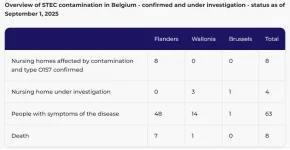
Around twenty residents of six nursing homes in Flemish Brabant, Antwerp, and the Aalst region fell ill after being infected with Shiga toxin-producing E. coli (STEC). Laboratory tests show that the infections are caused by the same genetic type of bacteria, indicating a common source. Such infections usually occur through food. The Flemish Department of Health, the FASFC (Federal Agency for the Safety of the Food Chain), the National Reference Center in Brussels, and Sciensano are currently investigating this outbreak. Food consumption in these nursing homes is being mapped and examined.
Joris Moonens - spokesperson for the Flemish department Zorg: " In the last few days and hours, we have received several reports of nursing home residents with symptoms indicating a STEC infection. Currently, we have 4 nursing homes in the Leuven region, 1 nursing home in the Aalst region, and two nursing homes in the Antwerp region where residents have been confirmed or have most likely become ill with this type of E. coli bacteria. In total, this currently affects just over 20 residents and 1 staff member. Most of them became ill between 18 and 21 August. Tests carried out on these residents show that they were infected with the same type of bacteria ."
Aline Van den Broeck - spokesperson for the FASFC: " The type of infection and its spread indicate contamination through food. We are currently examining all food consumption in the various nursing homes where contamination has been detected. It is still too early at this stage of the investigation to identify a likely source of contamination. "
The Flemish Department of Health and Social Affairs (Zorg) and the FASFC are jointly investigating the source of the infections. Samples are being taken from people with symptoms to check whether they have been infected with the same type of bacteria and to determine what and when they ate. The FASFC is mapping the food chain and conducting sample analyses to identify the source. The Flemish Department of Health and Social Affairs (Zorg) is informing general practitioners and hospitals in the regions to report any potential cases. It is therefore possible that other cases of people who have fallen ill in recent days in nursing homes or other locations will be reported in the coming days.
About STEC infections
STEC (Shiga toxin-producing E. coli) is a serious bacterial infection caused by Shiga toxin-producing Escherichia coli. STEC infection may be asymptomatic. It may also cause mild or bloody diarrhea. Fever and headache may also occur. Hemolytic Uremic Syndrome (HUS) may occur as a complication. Food is a significant source of contamination. Person-to-person transmission is possible but less likely. In nursing homes where cases have been detected, people with symptoms are isolated from other residents and special attention is paid to hand hygiene and general hygiene.
For people living in nursing homes, who are often already in poor health, a STEC infection can be very serious.
https://favv-afsca.be/fr/publicatio...ec-dans-plusieurs-maisons-de-repos-en-flandre
----------------------------------------------------------
Stec bacteria infection confirmed in Brussels, suspected cases in Wallonia
UPDATE A resident of a nursing home in the Brussels-Capital Region has been infected with the Stec bacteria (Shiga toxin-producing Escherichia coli), Iriscare and Vivalis reported on Friday, confirming information reported by several media outlets. Investigations are underway to determine whether this contamination is linked to the cases detected in Flanders.
MDV 29-08-25, 14:02 Source: BELGA
In Flanders, infections with this bacteria have been detected in several nursing homes. To date, 21 people have been infected, five of whom have died.
In Brussels, "a case was detected in a nursing home around August 19," said a spokesperson for Vivalis, the Brussels social and health administration. The infection was confirmed in a laboratory. Tests are underway to determine whether the contamination is linked to the cases detected in Flanders.
Only one person has been infected and "is out of danger, they are in good health," the spokesperson said.
Suspected cases in a home in Ottignies
In Wallonia, suspected cases have been reported in a nursing home in Ottignies, but infection with the Stec bacteria has not yet been confirmed.
The nursing home in question notified the Federal Agency for the Safety of the Food Chain (FASFC) late Thursday, a spokesperson said. “For the time being, this is a suspected infection. Our services are going to the site this (Friday) morning and we will have to wait for the test results to be sure that we are dealing with the same strain of the bacteria” as the one that caused contamination in Flanders.
The Walloon Agency for a Quality Life (Aviq) is trying to be reassuring. “Don't panic,” assures a spokesperson, even though “we obviously remain very vigilant.” Thus, “nothing confirms at this time that it was indeed this bacteria” that made some residents of the nursing home sick. There are currently eight cases. “At this stage, there is nothing to suggest that the problem stems from the food, which may have been contaminated,” she insists. “Unfortunately, gastroenteritis occurs every day in nursing homes.”
Aviq is also sending an inspection team to the site, which will take samples. The agency has not been informed by the home. “In view of the situation in Flanders, we will remind all nursing homes in Wallonia of the rules in force: when there is a suspected case, it is mandatory to report it to Aviq to allow us to contain” a possible epidemic.
As for the nursing home in Ottignies, “everything is contained”.
https://www.7sur7.be/belgique/une-i...xelles-des-cas-suspects-en-wallonie~a4b63da0/
--------------------------------------------------------------------------
Fifth nursing home resident dies from STEC bacteria: "One other person critical"
A resident infected with the STEC bacteria has also died at the Edouard Rémy nursing home in Leuven. Another resident is in critical condition. Leuven Alderman Bieke Verlinden (Vooruit) confirmed this to our editorial team. This brings the number of deaths linked to the bacteria to five.
August 28, 2025 at 2:00 PM
The rare but dangerous STEC bacteria, a variant of E. coli, has spread to at least six Flemish nursing homes in recent weeks. Three of these are part of 'Zorg Leuven': Edouard Rémy (five infected residents), Booghuys (one infected), and Ter Putkapelle (one infected). One of the infected residents at the first nursing home has since died in hospital, according to Alderman Bieke Verlinden, who is also the chair of Zorg Leuven. "Another resident is in critical condition."
At least four deaths suspected of being linked to the bacteria had already been reported in the other three residential care centers involved, located in the Antwerp and Aalst regions. The Federal Agency for the Safety of the Food Chain (FASFC) and the Department of Care are currently doing everything possible to determine the source of the infections – most likely a contaminated food product. The total number of infections remains around twenty.
https://www.nieuwsblad.be/binnenlan...-nog-een-andere-persoon-kritiek/86529967.html