• FluTrackers.com Inc. does not provide medical advice. Information on this web site is collected from various internet resources, and the FluTrackers board of directors makes no warranty to the safety, efficacy, correctness or completeness of the information posted on this site by any author or poster. The information collated here is for instructional and/or discussion purposes only and is NOT intended to diagnose or treat any disease, illness, or other medical condition. Every individual reader or poster should seek advice from their personal physician/healthcare practitioner before considering or using any interventions that are discussed on this website. By continuing to access this website you agree to consult your personal physican before using any interventions posted on this website, and you agree to hold harmless FluTrackers.com Inc., the board of directors, the members, and all authors and posters for any effects from use of any medication, supplement, vitamin or other substance, device, intervention, etc. mentioned in posts on this website, or other internet venues referenced in posts on this website.
  • We are not asking for any donations. Do not donate to any entity who says they are raising funds for us.

Bangladesh: 2022 Dengue

Source: https://www.siasat.com/bangladesh-sees-highest-daily-spike-of-8-dengue-deaths-2433858/


Bangladesh sees highest daily spike of 8 dengue deaths
The country, with a population of about 170 million, is especially vulnerable to the virus because of insufficient biosecurity and deficient disease surveillance.
Updated: 14th October 2022 1:56 pm IST

Dhaka: Bangladesh has reported eight more fatalities from dengue, the highest daily caseload, bringing the death toll to 83 so far this year.

The South Asian country has witnessed a significant spike in dengue cases this month, with 7,190 cases and 28 deaths registered, according to the country’s Directorate General of Health Services (DGHS).

In September, 9,911 dengue cases were recorded after 3,521 people were infected with the mosquito-borne disease in August, Xinhua news agency quoted the Directorate as saying.

By region, Dhaka and its neighbouring districts are more vulnerable to the risk of the disease, according to the DGHS.

Hospitals and clinics in Dhaka are now crammed with dengue patients.

A total of 765 fresh cases including 497 in Dhaka were reported in the last 24 hours...
 
Source: https://www.dhakatribune.com/bangla...death-toll-rises-to-96-as-2-more-patients-die

Dengue death toll rises to 96 as 2 more patients die
A total of 857 patients were hospitalized in 24 hours
UNB
October 17, 2022 7:25 AM

Two more dengue patients died in 24 hours till Monday morning, raising this year’s death toll from the mosquito-borne disease in Bangladesh to 96.

During this period, 857 more patients were hospitalized with viral fever as cases kept rising, according to the Directorate General of Health Services (DGHS).

Of the latest deaths, one was reported from Dhaka division and another from Khulna division...
 
Source: https://www.globaltimes.cn/page/202210/1277451.shtml

Bangladesh reports highest single-day dengue cases of 900
By Xinhua Published: Oct 19, 2022 01:18 PM

A total of 900 people were diagnosed with dengue fever in Bangladesh in the past 24 hours on Tuesday, the highest number in a single day so far this year, the Directorate General of Health Services (DGHS) said.

According to figures reported by the DGHS under the Ministry of Health, 528 people were diagnosed with dengue in Dhaka alone Tuesday.

With the fresh infections reported as of 8:00 a.m. local time Tuesday, the number of dengue cases has surged to 26,938 in Bangladesh so far this year, the DGHS said.

A total of 23,612 dengue patients returned home after receiving treatment from various hospitals across the country from Jan. 1 to Oct. 18 this year...
 
Source: https://www.dhakatribune.com/bangla...e-death-toll-climbs-to-110-with-4-more-deaths

Dengue death toll climbs to 110 with 4 more deaths
896 more patients were hospitalized
UNB
October 20, 2022 8:42 AM

Four more deaths from dengue confirmed in 24 hours till Thursday morning raised this year’s fatalities from the mosquito-borne disease in Bangladesh to 110.

During this period, 896 more patients were hospitalized with the viral fever as cases keep rising, according to the Directorate General of Health Services (DGHS).

Of the latest deaths, three were reported from Dhaka and another from Mymensingh division.

The dengue death toll in Dhaka division now stands at 66, in Mymensingh at two while it remained static in Chittagong division at 35, in Khulna at two and in Barisal division at five.

Of the new patients, 537 were admitted to different hospitals in Dhaka and 359 outside it...
 
Source: https://www.dhakatribune.com/bangla...-another-die-1034-more-hospitalized-in-24-hrs

Dengue death toll stands at 113 as another dies, 1034 more hospitalized in 24 hrs
589 patients were admitted to different hospitals in Dhaka and 455 patients outside it
UNB
October 23, 2022 7:44 AM

Another death from dengue confirmed in 24 hours till Sunday morning raised this year's fatalities from the mosquito-borne disease in Bangladesh to 113.
During this period, 1,034 more patients were hospitalized with the viral fever as cases keep rising, according to the Directorate General of Health Services (DGHS).
Of the latest deaths, one was reported from Dhaka and another from Chittagong division, raising the death tolls in the divisions to 67 and 36 respectively.
The dengue death toll remained static in Mymensingh and Khulna at two and in Barisal division at five.
Of the new patients, 589 were admitted to different hospitals in Dhaka and 455 outside it, according to the Directorate General of Health Services (DGHS).
A total of 3,492 dengue patients, including 2,286 in the capital, are now receiving treatment at hospitals across the country...
 
Source: https://www.dhakatribune.com/evening-brief/2022/10/31/evening-brief-84

Dengue death toll up by 150% in October
Five more people died in 24 hours, taking this year’s toll to 141
Tribune Report
October 31, 2022 7:35 AM

The confirmed death toll from dengue has jumped by over 150% in October, compared to a month ago.

With five fresh deaths reported in 24 hours to Monday morning, the Directorate General of Health Services (DGHS) so far confirmed 86 deaths in October. The toll was 34 in September.

So far, 141 people died of this mosquito-borne disease in Bangladesh in 2022, second-highest deaths on record after the 179 deaths recorded in 2019.

Four of the deaths were reported from Dhaka and another from Khulna division.

With this, the dengue death toll in Dhaka division rose to 86 and in Khulna division to six.

The death toll remained unchanged at 38 in Chittagong, five in Barisal, four in Mymensingh, and two in Rajshahi division.

On the other hand, the number of hospitalizations from dengue fever is also increasing every day with 873 people hospitalized in the last 24 hours till Monday morning.

Of the new patients, 545 were admitted to different hospitals in Dhaka and 328 outside it, according to the DGHS.

A total of 3,584 dengue patients, including 2,309 in the capital, are now receiving treatment at hospitals across the country...
 
Source: https://bdnews24.com/health/srkelf8gb9

Bangladesh's dengue death toll hits 167, surpassing annual record
The number of people who died from dengue fever so far this year has increased by five in a day
Senior Correspondentbdnews24.com
Published : 5 Nov 2022, 9:24 AM
Updated : 5 Nov 2022, 9:24 AM

The number of people who died from dengue fever so far this year has increased by five in a day to 167, surpassing the previous annual record.

Bangladesh reported the previous highest toll from the mosquito-borne disease at 164 in 2019.

The number of patients hospitalised with dengue increased in the latest 24-hour count until Saturday morning by 788 to 42,199 this year, also the second highest after 101,354 hospitalisations in 2019.

The government reported 86 deaths from the disease in October, the highest for a month in the country’s history. The previous highest monthly toll from dengue was 83 in August 2019.

In the first five days of November, 4,175 patients were hospitalised and 26 died.

As many as 2,737 dengue patients were being treated in hospital care on Saturday morning...
 
Source: https://www.newagebd.net/article/185871/bangladeshs-yearly-dengue-deaths-break-all-previous-records

Yearly dengue death toll breaks record
5 more die, 820 hospitalised in 24hrs
Staff Correspondent | Published: 18:07, Nov 08,2022 | Updated: 00:07, Nov 09,2022

The official death toll from dengue broke record in Bangladesh as at least five more people die of the Aedes mosquito-borne viral disease in the past 24 hours till Tuesday morning taking to 182 the toll in 2022.

According to the data of the Directorate General of Health Services, 1,01,354 dengue patients were hospitalised and 179 of them died in Bangladesh in 2019, which was so far the highest official figure since 2000 when Bangladesh started keeping records of dengue cases and deaths.

Dengue forced 44,802 people to get admitted to hospitals, including 21,932 in October with 86 deaths...
 
Source: https://www.dhakatribune.com/bangladesh/2022/11/10/dengue-toll-rises-to-192-with-5-more-deaths

Dengue toll rises to 192 with 5 more deaths
Another 888 patients hospitalized in 24 hours
UNB
November 10, 2022 8:57 AM

With five more deaths reported in 24 hours till Thursday morning, this year's number of fatalities from dengue has climbed to 192.

During this period, 888 patients were hospitalized with the viral fever, according to the Directorate General of Health Services (DGHS).

Of the latest deaths, three were reported in Chittagong and one each in Dhaka and Mymensingh divisions.

The new figures took the death toll in Dhaka division to 118, in Chittagong division to 48 and in Mymensingh to five.

Of the new patients, 475 were admitted to different hospitals in Dhaka and 413 outside it.

A total of 3,248 dengue patients, including 1,915 in the capital, are now receiving treatment at hospitals across the country...
 
Source: https://bdnews24.com/health/kbjvn95kqe

Dengue enshrouds almost all of Bangladesh as cases, deaths surge
Out of the 64 districts, no dengue patient has been hosptalised in Kurigram and Gaibandha so far this year
Senior Correspondentbdnews24.com
Published : 14 Nov 2022, 02:16 PM
Updated : 14 Nov 2022, 02:16 PM

Dengue fever has spread to almost all parts of Bangladesh, with the number of cases and deaths from the mosquito-borne disease surging.

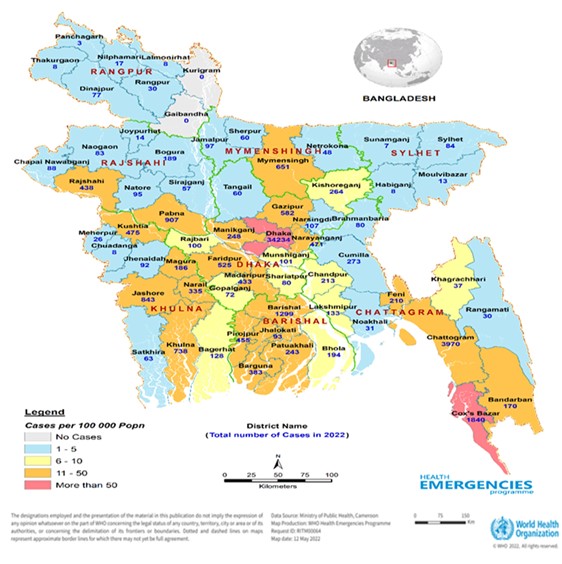
Out of the 64 districts, no dengue patient has been hosptalised in Kurigram and Gaibandha so far this year.

In 2019, when the government reported a record 101,354 dengue hospitalisations, the disease was found in all the districts. As many as 164 dengue patients died that year.

The number of hospitalisations over dengue this year was 49,300 as of Monday morning, the second highest annual count. The patients included 760 hospitalised in the 24 hours to 8am.

The death toll this year, however, has increased to 205, with three deaths in the latest daily count.

Bangladesh recorded 28,429 hospitalisations last year as the disease was found in 57 districts...
 
Source: https://www.dhakatribune.com/bangladesh/2022/11/22/dengue-death-toll-rises-to-237-as-3-more-die

Dengue: Death toll rises to 237 as 3 more die
515 more patients hospitalized
November 22, 2022 5:57 AM

With three more deaths from dengue recorded in 24 hours till Tuesday morning, the official death toll from the mosquito-borne disease rose to 237 this year.

During this time, 515 more patients, including 266 in Dhaka city, were hospitalized, according to the Directorate General of Health Services (DGHS)...
 
Source: https://www.dhakatribune.com/bangladesh/2022/11/27/dengue-513-cases-3-deaths-reported-in-24-hrs

Dengue: 513 cases, 3 deaths reported in 24 hours
A total of 1,929 dengue patients, including 1,129 in the capital, are now receiving treatment at hospitals across the country

November 27, 2022 6:47 AM

With three more deaths from dengue recorded in 24 hours till Sunday morning, the official death toll from the mosquito-borne disease rose to 247 this year.

During this period, 513 more patients, including 277 in Dhaka city, were hospitalized, according to the Directorate General of Health Services (DGHS)...
 
Source: https://www.who.int/emergencies/disease-outbreak-news/item/2022-DON424


Dengue - Bangladesh

28 November 2022


Outbreak at a glance
As of 20 November 2022, a total of 52 807 laboratory-confirmed dengue cases and 230 related deaths have been reported by the Ministry of Health & Family Welfare of Bangladesh since 1 January 2022 with a case fatality rate (CFR) of 0.44%. Dengue is endemic in Bangladesh however a surge of cases started in June 2022. Currently, all eight divisions in the country are reporting cases and deaths. This is the second-largest outbreak since 2000, with the largest having occurred in 2019. The current dengue outbreak is unusual in its scale and seasonality.
Description of the outbreak
Between 1 January and 20 November 2022, a total of 52 807 dengue cases including 230 related deaths (case fatality rate = 0.44%) were reported by the Ministry of Health & Family Welfare (MOHFW) (Figure 1). The cases were confirmed either by non-structural protein (NS1) diagnostic kits or by Immunoglobulin M (IgM) tests. According to information available for 40% of reported cases (n=20 982) the median age is 25 years (range: 0 – 89) with males accounting for 60% of the cases. This is the second highest annual number of cases since 2000, the highest having occurred in 2019, when 101 354 cases including 164 deaths were reported (Figure 2 & 3).
The most affected division is Dhaka, accounting for 70.6% of cases and 60.4% of deaths. Dhaka city, the largest city in Bangladesh, located in Dhaka division, has reported 64.5% (n= 34 071) of the total number of cases. Other affected divisions include Chattogram division (13.2% of cases and 24.8% of deaths) and Khulna division (5.5% of cases and 4.8% of deaths) (Figure 4).
The high incidence of dengue cases this year is taking place in the context of an unusual amount of rainfall since June 2022, accompanied by high temperatures and high humidity which have resulted in an increased mosquito population throughout Bangladesh.
Figure 1. Number of dengue cases and deaths reported in Bangladesh from 1 January to 20 November 2022.
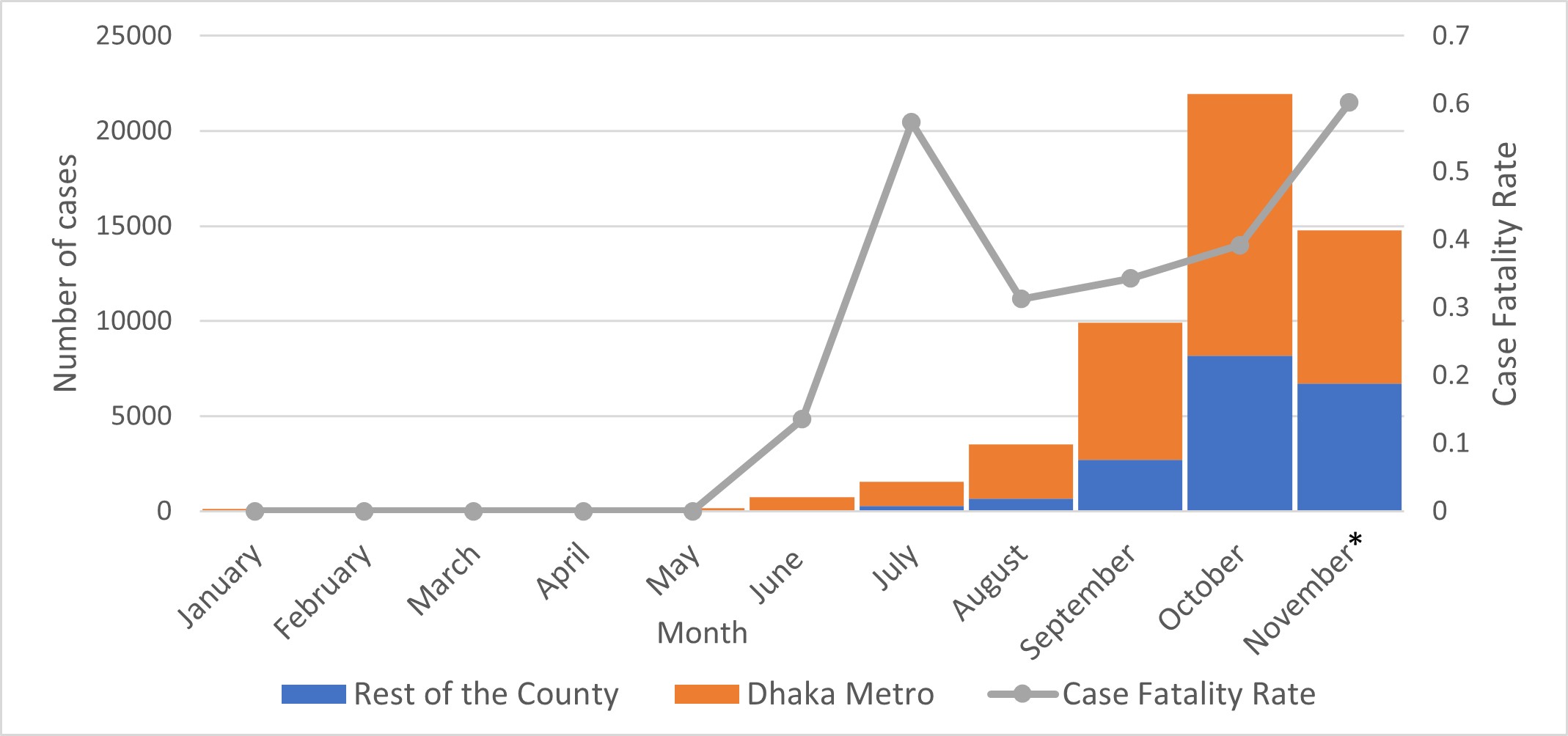
*The data for November is incomplete
Figure 2. Number of dengue cases and case fatality rates reported by year in Bangladesh from 1 January 2000 to 20 November 2022.

*Data up to 20 November 2022
Figure 3: Number of dengue cases reported by week for the period from 2017 to 2022 (until week 46, as of 20 November)

Figure 4. Number of dengue cases by district in Bangladesh from 1 January to 20 November 2022.
Epidemiology of dengue
Dengue is a viral infection transmitted to humans through the bite of infected mosquitoes and is found in tropical and sub-tropical climates worldwide, mostly in urban and semi-urban areas. The primary vectors that transmit the disease are Aedes aegypti mosquitoes and, to a lesser extent, Aedes albopictus.
Dengue virus (DENV) has four serotypes (DENV-1, DENV-2, DENV-3, DENV-4) and it is possible to be infected by each. Infection with one serotype provides long-term immunity to the homologous serotype but not to the other serotypes; sequential infections put people at greater risk for severe dengue. Many DENV infections produce only mild illness; over 80% of cases are asymptomatic. DENV can cause an acute flu-like illness.
There is no specific treatment for dengue; however, timely detection of cases, identifying any warning signs of severe dengue infection, and appropriate case management are key elements of care to prevent patient death and can lower fatality rates of severe infection to below 1%.
Dengue was first recorded in the 1960s in Bangladesh (then East Pakistan) and was known as “Dacca fever”. The establishment of the Aedes aegypti mosquito vector and urban cycles have made dengue endemic in Bangladesh. The growth factor of dengue cases since 2010 appeared to be linked to regional rainfall patterns (May to September) and is coincidental with higher environmental temperatures. Bangladesh’s climate conditions are becoming more favorable for the transmission of dengue and other vector-borne diseases like malaria and chikungunya due to excessive rainfall, waterlogging, flooding, rise in temperature and the unusual shifts in the country’s traditional seasons.

Public health response
  • The Directorate General of Health Services (DGHS) has taken the following actions:
    • Repurposed six COVID-19 dedicated hospitals in Dhaka city for dengue case management
    • Established dedicated dengue wards/dengue corners in Medical College hospitals
    • Activated Control Rooms in all district and Medical College hospitals for sharing awareness information and situation update with the stakeholders (including media and local leaders) to access the information locally available
    • Conducted capacity-building activity on clinical case management by the inhouse trained facilitators at DGHS and trained 250 doctors and 300 nurses on clinical case management.
  • The MOHFW and WHO distributed a total of 284 000 non-structural protein (NS1) diagnostic kits to all the Upazila health complexes, district hospitals and Medical College hospitals in the country.
  • Supplied adequate IV Saline and other supportive medicines for immediate response from the WHO-supported emergency buffer stock to health facilities all over the country.
  • Blood banks are geared towards making platelets available for hemorrhagic dengue patients.
  • Strengthened mass awareness campaigns – continued awareness through television and other mass media. The local ward counsellors have been trained in community awareness. The City Corporations carried out awareness programme and alerted building owners including buildings under construction to prevent water collection. Fines have been imposed on buildings where the Aedes larvae have been found.
  • The local government engineering department (LGED) is leading vector control activities including the elimination of breeding sites and larvicidal and adult mosquito control using different insecticides such as Temephos and Deltamethrin among others.
  • WHO supported pre-monsoon entomological survey through DFC, and is providing technical guidance to the outbreak response at the national level.

WHO risk assessment

Bangladesh experienced a moderate rainfall during October this year which was unusual (monsoon is from May to September). Due to the untimely rainfall and favorable climate conditions, the density of the Aedes mosquito population is increasing. In addition, many people keep water in different containers like buckets and pots in their houses, enabling Aedes mosquitos to readily breed in such artificial collections of water.
A pre-monsoon survey carried out by the health directorate earlier this year found a higher density of Aedes mosquitoes in the capital compared to 2021. Experts in the Communicable Disease Control (CDC) unit of the Directorate General of Health Services (DGHS) predicted a worsening dengue situation this year in Dhaka city unless preventive steps were taken. The CDC unit revealed its most recent monsoon survey in September and found that mosquito density was twice as high in Dhaka city as in the pre-monsoon survey.
Dengue is a mosquito-borne viral infection caused by four dengue virus serotypes (DENV-1, DENV-2, DENV-3, DENV-4). The predominant currently circulating serotype in Bangladesh is unknown at this stage, but limited serotyping has detected dengue virus 3 (DENV-3) and dengue virus 4 (DENV-4). DENV-3 has been consistently predominant since 2019 but DEN-4 has not been reported for several years.
Dengue virus has the potential to cause epidemics resulting in high morbidity and mortality. There is no specific treatment. However, early recognition of dengue virus infection and appropriate clinical management can reduce disease severity and mortality among dengue patients. At present, the number of severe dengue cases and case-fatality rates appear to be increasing, likely due to late health-seeking behaviour and access issues.
With the receding COVID-19 pandemic, the travel restrictions have been lifted. This has led to the movement of people to and from Dhaka. Although there have been concerted efforts by the Local Government Engineering Department (LGED), City Corporations, and the Ministry of Health towards curbing the dengue outbreak in Dhaka in the past few months, yet the continued movements have led to an inflow of possibly infected individuals with a potential to contribute to dengue transmission cycles. Vector control activities have been less intense in the other districts of Bangladesh.
Dengue poses a significant public health concern for Bangladesh which experiences regular seasonal outbreaks of dengue. Furthermore, the clinical management of people who develop severe illnesses, often requiring hospital care, puts additional strain on an already overburdened healthcare system.

WHO advice

The proximity of mosquito vector breeding sites to human habitation is a significant risk factor for dengue virus infection. Although dengue does not directly spread from human-to-human, Aedes species mosquitoes can become infected after biting dengue-infected individuals, thus creating a cycle of transmission capable of spreading dengue and leading to clusters of cases.
The prevention and control of dengue depends on effective vector control. WHO promotes a strategic approach known as Integrated Vector Management (IVM) to control mosquito vectors, including the mosquito genus Aedes (the primary vector for dengue). IVM should be enhanced to remove potential breeding sites, reduce vector populations, and minimize individual exposure. This should involve vector control strategies for larvae and adults (i.e., environmental management and source reduction, biological control, and chemical control measures), as well as strategies for protecting people and households. Bangladesh should implement the IVM strategy developed in 2021.
Vector control activities should focus on all areas where there is a risk of human-vector contact (place of residence, workplaces, schools and hospitals). Vector control activities can include covering, draining, and cleaning household water storage containers on a weekly basis. Space spraying with insecticide can be deployed as an emergency measure. Chlorination and application of suitable larvicides/insecticides for water storage in outdoor containers should also be considered.
Personal protective measures during outdoor activities include the topical application of repellents to exposed skin or on clothing, and the use of long sleeve shirts and pants. Indoor protection can include the use of household insecticide aerosol products or mosquito coils. Window and door screens, as well as air conditioning, can reduce the probability of mosquitoes entering the house. Insecticide-treated nets offer good protection to people against mosquito bites while sleeping during the day. Since Aedes mosquitoes are active at dawn and dusk, personal protective measures are recommended particularly at these times of day.
There is no specific treatment for dengue infection; however, early detection of cases, identifying any warning signs of severe dengue, and timely access to appropriate clinical management are key elements of care to reduce the risk for severe dengue complications and deaths due to dengue. Case surveillance should continue to be enhanced in all affected areas and across the country. Where feasible, resources should be allocated to the strengthening of laboratory sample referral mechanisms for the confirmation and sub-typing of the dengue virus.
WHO does not recommend any travel or trade restrictions be applied to Bangladesh based on the information available for this event.


Further information
Citable reference: World Health Organization (28November 2022). Disease Outbreak News; Dengue – Bangladesh. Available at: https://www.who.int/emergencies/dise...em/2022-DON424

 
Source: https://www.dhakatribune.com/bangladesh/2022/12/06/dengue-death-toll-rises-to-258

Dengue death toll rises to 258
The new death was reported from Dhaka
UNB
December 6, 2022 7:55 AM

With another death from dengue recorded in 24 hours till Tuesday morning, the official death toll from the mosquito-borne disease rose to 258 this year.

During this period, 269 more patients, including 134 in Dhaka city, were hospitalized, according to the Directorate General of Health Services (DGHS).

The new death was reported from Dhaka raising the division's death toll to 159.

A total of 1,227 dengue patients, including 719 in the capital, are now receiving treatment at hospitals across the country...
 
Source: https://www.thedailystar.net/health...ue-fever-24hrs-cases-cross-61000-mark-3196981


2 die of dengue fever in 24hrs, cases cross 61,000 mark
Star Digital Report
Thu Dec 15, 2022 06:27 PM Last update on: Thu Dec 15, 2022 06:28 PM

At least two dengue patients died while 163 others were hospitalised across the country in 24 hours till this morning.

With these, the total number of deaths rose to 269 while the total number of cases rose to 61,089, of whom 22,563 are from outside Dhaka...
 
Source: https://www.dhakatribune.com/bangladesh/2022/12/30/14-new-dengue-patients-hospitalized-in-24-hours

14 new dengue patients hospitalized in 24 hours
The DGHS recorded 62,335 dengue cases so far this year
UNB
December 30, 2022 8:27 AM

Fourteen more people were hospitalized with dengue in 24 hours till Friday morning.

The official death toll from the mosquito-borne disease remained unchanged at 281 as no death was recorded during the period, according to the Directorate General of Health Services (DGHS).

Of the new patients, six were admitted to the hospitals in Dhaka and eight outside it, said DGHS....
 
Back
Top