Research warns of avian influenza introduction routes in Antarctica
By Maíra Menezes (IOC/Fiocruz)
Published in 08/14/2025 3:42 pm
The Fiocruz research program in Antarctica (Fioantar) presents yet another important contribution to the protection of biodiversity and global health. A study led by Fiocruz decoded the genomes of three strains of the influenza A H5N1 virus, the causative agent of avian influenza, detected on the frozen continent. The pathogen was identified in two birds and one Antarctic fur seal found dead on the South Shetland Islands.
Fiocruz researchers' camp in Antarctica set up to collect samples last summer (photo: Maria Ogrzewalska)
The findings expand the evidence of H5N1 circulation in Antarctica and contribute to understanding the virus’s dissemination routes, which pose an additional threat to wildlife in a vulnerable ecosystem, endangered by climate change, invasive species, tourism, and fishing. According to the authors, the data reinforce the importance of surveillance and the One Health approach to this condition, which has been decimating wild animal populations, impacting poultry and dairy cattle production chains, and causing sporadic human infections.
For professionals working in Antarctica, the researchers emphasize the relevance of biosafety protocols to prevent infections that may occur through contact with sick or dead animals. “Genome analysis is essential to understand the paths taken by microorganisms. We observed that each of the three viruses analyzed is linked to a different introduction of H5N1 in Antarctica. This reinforces the need for surveillance, with ongoing research to monitor the spread and impacts of this pathogen in the region,” says Maria Ogrzewalska, researcher at the Laboratory of Respiratory Viruses, Exanthematous Diseases, Enteroviruses and Viral Emergencies of the Instituto Oswaldo Cruz (IOC/Fiocruz) and member of the Fioantar team.
“We work from the perspective of ‘One Health.’ A respiratory virus detected in animals, anywhere in the world, can impact global human health. Monitoring in different regions of the world, including Antarctica, is strategic for better prevention and response to potential pandemics,” emphasizes Marilda Siqueira, head of the Laboratory of Respiratory Viruses, Exanthematous Diseases, Enteroviruses and Viral Emergencies at IOC/Fiocruz.
As a means of rapid communication with the scientific community, the decoded genetic sequences were deposited on the GISAID platform, and a preliminary version of the study was published on the preprint platform Research Square, which allows immediate dissemination of research without peer review process. Simultaneously, an article was submitted for publication in a scientific journal and is currently under review.
The Fioantar project is part of the Brazilian Antarctic Program (Proantar), conducted by the Interministerial Commission for Marine Resources (Cirm) of the Brazilian Navy. The study involved researchers from the Instituto Oswaldo Cruz (IOC/Fiocruz), the Universidade Federal do Rio Grande do Sul (UFRGS), and the University of California (UC), in the United States.
Viral detection and genetic sequencing of the samples were carried out by the Laboratory of Respiratory Viruses, Exanthematous Diseases, Enteroviruses and Viral Emergencies at IOC/Fiocruz, which serves as a national reference center for influenza for the Ministry of Health and the World Health Organization (WHO). The research was funded by Proantar, the National Council for Scientific and Technological Development (CNPq), and the Department of Science and Technology of the Ministry of Health (Decit/MS).
Great gull (Larus dominicanus, top), Antarctic sea lion (Arctocephalus gazella) and spotted petrel (Daption capense) were identified with H5N1 virus in research led by Fiocruz (photos: Maria Ogrzewalska)
Different Virus Introduction
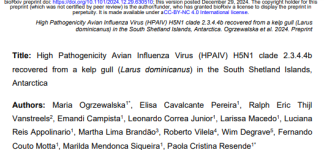
The study is the result of expeditions carried out by Fioantar over the last two summers. Confirmation of the virus in the carcass of a kelp gull (Larus dominicanus) on Livingston Island in January 2024, conducted by Fiocruz, represents the earliest record of H5N1 presence in the Antarctic Treaty area.
Almost a year later, in December 2024, the pathogen was confirmed in samples from a Cape petrel (Daption capense) on Livingston Island and an Antarctic fur seal (Arctocephalus gazella) on Robert Island. Upon analyzing the genomes of the pathogens, researchers observed variations indicating different introductions of the virus into Antarctica.
Microorganisms from the so-called “South American marine mammal lineage” were detected in the carcasses of the kelp gull and the Antarctic fur seal. This lineage emerged in 2023 in northern Chile, spreading along the coast to the south of the country and subsequently to Argentina, the Falkland Islands, Uruguay, and Brazil.
The infections affected a large number of marine mammals and, less frequently, seabirds. The lineage was also associated with an H5N1 outbreak in a domestic chicken farm in Brazil and a human infection in Chile, both in 2023.
According to the researchers, genetic data indicate that the two strains analyzed in Antarctica stem from distinct virus introductions, likely from Argentina.
H5N1 viruses from the marine mammal clade were implicated in mass mortality events of pinnipeds, such as sea lions and fur seals, in Chile, Argentina, Uruguay, and Brazil. In another trajectory, the virus detected in the Cape petrel belongs to the so-called “South American avian lineage” and was introduced from South Georgia, reinforcing the role of this territory as a springboard for H5N1 dissemination in Antarctica. This viral lineage emerged in Peru in 2022 and spread southward to Chile and eastward to Uruguay, Argentina, and Brazil. In 2023, it reached South Georgia, an archipelago located in the subantarctic region, just north of the Antarctic region.
Fiocruz researchers Bruno Pribul and Roberto Vilela, members of the Fioantar Project, in the procedure to collect a penguin sample (photo: Maria Ogrzewalska)
Genetic data from various studies, including the one led by Fiocruz, indicate that from South Georgia, the avian lineage of H5N1 reached the South Shetland Islands, Torgersen, Crozet, and Kerguelen — all within the Antarctic Treaty area, with the latter two more than 5,000 km away. Although primarily detected in domestic and wild birds, there are also records of infections by the avian lineage in marine mammals.
According to the scientists, expanding research should help understand differences between the H5N1 viral lineages characterized in South America. “Some genetic variations indicate that the marine mammal clade has adaptations that facilitate transmission among mammals. However, characterization of H5N1 lineages is still in its early stages. So far, we’ve observed that viruses from both clades can infect birds and mammals, but there are differences in infection frequency,” notes Maria.
Preparedness against H5N1 influenza
The H5N1 virus has been a focus of influenza surveillance since 1996, when the pathogen was first isolated in birds.
Attention intensified from 2020 onward due to the emergence of a viral variant that spread worldwide, causing outbreaks with high mortality in birds and mammals, as well as occasional human infections.
In the United States, the virus affected poultry farms and spread to dairy cattle. Seventy people were infected, most of them workers with direct contact with cattle or birds. One person died.
In Brazil, the virus was identified for the first time in May 2023 in seabirds in Espírito Santo. Since then, 174 infection outbreaks have been confirmed, according to the Ministry of Agriculture and Livestock. Wild animals were the most affected, accounting for 168 outbreaks, mainly in seabirds, as well as some sea lions. Five outbreaks were reported in domestic chicken and goose farms in different states, three in 2023 and two this year. In May of this year, the first outbreak in a commercial farm was recorded in the city of Montenegro, in Rio Grande do Sul.
As a reference service, the Laboratory of Respiratory Viruses, Exanthematous Diseases, Enteroviruses and Viral Emergencies at IOC/Fiocruz performs diagnosis of suspected avian influenza cases in humans and supports the Ministry of Health in surveillance of the condition, participating in working groups established by the ministry, along with the Health Surveillance Coordination and Reference Laboratories of the Fiocruz Presidency.
The head of the Laboratory emphasizes that combating avian influenza requires integrated action from the Ministries of Agriculture and Livestock, Environment, and Health. “We need real-time monitoring of virus circulation in different hosts. Together with the Ministry of Health, we are closely following this issue. So far, all suspected cases have been ruled out, meaning no presence of the H5N1 virus has been detected in patients,” reports Marilda.
Discoveries on the frozen continent
The Fioantar project began in 2019. Each summer, Fiocruz researchers travel to Antarctica to investigate the presence of microorganisms in the region that may threaten global health or contribute to biotechnology.
In the first expedition, scientists identified the influenza A virus, subtype H11N2, in penguins on the South Shetland Islands. The pathogen was detected in fecal samples from Adélie penguins (Pygoscelis adeliae) and chinstrap penguins (Pygoscelis antarcticus) collected between November 2019 and January 2020. Published in the scientific journal Microbiology Spectrum, the study indicated continuous circulation of the pathogen in the region, reinforcing the importance of surveillance.
Based on samples collected in January and February 2023, an avian coronavirus was detected in feces from kelp gulls (Larus dominicanus). Using metagenomic techniques, researchers were able to sequence the complete genome of the pathogen, identifying a Deltacoronavirus previously found in gentoo penguins (Pygoscelis papua) in 2014. The finding was published in a recently released article in the journal Microbiology Spectrum, drawing attention to the circulation of the virus among different bird species.
“Through Fioantar, Fiocruz has been researching the presence of various types of pathogens in animals and the Antarctic environment. Studies on respiratory viruses help expand our understanding of how these diseases, including influenza, spread over time among different species in this region,” notes Marilda.
https://fiocruz.br/en/news/2025/08/research-warns-avian-influenza-introduction-routes-antarctica