

Michael Coston
Editor, Senior Moderator
Avian Flu's New Normal: When the Extraordinary Becomes Ordinary
#17,544
Last week, relatively unnoticed amid the crush of other, more pressing avian flu stories (see here, here, and here), Chile's National Fisheries and Aquaculture Service (SERNAPESCA) released a 6-month report card on the impact of H5N1 on marine animals since its arrival in Southern South America in late 2022.
In early April, we looked at their first 3 month summary, which reported more than 2,200 mammals had been found dead along the coast during the first 3 months of 2023, most (if not all) believed due to avian H5N1.
Since that represented a 17-fold increase over all of the marine strandings reported in 2022 (n=131), this was greeted with both scientific concern and considerable international attention.
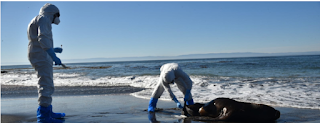
While it is likely an undercount (not all carcasses wash up on shore or are counted), last week's 6 month update (see below) from SERNAPESCA reported a 7-fold increase over the past 90 days (n=15,185).
In Scotland this week, authorities are cleaning the beaches of hundreds of dead birds (believed killed by H5N1), according to the following statement from the Aberdeenshire Council.
Avian Influenza clean-up continues across Aberdeenshire
Aberdeenshire Council Landscape Services staff have again been undertaking the removal of dead seabirds from the many shorelines around the region.
A year on from the previous outbreak, our frontline crews have been kitted out in full PPE to carry out the safe removal of hundreds of birds which, it is suspected, carry Avian Influenza, and we thank them for all their efforts once again.
At Stonehaven this week more than 520 birds were removed from the beach over the course of three days. At Cruden Bay more than 120 carcasses were collected. Today (Wednesday), more than 150 were recovered from Balmedie as well as 250 from Inverbervie.
Our thanks also go to a number of our own staff from various services who have come forward and volunteered to assist with future collections as and when required.
We have heard reports of people trying to assist in the clean-up by burying or binning bird carcasses, but please—for your own safety—eave the disposal to us.
Thanks to our very supportive residents and community groups who have been reporting sightings, we’ve again been able to quickly map out and prioritise removal of the birds and we will be getting to all these areas just as soon as we can.
We would urge you to continue that vital reporting—both to Defra on 03459 335577 and, if you come across large numbers of birds in popular areas, via the council’s online reporting form at https://www.aberdeenshire.gov.uk/environment/animal-health/dead-birds/
Again, please be assured that our beaches are still safe to enjoy this summer and the threat of transmission to humans is very low.
But remember to follow this safety advice at all times:
If you keep poultry or other birds, it is vital that you wash your hands and clean and disinfect your footwear before tending to your birds.
For more details on avian influenza, visit www.gov.scot/publications/avian-influenza-bird-flu/
These reports, along with accounts of scores of cats supposedly infected with H5N1 in Poland, the spillover of H5N1 into pigs and cattle in Europe and Africa, and the almost daily barrage of avian flu reports in non-avian hosts on WAHISwould have been received far differently just 8 or 12 months ago, but today are almost taken in stride.
Where H5N1 goes from here is anyone's guess. It has threatened before, only to recede unexpectedly. And we could get lucky again.
But pandemics do happen. And given what we've just been through, we can't afford to ignore the warning signs all around us.
https://afludiary.blogspot.com/2023/07/avian-flus-new-normal-when.html
#17,544
Last week, relatively unnoticed amid the crush of other, more pressing avian flu stories (see here, here, and here), Chile's National Fisheries and Aquaculture Service (SERNAPESCA) released a 6-month report card on the impact of H5N1 on marine animals since its arrival in Southern South America in late 2022.
In early April, we looked at their first 3 month summary, which reported more than 2,200 mammals had been found dead along the coast during the first 3 months of 2023, most (if not all) believed due to avian H5N1.
Since that represented a 17-fold increase over all of the marine strandings reported in 2022 (n=131), this was greeted with both scientific concern and considerable international attention.
While it is likely an undercount (not all carcasses wash up on shore or are counted), last week's 6 month update (see below) from SERNAPESCA reported a 7-fold increase over the past 90 days (n=15,185).
(translated)
Avian influenza in Chile: First semester closes with more than 15,000 dead marine animals
Thursday July 6, 2023
A new positive case of highly pathogenic avian influenza (HPAI) by H5 subtype of Eurasian lineage was detected in recent days. This is a common sea lion found in the Punta Gusano sector, near Puerto Williams, which is the first case of this species to be detected in the Magallanes Region.
With this finding, there are 46 specimens of marine animals under the tutelage of the General Fisheries and Aquaculture Law (LGPA) detected as positive cases for avian influenza: 35 common sea lions, 4 Humboldt penguins, 2 chungungos, 2 spiny porpoises, 2 Chilean dolphins and a huillín.
“When reviewing the report of dead animals associated with avian influenza, during the first half of 2023, we recorded that, from February 7 to June 30, 15,185 specimens of dead marine fauna have been identified. The breakdown is as follows: 13,025 common sea lions, 2,093 Humboldt penguins, 30 chungungos, 21 spiny porpoises, 15 Chilean dolphins and one huillín”, explained the National Director of SERNAPESCA, Soledad Tapia.
Likewise, the authority valued the work carried out together with other public entities such as SENAPRED, SAG, the Regional Governments, the Presidential Delegations and the municipalities, among others and communities, since "the important thing is to see that we must work together, work in coordination to being able to attend this type of event, which, as I repeat, had never occurred in Chile”.
“I want to highlight the tremendous work of our officials throughout the country, especially in the North macrozone. Mainly the regions of Arica and Parinacota and Antofagasta are the hardest hit, as high numbers of animals that appear with avian influenza symptoms remain, as well as in the Atacama and Coquimbo regions,” Tapia added.
WHY ARE SEA LIONS THE MOST AFFECTED SPECIES?
Among the more than 13,000 dead common sea lions associated with avian influenza during the first semester, the largest number occurred during the month of May, with 3,929 stranded specimens. The area where there were more strandings of dead common sea lions was in the north between the Arica and Atacama regions, the Antofagasta Region being the most affected, with 4,626 dead specimens, most of them found in the month of June.
Mauricio Ulloa, Sernapesca's avian influenza manager, explained in this regard that “a very special situation occurs, which is the passage of a virus that normally affected birds to a marine mammal. This step has caused the marine mammal to be very defenseless against this new virus and that is why this massive and unusual mortality that we have observed has occurred ”.
To this is added, in the case of the northern zone, that marine animals and birds -carriers of the virus- share the same sources of food, which are schools of fish such as anchovies and sardines, for which reason "they have been infected a lot by sharing feeding habitats and spaces where they develop”.
It should be remembered that, when a dead specimen is found on the coast, it is extremely important that people avoid contact with said animal and immediately report it to Sernapesca's telephone number 800 320 032, to begin coordination with municipalities or other services. state, to see the final disposition of the animals.
Thursday July 6, 2023
A new positive case of highly pathogenic avian influenza (HPAI) by H5 subtype of Eurasian lineage was detected in recent days. This is a common sea lion found in the Punta Gusano sector, near Puerto Williams, which is the first case of this species to be detected in the Magallanes Region.
With this finding, there are 46 specimens of marine animals under the tutelage of the General Fisheries and Aquaculture Law (LGPA) detected as positive cases for avian influenza: 35 common sea lions, 4 Humboldt penguins, 2 chungungos, 2 spiny porpoises, 2 Chilean dolphins and a huillín.
“When reviewing the report of dead animals associated with avian influenza, during the first half of 2023, we recorded that, from February 7 to June 30, 15,185 specimens of dead marine fauna have been identified. The breakdown is as follows: 13,025 common sea lions, 2,093 Humboldt penguins, 30 chungungos, 21 spiny porpoises, 15 Chilean dolphins and one huillín”, explained the National Director of SERNAPESCA, Soledad Tapia.
Likewise, the authority valued the work carried out together with other public entities such as SENAPRED, SAG, the Regional Governments, the Presidential Delegations and the municipalities, among others and communities, since "the important thing is to see that we must work together, work in coordination to being able to attend this type of event, which, as I repeat, had never occurred in Chile”.
“I want to highlight the tremendous work of our officials throughout the country, especially in the North macrozone. Mainly the regions of Arica and Parinacota and Antofagasta are the hardest hit, as high numbers of animals that appear with avian influenza symptoms remain, as well as in the Atacama and Coquimbo regions,” Tapia added.
WHY ARE SEA LIONS THE MOST AFFECTED SPECIES?
Among the more than 13,000 dead common sea lions associated with avian influenza during the first semester, the largest number occurred during the month of May, with 3,929 stranded specimens. The area where there were more strandings of dead common sea lions was in the north between the Arica and Atacama regions, the Antofagasta Region being the most affected, with 4,626 dead specimens, most of them found in the month of June.
Mauricio Ulloa, Sernapesca's avian influenza manager, explained in this regard that “a very special situation occurs, which is the passage of a virus that normally affected birds to a marine mammal. This step has caused the marine mammal to be very defenseless against this new virus and that is why this massive and unusual mortality that we have observed has occurred ”.
To this is added, in the case of the northern zone, that marine animals and birds -carriers of the virus- share the same sources of food, which are schools of fish such as anchovies and sardines, for which reason "they have been infected a lot by sharing feeding habitats and spaces where they develop”.
It should be remembered that, when a dead specimen is found on the coast, it is extremely important that people avoid contact with said animal and immediately report it to Sernapesca's telephone number 800 320 032, to begin coordination with municipalities or other services. state, to see the final disposition of the animals.
In Scotland this week, authorities are cleaning the beaches of hundreds of dead birds (believed killed by H5N1), according to the following statement from the Aberdeenshire Council.
Avian Influenza clean-up continues across Aberdeenshire
Aberdeenshire Council Landscape Services staff have again been undertaking the removal of dead seabirds from the many shorelines around the region.
A year on from the previous outbreak, our frontline crews have been kitted out in full PPE to carry out the safe removal of hundreds of birds which, it is suspected, carry Avian Influenza, and we thank them for all their efforts once again.
At Stonehaven this week more than 520 birds were removed from the beach over the course of three days. At Cruden Bay more than 120 carcasses were collected. Today (Wednesday), more than 150 were recovered from Balmedie as well as 250 from Inverbervie.
Our thanks also go to a number of our own staff from various services who have come forward and volunteered to assist with future collections as and when required.
We have heard reports of people trying to assist in the clean-up by burying or binning bird carcasses, but please—for your own safety—eave the disposal to us.
Thanks to our very supportive residents and community groups who have been reporting sightings, we’ve again been able to quickly map out and prioritise removal of the birds and we will be getting to all these areas just as soon as we can.
We would urge you to continue that vital reporting—both to Defra on 03459 335577 and, if you come across large numbers of birds in popular areas, via the council’s online reporting form at https://www.aberdeenshire.gov.uk/environment/animal-health/dead-birds/
Again, please be assured that our beaches are still safe to enjoy this summer and the threat of transmission to humans is very low.
But remember to follow this safety advice at all times:
- Do not pick up or touch dead or sick wild birds
- Keep pets/dogs away from any dead or sick birds
- Don't feed wild waterfowl
- Don't touch wild bird feathers or surfaces contaminated with droppings
If you keep poultry or other birds, it is vital that you wash your hands and clean and disinfect your footwear before tending to your birds.
For more details on avian influenza, visit www.gov.scot/publications/avian-influenza-bird-flu/
These reports, along with accounts of scores of cats supposedly infected with H5N1 in Poland, the spillover of H5N1 into pigs and cattle in Europe and Africa, and the almost daily barrage of avian flu reports in non-avian hosts on WAHISwould have been received far differently just 8 or 12 months ago, but today are almost taken in stride.
Where H5N1 goes from here is anyone's guess. It has threatened before, only to recede unexpectedly. And we could get lucky again.
But pandemics do happen. And given what we've just been through, we can't afford to ignore the warning signs all around us.
https://afludiary.blogspot.com/2023/07/avian-flus-new-normal-when.html
Last edited:

