• FluTrackers.com Inc. does not provide medical advice. Information on this web site is collected from various internet resources, and the FluTrackers board of directors makes no warranty to the safety, efficacy, correctness or completeness of the information posted on this site by any author or poster. The information collated here is for instructional and/or discussion purposes only and is NOT intended to diagnose or treat any disease, illness, or other medical condition. Every individual reader or poster should seek advice from their personal physician/healthcare practitioner before considering or using any interventions that are discussed on this website. By continuing to access this website you agree to consult your personal physican before using any interventions posted on this website, and you agree to hold harmless FluTrackers.com Inc., the board of directors, the members, and all authors and posters for any effects from use of any medication, supplement, vitamin or other substance, device, intervention, etc. mentioned in posts on this website, or other internet venues referenced in posts on this website.
  • We are not asking for any donations. Do not donate to any entity who says they are raising funds for us.

Avian flu H5N1 discussion - news/case lists links - 2022+

The world should prepare now for a potential H5N1 flu pandemic, experts warn

​6th March 2025

The rapid spread and mutation of a deadly bird flu virus in the United States warrants urgent global action on pandemic preparedness to close dangerous gaps in the world’s ability to develop and deliver new protective vaccines, flu and disease outbreak specialists are warning.

In a letter to the journal Science, CEPI’s Executive Director for Preparedness and Response Dr Nicole Lurie and six other experts said the bird flu virus – known as H5N1 and known to be very severe in some human cases—had in recent years crossed species from birds to mammals, including dairy cattle, and was now causing widespread exposure and sporadic human infections in the U.S. and beyond.
​-snip-
The experts outlined three critical efforts that they said should begin now in preparation for a potential wider human outbreak of H5N1: health authorities should establish a programme involving industry, governments, regulators and the scientific community to develop rapidly scalable pandemic flu vaccines, tests and treatments—with equitable access supported by a funded global framework; a comprehensive public communications programme should be initiated to address misinformation and hesitancy about vaccines; and governments should develop and transparently stress-test pandemic response plans to deal with a range of different disease scenarios and immunisation strategies.​

https://cepi.net/world-should-prepare-now-potential-h5n1-flu-pandemic-experts-warn
 
Media
Ohio 3/6/25

DeWine urges federal bird flu research, with over 30% of Ohio's egg laying hens killed

​Gov. Mike DeWine said the federal government needs to speed up bird flu research to contain the outbreak, which has cost Ohio nearly a third of its egg-laying hens.

Darke County is the center of Ohio's egg industry and its egg and poultry farmers have been particularly hit hard. This loss drew Gov. Mike DeWine and other state and industry leaders out Thursday afternoon.
​-snip-
Ohio is the second largest egg producing state in the country.
-snip-
DeWine said his primary focus is speeding up federally funded research into bird flu and he plans to meet with the U.S. Secretary of Agriculture to advocate for this.

"And I think what we need, frankly, is just a real sense of urgency. And that would be my message when I talk to the secretary," DeWine said.
​-snip-
According to Baldridge, 15.5 million birds have been destroyed to mitigate the spread of the illness.

According to data from the USDA, Ohio is at the heart of the outbreak with more than 5.7 million affected birds across the state.

The USDA also reported that 28 commercial flocks and 3 backyard flocks have been affected by the outbreak since Feb. 28. The highest number of confirmed detections of bird flu have come from Darke and Mercer Counties.
​-snip-
"Our farmers are working every day to get those barns cleaned and disinfected so they could repopulate and start producing eggs again. That takes time," he said. "It takes that chick 21 days to hatch, it takes 18 weeks before that hen is going to start laying eggs again."

continued: https://www.wyso.org/news/2025-03-0...with-over-30-of-ohios-egg-laying-birds-killed
 
[bolding is mine]

March 7, 2025
Are We on the Cusp of a Major Bird Flu Outbreak?

Scientists weigh in on the spread of H5N1 and highlight clues that portend what might come next

​Experts from the Harvard Medical School-led Massachusetts Consortium on Pathogen Readiness, or MassCPR, answered questions on March 5 about how H5N1 is spreading and evolving and discussed the state of surveillance efforts, testing, and vaccines.​

I think we’re all wondering whether this is a minor blip or if we are facing what may turn into an existential threat,” said Bruce Walker, director of the Ragon Institute of Mass General, MIT, and Harvard and member of the MassCPR executive committee.

Experts included:
  • Robert Goldstein, Massachusetts Department of Public Health Commissioner
  • Jacob Lemieux, HMS assistant professor of medicine and infectious disease specialist at Massachusetts General Hospital
  • Jeremy Luban, professor of molecular medicine, biochemistry & molecular biotechnology at UMass Chan Medical School
  • Jonathan Runstadler, professor and chair, department of Infectious Disease and Global Health, Cummings School of Veterinary Medicine at Tufts University
  • Kathryn Stephenson, HMS associate professor of medicine and infectious disease expert at Beth Israel Deaconess Medical Center
Harvard Medicine News: What do we know about the history and evolution of influenza viruses, and specifically H5N1?​....

HMNews: How does H5N1 affect humans?​,,,,

HMNews: What is the status of treatments and vaccines for H5N1?​...

HMNews: What is happening in terms of surveillance in the United States?​...

HMNews: How can we improve surveillance?​...

HMNews: On a scale from one to ten, how worried are you about H5N1 becoming a major pandemic?​...

Complete article: https://hms.harvard.edu/news/are-we...Bird flu, or H5N1 avian,only a matter of time.
 
CDC: People at Increased Risk for Bird Flu

March 7, 2025
Things that increase your risk of getting sick

Prolonged, unprotected exposure to infected animals
Avian influenza A virus infections in people happen most often after close, prolonged and unprotected (not using respiratory or eye protection) exposure to infected birds, infected dairy cows, or other infected animals or environments contaminated by infected animals.

How you get infected
People who get avian influenza A viruses in their eyes, nose, or mouth (from a splash to the eye, touching their eyes with contaminated gloves or fingers, for example) or inhale virus, can be infected.

Higher level of exposure
Also, exposure to high amounts of virus can increase people's risk of becoming sick. Activities like milking infected dairy cows, depopulating infected poultry flocks, or handling or defeathering infected poultry can expose people high levels of avian influenza A virus.


Things that increase your risk of getting very sick

Timeliness of medical care
Global data show that people who get early antiviral treatment with oseltamivir are less likely to get very sick and die than people who do not get treatment with flu antivirals or who get it later in their bird flu illness. Antiviral treatment works best when started soon after symptoms begin, ideally within 2 days of developing symptoms.


Increasing age
Based on data from other countries, the risk of getting very sick from bird flu increases with age, such as in older adults. Infants and young children have had the lowest risk of becoming very sick with bird flu. However, some children and young adults have died of bird flu in other countries.


Underlying medical conditions
People with certain underlying chronic medical conditions might be at higher risk of becoming severely ill with bird flu. People who are at increased risk of serious seasonal flu complications may be at higher risk for severe bird flu. However, some people who are otherwise healthy have become severely ill with bird flu in other countries.


People at increased risk for getting bird flu
In the United States, people with job-or recreational-related exposures to birds, dairy cows, or other avian influenza A virus-infected animals or to contaminated products (e.g., raw milk) from infected animals are at greater risk of infection.

These farm workers are currently most likely to be exposed:

continiued: https://www.cdc.gov/bird-flu/risk-factors/index.html
 
Last edited:
Bird flu cases continue to spread across Valley, but state officials say the virus may be slowing down
Updated: Mar 8, 2025, 1:53 AM

[bolding is mine]
Excerpt:

Most of California’s human cases are in the Valley

More than half of the 70 confirmed human cases of avian flu in the U.S. have occurred in California. So far, all but two of California’s 38 cases have contracted the virus through exposure to dairy herds.

In the Valley, at least 31 cases of bird flu among humans have been reported since October:
  • 18 in Tulare County
  • 4 in Kern County
  • 3 in San Joaquin County
  • 2 in Kings County
  • 2 in Madera County
  • 1 in Stanislaus County
  • 1 in Fresno County
Nearly all of the Valley cases have been the result of contact with infected dairy cattle or other livestock, according to health officials.

The Fresno County Department of Public Health and the CDC report that the virus can spread through droplets or particles from the feces, raw milk or saliva of an infected animal. The virus can enter through a person’s eyes, nose or mouth, including through breathing. The most at-risk people are those who handle raw milk from infected cows, those who care for sick animals or who clean livestock pens or barns.


https://www.turlockjournal.com/news...officials-say-the-virus-may-be-slowing-down/​
 
New York- Cornell

MARCH 8, 2025​
Talking Animals: Cornell Public Health’s Dr. Travis discusses Bird Flu and the university’s online informational portal, The Avian Flu Resource Center

Joining me on “Talking Animals” to discuss bird flu and the Avian Flu Resource Center–an online portal Cornell recently launched, designed to provide timely and accurate information about bird flu, amidst ongoing rumors and misinformation—Travis describes the current strain, and why it’s become so nefarious.

As part of that description, he outlines how the current flu–also known as Highly Pathogenic Avian Influenza, or HPAI—is transmitted, and how it’s so deadly, and contagious, that huge flocks of poultry have had to be euthanized. Meaning that, since the current strain reached the U.S. in 2022, some 150 million birds have been destroyed.

Travis mentions that this iteration of bird flu has crossed species to some mammals, including domestic cats—particularly farm cats who have ready access to infected birds and raw milk. Some of those exposed cats have become so sick that they died, Travis says. Thus far, this flu does not appear to infect dogs.

Asked about the genesis of the Avian Flu Resource Center—including who first proposed the concept, how the notion took hold and evolved—Travis sheepishly responded that “unfortunately,” the idea was primarily his. When I inquired why “unfortunately,” Travis explained that creating the

Avian Flu Resource Center was an enormous undertaking, as is regularly updating it to reflect new flu outbreaks and other relevant recent developments. But seemed like the right thing for them to do, as a noted Public Health entity.

There was a segment of the conversation devoted to the topic of the moment—eggs—with a heightened emphasis from both Travis and a recent New York Times piece on the importance of thoroughly cooking any eggs to be consumed, especially against the backdrop of this current bird flu episode.

Listen Below:
(scroll down at the website). https://www.wmnf.org/talking-animal...ational-portal-the-avian-flu-resource-center/

Cornell Cooperative Extension
Madison County, NY
https://ccemadison.org/agriculture/avian-flu-resources


COLUMBUS, Ohio (WSYX) — Ohio Gov. Mike DeWine provided an update on the bird flu crisis, revealing that he had a "positive conversation" with the Secretary of the U.S. Department of Agriculture over the weekend.

Governor Mike DeWine
@GovMikeDeWine
·
Follow
I had a very positive conversation with @USDA Secretary @BrookeLRollins this weekend about the serious impacts that Highly Pathogenic Avian Influenza is having on Ohio’s poultry farmers. I invited her to visit us in Ohio and speak directly with our agricultural community. I hope… Show more.
https://abc6onyourside.com/newslett...gency-dewine-agriculture-birds-eggs-inflation
 
NWHC Wildlife Health Bulletin - Avian Influenza Update (March 19, 2025)

NWHC Wildlife Health Bulletin - Avian Influenza Update

By National Wildlife Health Center March 19, 2025
NWHC Wildlife Health Bulletin - Avian Influenza Update
WHB 2025-01 HPAI update.pdf (333.37 KB) Detailed Description


USGS National Wildlife Health Center

Wildlife Health Bulletin 2025-01

Summary
  • The current HPAI outbreak in North America began in late 2021 and the virus has continued to circulate in North American wild birds (165 species affected) with sporadic spillover infections into North American wild mammals (27 species affected).
  • The current outbreak has different transmission patterns than the 2014-2015 outbreak, notably, sustained transmission in wild birds and a broader host range including multiple previously uninfected species of wild birds, wild and domestic mammals, and humans.
  • Waterfowl have emerged to be an important reservoir host in this outbreak; apparently healthy birds have regularly tested positive for HPAI virus during live-bird and hunter-harvest sampling.
  • Since the current outbreak began in North America, HPAI has been detected in >1,600 poultry facilities in every state and Puerto Rico, nearly 1,000 dairy operations in 17 states, and 70 humans.
  • The HPAI H5N1 virus remains avian-adapted, although sporadic mammalian mutations have been detected.
https://www.usgs.gov/media/files/nwhc-wildlife-health-bulletin-avian-influenza-update

------------------------------------------------------
Screenshots from the PDF:


...


...


...

https://d9-wret.s3.us-west-2.amazon...ublic/media/files/WHB 2025-01 HPAI update.pdf
 

Attachments

  • image.png
    image.png
    36.1 KB · Views: 0
  • image.png
    image.png
    185.9 KB · Views: 0
  • image.png
    image.png
    169.6 KB · Views: 0
  • image.png
    image.png
    190.7 KB · Views: 0
[bolding is mine]
Bird Flu Battle Stations

​PUBLISHED ON MARCH 22, 2025

NEWARK, Del. — In late fall, approximately 237,000 wild birds, representing 32 waterfowl species, fly south along the Atlantic Flyway from their Arctic home and settle along the Delmarva Peninsula. The impressive figure, calculated by the University of Delaware from surveys conducted by the Delaware Department of Natural Resources, includes the familiar snow geese, Canada geese and ducks. In all, our temporary avian visitors rest and co-mingle in our local region before returning north at the beginning of spring.

For Georgie Cartanza, the flying V formations migrating overhead are cause for concern. As the University of Delaware Cooperative Extension poultry extension agent, Cartanza knows the odds are high that the wild birds are carrying avian influenza, which, if spread, is a direct threat to millions of broiler chickens raised on the peninsula — a $5 billion industry.
​-snip-
Cartanza is part of that community, raising organic chickens in four poultry houses. On her family farm in Kent County, she produces 148,000 chickens per single flock, with multiple flocks totaling 5 million pounds of chicken each year.

During winter, Cartanza is constantly reinforcing her all-hands-on-deck approach to biosecurity in person and through her web page.

“One wild bird dropping contains enough virus to infect 1 million birds,” Cartanza warned growers in a fact sheet. “We cannot control where wild birds defecate, but we can take steps to prevent this virus from entering the houses.”
-snip-
The announcement was a harbinger of more serious times ahead. On Jan. 3, a test from a poultry farm in Kent County produced a positive result, and a second farm soon followed. As a result, Cartanza reluctantly called for canceling three educational poultry sessions, an opportunity to reach hundreds of family farmers scheduled for January’s annual Delaware Agriculture Week.

The cancellation attracted media attention. Cartanza broadcasted her biosecurity message over the airwaves. Positive tests were increasing.

Cartanza’s instincts were spot on. From January to February, nine commercial poultry farms in Delmarva tested positive for avian influenza. Cartanza’s farm was one of them.​
-snip-
To compare, from January through February 2024, during routine, non-HPAI conditions, Lasher ran 1,200 PCR tests for avian influenza. This year, approximately 3,600 samples were tested at the same time frame, 2,448 of which were for the incident.
-snip-
Cartanza’s 148,000 birds were immediately depopulated, an unfortunate but necessary measure to control the virus like the seven farms before her and the one that would follow.​
-snip-

While Cartanza will eventually receive financial indemnity from the USDA for her flock, other costs and delays will cause her economic hardship.

Her immediate and profound sense of failure was far more upsetting to Cartanza than the loss of her flock.

“I felt I had let fellow chicken farmers down,” she said. “Despite communicating best practices, I still ended up with it on my farm.”

After reviewing biosecurity practices, Cartanza attributes an area of vulnerability to a combination of a large pond running parallel to her farm, which the property owner recently enlarged. That body of water created an oasis for migratory birds. An opening in a vegetative windbreak increased the risk of bird flu exposure on her farm.

Cartanza is exploring a laser light system to deter birds from landing in this area.


Aerial observations will become part of Cartanza’s review process. She will share these updates with the poultry community so they can benefit, too.

“This real-world experience is humbling, but it’s helped me to be a better extension agent,” Cartanza reflected. “Someone told me afterward it was the best professional development I will ever get. It was a tough lesson, but now I can say with authority, ‘If it can happen to me, it can happen to you.’ That message will resonate with my fellow growers.”

https://www.morningagclips.com/bird-flu-battle-stations/


[bolding is mine]

MN farmer blames waterfowl for spreading bird flu
March 22, 2025

FAIRMONT — A Martin County farmer said he’s been battling the avian flu from spreading in his poultry operation since November.
Andrew Moeller said he is currently one of the bigger poultry producers in the Martin County area and the only state-certified emu producer in Minnesota.
“I legally can transport the birds across state lines with all the surrounding states of Minnesota,” he said. “I’ll ship eggs to anywhere in the U.S. I’ve shipped them to 46 of 50 states over the past few years.
-snip-
He said all of his operations came to a screeching halt when Highly Pathogenic Avian Influenza (HPAI) infected his farm.
-snip-
“The reason we keep on seeing an increase in this virus is being spread by wild waterfowl,” Moeller said. “Mostly they are landing in a field. They are depositing the viral matter through any sort of bodily fluids. They take off and it’s going to freeze into the soil. Next spring, when the waterfowl comes back through the same flyaways and lands in the same areas, they pick it back up again.”​

The sickness was immediately reported. While the Minnesota Department of Health investigated first, once emus came into question the United States Department of Agriculture (USDA) took over.

“My emu operation was the first outbreak that affected emus the USDA was able to get their hands on,” Moeller said. “They wanted numbers. They wanted to be able to see what the death rate was with those birds.”
In chickens, the mortality rate is 100 percent. Moeller’s family was also tested for the disease, but came back negative, as did his dog and barn cats.

At the time, Moeller’s emu operation was listed as a hobby operation. He said this gave him the ability to tell the USDA he did not want his emus euthanized. Moeller said the USDA agreed, as they wanted to see if any Emus survived.
-snip-
Unfortunately, his standard laying hens would not be so lucky. They were kept in a different spot, on the hog site. Moeller said USDA officials are very concerned with the most recent strain of HPAI spreading to hogs because viruses mutate much easier in pigs than other animals or humans.

Because of this, all of them had to be euthanized. They, along with the hobby chickens, ducks and other miscellaneous animals on the farm were put down. For the beef cattle and sheep, the USDA gave Moeller the choice to hold on to them.

Of the 13 emus, only five survived. Of the survivors, only one was a male. Moeller said the breeding habits of emus make this development more of a blow.
​-snip-

Overall, Moeller said he wouldn’t count on egg or poultry products lowering in price anytime soon.

“Especially with the eggs, as we’re losing laying hens,” he said. “We can’t just repopulate laying hens right away. They have to be hatched. Every egg that is being held back is not going into the market. Right now, it’s almost more to ship that egg to the consumer versus keeping it back for a replacement, because they’re making so much money. It’s just going to be a long process to build back.”

Fairmont Chamber of Commerce President Kandi Menne said it was shocking to hear about what Moeller had gone through.

“We’ve all been troubled about the egg prices and everything else,” she said. “To hear it from a personal side, the massiveness of what it was. They were being honest, reporting their situation. All of the paperwork and everything they had to go through to wait before they could start up with their business again. I had no idea.”
​​
https://www.marshallindependent.com...rmer-blames-waterfowl-for-spreading-bird-flu/
 
Related to:

UK Defra: H5N1 Detected In Domestic Sheep with Mastitis

Go to post

​---------------------------------------------​

March 24, 2025
expert reaction to news that influenza of avian origin (H5N1) has been confirmed in a single sheep in Yorkshire
...
Prof James Wood, Infectious Disease Epidemiologist at the University of Cambridge and Co-Director of Cambridge Infectious Diseases, University of Cambridge, said:

“This is a very important finding. It is the first case of a domesticated animal getting infected with avian influenza H5N1 over the 5 years or so of the current epidemic in wild birds and poultry. The case was detected in a sheep which reportedly had multiple positive tests in its milk and was on a farm clearly undergoing heightened surveillance as cases of the notifiable disease had been detected there in domestic poultry. Few details are yet available, but it seems reasonable to infer that the sheep was infected by close contact with infected birds or fomites from them on the same farm.

“Detection in milk is reported and some outlets report that lambs were tested and none found positive. It is not clear if this was a sheep being milked for human consumption or one that was only nursing lambs. No other sheep in contact were found to be positive.

“The case appears to have worrying parallels with the dairy cattle situation in the US, but also some reassuring differences. The case is one in which a mammary infection was found, as in the US cattle, but thankfully no within farm spread has been found. In the US, transmission between cattle is thought to have been mostly from the milking process. Differences in how sheep are milked (when they are) may make transmission risks lower than in dairy cattle – or the level of mammary infection may be different in sheep; it is hard to infer much from single cases. The surveillance in animals on the farm is a stark contrast to what has been done in the US; the simple act of stopping movement from infected farms can be expected to halt any farm to farm spread of this disease in sheep.

“While this is an important observation, it doesn’t change the global or national situation. Risks from avian influenza remain high and all care needs to be taken to ensure that there is no transmission from infected farms. Mammals in contact with avian influenza outbreaks will from time to time become infected and may become ill or die. Defra has announced this morning that they have updated their case definition for avian influenza in kept (and wild) mammals which will enhance their ability to control outbreaks. The heightened awareness of this potential transmission may result in other cases being found, should the current numbers of avian influenza outbreaks on poultry farms continue, despite the knowledge that strong biosecurity can prevent most of them. Pasteurisation of milk inactivates the risks to human health from avian influenza virus in it.”​
...

https://www.sciencemediacentre.org/...een-confirmed-in-a-single-sheep-in-yorkshire/
 
Bird flu reinfections at US poultry farms highlight need for vaccines, experts say

​Fri 28 Mar 2025 06.00 EDT

Scores of poultry operations in the US have been reinfected by bird flu since 2022, costing hundreds of millions of dollars in federal payouts, according to documents obtained by the Guardian.

The recurring outbreaks highlight the need for more aggressive prevention, including poultry vaccination and changes to how poultry is farmed, experts say.

continued: https://www.theguardian.com/world/2025/mar/28/bird-flu-us-poultry-farms-vaccines
 
NBC News
It's time to worry about bird flu in cats
March 30, 2025
By Aria Bendix


Bird flu wasn’t on Tim Hanson’s mind when he fed his cats specialty pet food containing raw chicken.

“You go to the pet shop and it was the premium raw food,” he said. “It was finely ground to a consistency that I thought was beneficial to my cats.”

But in early February, one of his cats, Kira, developed a fever and stopped eating. A test ordered by a veterinarian came back positive for bird flu. Within days, Kira’s condition had deteriorated — she became lethargic and had trouble breathing.
-snip

Although there’s some evidence that cats can pass bird flu to each other, there’s no evidence so far that they have transmitted the virus to people. However, the more the virus spreads in cats, the more opportunities it has to mutate and get better at spreading to humans. Outdoor cats, in particular, could serve as a transmission “bridge” between wild animals and domestic pets or humans, Kuchipudi said.

In 2016, a veterinarian at a New York City animal shelter tested positive for a different strain of bird flu, H7N2, after contact with sick cats.

“We need to be aware of these ongoing circulations that could potentially complicate the disease transmission and also [pose] a risk to human health,” Kuchipudi said.


continued: https://www.nbcnews.com/health/rcna198374

 
H5N1 Outbreak Hits 1,000 U.S. Dairy Herds; California Hardest Hit, Nevada Detects New Strain
11.04.2025

A highly pathogenic strain of avian influenza has infected more than 1,000 U.S. dairy herds, triggering the country’s most severe livestock health crisis in decades. Federal and state officials are ramping up biosecurity measures as California emerges as the epicenter and Nevada reports a newly identified strain with mutations linked to mammalian adaptation.

-snip-

Read more at © DairyNews.today https://dairynews.today/news/h5n1-o...ia-hardest-hit-nevada-detects-new-strain.html


Dr. Angela Rasmussen

@angie_rasmussen


So this interview lasted 2 hours so this “you’re scaring me” part might seem like an overreaction or fearmongering to someone without that context. There’s a lot of evidence to support my hypothesis that a potential H5N1 pandemic would be worse than COVID.
1:07
Quote
oku_x_dt_normal.jpg

Dr. Angela Rasmussen
@angie_rasmussen
·
17h
Talked to @BillWhitakerCBS on @60Minutes about H5N1. As Kamran Khan @hellobluedot told Bill, we don’t know if or when this virus might acquire pandemic capabilities, but it can. And if it does, as I told Bill, that will be worse than COVID. Much worse. https://www.cbsnews.com/news/bird-flu-risk-as-pathogen-spreads-60-minutes-transcript/
Show more
8:56 AM · Apr 21, 2025
·
249.9K
Views


49


649


2.1K


466

FluTrackers.com
Post your reply


Reply
Dr. Angela Rasmussen

@angie_rasmussen
·
4h


The clade 2.3.4.4.b viruses circulating in the US have infected many different mammalian species. In the course of this, we are seeing many opportunities for these viruses to adapt to mammalian hosts, including switching receptor usage & increasing virus fitness.


2


11


76

3.1K


Dr. Angela Rasmussen

@angie_rasmussen
·
4h


Viruses going back & forth in many mammalian hosts creates a lot of unique and complex selection pressures. It also leads to more infected individual animals, including in species we have frequent contact with: cows, poultry, dogs, cats, rodents, peridomestic wildlife.


2


12


80

2.9K


Dr. Angela Rasmussen

@angie_rasmussen
·
4h


More species infected with mammal-adapted viruses can mean more infections in humans. That in turn leads to more human adaptation, which could lead to emergence of a virus that replicates well and is efficiently transmitted between human hosts.


1


9


59

2.3K


Dr. Angela Rasmussen

@angie_rasmussen
·
4h


If we aren’t looking for cases, we won’t find them until so many people get sick that we detect them through the health care system. ~6% of infected people get severely ill. If so many people get sick enough to show up at the hospital in large numbers, it’s already a pandemic.


2


15


82

2.8K


Dr. Angela Rasmussen

@angie_rasmussen
·
4h


Now’s usually the time someone points out that mortality is much less than 50%, which is an overestimate based on undercounting cases. We calculated mortality at ~2% in this recent review. 2% doesn’t sound too bad, right?
Quote
oku_x_dt_normal.jpg

Dr. Angela Rasmussen
@angie_rasmussen
·
Mar 27
What is H5N1? Where is H5N1? What hosts is H5N1 infecting? Is H5N1 causing disease? Do we have countermeasures? It was a privilege to work with @florian_krammer & his very talented postdoc @enikohermann on this @JVirology Gem piece about bird flu. https://journals.asm.org/doi/10.1128/jvi.02209-24…
Show more


2


5


50

3.2K


Dr. Angela Rasmussen

@angie_rasmussen
·
4h


2% mortality is pretty bad. This is much higher than Covid and it’s in spite of prior immunity. In an immune population, Covid mortality is somewhere around 0.1%. 2% is 20x higher! Covid killed 1.4M. Still a lot. But H5N1 at 2% lethality is 7 million Americans dead. At minimum.


3


13


86

3.7K


Dr. Angela Rasmussen

@angie_rasmussen
·
4h


I don’t think people are prepared for who those 7 million dead Americans would be. Like Covid, flu is severe in older people or those with underlying medical issues. Unlike Covid, it is also severe in children. An H5N1 pandemic would kill millions of American kids.


2


8


68

3.6K


Dr. Angela Rasmussen

@angie_rasmussen
·
4h


Meanwhile, infections in poultry & dairy cows would continue to impact the food supply & economy. There would be potential shortages depending on how effective the USDA’s new strategy is (and I’m pessimistic about this). A pandemic in a tanking economy with food security issues.


3


14


80

4.8K


Dr. Angela Rasmussen

@angie_rasmussen
·
4h


And egg shortages would have a particularly bad impact on response capacity. Do you know how flu vaccines are made? The old fashioned and still primary method is to grow vaccine viruses in embryonated chicken eggs. So no eggs means no manufacturing vaccines at scale.


1


15


70

4.6K


Dr. Angela Rasmussen

@angie_rasmussen
·
4h


Also, hard to respond at all when there’s nobody to do any responding. Covid was awful, but govt programs like Operation Warp Speed saved lives. CDC did epi investigations. NIH invented the Moderna vaccine & funded research. FDA authorized tests, vaccines, drugs. Not this time


-----------------------------------------------------------

Please see our main H5N1 links:

US - H5N1 Avian Flu in Mammal Livestock List - Scroll down

H5N1 Avian Flu: FluTrackers 2016 - Current Global Case List

US H5N1 tracking by state link

H5N1 scientific library link
 
hat tip Hogvet51


snip


In summary we are at the point where the case load is slowing and released information is slowing even more as federal and state animal and public health staffs are reduced by cuts and less proactive U.S. public health policies come to the forefront. I don’t think our risk for cross species infections or for another human pandemic from H5N1 (or any other agent) has lessened whatsoever; however, our odds for early detection and a timely effective response continue to deteriorate daily.

I talked to an unnamed former VS colleague at the North Carolina meeting, still with a job, but quite pessimistic that VS or the animal health regulatory infrastructure in general has even minimal staff in place to handle a large resurgence in HPAI outbreaks next fall, let alone a major zoonotic pandemic or foreign animal disease response.

I hope industry is ready to step up to fend for itself in the event of a major animal health challenge, including one that involves a One Health threat. The capacity for a sustained federal or state effort will not be there initially. Plan accordingly to protect your interests.

For those of us who still believe, it may be a good time keep up our seasonal influenza vaccines for limited cross protection and to stockpile some N-95’s for those we love!

https://hogvet51.substack.com/p/h5n1-out-of-the-headlines-catching
 
CDC - EID Journal - Avian Influenza A(H5N1) Isolated from Dairy Farm Worker, Michigan

ISSN: 1080-6059

Disclaimer: Early release articles are not considered as final versions. Any changes will be reflected in the online version in the month the article is officially released.

Volume 31, Number 6—
June 2025


Research Letter

Avian Influenza A(H5N1) Isolated from Dairy Farm Worker, Michigan

Nicole Brock, Joanna A. Pulit-Penaloza, Jessica A. Belser, Claudia Pappas, Xiangjie Sun, Troy J. Kieran, Hui Zeng, Juan A. De La Cruz, Yasuko Hatta, Han Di, C. Todd Davis, Terrence M. Tumpey, and Taronna R. MainesComments to Author
Author affiliation: Centers for Disease Control and Prevention, Atlanta, Georgia, USA

Suggested citation for this article

Abstract

Influenza A(H5N1) viruses have been detected in US dairy cow herds since 2024. We assessed the pathogenesis, transmission, and airborne release of A/Michigan/90/2024, an H5N1 isolate from a dairy farm worker in Michigan, in the ferret model. Results show this virus caused airborne transmission with moderate pathogenicity, including limited extrapulmonary spread, without lethality.

Highly pathogenic avian influenza A(H5N1) clade 2.3.4.4b viruses have displayed unprecedented global spread among wild birds leading to numerous spillover infections in mammalian species. Of note, outbreaks in dairy cattle and gallinaceous birds have resulted in human infections in the United States during 2024–2025 (1). Increased frequency of H5N1 viruses crossing species barriers has caused concern that the avian influenza viruses are adapting to mammals. A critical component of influenza pandemic preparedness is early identification of emerging novel influenza viruses that cause disease and transmit efficiently in humans. A clade 2.3.4.4b H5N1 virus, A/Michigan/90/2024 (MI90), genotype B3.13, was isolated from a conjunctival swab specimen collected from a human patient in Michigan with conjunctivitis after exposure to infected cattle (2,3). In this article, we report the pathogenesis, transmission, and airborne exhalation of MI90 virus in ferrets, the standard animal model for influenza virus risk assessments (4).

We inoculated 18 ferrets with MI90 virus as previously described (5,6). We euthanized 3 ferrets on 3 and 5 days postinoculation (dpi) to assess virus spread in tissues. We used 6 ferrets to assess transmission in a cohoused, direct contact setting as a direct contact transmission model and through the air in the absence of direct or indirect contact as a respiratory droplet transmission model. We paired each ferret with a naive contact, as previously described (4). We observed clinical manifestations daily and collected nasal wash (NW), conjunctival, and rectal swab samples every 2 days postinoculation or postcontact. We confirmed transmission by testing for seroconversion to homologous virus in the contact animals.

Although all MI90-infected ferrets survived the 21-day study, we noted moderate disease. In inoculated ferrets, the mean maximum weight loss was 9.8%, fever (1.8°C above baseline) and lethargy were transient, and nasal and ocular discharge and sneezing were evident on days 4–9 dpi (Table). We detected virus 3 dpi primarily in respiratory tract tissues; titers were highest in ethmoid turbinate samples (7.4 log[SUB]10[/SUB] PFU/mL) and at low levels in brain and gastrointestinal tissues. We observed similar results in tissues collected 5 dpi.
25-0386-F1-tn.jpg

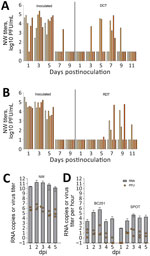
Figure. Transmission and measurement of airborne avian influenza A(H5N1) virus isolated from dairy farm worker, Michigan. A, B) For DCT and RDT testing, ferrets (n = 12) were intranasally inoculated with...

During the direct contact transmission experiment, inoculated ferrets shed virus in NW that peaked at 4.7–5.4 log[SUB]10[/SUB] PFU/mL at 1–5 dpi (Figure, panel A). Four of 6 cohoused contact animals had virus in NW (peak 2.5–4.9 log[SUB]10[/SUB] PFU/mL) at 5–7 days postcontact, whereas all 6 contact animals had viral RNA detected (3.6–7.7 log[SUB]10[/SUB] copies/mL) in NW (7) and seroconverted to MI90 virus, indicating that transmission was 100% (6/6 animals). In the respiratory droplet transmission experiment, NW collected from inoculated animals peaked 2.6–4.8 log[SUB]10[/SUB] PFU/mL at 1–3 dpi, whereas 3/6 contact ferrets had detectable virus in NW by day 7 postcontact (peak 2.6–4.8 log[SUB]10[/SUB] PFU/mL; days 9–11 postcontact) (Figure, panel B) as well as viral RNA (6.7–8.2 log[SUB]10[/SUB] copies/mL), and seroconverted, confirming transmission through the air in 50% of ferrets (3/6). We also detected infectious virus in conjunctival and rectal samples from inoculated animals, but only from 2 contact animals (Table).

To further evaluate the level of virus exhaled by MI90-inoculated ferrets and the potential for airborne transmission, we collected aerosol samples 1 time each day at 1–5 dpi for 1 hour from the 3 ferrets that were euthanized at 5 dpi. Air samples were analyzed for infectious virus and viral RNA by using the BC251 cyclone-based sampler (kindly provided by Dr. William Lindsley, National Institute for Occupational Safety and Health) and the SPOT water condensation sampler (Aerosol Devices, https://aerosoldevices.comExternal Link), as described previously (8) (Figure, panel D). The highest mean titer of virus was detected at 2 dpi in NW collected from all 3 inoculated ferrets (6.5 log[SUB]10[/SUB] PFU/mL) (Figure, panel C). Airborne virus was highest at 3 dpi as measured in both samplers, up to 133 and 41 PFU/hour, supporting transmission observed in both contact models within 3–5 days after exposure.

Overall, MI90 virus displayed reduced virulence in ferrets compared to another H5N1 virus isolated from a dairy farm worker in Texas (8,9); the Texas virus possesses a genetic marker in the polymerase basic 2 protein (E627K), known for enhanced replication and pathogenesis in mammals. At this position, MI90 encodes 627E, like most other viruses isolated from cattle, and contains polymerase basic 2 M631L, which is associated with mammal adaptation (3,9). In addition, polymerase acidic 142N/E has been linked to increased virulence in mice (10); the Texas virus has an E and MI90 virus has a K at this position. Both viruses have identical hemagglutinin sequences associated with receptor binding and the multi-basic cleavage site. Despite differences in virulence, both viruses transmitted in the ferret model with similar proficiency and levels of airborne virus.

Because avian H5N1 viruses cross the species barrier and adapt to dairy cattle, each associated human infection presents further opportunity for mammal adaption. This potential poses an ongoing threat to public health and requires continual surveillance and risk assessment of emerging viruses to improve our ability to predict and prepare for the next influenza pandemic.

Dr. Brock is a microbiologist in the Influenza Division, National Center for Immunization and Respiratory Diseases, at the Centers for Disease Control and Prevention. Her research interests include the pathogenicity, transmissibility, and host response associated with emerging strains of influenza virus.

...

https://wwwnc.cdc.gov/eid/article/31/6/25-0386_article

 
Back
Top