
• FluTrackers.com Inc. does not provide medical advice. Information on this web site is collected from various internet resources, and the FluTrackers board of directors makes no warranty to the safety, efficacy, correctness or completeness of the information posted on this site by any author or poster. The information collated here is for instructional and/or discussion purposes only and is NOT intended to diagnose or treat any disease, illness, or other medical condition. Every individual reader or poster should seek advice from their personal physician/healthcare practitioner before considering or using any interventions that are discussed on this website. By continuing to access this website you agree to consult your personal physican before using any interventions posted on this website, and you agree to hold harmless FluTrackers.com Inc., the board of directors, the members, and all authors and posters for any effects from use of any medication, supplement, vitamin or other substance, device, intervention, etc. mentioned in posts on this website, or other internet venues referenced in posts on this website.
  • We are not asking for any donations. Do not donate to any entity who says they are raising funds for us.

Australia Influenza Surveillance 2013

Re: Australia Influenza Surveillance 2013

Updated information is indicated with a *

*New South Wales

Week 36 Ending 8 September 2013

Summary:
For the week ending 8 September 2013, influenza activity eased. Influenza surveillance measures appear to indicate that we have passed the peak of influenza activity for the current influenza season.
 Emergency Department surveillance ? the index of increase for influenza-like illness (ILI) presentations was above the seasonal threshold, although continues to decline. The current level is consistent with the winter influenza season.
 Laboratory surveillance ? the proportion of respiratory samples positive for influenza A and B eased slightly this week (27.4%), predominantly influenza A(H1N1)pdm09. Other respiratory virus activity is also high.
 Community illness surveillance ? data collected from eGPs, ASPREN and FluTracking on ILI activity in NSW overall eased further this week.
 National and International influenza surveillance ? No new human cases of infection with the novel avian influenza A(H7N9) strain from China; otherwise low influenza activity worldwide.

For more information: NSW Health - Infectious Diseases Alert

*Queensland

Week ending September 8th.

There were 237 cases of influenza virus infection reported this week. Of these cases, 113 were attributed to influenza B virus, 117 were listed as Influenza A unsubtyped, 0 as A/H3N2 and 7 as A/H1N1(pdm09). 17 hospitalizations occurred (public hospitals only). There have been 3,219 influenza cases year-to-date.

There have been 260 hospital admissions including 39 to ICU.

For more information: QLD Health - Preventable Diseases

*South Australia

1 to 7 September 2013

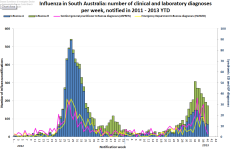
Two hundred and seventy-four cases of influenza were reported this week, compared to 308 cases reported in the previous week. Of these cases, 148 were attributed to influenza A virus and 125 were typed as influenza B. There have been 2,277 influenza cases notified year-to-date compared with 5,026 cases reported for the same period last year.

Cases comprised of 115 males and 158 females, with a median of 20 years. Of these, 30% were children <10 years of age and 6% were reported in persons aged 65 years or older. Since the beginning of 2013, 22% of notified influenza cases were reported in children <10 years of age.

For more information: Communicable Diseases Control Branch

Tasmania

Week ending September 1st

Summary
There has been an increase in Tasmanian influenza notifications during the last fortnight. Syndromic surveillance systems are reporting increasing levels of influenza like illness (ILI) above the baseline. Respiratory pathogen testing suggests that influenza and other non-influenza viruses are contributing to ILI in Tasmania.

There has been an increase in the number of influenza notifications, with 42 cases received during the last fortnight ending 1 September. These notifications account for 45% of the 93 influenza notifications now received during 2013.
The majority of notifications received have been in residents of the South region of Tasmania. Differences in notifications for the year to date may not reflect the different level of influenza between regions. Apart from differences in regional populations, this is also affected by how many people seek medical care and get tested for influenza.

Influenza types
During 2013 up to 1 September, 78 Influenza A notifications and 15 Influenza B notifications were received. The
majority of typed Influenza A cases have been Influenza A H1N1 (2009 strain).

For more information: DHHS Tasmania

Victoria

Report No: 19

Week Ending: September 8, 2013

Summary

? Influenza-like illness (ILI) fell below baseline levels this week with a presentation rate of 3.8 cases per 1000 patients seen. MMDS rates remained above baseline levels.
? From the 306 swabs received from surveillance GPs this season (30/4/13 ? 8/9/13) 30 have been positive for influenza A and 36 for influenza B.
? The majority of viruses detected through routine testing this week were influenza. Of the 144 influenza viruses detected so far this year 41 were A(H1N1)pdm09, 30 were H3, seven are untyped/ yet to be typed and 66 were influenza B.
? This week the Influenza Complications Network (FluCAN) reported nine hospitalisations, six from influenza B, one from influenza A(H3N2) and two from influenza A untyped. Since 6/4/2013 FluCAN have reported 150 hospitalisations with confirmed influenza, of which two were patients with A(H1N1)pdm09, 54 were untyped influenza A patients, 27 were influenza A(H3N2) and 66 were influenza B from the four Victorian sentinel hospitals. Of the 150 hospitalisations 18 were admitted to ICU, three were pregnant and 116 had comorbidities.
? Of the 208 influenza viruses analysed at the WHO Collaborating Centre for Reference and Research on Influenza year to date from Victoria, 44 were A(H1N1)pdm09, 42 H3 and 122 influenza B. The majority of strain-typed influenza B viruses in Victoria in 2013 have been B/Massachusetts/2/2012-like, an antigenic drift variant of the B/Wisconsin/1/2010-like virus in the 2013 southern hemisphere vaccine.
? The total number of laboratory confirmed notifications to the National Notifiable Diseases Surveillance System (NNDSS) to date was 16.026, of which 2,906 (18%) were from Victoria.

For more information: Victorian Infectious Diseases Reference Laboratory

Western Australia

WEEK ENDING 8TH OF SEPTEMBER 2013

INFLUENZA AND INFLUENZA-LIKE ILLNESSES (ILI)
Summary: Influenza activity was generally stable or decreasing, although hospitalisations continued to
increase.
? Influenza-like illness presentations to both general practice and hospitals increased marginally, but
influenza laboratory detections, especially of A/H3N2 virus, decreased.
? Influenza A/H3N2 and A/H1N1 were detected in nearly equal numbers, and influenza B activity remains
relatively low.
? Influenza hospital admissions increased, both numerically and as a proportion of all admissions.
? Detections of parainfluenza viruses and metapneumovirus continue to increase, while RSV
activity is declining.

For more information: WA Virus Watch

*Nationally

For the period to Jan 1- Sep 21, 2013 there were 18,336 confirmed Influenza cases.

The majority of notifications have been in NSW with 6,481, QLD had 3,638, Victoria 3,271, SA 2,675, WA had 1,498, ACT 399, NT 247 and Tas 127.

For national data: National Notifiable Diseases Surveillance System

Australian Sentinel Practices Research Network (ASPREN)

ASPREN is a national syndromic surveillance program co-ordinated by the Discipline of General Practice at the University of Adelaide and The Royal Australian College of General Practitioners. One of the conditions under surveillance is influenza like illness (ILI). General practitioners participating in the ASPREN program contribute data on the proportion of consultations which are ILI related.

No. 16, 2013
29th July ? 11th August 2013

Nationally, ILI notifications remained steady over the period with 243 and 177
notifications in week 31 and 32 respectively. ILI rates reported in this period increased
remained steady with 13 and 10 cases per 1000 consultations in weeks 31 and 32
respectively, compared to 12 cases per 1000 in weeks 29 and 30. For the same
reporting period in 2012, ILI rates were higher at 20 cases per 1000 consultations (see
Figure 1). On a state-by-state basis, it is important to note the increased ILI rate in urban
NSW (see figure 3).

For more information: ASPREN

*Flu Tracking

Flutracking Weekly Interim Report
Week #21 - ending 15 September 2013

Low levels of influenza-like illness activity.

This survey was sent on Monday 16 September 6:15 AM and by Thursday 19 September 9:00 AM we had
received 14623 responses (14499 last week) from 9432 people responding for themselves and 5191 household
members across Australia.

Across Australia, fever and cough was reported by
2.6% of vaccinated participants and 2.7% of
unvaccinated participants. Fever, cough and absence
from normal duties was reported by 1.6% of vaccinated
participants and 1.7% of unvaccinated participants.

For participants this week, 8756/14614 (59.9%) have
received the seasonal vaccine so far. Of the 2982
participants who identified as working face-to-face with
patients, 2344 (78.6%) have received the vaccine.

For more information, or to enrol: Flu Tracking

Australian influenza report 2013 - Current report:

Australian influenza report 2013? 17 August to 30 August 2013 (#06/2013)

Current Report Summary

The seasonal increase in influenza activity has slowed. Influenza activity remains relatively low compared to 2011 and 2012.

Since the beginning of the year there have been 14,068 laboratory confirmed cases of influenza reported. Over the past fortnight there were 3,262 notifications, with almost half reported from New South Wales (1,419).

Nationally, whilst influenza A remains the predominant influenza virus type, the proportion of influenza B this season has been higher than recent years. During the 2012 season there were very few notifications of influenza A(H1N1) pdm09. So far in 2013, whilst the majority of influenza A reports are unsubtyped, approximately 15% of overall notifications have been reported as influenza A(H1N1)pdm09.

Across jurisdictions the distribution of influenza types and subtypes is variable. In Western Australia, influenza A(H3N2) remains the predominant subtype, however the proportion of A(H1N1)pdm09 is increasing. Influenza type B continues to represent over half of Victoria's influenza notifications. In recent weeks there have been increasing proportions of influenza B in South Australia, Queensland and New South Wales.

Notification data show that there is a predominance of influenza B infections in those aged less than 15 years, with influenza A infections peaking in the 0-4 and 30-34 years age groups. Consistent with A(H1N1)pdm09 dominant years, there are very few notifications of this subtype in those aged 65 years and over.

Over the past few weeks the rate of seasonal increase in influenza associated hospitalisations has stabilised. Almost 15% of influenza cases have been admitted directly to ICU. The age distribution of hospital admissions shows peaks in the 0-9 and over 60 years age groups.

The WHO has reported that influenza activity in the northern hemisphere temperate zones remains at inter-seasonal levels. In the temperate countries of South America and Southern Africa, influenza transmission peaked in late June and was primarily associated with influenza A(H1N1)pdm09.

For more information see Department of Health and Ageing
 
Re: Australia Influenza Surveillance 2013

Updated information is indicated with a *

*New South Wales

Week 38 Ending 22 September 2013

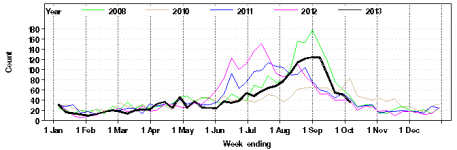
For the week ending 22 September 2013, influenza activity decreased further. Influenza surveillance measures appear to indicate that we have passed the peak (1 September) of influenza activity for the current influenza season.

 Emergency Department surveillance ? the index of increase for influenza-like illness (ILI) presentations fell well below the seasonal threshold. The current level is consistent with the winter influenza season ending.
 Laboratory surveillance ? the proportion of respiratory samples positive for influenza A and B continues to decrease but remains elevated (15.8%), predominantly influenza A(H1N1)pdm09. Other respiratory virus activity continues to remain high.
 Community illness surveillance ? data collected from eGPS, ASPREN and FluTracking on ILI activity in NSW overall decreased further this week and for some returned to pre-season levels.
 National and International influenza surveillance ? No new human cases of infection with the novel avian influenza A(H7N9) strain from China; otherwise low influenza activity worldwide.

For more information: NSW Health - Infectious Diseases Alert

*Queensland

Week ending September 15th.

There were 266 cases of influenza virus infection reported this week. Of these cases, 110 were attributed to influenza B virus, 137 were listed as Influenza A unsubtyped, 1 as A/H3N2 and 18 as A/H1N1(pdm09). 25 hospitalizations occurred (public hospitals only). There have been 3,505 influenza cases year-to-date.

There have been 297 hospital admissions including 43 to ICU.

For more information: QLD Health - Preventable Diseases

*South Australia

15 to 21 September 2013

Influenza
Two hundred and forty cases of influenza were reported this week, a decrease from 269 cases that were reported in the previous week. Of these cases, 114 were attributed to influenza A virus and 126 were typed as influenza B. There have been 2,784 influenza cases notified year-to-date compared with 5,272 cases reported for the same period last year.

Cases comprised of 110 males and 130 females, with a median of 30 years. Of these, 29% were children <10 years of age and 6% were reported in persons aged 65 years or older. Since the beginning of 2013, 23% of notified influenza cases were reported in children <10 years of age.

For more information: Communicable Diseases Control Branch

*Tasmania

Week ending September 15th

Summary
The recent increase in Tasmanian influenza notifications was maintained during the last fortnight. Syndromic surveillance systems are reporting fluctuating levels of influenza-like illness (ILI) above the baseline. Respiratory pathogen testing suggests that influenza is continuing to contribute to ILI in Tasmania together with other non-influenza pathogens.

The recent increase in influenza notifications has slowed, with 31 cases received during the last fortnight ending 15 September. These notifications account for one quarter of the 124 influenza notifications now received during 2013.
The notifications received during the last fortnight related to residents across all regions of Tasmania. Regional differences in notifications for the year to date may not precisely reflect the different level of influenza between regions. Apart from differences in regional populations, this is also affected by how many people seek medical care and get tested for influenza.

Influenza types
During 2013 up to 15 September, 99 Influenza A notifications and 25 Influenza B notifications were received. The
majority of typed Influenza A cases have been Influenza A H1N1 (2009 strain).

For more information: DHHS Tasmania

*Victoria

Report No: 21

Week Ending: September 22, 2013
Summary

? Influenza-like illness (ILI) fell below baseline levels this week with a presentation rate of 2.5 cases per 1000 patients seen. MMDS rates remained above baseline levels.
? From the 327 swabs received from surveillance GPs this season (30/4/13 ? 22/9/13) 33 have been positive for influenza A and 37 for influenza B.
? The majority of viruses detected through routine testing this week were influenza. Of the 167 influenza viruses detected so far this year 51 were A(H1N1)pdm09, 36 were H3, six are untyped/ yet to be typed and 71 were influenza B.
? This week the Influenza Complications Network (FluCAN) reported seven hospitalisations, one from influenza B and six from influenza A untyped. Since 6/4/2013 FluCAN have reported 198 hospitalisations with confirmed influenza, of which four were patients with A(H1N1)pdm09, 71 were untyped influenza A patients, 41 were influenza A(H3N2) and 82 were influenza B from the four Victorian sentinel hospitals. Of the 198 hospitalisations 21 were admitted to ICU, five were pregnant and 156 had comorbidities.
? Of the 253 influenza viruses analysed at the WHO Collaborating Centre for Reference and Research on Influenza year to date from Victoria, 55 were A(H1N1)pdm09, 48 H3 and 150 influenza B. The majority of strain-typed influenza B viruses in Victoria in 2013 have been B/Massachusetts/2/2012-like, an antigenic drift variant of the B/Wisconsin/1/2010-like virus in the 2013 southern hemisphere vaccine.
? The total number of laboratory confirmed notifications to the National Notifiable Diseases Surveillance System (NNDSS) to date was 18,995, of which 3,775 (18%) were from Victoria.

For more information: Victorian Infectious Diseases Reference Laboratory

*Western Australia

INFLUENZA AND INFLUENZA-LIKE ILLNESSES (ILI)
Summary: Influenza activity appears to be at or near the peak, with some differences between indicators.
? The rate of consultations for ILI at sentinel General Practices (GPs) increased 46% this week, but ILI presentations to hospital Emergency Departments decreased.
? A/H3N2 continues to be the dominant circulating influenza virus, with influenza A/H1N1 constituting one-quarter of detections and influenza B another 15%.
? Influenza hospital admissions appear to have plateaued.
? Detections of respiratory viruses other than influenza decreased slightly this week.

For more information: WA Virus Watch

*Nationally

For the period to Jan 1- Sep 28, 2013 there were 20,080 confirmed Influenza cases.

The majority of notifications have been in NSW with 6,831, Victoria had 4,000, QLD 3,862, SA 2,908, WA had 1,619, ACT 439, NT 264 and Tas 157.

For national data: National Notifiable Diseases Surveillance System

Australian Sentinel Practices Research Network (ASPREN)

ASPREN is a national syndromic surveillance program co-ordinated by the Discipline of General Practice at the University of Adelaide and The Royal Australian College of General Practitioners. One of the conditions under surveillance is influenza like illness (ILI). General practitioners participating in the ASPREN program contribute data on the proportion of consultations which are ILI related.

No. 16, 2013
29th July ? 11th August 2013

Nationally, ILI notifications remained steady over the period with 243 and 177
notifications in week 31 and 32 respectively. ILI rates reported in this period increased
remained steady with 13 and 10 cases per 1000 consultations in weeks 31 and 32
respectively, compared to 12 cases per 1000 in weeks 29 and 30. For the same
reporting period in 2012, ILI rates were higher at 20 cases per 1000 consultations (see
Figure 1). On a state-by-state basis, it is important to note the increased ILI rate in urban
NSW (see figure 3).

For more information: ASPREN

*Flu Tracking

Flutracking Weekly Interim Report
Week #22 - ending 22 September 2013

Low levels of influenza-like illness activity.

This survey was sent on Monday 23 September 12:32 AM and by Thursday 26 September 9:00 AM we had
received 13936 responses (14719 last week) from 9021 people responding for themselves and 4915 household
members across Australia.

Across Australia, fever and cough was reported by
2.2% of vaccinated participants and 2.5% of
unvaccinated participants. Fever, cough and absence
from normal duties was reported by 1.4% of vaccinated
participants and 1.5% of unvaccinated participants.

For participants this week, 8369/13926 (60.1%) have
received the seasonal vaccine so far. Of the 2843
participants who identified as working face-to-face with
patients, 2237 (78.7%) have received the vaccine.

For more information, or to enrol: Flu Tracking

Australian influenza report 2013 - Current report:

Australian influenza report 2013? 17 August to 30 August 2013 (#06/2013)

Current Report Summary

The seasonal increase in influenza activity has slowed. Influenza activity remains relatively low compared to 2011 and 2012.

Since the beginning of the year there have been 14,068 laboratory confirmed cases of influenza reported. Over the past fortnight there were 3,262 notifications, with almost half reported from New South Wales (1,419).

Nationally, whilst influenza A remains the predominant influenza virus type, the proportion of influenza B this season has been higher than recent years. During the 2012 season there were very few notifications of influenza A(H1N1) pdm09. So far in 2013, whilst the majority of influenza A reports are unsubtyped, approximately 15% of overall notifications have been reported as influenza A(H1N1)pdm09.

Across jurisdictions the distribution of influenza types and subtypes is variable. In Western Australia, influenza A(H3N2) remains the predominant subtype, however the proportion of A(H1N1)pdm09 is increasing. Influenza type B continues to represent over half of Victoria's influenza notifications. In recent weeks there have been increasing proportions of influenza B in South Australia, Queensland and New South Wales.

Notification data show that there is a predominance of influenza B infections in those aged less than 15 years, with influenza A infections peaking in the 0-4 and 30-34 years age groups. Consistent with A(H1N1)pdm09 dominant years, there are very few notifications of this subtype in those aged 65 years and over.

Over the past few weeks the rate of seasonal increase in influenza associated hospitalisations has stabilised. Almost 15% of influenza cases have been admitted directly to ICU. The age distribution of hospital admissions shows peaks in the 0-9 and over 60 years age groups.

The WHO has reported that influenza activity in the northern hemisphere temperate zones remains at inter-seasonal levels. In the temperate countries of South America and Southern Africa, influenza transmission peaked in late June and was primarily associated with influenza A(H1N1)pdm09.

For more information see Department of Health and Ageing
 
Re: Australia Influenza Surveillance 2013

Updated information is indicated with a *

*New South Wales

Week 39 Ending 29 September 2013

Summary:
For the week ending 29 September 2013, influenza activity decreased further. Influenza surveillance measures appear to indicate that we have passed the peak (1 September) of influenza activity for the current influenza season.
 Emergency Department surveillance ? the index of increase for influenza-like illness (ILI) presentations fell well below the seasonal threshold. The current level is consistent with the winter influenza season ending.
 Laboratory surveillance ? the proportion of respiratory samples positive for influenza A and B continues to decease but remains elevated (13.0%), predominantly influenza B. Other respiratory virus activity are decreasing.
 Community illness surveillance ? data collected from eGPS, ASPREN and FluTracking on ILI activity in NSW overall decreased further this week and for some returned to pre-season levels.
 National and International influenza surveillance ? No new human cases of infection with the novel avian influenza A(H7N9) strain from China; otherwise low influenza activity worldwide.

For more information: NSW Health - Infectious Diseases Alert

*Queensland

Week ending September 30th.

There were 206 cases of influenza virus infection reported this week. Of these cases, 109 were attributed to influenza B virus, 95 were listed as Influenza A unsubtyped, 0 as A/H3N2 and 2 as A/H1N1(pdm09). 18 hospitalizations occurred (public hospitals only). There have been 3,944 influenza cases year-to-date.

There have been 344 hospital admissions including 47 to ICU.

For more information: QLD Health - Preventable Diseases

*South Australia

22 to 28 September 2013

Two hundred and twenty cases of influenza were reported this week, a decrease from 241 cases that were reported in the previous week. Of these cases, 86 were characterised as influenza A virus and 134 were characterised as influenza B. There have been 3,006 influenza cases notified year-to-date compared with 5,376 cases reported for the same period last year.

Cases comprised of 108 males and 112 females, with a median of 30 years. Of these, 29% were children <10 years of age and 10% were reported in persons aged 65 years or older. Since the beginning of 2013, 24% of notified influenza cases were reported in children <10 years of age.

For more information: Communicable Diseases Control Branch

Tasmania

Week ending September 15th

Summary
The recent increase in Tasmanian influenza notifications was maintained during the last fortnight. Syndromic surveillance systems are reporting fluctuating levels of influenza-like illness (ILI) above the baseline. Respiratory pathogen testing suggests that influenza is continuing to contribute to ILI in Tasmania together with other non-influenza pathogens.

The recent increase in influenza notifications has slowed, with 31 cases received during the last fortnight ending 15 September. These notifications account for one quarter of the 124 influenza notifications now received during 2013.
The notifications received during the last fortnight related to residents across all regions of Tasmania. Regional differences in notifications for the year to date may not precisely reflect the different level of influenza between regions. Apart from differences in regional populations, this is also affected by how many people seek medical care and get tested for influenza.

Influenza types
During 2013 up to 15 September, 99 Influenza A notifications and 25 Influenza B notifications were received. The
majority of typed Influenza A cases have been Influenza A H1N1 (2009 strain).

For more information: DHHS Tasmania

*Victoria

Report No: 22

Week Ending: September 29, 2013
Summary

? Influenza-like illness (ILI) remained above baseline levels this week with a presentation rate of 3.0 cases per 1000 patients seen. MMDS rates remained above baseline levels.
? From the 340 swabs received from surveillance GPs this season (30/4/13 ? 29/9/13) 36 have been positive for influenza A and 38 for influenza B.
? The majority of viruses detected through routine testing this week were influenza. Of the 178 influenza viruses detected so far this year 58 were A(H1N1)pdm09, 38 were H3, six are untyped/ yet to be typed and 72 were influenza B.
? This week the Influenza Complications Network (FluCAN) reported three hospitalisations, one from influenza B and six from influenza A untyped. Since 6/4/2013 FluCAN have reported 205 hospitalisations with confirmed influenza, of which four were patients with A(H1N1)pdm09, 76 were untyped influenza A patients, 42 were influenza A(H3N2) and 83 were influenza B from the four Victorian sentinel hospitals. Of the 205 hospitalisations 21 were admitted to ICU, six were pregnant and 161 had comorbidities.
? Of the 286 influenza viruses analysed at the WHO Collaborating Centre for Reference and Research on Influenza year to date from Victoria, 61 were A(H1N1)pdm09, 48 H3 and 177 influenza B. The majority of strain-typed influenza B viruses in Victoria in 2013 have been B/Massachusetts/2/2012-like, an antigenic drift variant of the B/Wisconsin/1/2010-like virus in the 2013 southern hemisphere vaccine.
? The total number of laboratory confirmed notifications to the National Notifiable Diseases Surveillance System (NNDSS) to date was 21,139, of which 4,430 (21%) were from Victoria.

For more information: Victorian Infectious Diseases Reference Laboratory

*Western Australia

WEEK ENDING 29TH OF SEPTEMBER 2013

The number of influenza virus detections and the rate of ILI consultations decreased marginally
this week. A total of 69 swabs were collected in sentinel practices, of which 14 (20%) tested
positive for an influenza virus; of 433 routinely collected specimens, 90 tested positive (21%).

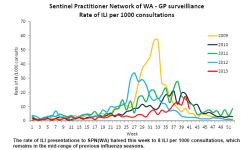
The rate of ILI presentations to SPN(WA) decreased slightly to 11 ILI per 1000 consultations,
which is in the mid-range of levels observed at this time in recent years.

For more information: WA Virus Watch

*Nationally

For the period to Jan 1- Sep 28, 2013 there were 21,555 confirmed Influenza cases.

The majority of notifications have been in NSW with 7,194, Victoria had 4,510, QLD 4,068, SA 3,093, WA had 1,737, ACT 490, NT 280 and Tas 183.

For national data: National Notifiable Diseases Surveillance System

*Australian Sentinel Practices Research Network (ASPREN)

No. 19, 2013
9th September ? 22nd September 2013

Nationally, ILI notifications decreased over the period with
214 and 158 notifications in week 37 and 38 respectively.
ILI rates reported in this period remained steady with 12 and
13 cases per 1000 consultations in weeks 37 and 38
respectively, compared to 12 and 13 cases per 1000 in
weeks 35 and 36 respectively. For the same reporting
period in 2012, ILI rates were lower at 8 cases per 1000
consultations (see Figure 5). On a state-by-state basis, it is
important to note the increased ILI rate in urban NSW (see
Figure 2).

For more information: ASPREN

*Flu Tracking

Flutracking Weekly Interim Report
Week #22 - ending 22 September 2013

Low levels of influenza-like illness activity.

This survey was sent on Monday 23 September 12:32 AM and by Thursday 26 September 9:00 AM we had
received 13936 responses (14719 last week) from 9021 people responding for themselves and 4915 household
members across Australia.

Across Australia, fever and cough was reported by
2.2% of vaccinated participants and 2.5% of
unvaccinated participants. Fever, cough and absence
from normal duties was reported by 1.4% of vaccinated
participants and 1.5% of unvaccinated participants.

For participants this week, 8369/13926 (60.1%) have
received the seasonal vaccine so far. Of the 2843
participants who identified as working face-to-face with
patients, 2237 (78.7%) have received the vaccine.

For more information, or to enrol: Flu Tracking

*Australian influenza report 2013 - Current report:

Australian influenza report 2013? 31 August to 13 September 2013 (#07/2013)

Current Report Summary
Nationally the 2013 influenza season appears to have peaked. Overall influenza activity has been relatively low compared to 2011 and 2012.

Since the beginning of the year there have been 17,990 laboratory confirmed cases of influenza reported including 2,992 in the past fortnight. Consistent with reporting periods throughout the season, the majority of this period?s notifications were reported from NSW (1,387).

Nationally, whilst influenza A remains the predominant influenza virus type, the proportion of influenza B this season has been higher than in recent years. Influenza A(H1N1)pdm09 has also re-emerged this season with approximately 15% of overall notifications have been reported as influenza A(H1N1)pdm09 compared to <1% of notifications in 2012.

Across jurisdictions, the distribution of influenza types and subtypes is variable. In Western Australia, influenza A(H3N2) remains the predominant subtype, however the proportion of A(H1N1)pdm09 is increasing. Influenza type B continues to represent over half of Victoria's influenza notifications. In recent weeks there have been increasing proportions of influenza B in South Australia and Queensland.

Notification data show that there is a predominance of influenza B infections in those aged less than 15 years, with influenza A infections peaking in the 0-4 and 30-34 years age groups. Consistent with A(H1N1)pdm09 dominant years, there are very few notifications of this subtype in those aged 65 years and over.

The rate of influenza associated hospitalisations has been relatively stable since 16 August. Almost 15% of influenza cases have been admitted directly to ICU. The age distribution of hospital admissions shows peaks in the 0-9 and over 60 years age groups.

Interim vaccine effectiveness estimates suggest that immunisation with the seasonal influenza vaccine reduces a person?s risk of requiring medical treatment or hospitalisation with confirmed infection with any influenza virus by 40-64%. The 2013 trivalent influenza vaccine was estimated to be more effective against infection with influenza B viruses than influenza A viruses.

The WHO has reported that influenza activity in the northern hemisphere temperate zones remains at inter-seasonal levels. In the temperate countries of South America and Southern Africa, influenza transmission peaked in late June and was primarily associated with influenza A(H1N1)pdm09.

For more information see Department of Health and Ageing
 
Re: Australia Influenza Surveillance 2013

Updated information is indicated with a *

New South Wales

Week 39 Ending 29 September 2013

Summary:
For the week ending 29 September 2013, influenza activity decreased further. Influenza surveillance measures appear to indicate that we have passed the peak (1 September) of influenza activity for the current influenza season.
 Emergency Department surveillance – the index of increase for influenza-like illness (ILI) presentations fell well below the seasonal threshold. The current level is consistent with the winter influenza season ending.
 Laboratory surveillance – the proportion of respiratory samples positive for influenza A and B continues to decease but remains elevated (13.0%), predominantly influenza B. Other respiratory virus activity are decreasing.
 Community illness surveillance – data collected from eGPS, ASPREN and FluTracking on ILI activity in NSW overall decreased further this week and for some returned to pre-season levels.
 National and International influenza surveillance – No new human cases of infection with the novel avian influenza A(H7N9) strain from China; otherwise low influenza activity worldwide.

For more information: NSW Health - Infectious Diseases Alert

*Queensland

Week ending October 7th.

There were 129 cases of influenza virus infection reported this week. Of these cases, 48 were attributed to influenza B virus, 76 were listed as Influenza A unsubtyped, 0 as A/H3N2 and 5 as A/H1N1(pdm09). 13 hospitalizations occurred (public hospitals only). There have been 4,110 influenza cases year-to-date.

There have been 362 hospital admissions including 48 to ICU.

For more information: QLD Health - Preventable Diseases

*South Australia

29 September to 5 October 2013

One hundred and ninety-three cases of influenza were reported this week, a decrease from 219 cases that were reported in the previous week. Of these cases, 76 were characterised as influenza A virus and 117 were characterised as influenza B. There have been 3,197 influenza cases notified year-to-date compared with 5,416 cases reported for the same period last year.

Cases comprised of 70 males and 122 females, with a median of 34 years. Of these, 19% were children <10 years of age and 11% were reported in persons aged 65 years or older. Since the beginning of 2013, 23% of notified influenza cases were reported in children <10 years of age.

For more information: Communicable Diseases Control Branch

*Tasmania

Week ending September 29th

Summary
The late seasonal elevation of Tasmanian influenza notifications continued during the last fortnight. Syndromic surveillance systems are continuing to report elevated levels of influenza-like illness (ILI). Respiratory pathogen testing suggests that Influenza A and Influenza B infections are continuing to contribute to ILI in Tasmania together with other non-influenza pathogens.

Influenza notifications
Tasmanian laboratories are required to notify evidence of influenza infection in specimens collected from patients. These specimens are usually nose or throat swabs but some may be blood tests.

The recent increase in new influenza notifications was sustained during the last fortnight ending 29 September, with 39 notifications received. This recent fortnight accounted for a quarter of the 163 influenza notifications now received during 2013.

The notifications received during the last fortnight related to residents across all regions of Tasmania. Regional differences in notifications for the year to date may not precisely reflect the different levels of influenza in regions. Apart from differences in regional populations, this is also affected by how many people seek medical care and get tested for influenza.

During 2013 up to 29 September, 124 Influenza A notifications and 39 Influenza B notifications were received. The
majority of typed Influenza A cases have been Influenza A H1N1 (2009 strain).

For more information: DHHS Tasmania

*Victoria

Report No: 23

Week Ending: October 10, 2013
Summary

• Influenza-like illness (ILI) fell below baseline levels this week with a presentation rate of 2.0 cases per 1000 patients seen. MMDS rates remained above baseline levels.
• From the 347 swabs received from surveillance GPs this season (30/4/13 – 6/10/13) 37 have been positive for influenza A and 39 for influenza B.
• The majority of viruses detected through routine testing this week were picornavirus. Of the 183 influenza viruses detected so far this year 58 were A(H1N1)pdm09, 38 were H3, 14 are untyped/ yet to be typed and 73 were influenza B.
• This week the Influenza Complications Network (FluCAN) reported two hospitalisations, one from influenza A untyped and one from influenza A(H3N2). Since 6/4/2013 FluCAN have reported 210 hospitalisations with confirmed influenza, of which four were patients with A(H1N1)pdm09, 79 were untyped influenza A patients, 43 were influenza A(H3N2) and 84 were influenza B from the four Victorian sentinel hospitals. Of the 210 hospitalisations 22 were admitted to ICU, six were pregnant and 166 had comorbidities.
• Of the 307 influenza viruses analysed at the WHO Collaborating Centre for Reference and Research on Influenza year to date from Victoria, 79 were A(H1N1)pdm09, 51 H3 and 177 influenza B. The majority of strain-typed influenza B viruses in Victoria in 2013 have been B/Massachusetts/2/2012-like, an antigenic drift variant of the B/Wisconsin/1/2010-like virus in the 2013 southern hemisphere vaccine.
• The total number of laboratory confirmed notifications to the National Notifiable Diseases Surveillance System (NNDSS) to date was 22,086, of which 4,646 (21%) were from Victoria.

For more information: Victorian Infectious Diseases Reference Laboratory

*Western Australia

WEEK ENDING 6TH OCTOBER 2013

Summary: Indicators suggest that influenza activity has peaked with some indicators suggesting
influenza activity has begun to decline.
· The rate of ILI consultations at sentinel General Practices (GPs) increased this week; however, ILI
presentations to Emergency Departments (ED) remain stable and the number of notified influenza
cases and laboratory detections decreased this week.
· A/H3N2 continues to be the dominant circulating influenza virus, constituting 42% of the characterised
viruses.
· Detections of respiratory viruses other than influenza continued to decrease this week, with the
exception of parainfluenza and human metapneumovirus.

For more information: WA Virus Watch

*Nationally

For the period to Jan 1- Oct 12, 2013 there were 22,280 confirmed Influenza cases.

The majority of notifications have been in NSW with 7,364, Victoria had 4,693, QLD 4,185, SA 3,232, WA had 1,825, ACT 490, NT 290 and Tas 201.

For national data: National Notifiable Diseases Surveillance System

Australian Sentinel Practices Research Network (ASPREN)

No. 19, 2013
9th September — 22nd September 2013

Nationally, ILI notifications decreased over the period with
214 and 158 notifications in week 37 and 38 respectively.
ILI rates reported in this period remained steady with 12 and
13 cases per 1000 consultations in weeks 37 and 38
respectively, compared to 12 and 13 cases per 1000 in
weeks 35 and 36 respectively. For the same reporting
period in 2012, ILI rates were lower at 8 cases per 1000
consultations (see Figure 5). On a state-by-state basis, it is
important to note the increased ILI rate in urban NSW (see
Figure 2).

For more information: ASPREN

*Flu Tracking

Flutracking Weekly Interim Report
Week #41 - ending 6 October 2013
Low levels of influenza-like illness activity.

This survey was sent on Monday 7 October 12:19 AM and by Thursday 10 October 9:00 AM we had received
13911 responses (13392 last week) from 8977 people responding for themselves and 4934 household members
across Australia.

Across Australia, fever and cough was reported by
1.8% of vaccinated participants and 2.6% of
unvaccinated participants. Fever, cough and absence
from normal duties was reported by 1.0% of vaccinated
participants and 1.7% of unvaccinated participants.

For participants this week, 8313/13909 (59.8%) have
received the seasonal vaccine so far. Of the 2870
participants who identified as working face-to-face with
patients, 2244 (78.2%) have received the vaccine.

For more information, or to enrol: Flu Tracking

Australian influenza report 2013 - Current report:

Australian influenza report 2013— 31 August to 13 September 2013 (#07/2013)

Current Report Summary
Nationally the 2013 influenza season appears to have peaked. Overall influenza activity has been relatively low compared to 2011 and 2012.

Since the beginning of the year there have been 17,990 laboratory confirmed cases of influenza reported including 2,992 in the past fortnight. Consistent with reporting periods throughout the season, the majority of this period’s notifications were reported from NSW (1,387).

Nationally, whilst influenza A remains the predominant influenza virus type, the proportion of influenza B this season has been higher than in recent years. Influenza A(H1N1)pdm09 has also re-emerged this season with approximately 15% of overall notifications have been reported as influenza A(H1N1)pdm09 compared to <1% of notifications in 2012.

Across jurisdictions, the distribution of influenza types and subtypes is variable. In Western Australia, influenza A(H3N2) remains the predominant subtype, however the proportion of A(H1N1)pdm09 is increasing. Influenza type B continues to represent over half of Victoria's influenza notifications. In recent weeks there have been increasing proportions of influenza B in South Australia and Queensland.

Notification data show that there is a predominance of influenza B infections in those aged less than 15 years, with influenza A infections peaking in the 0-4 and 30-34 years age groups. Consistent with A(H1N1)pdm09 dominant years, there are very few notifications of this subtype in those aged 65 years and over.

The rate of influenza associated hospitalisations has been relatively stable since 16 August. Almost 15% of influenza cases have been admitted directly to ICU. The age distribution of hospital admissions shows peaks in the 0-9 and over 60 years age groups.

Interim vaccine effectiveness estimates suggest that immunisation with the seasonal influenza vaccine reduces a person’s risk of requiring medical treatment or hospitalisation with confirmed infection with any influenza virus by 40-64%. The 2013 trivalent influenza vaccine was estimated to be more effective against infection with influenza B viruses than influenza A viruses.

The WHO has reported that influenza activity in the northern hemisphere temperate zones remains at inter-seasonal levels. In the temperate countries of South America and Southern Africa, influenza transmission peaked in late June and was primarily associated with influenza A(H1N1)pdm09.

For more information see Department of Health and Ageing
 
Re: Australia Influenza Surveillance 2013

My last update as the season winds down;

Updated information is indicated with a *

*New South Wales

Week 40 Ending 6 October 2013

Summary:
For the week ending 6 October 2013, influenza activity decreased further. Influenza surveillance measures appear to indicate that we have passed the peak (1 September) of influenza activity for the current influenza season. Emergency Department surveillance ? the index of increase for influenza-like illness (ILI) presentations fell well below the seasonal threshold. The current level is consistent with the winter influenza season ending.
Laboratory surveillance ? the proportion of respiratory samples positive for influenza A and B continues to decease but remains elevated (12.4%). Other respiratory virus activity is decreasing.
Community illness surveillance ? data collected from eGPS, ASPREN and FluTracking on ILI activity in NSW overall decreased further this week and have returned to pre-season levels.
National and International influenza surveillance ? No new human cases of infection with the novel avian influenza A(H7N9) strain from China; otherwise low influenza activity worldwide. Recommended composition of 2014 southern hemisphere influenza vaccines ? WHO has provided recommendations for the 2014 southern hemisphere winter influenza season.

NSW.PNG

For more information: NSW Health - Infectious Diseases Alert

Queensland

Week ending October 7th.

There were 129 cases of influenza virus infection reported this week. Of these cases, 48 were attributed to influenza B virus, 76 were listed as Influenza A unsubtyped, 0 as A/H3N2 and 5 as A/H1N1(pdm09). 13 hospitalizations occurred (public hospitals only). There have been 4,110 influenza cases year-to-date.

There have been 362 hospital admissions including 48 to ICU.

For more information: QLD Health - Preventable Diseases

*South Australia

6 October to 12 October 2013

One hundred and seventy-three cases of influenza were reported this week, a decrease from 192 cases that were reported in the previous week. Of these cases, 69 were characterised as influenza A virus and 104 were characterised as influenza B. There have been 3,686 influenza cases notified year-to-date compared with 5,474 cases reported for the same period last year.

Cases comprised of 91 males and 82 females, with a median of 37 years. Of these, 18.5% were children <10 years of age and 12% were reported in persons aged 65 years or older. Since the beginning of 2013, 23% of notified influenza cases were reported in children <10 years of age.

SA.PNG

For more information: Communicable Diseases Control Branch

Tasmania

Week ending September 29th

Summary
The late seasonal elevation of Tasmanian influenza notifications continued during the last fortnight. Syndromic surveillance systems are continuing to report elevated levels of influenza-like illness (ILI). Respiratory pathogen testing suggests that Influenza A and Influenza B infections are continuing to contribute to ILI in Tasmania together with other non-influenza pathogens.

Influenza notifications
Tasmanian laboratories are required to notify evidence of influenza infection in specimens collected from patients. These specimens are usually nose or throat swabs but some may be blood tests.

The recent increase in new influenza notifications was sustained during the last fortnight ending 29 September, with 39 notifications received. This recent fortnight accounted for a quarter of the 163 influenza notifications now received during 2013.

The notifications received during the last fortnight related to residents across all regions of Tasmania. Regional differences in notifications for the year to date may not precisely reflect the different levels of influenza in regions. Apart from differences in regional populations, this is also affected by how many people seek medical care and get tested for influenza.

During 2013 up to 29 September, 124 Influenza A notifications and 39 Influenza B notifications were received. The
majority of typed Influenza A cases have been Influenza A H1N1 (2009 strain).

For more information: DHHS Tasmania

Victoria

Report No: 23

Week Ending: October 10, 2013
Summary

? Influenza-like illness (ILI) fell below baseline levels this week with a presentation rate of 2.0 cases per 1000 patients seen. MMDS rates remained above baseline levels.
? From the 347 swabs received from surveillance GPs this season (30/4/13 ? 6/10/13) 37 have been positive for influenza A and 39 for influenza B.
? The majority of viruses detected through routine testing this week were picornavirus. Of the 183 influenza viruses detected so far this year 58 were A(H1N1)pdm09, 38 were H3, 14 are untyped/ yet to be typed and 73 were influenza B.
? This week the Influenza Complications Network (FluCAN) reported two hospitalisations, one from influenza A untyped and one from influenza A(H3N2). Since 6/4/2013 FluCAN have reported 210 hospitalisations with confirmed influenza, of which four were patients with A(H1N1)pdm09, 79 were untyped influenza A patients, 43 were influenza A(H3N2) and 84 were influenza B from the four Victorian sentinel hospitals. Of the 210 hospitalisations 22 were admitted to ICU, six were pregnant and 166 had comorbidities.
? Of the 307 influenza viruses analysed at the WHO Collaborating Centre for Reference and Research on Influenza year to date from Victoria, 79 were A(H1N1)pdm09, 51 H3 and 177 influenza B. The majority of strain-typed influenza B viruses in Victoria in 2013 have been B/Massachusetts/2/2012-like, an antigenic drift variant of the B/Wisconsin/1/2010-like virus in the 2013 southern hemisphere vaccine.
? The total number of laboratory confirmed notifications to the National Notifiable Diseases Surveillance System (NNDSS) to date was 22,086, of which 4,646 (21%) were from Victoria.

For more information: Victorian Infectious Diseases Reference Laboratory

*Western Australia

WEEK ENDING 13TH OCTOBER 2013

Summary: Indicators suggest that influenza activity is beginning to decline.
? Presentations to sentinel General Practices (GPs) and Emergency Departments (EDs) decreased this
week, indicating influenza activity is declining.
? Influenza A/H3N2, A/H1N1 and B viruses continue to co-circulate.
? Detections of respiratory viruses other than influenza continued to decrease this week.
WA.PNG

For more information: WA Virus Watch

*Nationally

For the period to Jan 1- Oct 19, 2013 there were 22,914 confirmed Influenza cases.

The majority of notifications have been in NSW with 7,528, Victoria had 4,779, QLD 4,312, SA 3,369, WA had 1,913, ACT 503, NT 300 and Tas 210.

For national data: National Notifiable Diseases Surveillance System

Australian Sentinel Practices Research Network (ASPREN)

No. 19, 2013
9th September ? 22nd September 2013

Nationally, ILI notifications decreased over the period with
214 and 158 notifications in week 37 and 38 respectively.
ILI rates reported in this period remained steady with 12 and
13 cases per 1000 consultations in weeks 37 and 38
respectively, compared to 12 and 13 cases per 1000 in
weeks 35 and 36 respectively. For the same reporting
period in 2012, ILI rates were lower at 8 cases per 1000
consultations (see Figure 5). On a state-by-state basis, it is
important to note the increased ILI rate in urban NSW (see
Figure 2).

For more information: ASPREN

Flu Tracking

Flutracking Weekly Interim Report
Week #41 - ending 6 October 2013
Low levels of influenza-like illness activity.

This survey was sent on Monday 7 October 12:19 AM and by Thursday 10 October 9:00 AM we had received
13911 responses (13392 last week) from 8977 people responding for themselves and 4934 household members
across Australia.

Across Australia, fever and cough was reported by
1.8% of vaccinated participants and 2.6% of
unvaccinated participants. Fever, cough and absence
from normal duties was reported by 1.0% of vaccinated
participants and 1.7% of unvaccinated participants.

For participants this week, 8313/13909 (59.8%) have
received the seasonal vaccine so far. Of the 2870
participants who identified as working face-to-face with
patients, 2244 (78.2%) have received the vaccine.

For more information, or to enrol: Flu Tracking

*Australian influenza report 2013 - Current report:

Australian influenza report 2013? 14 September to 27 September 2013 (#08/2013)

Current Report Summary
Nationally the 2013 influenza season appears to have peaked at the end of August. In comparison to recent seasons, overall influenza activity has been relatively low and the 2013 season appears to have started later, with the duration of the season appearing to have occurred over a shorter period.
Since the beginning of the year there have been 21,319 laboratory confirmed cases of influenza reported. Over the past fortnight there have been 2,415 notifications, a 32% decrease compared to the previous fortnight. Consistent with reporting periods throughout the season, New South Wales continued to report the highest number of notifications. Influenza notifications continue to decrease across most jurisdictions, with activity currently plateauing in Queensland, South Australia and Western Australia.
Nationally, influenza A continues to be the predominant influenza virus type. Influenza A(H1N1)pdm09 has also re-emerged this season with over 15% of overall notifications being reported as influenza A(H1N1)pdm09 compared to <1% of notifications in 2012. Overall, the proportion of influenza B this season has been higher than in recent years.
Across jurisdictions, the distribution of influenza types and subtypes is variable. In Western Australia, influenza A(H3N2) remains the predominant subtype, however the proportion of A(H1N1)pdm09 continues to increase. Whilst the proportion of influenza type B nationally has remained relatively stable, there have been increasing proportions of influenza B in New South Wales, South Australia and Queensland; combined with decreases in Victoria.
Notification data show that there is a predominance of influenza B infections in those aged less than 15 years, with influenza A infections peaking in the 0-4 and 30-34 years age groups. Consistent with A(H1N1)pdm09 dominant years, there are very few notifications of this subtype in those aged 65 years and over.
The rate of influenza associated hospitalisations has started to decline over the past fortnight. During the season around 12% of influenza cases were admitted directly to ICU and a high proportion of cases had known medical co-morbidities reported. The age distribution of hospital admissions shows a peak in the 0-9 years age group, with increasing numbers of admissions occurring in older age groups.
The WHO has reported that influenza activity in the northern hemisphere temperate zones remains at inter-seasonal levels. In the temperate countries of South America and Southern Africa, influenza transmission peaked in late June and was primarily associated with influenza A(H1N1)pdm09, however since July there has been an increase in the proportion of influenza A(H3N2) and influenza type B viruses.

For more information see Department of Health and Ageing
 
Back
Top