Re: Australia Influenza Surveillance 2011.
AUSTRALIAN INFLUENZA SURVEILLANCE REPORT
No. 12, 2011, REPORTING PERIOD:
20 August to 2 September 2011
...
Summary
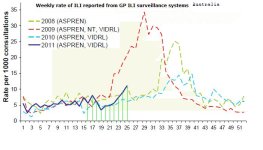
Levels of influenza-like illness (ILI) in the community continued to increase through both sentinel general practitioner surveillance systems and ILI presentations to emergency departments.
Notifications have continued to decrease in Queensland and New South Wales and recently have also started to decrease in other states and territories, except the Northern Territory. Currently the weekly number of notifications in the ACT, New South Wales, Queensland and Tasmania remain above the peak frequency of notifications observed in 2010.
During this fortnights reporting period there were 2,589 laboratory confirmed notifications of influenza, with Queensland reporting the highest number of notifications, followed by South Australia. Nationally, the majority of virus detections have been pandemic (H1N1) 2009, with co-circulation of influenza B.
The majority of states and territories have predominately reported pandemic (H1N1) 2009, with co-circulation of influenza B. However in Tasmania and New South Wales influenza B is the dominant strain, and in Western Australia, where mostly pandemic (H1N1) 2009 is reported, almost a quarter of reports are A/H3N2 and there is very little influenza B.
As at 2 September 2011, there have been 19,987 confirmed cases of influenza reported to the National Notifiable Diseases Surveillance System (NNDSS) in 2011. Nationally weekly notifications for this season have peaked. This season?s peak appears to have occurred in the week ending 5 August 2011 with 1,952 influenza notifications, and was above the peak frequency experienced in previous years, except 2009.
In addition to the previously reported cluster of pandemic (H1N1) 2009 influenza viruses showing resistance to oseltamivir within the Hunter New England region of New South Wales, a further two cases linked to this cluster have been detected in other regions of NSW. These additional cases had no prior travel history to the Hunter New England region. All of the viruses are sensitive to zanamivir and have not shown any antigenic changes that would affect their recognition by vaccine-induced antibodies.
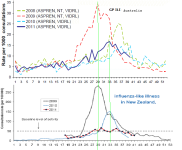
The WHO has reported that influenza activity in the temperate regions of the northern hemisphere remains low. Influenza transmission continues to occur in a few countries of the tropical region. After peaking in early June, influenza transmission in South Africa has declined to low levels. In New Zealand, rates of national ILI consultations are now above baseline activity levels and influenza type B is currently the predominant strain circulating.
...
FluTracking, a national online system for collecting data on ILI in the community, noted that in the week ending 4 September 2011 fever and cough was reported by 2.9% of vaccinated participants and 3.3% of unvaccinated participants.4 Fever, cough and absence from normal duties was reported by 1.6% of vaccinated participants and 1.6% of unvaccinated participants. Rates of ILI among FluTracking participants has remained relatively stable this season, compared to previous years (Figure 3).
Up to 4 September 2011, 5,680 out of 10,186 (55.8%) participants reported having received the seasonal vaccine so far. Of the 2,324 participants who identified as working face-to-face with patients, 1,699 (73.1%) have received the vaccine.
...
Of the 2,589 influenza notifications reported to the NNDSS this reporting period, 1,684 were influenza A (1,149 were influenza A (untyped), 459 were pandemic (H1N1) 2009 and 76 were A/H3N2), 896 were influenza B, 3 were influenza A&B and 6 notifications were reported as untyped (Figure 8). Compared to the beginning of the year, there appears to be very little A/H3N2 circulating.
The majority of states and territories have reported mostly pandemic (H1N1) 2009, with co-circulation of influenza B. However, in Tasmania and more recently New South Wales, influenza B is the dominant strain, and in Western Australia there is very little influenza B circulating and of the small number of A/H3N2 notifications nationally these are also mostly from Western Australia.
So far in 2011, 14,222 (71%) cases were reported as influenza A (35% influenza A (untyped), 31% pandemic (H1N1) 2009 and 5% A/H3N2) and 5,620 (28%) were influenza B. A further 59 (<1%) were influenza type A&B and 86 (<1%) were untyped (Figure 8).
...
Nationally Notified Influenza Associated Deaths
In 2011, 11 influenza associated deaths have been notified to the NNDSS, with a median age of 45 years. Eight of these cases were reported as having a pandemic (H1N1) 2009 infection, two with influenza type B and the other case reported as having influenza type A (untyped).
New South Wales Influenza and Pneumonia Death Registrations
Death registration data up to 19 August 2011 showed that there were 1.2 pneumonia or influenza associated deaths per 100,000 population in NSW, which is below the seasonal threshold of 1.8 per 100,000 NSW population for this period (Figure 11).3
...
Antiviral Resistance
The WHO Collaborating Centre in Melbourne has reported that from 1 January to 11 September 2011, 15 influenza viral isolates (out of 1,649 tested) have shown resistance to the neuraminidase inhibitor oseltamivir by enzyme inhibition assay (EIA). A further 18 specimens, out of a total of 203 tested by pyrosequencing, have shown the H275Y mutation known to confer resistance to oseltamivir. A total of 33 influenza viruses have shown resistance to oseltamivir in 2011, all have been the pandemic (H1N1) 2009 subtype.
The recent increases in oseltamivir resistance in pandemic (H1N1) 2009 influenza isolates have predominately occurred in the Hunter New England region of New South Wales between June and August 2011. The cluster consists of 25 cases, of which 6 were hospitalised and three were pregnant. A further two oseltamivir-resistant pandemic (H1N1) 2009 viruses, sampled in July and August, have also been found to belong to the cluster. Both of these cases were detected outside the Hunter New England region with no recent travel history to this region. None of the cases reported so far were treated with oseltamivir prior to their positive test for influenza. All of the viruses are sensitive to zanamivir and have not shown any antigenic changes that would affect their recognition by vaccine-induced antibodies.
...
http://www.health.gov.au/internet/main/publishing.nsf/Content/cda-ozflu-no12-11.htm/$file/ozflu-no12-2011.pdf