• FluTrackers.com Inc. does not provide medical advice. Information on this web site is collected from various internet resources, and the FluTrackers board of directors makes no warranty to the safety, efficacy, correctness or completeness of the information posted on this site by any author or poster. The information collated here is for instructional and/or discussion purposes only and is NOT intended to diagnose or treat any disease, illness, or other medical condition. Every individual reader or poster should seek advice from their personal physician/healthcare practitioner before considering or using any interventions that are discussed on this website. By continuing to access this website you agree to consult your personal physican before using any interventions posted on this website, and you agree to hold harmless FluTrackers.com Inc., the board of directors, the members, and all authors and posters for any effects from use of any medication, supplement, vitamin or other substance, device, intervention, etc. mentioned in posts on this website, or other internet venues referenced in posts on this website.
  • We are not asking for any donations. Do not donate to any entity who says they are raising funds for us.

Australia: Agriculture Victoria Investigating Sudden, Unexplained Horse Deaths (n=17)

Michael Coston

Editor, Senior Moderator
Australia: Agriculture Victoria Investigating Sudden, Unexplained Horse Deaths


#17,553

Unusual diseases, or die-offs, in animals are always a concern - both for the animal's welfare and potential economic impact - and because of the possibility that an emerging disease may be - or become - a zoonotic threat as well.

In 2014, in Emerging zoonotic viral diseases L.-F. Wang (1, 2) * & G. Crameri wrote:

The last 30 years have seen a rise in emerging infectious diseases in humans and of these over 70% are zoonotic (2, 3). Zoonotic infections are not new. They have always featured among the wide range of human diseases and most, e.g. anthrax, tuberculosis, plague, yellow fever and influenza, have come from domestic animals, poultry and livestock. However, with changes in the environment, human behaviour and habitat, increasingly these infections are emerging from wildlife species.


So media reports of as many as 10 sudden horse deaths, on three separate properties in Victoria, Australia since July 4th are worthy of our attention. Agriculture Victoria has posted the following statement on their website:

Sudden horse death investigations

Current situation

Agriculture Victoria staff are working with local veterinarians and experts to investigate the cause of multiple sudden horse deaths which have occurred since Tuesday 4 July.

The investigation is in its very early stages and extensive surveillance and testing is underway to understand the possible causes of the illness and death.

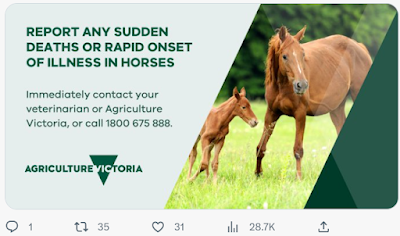
Horse owners should monitor their animals and report any sudden deaths or onset of illness in their horses immediately to their local vet, Agriculture Victoria or via the emergency animal disease hotline on
1800 675 888.

There have been ten confirmed sudden horse deaths on three separate properties. The properties are located on the Mornington Peninsula, south-east Melbourne and southwest Victoria.

It is not yet known what has caused these deaths. All horses died quickly with short term non-specific signs of illness and initial assessment had not revealed immediate common links.

There have also been several reports on social media channels of further affected properties. Agriculture Victoria is calling on these owners to make contact so they can assist with investigations.

Early testing for some infectious diseases has been negative. More testing is required, however, for a range of possible infectious and non-infectious causes.

Please do not share misinformation online or on social media.


One assumes that the `early testing' mentioned above would include Influenza A (equine H3N8), and presumably Hendra, a bat-borne virus (similar to Nipah) which first came to light in 1994 after the deaths of 13 horses and a trainer in Hendra, a suburb of Brisbane, Australia.

Since then, more than 40 outbreaks in horses, and a handful of human infections, have been reported in Australia. Two years ago researchers discovered A Novel Variant Of the Hendra Virus which had previously eluded tests.​


Australia has reported only one outbreak of Equine influenza (in 2007), but they maintain a long list of other notifiable equine diseases, including arboviruses spread by biting insects.

Outbreaks can have huge economic impacts. From the 2022 edition of the Victorian Government State Emergency Animal Disease Response Plan, a brief summary of the 2007 Equine Influenza outbreak:

In 2007, EI was detected in a horse in New South Wales (NSW) after the virus escaped quarantine. After six months, and a total estimated cost of $571 million to Australian governments, the disease was eradicated through the use of vaccination and strict movement controls. Australia is the only country in the world to have eradicated EI following an incursion.


For now, there are no obvious suspects, and there is no indication that there is a threat to human health. It is even possible that there is an environmental, or non-infectious disease, cause for these deaths.

Given the efforts Australia puts into keeping agricultural diseases out of their country, I expect this investigation will move swiftly.​


Stay tuned.​

https://afludiary.blogspot.com/2023/07/australia-agriculture-victoria.html
 
Last edited:
Australia: Update On Unexplained Horse Deaths (n=13) In Victoria


#17,556


Yesterday, in Australia: Agriculture Victoria Investigating Sudden, Unexplained Horse Deaths, we saw reports of 10 unexplained equine deaths across 3 horse farms located on the Mornington Peninsula, south-east Melbourne and southwest Victoria, with no immediately apparent epidemiological links.

While the cause remains unknown, today Agriculture Victoria reports that the numbers have risen to at least 13 horses across 5 properties.

Tests for Anthrax and Hendra virus have reportedly come back negative, and investigations are looking at a variety of other possible causes. Their most recent update follows:

Current situation - 17 July 2023

Agriculture Victoria's investigation into multiple sudden horse deaths is continuing.

The investigation is in its early stages and extensive surveillance and testing is explore the possible causes of the illness and death in horses, which have occurred since Tuesday 4 July.
Agriculture Victoria is working with private veterinarians and industry experts, responding to calls and building a bigger picture of the situation.

Horse owners should monitor their animals and report any sudden deaths or rapid onset illness immediately to their local vet, Agriculture Victoria or via the emergency animal disease hotline on 1800 675 888.

Those who are concerned about sick horses should seek advice from their vet. Rapid reporting after death will assist Agriculture Victoria and veterinarians to further investigate the situation.

As at 4pm Monday 17 July 2023, there have been 13 confirmed sudden horse deaths on five separate properties reported to Agriculture Victoria. The reported properties are located on the Mornington Peninsula (one property), south-east Melbourne (two properties near Cranbourne) and near Ballarat and Colac in the west. It is not yet known what has caused these deaths. Some of the cases which have just been reported occurred some weeks ago.

Early testing for a wide variety of infectious diseases, including Hendra and anthrax, has been negative however the investigation remains ongoing. More testing is required, for a range of possible infectious and non-infectious causes.

It is not yet known what has caused these deaths. All horses died quickly with short term non-specific signs of illness and initial assessment has not revealed immediate common links.
Agriculture Victoria has also looked into other reports made to the hotline which are not believed to have any connection at this stage.

As testing of samples for infectious disease to date has been negative, there’s no cause to restrict any movements of horses or separate horses at this stage. Horse events and movements can go ahead as planned.

There have also been several reports on social media channels of further affected properties. Agriculture Victoria is calling on these owners to make contact so they can assist with investigations.

Early testing for some infectious diseases has been negative. More testing is required, however, for a range of possible infectious and non-infectious causes.

Please be mindful of what you share online, and do not share misinformation online or on social media.​

Agriculture Victoria also sent out the following Veterinary Alert yesterday.

17 July 2023
Veterinary alert: sudden horse deaths


Agriculture Victoria is working to investigate the cause of multiple sudden deaths in horses which have occurred on separate properties since Tuesday 4 July. To date, there have been ten confirmed horse deaths on three separate properties. The properties are located on the Mornington Peninsula, south-east Melbourne and southwest Victoria, with no common links immediately evident. The affected horses reportedly died quickly with short-term non-specific signs of illness or no observed illness.

The investigation involves owners, private veterinarians, and a range of experts, including the Australian Centre of Disease Preparedness and the University of Melbourne. While the investigation is in early stages, testing for a number of infectious diseases has to date been negative. Potential toxicities are also being explored. Unfortunately, the investigators currently have access to limited suitable diagnostic samples.griculture Victoria website

Several informal reports of further affected properties are being investigated, with a number of instances of false information identified to date. Anyone aware of speculated further cases is asked to encourage official notification. Please do not share unconfirmed information online or on social media.

Agriculture Victoria is asking for notification of any sudden horse deaths in Victoria since 1 July 2023. Notifications can be made via EAD Hotline on 1800 675 888 for new cases or via cvo.victoria@agriculture.vic.gov.au for past cases (since 1 July) that have not yet been reported.

Timely engagement is critical for obtaining good quality diagnostic samples.

Although samples to date have tested negative for Hendra, each call-out should be considered on case-by-case basis and may not be connected to this incident, therefore Hendra precautions should be taken. Practitioners should consider rushed testing for Hendra (facilitated by Agriculture Victoria) in acutely ill or dead horses and prior to any invasive investigations or treatment. When contact is unavoidable, use of full PPE, including impervious boots (for example, gumboots), overalls and gloves, safety eyewear and P2 respirator mask is of critical importance in case of Hendra or other zoonotic diseases.

Horse owners are reminded to make sure their Property Identification Code (PIC) details are up to date. PICs are free and easy to get on the
Agriculture Victoria website.

More information

Please see the Agriculture Victoria website for situation overview
Advice on investigation procedures including sample collection can be found via on the Agriculture Victoria Website
See Reducing the risk of Hendra virus infection prepared by DAFF Queensland for comprehensive Hendra risk management advice.
Please share Agriculture Victoria social media posts on Facebook and Twitter.


https://afludiary.blogspot.com/2023/07/australia-update-on-unexplained-horse.html
 
Sudden Victorian horse deaths update


20 July 2023

Agriculture Victoria investigations into 13 sudden horse deaths since the start of July has found no common links to date between the five affected properties and no evidence of infectious disease.

At this point, Agriculture Victoria has only found normal causes of death.

Victoria’s Chief Veterinary Officer Dr Graeme Cooke today thanked horse owners and veterinarians for providing information and samples, helping to build the bigger picture.

‘Action was taken on Saturday, 15 July, as soon as we were notified of the multiple sudden horse deaths – we’ve been working with private veterinarians and experts to understand the causes of those deaths, and alerting horse owners and the public via a media release, website update, social media and industry updates,’ Dr Cooke said.

‘Our investigation has identified no immediate common link between these incidents, and no evidence of an infectious cause, so there’s no need to restrict horse movements or horse events.’

‘We’re continuing to attend properties, work with owners, vets and experts, test samples and look into all reports of horse deaths made to our hotline,’ Dr Cooke said.

‘The best chance of getting some answers requires early notification and extensive sample collection for any new cases.’

‘Even though substantial awareness has been raised about these incidents, the last reported multiple sudden deaths occurred on Friday, 14 July.

‘Further to that, some of the reports we’ve received this week date back to early July.’

Dr Cooke said Agriculture Victoria was aware of a recently confirmed case of Hendra virus in New South Wales. However, available samples from the incidents in Victoria have been tested for Hendra virus with negative results. Hendra virus has never been detected in horses in Victoria.

In the meantime, Dr Cooke advised that horse owners should always monitor their animals, conduct good parasite management and weed control, and ensure good quality feed and water is provided.

Horse owners should also register their horse with a Property Identification Code (PIC) – an important communications and traceability tool used during animal health incidents

‘This system has enabled Agriculture Victoria to contact 19,000 PIC holders registered in Victoria as having horses on their properties about this current issue,’ Dr Cooke said.

https://agriculture.vic.gov.au/abou...releases/sudden-victorian-horse-deaths-update
 
Australia: Update On Unexplained Horse Deaths (n=17) In Victoria


AVvXsEg1NFDWUKPNl1r_BgD45E70uZJprFWhPEMs0KJuGl0U3sfl6MrK4ZN4YOdP3nS7cGl9hXHzxSP_nhHKx2IYTW6_iFW3DMXUwGivufDycXw4SEvOjsbvCastl6Y3b6t1wdpCq85lOZQONtO0Lw1cUa13t_tVD3Vx_SgoDJm1JXbZeHQDVoG1t6h8Sw


#17,579

Ten days ago, in Australia: Agriculture Victoria Investigating Sudden, Unexplained Horse Deaths, we first learned of the mysterious sudden deaths of horses on multiple farms in Victoria. Since then, we've seen a single update, where the number of horse fatalities had risen to 13.

At this point, it is still unclear whether these horses are dying from an infectious disease, an environmental toxin, or some other cause. Thus far, no movement restrictions on horses have been ordered.​

Overnight Agriculture Victoria issued the following update, where we learn the number of suspicious horse deaths has increased to 17, but no cause has been determined.

Sudden horse death investigations

26 July 2023

Current Situation

To date, there have been sudden multiple horse deaths reported across 6 properties with a total of 17 horses that have died.

Following the announcement of an unusual level of sudden multiple deaths in horses, Agriculture Victoria has since received reports of a number of single deaths.

Only normal causes of death have been able to be identified in these and none appear to be infectious. The investigation continues into what could have been the possible causes of the multiple sudden horse deaths.

All affected horses have been reported to have died relatively quickly, within hours to one day from the first sign of illness. That is the only common factor to date.

Investigation

To date only normal causes of death found where adequate investigations and samples were possible. Examples include bacterial infection, and gut rupture. Toxic plants such as Marsh mallow (Malva parviflora) are also being investigated as a cause.

The investigation remains ongoing until all samples submitted to laboratories have been tested and final results are available.

Horse owners can be reassured however there is no need for any restrictions on horse movements and horse events and gatherings can go ahead as planned.

Agriculture Victoria will continue to attend properties, work with owners, and investigate all reports of multiple sudden horse deaths made to its hotline.

Agriculture Victoria is aware of the confirmed case of Hendra virus in New South Wales. Hendra virus has not been detected in Victoria as part of the current investigation, nor is there any known connection between these incidents.

It’s essential to remember that sudden death of individual horses is not uncommon, and there may not be a definitive answer or common link found. Multiple horse deaths within a short time frame though is unusual and veterinary advisers should be contacted as soon as possible.

Horse owners should monitor their animals, conduct good parasite management and weed control, and ensure good quality feed and water is provided.

No Movement Restrictions

As testing of samples for infectious disease to date has been negative, there’s no reason to restrict any movements of horses or separate horses. Horse events and movements can go ahead as planned.

If you have a sick horse, it would be wise to separate it from your other horses until your veterinarian has examined it.

Monitoring and Reporting

Horse owners should monitor their animals and report any multiple sudden deaths or rapid onset illness immediately to their local vet, Agriculture Victoria or via the emergency animal disease hotline on
1800 675 888.

Those who are concerned about sick horses should seek advice from their vet.

Property Identification Codeshttps://afludiary.blogspot.com/2023/07/australia-update-on-unexplained-horse_27.html

Horse owners should register their horse with a Property Identification Code (PIC). It is an important communication and traceability tool used during animal health incidents.

A PIC enables Agriculture Victoria to contact horse owners if required. It’s free, quick and can be done
here.

Misinformation

Please be mindful of what you share online, as posting misinformation can cause unnecessary alarm to horse owners.


https://afludiary.blogspot.com/2023/07/australia-update-on-unexplained-horse_27.html
 
Back
Top Bottom