• FluTrackers.com Inc. does not provide medical advice. Information on this web site is collected from various internet resources, and the FluTrackers board of directors makes no warranty to the safety, efficacy, correctness or completeness of the information posted on this site by any author or poster. The information collated here is for instructional and/or discussion purposes only and is NOT intended to diagnose or treat any disease, illness, or other medical condition. Every individual reader or poster should seek advice from their personal physician/healthcare practitioner before considering or using any interventions that are discussed on this website. By continuing to access this website you agree to consult your personal physican before using any interventions posted on this website, and you agree to hold harmless FluTrackers.com Inc., the board of directors, the members, and all authors and posters for any effects from use of any medication, supplement, vitamin or other substance, device, intervention, etc. mentioned in posts on this website, or other internet venues referenced in posts on this website.
  • We are not asking for any donations. Do not donate to any entity who says they are raising funds for us.

Aspirin Misuse May Have Made 1918 Flu Pandemic Worse

AlaskaDenise

In Memoriam
I just happened to find this article while searching the IDSA information.
-----------------------------------------------------------------
Press Release
For Immediate Release: October 2, 2009


Contact Name: John Heys
Contact E-mail: jheys@idsociety.org
Contact Phone: (703) 299-0412

Aspirin Misuse May Have Made 1918 Flu Pandemic Worse

The devastation of the 1918-1919 influenza pandemic is well known, but a new article suggests a surprising factor in the high death toll: the misuse of aspirin. Appearing in the November 1 issue of Clinical Infectious Diseases and available online now, the article sounds a cautionary note as present day concerns about the novel H1N1 virus run high.

High aspirin dosing levels used to treat patients during the 1918-1919 pandemic are now known to cause, in some cases, toxicity and a dangerous build up of fluid in the lungs, which may have contributed to the incidence and severity of symptoms, bacterial infections, and mortality. Additionally, autopsy reports from 1918 are consistent with what we know today about the dangers of aspirin toxicity, as well as the expected viral causes of death.

The motivation behind the improper use of aspirin is a cautionary tale, said author Karen Starko, MD. In 1918, physicians did not fully understand either the dosing or pharmacology of aspirin, yet they were willing to recommend it. Its use was promoted by the drug industry, endorsed by doctors wanting to “do something,” and accepted by families and institutions desperate for hope.

Understanding these natural forces is important when considering choices in the future,” Dr. Starko said. “Interventions cut both ways. Medicines can save and improve our lives. Yet we must be ever mindful of the importance of dose, of balancing benefits and risks, and of the limitations of our studies.”

http://www.idsociety.org/Content.aspx?id=15396
 
Last edited:
Re: Aspirin Misuse May Have Made 1918 Flu Pandemic Worse

Assuming the above is true, how many of the current unexpected severe cases may have used aspirin at home prior to the illness taking a turn for the worse? Aspirin can stay in the body for up to 2 weeks.

.
 
Re: Aspirin Misuse May Have Made 1918 Flu Pandemic Worse

I know the article talks about high doses of asprin, but many people take a low dose asprin everyday. I was just wondering if this low dose regiment would be of significance when talking about the H1N1 infection. Just curious.
 
Re: Aspirin Misuse May Have Made 1918 Flu Pandemic Worse

I know the article talks about high doses of asprin, but many people take a low dose asprin everyday. I was just wondering if this low dose regiment would be of significance when talking about the H1N1 infection. Just curious.

Good point. That might apply to the over-50 cases, but not kids.

While most people know not to give kids aspirin, the over 21YOs might be using it.


Geez, my statins will save me, but my low dose aspirin might do me in. :rolleyes:

.
 
Re: Aspirin Misuse May Have Made 1918 Flu Pandemic Worse

Especially those severe cases with hemorrhaging and coughing up of blood, as aspirin is an anticoagulant. That can't help. CDC may want to address this with the public- not to treat flu symptoms with aspirin but not to stop low dose aspirin therapy without talking to their doctor's.
 
Re: Aspirin Misuse May Have Made 1918 Flu Pandemic Worse

........ CDC may want to address this with the public- not to treat flu symptoms with aspirin but not to stop low dose aspirin therapy without talking to their doctor's.

Hopefully that study will be well publicized.

Wouldn't it be great if this discovery led to fewer severe cases. :)

.
 
Re: Aspirin Misuse May Have Made 1918 Flu Pandemic Worse

Study abstract (full article costs $15):
-------------------------------------------------------
1 November 2009 Previous Article | Next Article Volume 49, Number 9 Full Text PDF Version Add to Favorites Email Track Citations Download to Citation Mgr Track Citations By Email (NOTE: You must be logged in.) By RSS Clinical Infectious Diseases 2009;49:1405?1410
? 2009 by the Infectious Diseases Society of America. All rights reserved.
1058-4838/2009/4909-0020$15.00
DOI: 10.1086/606060
VIEWPOINTS

Salicylates and Pandemic Influenza Mortality, 1918?1919 Pharmacology, Pathology, and Historic Evidence

Karen M. Starko


Burlingame, California

The high case‐fatality rate?especially among young adults?during the 1918?1919 influenza pandemic is incompletely understood. Although late deaths showed bacterial pneumonia, early deaths exhibited extremely ?wet,? sometimes hemorrhagic lungs. The hypothesis presented herein is that aspirin contributed to the incidence and severity of viral pathology, bacterial infection, and death, because physicians of the day were unaware that the regimens (8.0?31.2 g per day) produce levels associated with hyperventilation and pulmonary edema in 33% and 3% of recipients, respectively. Recently, pulmonary edema was found at autopsy in 46% of 26 salicylate‐intoxicated adults. Experimentally, salicylates increase lung fluid and protein levels and impair mucociliary clearance. In 1918, the US Surgeon General, the US Navy, and the Journal of the American Medical Association recommended use of aspirin just before the October death spike. If these recommendations were followed, and if pulmonary edema occurred in 3% of persons, a significant proportion of the deaths may be attributable to aspirin.

Received 29 March 2009; accepted 25 June 2009; electronically published 29 September 2009.

Reprints or correspondence: Dr Karen M. Starko, 1515 Floribunda Ave, Burlingame, CA 94010 (karenstarko@gmail.com).

In February 1919?Edward?s fever kept getting higher and higher?aspirin?was given to him by the 1/2‐handful over and over?Edward sweated through his mattress?Dr.?could not save his patient.?

Clella B. Gregory, Pandemic Influenza Storybook, US Department of Health and Human Services [1]

http://www.journals.uchicago.edu/doi/abs/10.1086/606060
 
Re: Aspirin Misuse May Have Made 1918 Flu Pandemic Worse

New Scientist just put out a good article examining the common use of fever reducers/pain killers to treat flu symptoms.

Popping pills for flu fever might make things worse
00:01 22 January 2014 by Debora MacKenzie

The first analysis of the effect of this on the population shows that painkillers taken at current levels to treat fevers could cause 2000 flu deaths each year in the US alone.

Fever is thought to be an antiviral weapon, because many viruses find it hard to replicate above our normal 37 °C. But research hasn't made it clear whether relieving fever slows recovery.
http://www.newscientist.com/article...ver-might-make-things-worse.html#.Ut-vHdIo7Mo

Journal reference: Proceedings of the Royal Society B, DOI: 10.1098/rspb.2013.2570
This article will appear in print under the headline "A touch of flu? Hold the painkillers"


They cite a ferret study from 1982 (Full text of which is still behind a paywall)
Elevation of Nasal Viral Levels by Suppression of Fever in Ferrets Infected with Influenza Viruses of Differing Virulence
R. H. Husseini, C. Sweet, M. H. Collie and H. Smith

Abstract
The effect of suppression of fever on viral levels in nasal washes of ferrets infected with either of two clones (7a, virulent; 64d, attenuated) of the recombinant influenza virus A/Puerto Rico/8/34#x2013;A/England/939/69 (H3N2) was studied. The febrile response was reduced by shaving the ferrets or by treating them with sodium salicylate, which had no noticeable effect on the inflammatory response. For both clones, significantly more virus was shed in the nasal washes of ferrets whose febrile response was suppressed, and the viral levels decreased less rapidly than in untreated ferrets or in those in which the treatments were ineffective.

http://jid.oxfordjournals.org/content/145/4/520.short
 
Re: Aspirin Misuse May Have Made 1918 Flu Pandemic Worse

I didn't know that painkillers reduce fever.
So, increasing fever would be a good therapy ? Are there drugs for that ?

>They found that painkillers as used in the US could be increasing the
>transmission of ordinary winter flu by up to 5 per cent.

because with pain they are more likely to stay home ?
--------yes, confirmed below

>Every winter 41,000 people on average, mostly elderly, die of flu in the US.

i think that's an old estimate. it should be less meanwhile, maybe half (IMO)
 

Attachments

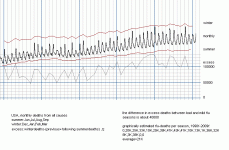
  • allmon.GIF
    allmon.GIF
    17.3 KB · Views: 1
Re: Aspirin Misuse May Have Made 1918 Flu Pandemic Worse

They recommend (acetaminophen) or aspirin; that's what caught my attention with this thread. Salicylates are chemicals found naturally in plants and are a major ingredient of aspirin and other pain-relieving medications.
 
Re: Aspirin Misuse May Have Made 1918 Flu Pandemic Worse

Letter
How to deal with influenza: Fever may be used as treatment
BMJ 2004; 329 doi: http://dx.doi.org/10.1136/bmj.329.7476.1238-a (Published 18 November 2004)
Cite this as: BMJ 2004;329:1238.2

http://www.bmj.com/content/339/bmj.b3874?tab=responses

5. Kluger MJ, Kozak W, Conn CA, Leon LR, Soszynski D. Role of fever in disease. Ann N Y Acad Sci 1998; 856:224-33.

reduced meningococcal growth at higher temperatures.

http://rspb.royalsocietypublishing.org/content/281/1778/20132570.abstract

fever suppression increases the expected number of influenza cases and deaths

in the US: for pandemic influenza with reproduction number ,
the estimated increase is 1% (95% CI: 0.0?2.7%), whereas
for seasonal influenza with , the estimated increase
is 5% (95% CI: 0.2?12.1%).

----------------------------------------
hmm, we should give pain increasing meds for flu
so people feel more miserable and are more likely to
stay at home and thus less likely to infect others

;:) ?

alternatively just charge a fee for carelessly infecting others,
e.g. by not staying at home long enough with flu
 
Re: Aspirin Misuse May Have Made 1918 Flu Pandemic Worse


Good questions raised in that article, gsgs. Why so much higher mortality in China and India? Herbal medications can contain salicylates as mixin said, but with a long history of use in those countries, it's unlikely they were experiencing more hemorrhaging from herbal use than aspirin users in the west. Maybe we in the West actually did have more hemorrhaging - it would be interesting to know, but the high death rates elsewhere had another explanation.

The IFITM3 CC gene variant Michael Coston covers in his excellent post quoted here could be a factor:
http://www.flutrackers.com/forum/showthread.php?p=517749
 
Re: Aspirin Misuse May Have Made 1918 Flu Pandemic Worse

Asprin ain't what it used to be. It completed clinical trials in 1899 and was launched by Bayer as Asprin. For much of its existence it was the frontline pain killer but now other drugs, with lower side effects, have largely taken its role. Now it is more commonly used as a low dose long-term treatment taking advantage of its blood thinning properties.

In 1918 I doubt they new much about this new miracle drug and most physicians are unlikely to have realised it was not a sensible treatment for a disease displaying primary pneumonia and severe cytokine mediated inflammatory damage to the alveoli/bronchi.

While historically interesting I doubt we would make the same mistakes today - why would we when there are so many new ones we can make instead.
 
Back
Top Bottom