

Michael Coston
Editor, Senior Moderator
Arch. Virology: Serological Evidence Of H5 Infection In Indigenous Species - Korea
#12,950
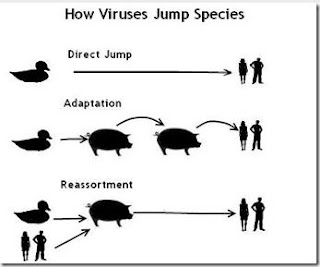
Zoonotic diseases can jump to humans either directly from the primary host, or via an intermediary host. MERS-Cov, for instance, is believed to have originated in bats, but bat-to-human infection has never been reported.
Since most avian flu infections so far have been acquired via direct contact with infected poultry, we tend to concentrate primarily on the risks posed by infected birds. But we've also seen evidence of these viruses jumping to other mammalian hosts (dogs, cats, pigs, etc.), and our understanding of those risks is incomplete.
A few of the H5Nx studies we've looked at recently include:
Although China is the world's hotbed for avian H7N9, South Korea has been the epicenter for H5Nx viruses (H5N1, H5N8 & H5N6) for the past few years. While no human infections have been reported there, we have seen scattered reports of mammalian infection by both H5N8 and H5N6. All of which leaves open the question: What other non-avian species might be susceptible to these H5Nx viruses in Korea?
We get at least a partial answer today from a study, published in the Archives of Virology, that looks at serological evidence of H5Nx infection in indigenous mammals and birds. Samples were collected from 367 wild animals and birds - collected near wild bird habitats over a 5 year period (2011-2016).
High viral titres were reported from two mammalian species, a leopard cat (Prionailurus bengalensis) and a water deer (Hydropotes inermis). The detection of H5 antibodies in a leopard cat is less surprising - given the history of avian flu infection in felines (see Catch As Cats Can) - than finding it in a herbavore like water deer.
While no survey can provide us with the full picture of what these viruses are doing in the wild, studies like this one serve remind us there is more than one path for an emerging virus to take to jump species, and potentially spark a pandemic.
http://afludiary.blogspot.com/2017/1...idence-of.html
#12,950
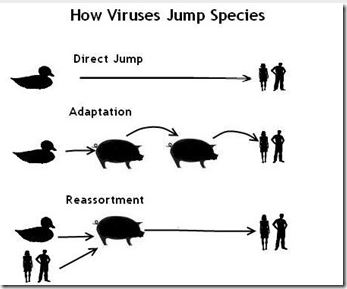
Zoonotic diseases can jump to humans either directly from the primary host, or via an intermediary host. MERS-Cov, for instance, is believed to have originated in bats, but bat-to-human infection has never been reported.
Instead, several decades ago the MERS virus apparently jumped from bats to camels. Now, after years of evolution, the virus is continually reintroduced into the human population from either direct or indirect contact with camels.
We've seen this same pattern with SARS, Ebola, Monkeypox, Rabies, Nipah . . . the list goes on. Some intermediate hosts can help a virus adapt to similar hosts, others can act as a platform for reassortment, while others may serve to amplify a pathogen (think: birds for WNV).Since most avian flu infections so far have been acquired via direct contact with infected poultry, we tend to concentrate primarily on the risks posed by infected birds. But we've also seen evidence of these viruses jumping to other mammalian hosts (dogs, cats, pigs, etc.), and our understanding of those risks is incomplete.
A few of the H5Nx studies we've looked at recently include:
Arch. Virology: Isolation & Characterization Of H5N1 In Swine - China 2015
Study: Experimental Infection Of Dogs With HPAI H5N1 & HPAI H5N6
Nature Sci Rpts: H5N6 Viruses Exhibit Varying Pathogenicity & Transmissibility In Mammals
Study: Experimental Infection Of Dogs With HPAI H5N1 & HPAI H5N6
Nature Sci Rpts: H5N6 Viruses Exhibit Varying Pathogenicity & Transmissibility In Mammals
Vet. Research: Synergistic AA Changes That Enhance Virulence Of H5N8 In Mice
J. Virulence : Altered Virulence Of (HPAI) H5N8 Reassortant Viruses In Mammalian Models
While most of these studies involved lab animals, we've seen earlier reports and/or studies involving dogs, cats, mink, and other mammals infected with H5N1, H5N6, and H5N8 viruses in the wild (see Arch. Of Virology: Novel Reassortant H5N6 Isolated From Cats - Eastern China).J. Virulence : Altered Virulence Of (HPAI) H5N8 Reassortant Viruses In Mammalian Models
Although China is the world's hotbed for avian H7N9, South Korea has been the epicenter for H5Nx viruses (H5N1, H5N8 & H5N6) for the past few years. While no human infections have been reported there, we have seen scattered reports of mammalian infection by both H5N8 and H5N6. All of which leaves open the question: What other non-avian species might be susceptible to these H5Nx viruses in Korea?
We get at least a partial answer today from a study, published in the Archives of Virology, that looks at serological evidence of H5Nx infection in indigenous mammals and birds. Samples were collected from 367 wild animals and birds - collected near wild bird habitats over a 5 year period (2011-2016).
High viral titres were reported from two mammalian species, a leopard cat (Prionailurus bengalensis) and a water deer (Hydropotes inermis). The detection of H5 antibodies in a leopard cat is less surprising - given the history of avian flu infection in felines (see Catch As Cats Can) - than finding it in a herbavore like water deer.
This study also found high viral titres invultures (Aegypius monachus), Whooper Swans (Cygnus cygnus), and the Eurasian eagle-owl (Bubo bubo).
Sadly, the abstract (below) leaves a lot of questions unanswered, and the rest of the report is behind a paywall. Serological evidence of H5-subtype influenza A virus infection in indigenous avian and mammalian species in Korea
Hye Kwon Kim, Hee-Jong Kim, Ji Yeong Noh,Le Van Phan, Ji Hyung Kim, Daesub Song, Woonsung Na, Aram Kang, Thi Lan Nguyen, Jeong-Hwa Shin, Dae Gwin Jeong Email author Sun-Woo Yoon Email author
Original Article
First Online: 04 December 2017
Abstract
In Korea, H5-subtype highly pathogenic avian influenza (HPAI) has caused huge economic losses in poultry farms through outbreaks of H5N1 since 2003, H5N8 since 2013 and H5N6 since 2016. Although it was reported that long-distance migratory birds may play a major role in the global spread of avian influenza viruses (AIVs), transmission from such birds to poultry has not been confirmed.
Intermediate hosts in the wild also may be a potential factor in viral transmission. Therefore, a total of 367 serum samples from wild animals were collected near major migratory bird habitats from 2011 to 2016 and tested by AIV-specific blocking ELISA and hemagglutination inhibition (HI) test. Two mammalian and eight avian species were seropositive according to the ELISA test.
Among these, two mammalian (Hydropotes inermis and Prionailurus bengalensis) and three avian (Aegypius monachus, Cygnus cygnus, and Bubo bubo) species showed high HI titres ( > 1,280) against one or two H5-subtype AIVs.
Hye Kwon Kim, Hee-Jong Kim, Ji Yeong Noh,Le Van Phan, Ji Hyung Kim, Daesub Song, Woonsung Na, Aram Kang, Thi Lan Nguyen, Jeong-Hwa Shin, Dae Gwin Jeong Email author Sun-Woo Yoon Email author
Original Article
First Online: 04 December 2017
Abstract
In Korea, H5-subtype highly pathogenic avian influenza (HPAI) has caused huge economic losses in poultry farms through outbreaks of H5N1 since 2003, H5N8 since 2013 and H5N6 since 2016. Although it was reported that long-distance migratory birds may play a major role in the global spread of avian influenza viruses (AIVs), transmission from such birds to poultry has not been confirmed.
Intermediate hosts in the wild also may be a potential factor in viral transmission. Therefore, a total of 367 serum samples from wild animals were collected near major migratory bird habitats from 2011 to 2016 and tested by AIV-specific blocking ELISA and hemagglutination inhibition (HI) test. Two mammalian and eight avian species were seropositive according to the ELISA test.
Among these, two mammalian (Hydropotes inermis and Prionailurus bengalensis) and three avian (Aegypius monachus, Cygnus cygnus, and Bubo bubo) species showed high HI titres ( > 1,280) against one or two H5-subtype AIVs.
As H. inermis (water deer), P. bengalensis (leopard cat), and B. bubo (Eurasian eagle owl) are indigenous animals in Korea, evidence of H5-subtype AIV in these animals implies that continuous monitoring of indigenous animals should be followed to understand interspecies transmission ecology of H5-subtype influenza viruses.
(Continue . . . .)While no survey can provide us with the full picture of what these viruses are doing in the wild, studies like this one serve remind us there is more than one path for an emerging virus to take to jump species, and potentially spark a pandemic.
http://afludiary.blogspot.com/2017/1...idence-of.html