

Michael Coston
Editor, Senior Moderator
Arch. Virology: Isolation & Characterization Of H5N1 In Swine - China 2015
#12,923
With the ?ber aggressiveness of H7N9 in China, and the recent geographic expansion and continual reassortment of H5N6 and H5N8, we don't hear as much about HPAI H5N1 as we used to.
Perhaps most worrisome have been scattered detections of H5N1 circulating in Chinese pigs, since their physiology is remarkably close to humans (If that bothers you, think how the pig feels).
First the link and abstract (the full study is behind a paywall), then I'll return with more.
Avian flu viruses are preferentially adapted to birds where it is primarily a gastrointestinal infection. What scientists are on the lookout for are `mammalian adaptations’; those that favor the infection and respiratory transmission among mammals – including humans.
Birds run `hotter’ than mammals, with a normal body temperature several degrees higher (plus avian viruses replicate in the gut, which is warmer than the upper airway of humans). Which means successful mammalian adapted viruses must be able to replicate at a lower temperature.
A reminder that old threats can re-emerge, and that we dare not focus too heavily on the threat du jour, since they can change with remarkable speed.
http://afludiary.blogspot.com/2017/1...isolation.html
#12,923
With the ?ber aggressiveness of H7N9 in China, and the recent geographic expansion and continual reassortment of H5N6 and H5N8, we don't hear as much about HPAI H5N1 as we used to.
Once the king of avian flu viruses, H5N1 has fallen from the headlines into the `Whatever happened to . . . " category of threats, along with SARS and Toxic Shock Syndrome.
But the virus is still out there, it continues to infect poultry (particularly in the Middle East, West Africa, and parts of Asia) (see Vietnam: Thousands Of Vaccinated Chickens Die Of Suspected H5N1) - and despite a big drop in reported human infections over the past year - it retains the potential to evolve into a pandemic threat. But to do that, it needs to better adapt to mammals.
During the last decade we saw reports of H5N1 infecting (and killing) hundreds of cats in Indonesia and across Southeast Asia, and more recently we've seen experimental infections of dogs, and other small mammals (see Study: Experimental Infection Of Dogs With HPAI H5N1 & HPAI H5N6).Perhaps most worrisome have been scattered detections of H5N1 circulating in Chinese pigs, since their physiology is remarkably close to humans (If that bothers you, think how the pig feels).
- As early as 2004 the World Health Organization reported H5N1 in Chinese swine (see Avian influenza: H5N1 detected in pigs in China), sparking concerns over potential mammalian adaptation of the virus.
- A 2008 study appearing in PLoS Pathogens found Domestic Pigs Have Low Susceptibility to H5N1 Highly Pathogenic Avian Influenza Viruses. While they could be experimentally infected, pigs demonstrated only mild disease, and did not shed the H5N1 virus as copiously as swine flu viruses.
- More on point, however, is a study that appeared in the EID Journal in 2010 (Influenza A (H5N1) Viruses from Pigs, Indonesia), which found H5N1 infected pigs in 4 Indonesian provinces between 2005 and 2007, but not in 2008-2009.
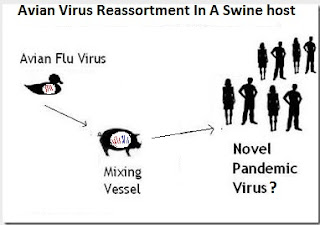
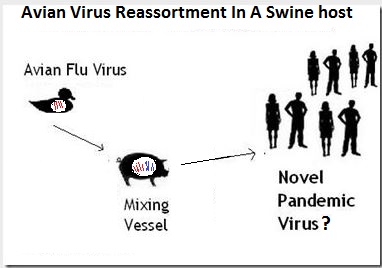
The chances for genetic reassortment depend upon both the duration of H5N1 circulation in pigs as well as the simultaneous presence of human and pig influenza A viruses (such as H3N2 or H1N1). As long as human and avian influenza viruses are co-circulating - whether in humans or in pigs - the possibility of an exchange of genetic material-exists.
The concerns over finding H5N1 in pigs are actually two-fold. The first is the potential for a reassortment event as described above. The second is the potential for host adaptation of the virus. The serial passage of an avian virus from pig - to pig - to pig can, over time, allow genetic traits to emerge that make the virus more adapted to mammalian hosts (see Virology J : Adaptation Of HPAI H5N2 In Mice).
All of which brings us to a new report in the Archives of Virology which describes the recent (2015) detection of an avian H5N1 virus in a Chinese pig, which carried one of the host adaptations in the PB2 gene (E627K) that is of particular interest.First the link and abstract (the full study is behind a paywall), then I'll return with more.
Isolation and molecular characterization of an H5N1 swine influenza virus in China in 2015
Haibo Wu, Fan Yang, Rufeng Lu, Lihua Xu, Fumin Liu, Xiuming Peng, Nanping Wu Email author
1.State Key Laboratory for Diagnosis and Treatment of Infectious Diseases, Collaborative Innovation Center for Diagnosis and Treatment of Infectious Diseases, the First Affiliated Hospital, School of MedicineZhejiang UniversityHangzhouChina
2.Department of Emergencythe First Affiliated Hospital of Zhejiang Chinese Medical UniversityHangzhouChina
3.Animal Husbandry and Veterinary InstituteZhejiang Academy of Agricultural ScienceHangzhouChina
Haibo Wu, Fan Yang, Rufeng Lu, Lihua Xu, Fumin Liu, Xiuming Peng, Nanping Wu Email author
1.State Key Laboratory for Diagnosis and Treatment of Infectious Diseases, Collaborative Innovation Center for Diagnosis and Treatment of Infectious Diseases, the First Affiliated Hospital, School of MedicineZhejiang UniversityHangzhouChina
2.Department of Emergencythe First Affiliated Hospital of Zhejiang Chinese Medical UniversityHangzhouChina
3.Animal Husbandry and Veterinary InstituteZhejiang Academy of Agricultural ScienceHangzhouChina
Brief Report
First Online: 21 November 2017
Abstract
In 2015, an H5N1 influenza virus was isolated from a pig in Zhejiang Province, Eastern China. This strain was characterized by whole-genome sequencing with subsequent phylogenetic analysis.
Phylogenetic analysis showed that all segments from this strain belonged to clade 2.3.2 and that it had received its genes from poultry influenza viruses in China. A Glu627Lys mutation associated with pathogenicity was observed in the PB2 protein.
This strain was moderately pathogenic in mice and was able to replicate without prior adaptation. These results suggest that active surveillance of swine influenza should be used as an early warning system for influenza outbreaks in mammals.
(Continue . . . )Abstract
In 2015, an H5N1 influenza virus was isolated from a pig in Zhejiang Province, Eastern China. This strain was characterized by whole-genome sequencing with subsequent phylogenetic analysis.
Phylogenetic analysis showed that all segments from this strain belonged to clade 2.3.2 and that it had received its genes from poultry influenza viruses in China. A Glu627Lys mutation associated with pathogenicity was observed in the PB2 protein.
This strain was moderately pathogenic in mice and was able to replicate without prior adaptation. These results suggest that active surveillance of swine influenza should be used as an early warning system for influenza outbreaks in mammals.
Avian flu viruses are preferentially adapted to birds where it is primarily a gastrointestinal infection. What scientists are on the lookout for are `mammalian adaptations’; those that favor the infection and respiratory transmission among mammals – including humans.
Birds run `hotter’ than mammals, with a normal body temperature several degrees higher (plus avian viruses replicate in the gut, which is warmer than the upper airway of humans). Which means successful mammalian adapted viruses must be able to replicate at a lower temperature.
Researchers have determined the (E627K) substitution in the (PB2) protein - the swapping out of the amino acid Glutamic acid (E) at position 627 for Lysine (K) - makes the an influenza virus better able to replicate at the lower temperatures (roughly 33C) normally found in the upper human respiratory tract (see Eurosurveillance: Genetic Analysis Of Novel H7N9 Virus).
As the abstract points out, the H5N1 virus isolated in Chinese pigs has picked up this important mammalian adaptation. While this is far from being the only change needed to turn H5N1 into a pandemic threat, it is one of the important ones.A reminder that old threats can re-emerge, and that we dare not focus too heavily on the threat du jour, since they can change with remarkable speed.
http://afludiary.blogspot.com/2017/1...isolation.html