• FluTrackers.com Inc. does not provide medical advice. Information on this web site is collected from various internet resources, and the FluTrackers board of directors makes no warranty to the safety, efficacy, correctness or completeness of the information posted on this site by any author or poster. The information collated here is for instructional and/or discussion purposes only and is NOT intended to diagnose or treat any disease, illness, or other medical condition. Every individual reader or poster should seek advice from their personal physician/healthcare practitioner before considering or using any interventions that are discussed on this website. By continuing to access this website you agree to consult your personal physican before using any interventions posted on this website, and you agree to hold harmless FluTrackers.com Inc., the board of directors, the members, and all authors and posters for any effects from use of any medication, supplement, vitamin or other substance, device, intervention, etc. mentioned in posts on this website, or other internet venues referenced in posts on this website.
  • We are not asking for any donations. Do not donate to any entity who says they are raising funds for us.

Antarctic ice is growing, not melting away

Shiloh

Editor, Senior Moderator
Source: http://www.news.com.au/story/0,27574,25348657-401,00.html

Antarctic ice is growing, not melting away
By Greg Roberts
The Australian
April 18, 2009 11:52am

* Ice expanding in much of Antarctica
* Eastern coast getting colder
* Western section remains a concern

ICE is expanding in much of Antarctica, contrary to the widespread public belief that global warming is melting the continental ice cap.

The results of ice-core drilling and sea ice monitoring indicate there is no large-scale melting of ice over most of Antarctica, although experts are concerned at ice losses on the continent's western coast.


Antarctica has 90 per cent of the Earth's ice and 80 per cent of its fresh water, The Australian reports. Extensive melting of Antarctic ice sheets would be required to raise sea levels substantially, and ice is melting in parts of west Antarctica. The destabilisation of the Wilkins ice shelf generated international headlines this month.

However, the picture is very different in east Antarctica, which includes the territory claimed by Australia.

East Antarctica is four times the size of west Antarctica and parts of it are cooling. The Scientific Committee on Antarctic Research report prepared for last week's meeting of Antarctic Treaty nations in Washington noted the South Pole had shown "significant cooling in recent decades".


Australian Antarctic Division glaciology program head Ian Allison said sea ice losses in west Antarctica over the past 30 years had been more than offset by increases in the Ross Sea region, just one sector of east Antarctica.

"Sea ice conditions have remained stable in Antarctica generally," Dr Allison said.

The melting of sea ice - fast ice and pack ice - does not cause sea levels to rise because the ice is in the water. Sea levels may rise with losses from freshwater ice sheets on the polar caps. In Antarctica, these losses are in the form of icebergs calved from ice shelves formed by glacial movements on the mainland.

Last week, federal Environment Minister Peter Garrett said experts predicted sea level rises of up to 6m from Antarctic melting by 2100, but the worst case scenario foreshadowed by the SCAR report was a 1.25m rise.

Mr Garrett insisted global warming was causing ice losses throughout Antarctica. "I don't think there's any doubt it is contributing to what we've seen both on the Wilkins shelf and more generally in Antarctica," he said.

Dr Allison said there was not any evidence of significant change in the mass of ice shelves in east Antarctica nor any indication that its ice cap was melting. "The only significant calvings in Antarctica have been in the west," he said. And he cautioned that calvings of the magnitude seen recently in west Antarctica might not be unusual.

"Ice shelves in general have episodic carvings and there can be large icebergs breaking off - I'm talking 100km or 200km long - every 10 or 20 or 50 years."


Ice core drilling in the fast ice off Australia's Davis Station in East Antarctica by the Antarctic Climate and Ecosystems Co-Operative Research Centre shows that last year, the ice had a maximum thickness of 1.89m, its densest in 10 years. The average thickness of the ice at Davis since the 1950s is 1.67m.

A paper to be published soon by the British Antarctic Survey in the journal Geophysical Research Letters is expected to confirm that over the past 30 years, the area of sea ice around the continent has expanded.
 
Re: Antarctic ice is growing, not melting away

The arctic ice cap is melting in a lop-sided fashion. Models show it melting more above Russia. I've not read any explanation.

Perhaps Antarctica's situation is similar.

.
 
Re: Antarctic ice is growing, not melting away

#1:
"Dr Allison said there was not any evidence of significant change in the mass of ice shelves in east Antarctica nor any indication that its ice cap was melting. "The only significant calvings in Antarctica have been in the west," he said. And he cautioned that calvings of the magnitude seen recently in west Antarctica might not be unusual.

"Ice shelves in general have episodic carvings and there can be large icebergs breaking off - I'm talking 100km or 200km long - every 10 or 20 or 50 years.""
...

"* Western section remains a concern"


We all were spectators of many studies and opposite studies about many dangerous items for the last 60 years especialy.

If we look the positive resolved outcomes and impacts of such study cohortas to an real preservation of global health, biodiversity, new clean energy sources implementation, sustainable development and the preservation of rain forest/species/clean air/clean water/..., it were very small.

So bilions of scientific research, studies, etc. were created, but an wide inovative better implementation on the field was globaly near null.

The above sci. comentary, apart of the real state of the matter, is only one of many diferent proves pro or contra on the item, nothing more.

The main postulate of scientific research is that its outcome must fit into the real evidence of the matter in the field, and without minimizing contrary evidences.

This comment seems to be more an rationalization than sticking to evidence.
History had plenty of scientific "ultimate" proves, which decades later must be dumped in the lights of new brainstorming foundings.

So it is possible to have many diferent results study outcomes on one item, because of our partial scientific knowledge which only after changes in better, generation after generation.

When it is now opticaly visible that something bad (melting and crushing deeply) is going on with the Earth poles, negating such evidence by some partial results is downplaying.

The presence of cooling in one place did not negate the melting on another, and vice versa.
At the north pole such events became overwhelming.

So, if this is not, what would be realy an case of melting for some researchers - the Ballard "Water world" ...

Obviously if the temperatures weren't higher, there were be no melting at all now.

Unfortunately such unbelieving our eyes would stranded some decision makers to an lighter response, as seen with the rain forests destruction (some positive new moves are drafted now maybe), and for other issues.

And finaly, the mass of scientists already previously stated that after an period of warming it would come an period of cooling.

So why things must be black and white only, these could be grey ...
 
Re: Antarctic ice is growing, not melting away

http://edition.cnn.com/2009/TECH/science/04/03/antarctica.ice.shelf/index.html

April 3, 2009 -- Updated 1904 GMT (0304 HKT)


<!--startclickprintinclude--><!-- google_ad_section_start -->Large ice shelf expected to break from Antarctica
  • <LI class=cnnHiliteHeader _extended="true">Story Highlights<!-- google_ad_section_start --> <LI _extended="true">A large Antarctic ice shelf is cracking and may break away


    <LI _extended="true">Scientists are investigating whether or not climate change is to blame
  • Satellite photos show cracks in the Wilkins Ice Shelf
  • The ice sheet formed over thousands of years by accumulated snow
(CNN) -- A large ice shelf is "imminently" close to breaking away from part of the Antarctic Peninsula, scientists said Friday.
<!--startclickprintexclude--><!----><!--===========IMAGE============-->
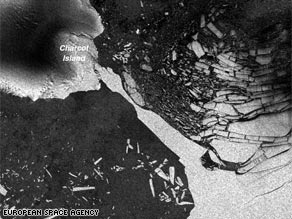
art.wilkins.shelf.esa.jpg
<!--===========/IMAGE===========--> <!--===========CAPTION==========-->Scientists are investigating whether the ice breakup is caused by global climate change.<!--===========/CAPTION=========-->


corner_wire_BL.gif


<!--endclickprintexclude-->Satellite images released by the European Space Agency on Friday show new cracks in the Wilkins Ice Shelf where it connects to Charcot Island, a piece of land considered part of the peninsula.
The cracks are quickly expanding, the ESA said.
Scientists are investigating the causes for the breakups and whether it is linked to global climate change.
The Wilkins Ice Shelf -- a large mass of floating ice -- would still be connected to Latady Island, which is also part of the peninsula, and Alexander Island, which is not, said professor David Vaughan, a glaciologist at the British Antarctic Survey.
The ice shelf experienced a great amount of changes last year, the ESA said.
In February 2008, the shelf dropped 164 square miles (425 square kilometers) of ice. In May it lost a 62-square-mile chunk.
<!--startclickprintexclude-->Don't Miss

<!--endclickprintexclude-->That meant the "bridge" of ice connecting Wilkins to the islands was just 984 yards wide at its narrowest location, the ESA said.
Further rifts developed in October and November, said Angelika Humbert of the Institute of Geophysics at Germany's Muenster University.
"During the last year the ice shelf has lost about 1800 square kilometers (694 square miles), or about 14 percent of its size," Humbert said.
Antarctica's ice sheet was formed over thousands of years by accumulated and compacted snow. Along the coast, the ice gradually floats on the sea, forming massive ledges known as ice shelves, the ESA says.
Several of these ice shelves, including seven in the past 20 years, have retreated and disintegrated.
The Wilkins Ice Shelf had been stable for most of the past century before it began retreating in the 1990s.
"It had been there almost unchanged since the first expeditions which mapped it back in the 1930s, so it had a very long period of real stability, and it's only in the last decade that it's started to retreat," Vaughan said.
Wilkins is the size of the state of Connecticut, or about half the area of Scotland. It is the largest ice shelf on the Antarctic Peninsula yet to be threatened.
If the ice shelf breaks away from the peninsula, it will not cause a rise in sea level because it is already floating, scientists say. Some plants and animals may have to adapt to the collapse.
The Antarctic Peninsula is the piece of the continent that stretches toward South America.
 
Re: Antarctic ice is growing, not melting away

About melting and the North pole (#2):


http://edition.cnn.com/2009/TECH/science/03/11/arctic.ice.explorers/index.html

March 11, 2009 -- Updated 1302 GMT (2102 HKT)

<!--startclickprintinclude--><!-- google_ad_section_start -->Team battles Arctic winter to measure melting ice caps

  • <LI class=cnnHiliteHeader _extended="true">Story Highlights<!-- google_ad_section_start --> <LI _extended="true">"No substitute for getting down on your hands and knees," says polar explorer


    <LI _extended="true">U.K. explorers en route to North Pole to measure thickness of ice cap
  • Some scientists predict polar ice cap could completely melt as soon as 2013
  • Melting ice could accelerate effects of global climate change
    <!-- google_ad_section_end --><!--startclickprintexclude-->
By Azadeh Ansari
CNN

(CNN) -- It could be the ultimate test of human endurance: Three British explorers are risking their lives in subzero temperatures to measure the melting Arctic ice cap.<!--startclickprintexclude-->
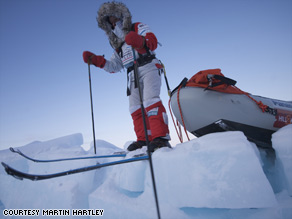
art.hartley.jpg
A member of the polar exploration team perches on skis inside the Arctic Circle.


1 of 3

more photos »

corner_wire_BL.gif


<SCRIPT type=text/javascript _extended="true"> var CNN_ArticleChanger = new CNN_imageChanger('cnnImgChngr','/2009/TECH/science/03/11/arctic.ice.explorers/imgChng/p1-0.init.exclude.html',2,1);//CNN.imageChanger.load('cnnImgChngr','imgChng/p1-0.exclude.html');</SCRIPT><!--endclickprintexclude-->The team is on a three-month, 621-mile (1,000-kilometer) hike to their final destination at the North Pole. Along the way, taking precise measurements to determine exactly how fast the ice cap is disappearing.
"It's extremely difficult to live out here. It's very, very easy to get cold injuries in seconds," said Martin Hartley, team photographer and filmmaker, via satellite phone.
The team has been braving temperatures as low as minus 40 degrees Fahrenheit/Celsius spending their nights sleeping in tents and their days trudging across the shifting, barren polar expanse.
"The other day, we had to move the tent first thing in the morning because where we were camped, the sheet of ice was breaking up into dozens of pieces because of a tidal swell or wind in the ocean," Hartley said.
video.gif
Watch CNN.com's Azadeh Ansari talk to the explorers »
<!--startclickprintexclude-->Don't Miss

<!--endclickprintexclude-->The unique expedition was prompted by this chilling prospect: The Arctic ice cap is melting at an unprecedented rate, which may lead to a dramatic shift in average global temperatures.
"In 2007, sea ice loss was the worst in recorded history," said oceanographer Kate Moran, professor of oceanography and ocean engineering at the University of Rhode Island.
The last time that scientists can say confidently that the Arctic was free of summertime ice was 125,000 years ago, according to the Web site of the National Snow and Ice Data Center in Boulder, Colorado.
All that could vanish within our lifetime, warn climate scientists, who predict that the Arctic sea ice in the summer season could be gone between 2013 and 2040.
Battling the daily grind of the brutal Arctic terrain, explorers Pen Hadow, 46; Ann Daniels, 44; and Hartley, 40, are in the second week of their 100-day journey to the top of the world.
photos.gif
See map and dramatic photos of their journey »
"The compasses don't work because we are so close to the north magnetic pole," said Hadow, director and head of surveying for the Catlin Arctic Survey.
"When the sun goes down, we have to use other techniques to keep ourselves orienting north based on wind direction alone and reading snow drifts and using them as a guide," added Hadow.
Current ice cap data are gathered by satellite and submarines, which can show the overall span of the Arctic ice melt, but these projections are not sufficient to provide an accurate estimate of its actual thickness.
"There is no substitute for getting down on your hands and knees with a tape measure and drilling a hole and measuring the snow thickness, ice thickness and the free board where the water comes in up through that surface," Hadow said.
The Arctic sea ice acts as a natural sunlight reflector, protecting the Earth from overheating.
As the ice thins, more sunlight passes through, further warming the ocean and accelerating the effects of climate change.
This feedback loop could have catastrophic consequences for people living in coastal areas and many animal species, according to the Intergovernmental Panel on Climate Change, a United Nations governing body on climate change.
The privately funded $4.3 million Catlin Arctic Survey is set to end in May.
"We are not here just to make a journey to the North Pole. We've all done that. That's not the motivating force. How much information can we find out and deliver back to the wider world for its use?" Hadow asked.
The scientific findings will be presented at the United Nations Climate Change Conference of Parties in Copenhagen, Denmark, in December. There, an international committee of scientists, heads of state and policymakers will gather to assess the Kyoto Protocol.
The explorers are also tracking their journey on Facebook and keeping the public updated with daily Internet-based feeds on Twitter.

"People ask me how I keep going. I don't know. I just have to, because if I don't keep going, it all falls apart," said Daniels, group navigator.
"You just have to grit your teeth and remember why you are out here and get on with it."
 
Back
Top