

sharon sanders
Editor-in-Chief & President
hat tip Michael Coston
Eurosurveillance: H2H Transmission of NCoV In UK Family Cluster
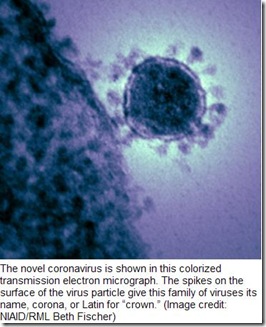
Photo Credit NIAID
# 7007
Although we?ve known since the middle of last month (see HPA: UK NCoV Cluster Expands To Three Cases) that human-to-human transmission was strongly suspected in the recent UK family cluster of novel coronavirus cases, today we get considerably more detail via a Rapid Communications that appears in the journal Eurosurveillance.
Interestingly, this investigation found that the index case, recently returned from Pakistan and Saudi Arabia, was co-infected with influenza A and that both family members who became infected were co-infected with Type 2 parainfluenza virus.
The authors write towards the end:
Stay tuned.
Eurosurveillance: H2H Transmission of NCoV In UK Family Cluster
Photo Credit NIAID
# 7007
Although we?ve known since the middle of last month (see HPA: UK NCoV Cluster Expands To Three Cases) that human-to-human transmission was strongly suspected in the recent UK family cluster of novel coronavirus cases, today we get considerably more detail via a Rapid Communications that appears in the journal Eurosurveillance.
Eurosurveillance, Volume 18, Issue 11, 14 March 2013
Rapid communications
Evidence of person-to-person transmission within a family cluster of novel coronavirus infections, United Kingdom, February 2013
The Health Protection Agency (HPA) UK Novel Coronavirus Investigation team
In February 2013, novel coronavirus (nCoV) infection was diagnosed in an adult male in the United Kingdom with severe respiratory illness, who had travelled to Pakistan and Saudi Arabia 10 days before symptom onset.
Contact tracing identified two secondary cases among family members without recent travel: one developed severe respiratory illness and died, the other an influenza-like illness. No other severe cases were identified or nCoV detected in respiratory samples among 135 contacts followed for 10 days.
What follows is long and fairly detailed account of the epidemiological investigation into these family members, and their contacts. Rapid communications
Evidence of person-to-person transmission within a family cluster of novel coronavirus infections, United Kingdom, February 2013
The Health Protection Agency (HPA) UK Novel Coronavirus Investigation team
In February 2013, novel coronavirus (nCoV) infection was diagnosed in an adult male in the United Kingdom with severe respiratory illness, who had travelled to Pakistan and Saudi Arabia 10 days before symptom onset.
Contact tracing identified two secondary cases among family members without recent travel: one developed severe respiratory illness and died, the other an influenza-like illness. No other severe cases were identified or nCoV detected in respiratory samples among 135 contacts followed for 10 days.
Interestingly, this investigation found that the index case, recently returned from Pakistan and Saudi Arabia, was co-infected with influenza A and that both family members who became infected were co-infected with Type 2 parainfluenza virus.
This raises the intriguing possibility that a respiratory virus co-infection might somehow influence the severity, and/or transmissibility of the NCoV virus.
At the same time, it serves to remind us that a positive influenza rapid test doesn?t necessarily rule out the possibility of a concurrent NCoV infection.
In the index case described in this report, a presumptive diagnosis of Influenza A was made on February 1st, and the NCoV diagnosis was not made until a full week later.
The third member of this family cluster only developed mild symptoms, and did not require hospitalization. This being the first clear indication that mild cases may be present, giving rise to the following commentary from this paper:At the same time, it serves to remind us that a positive influenza rapid test doesn?t necessarily rule out the possibility of a concurrent NCoV infection.
In the index case described in this report, a presumptive diagnosis of Influenza A was made on February 1st, and the NCoV diagnosis was not made until a full week later.
. . . This first reported case of a milder nCoV illness raises the possibility that the spectrum of clinical disease maybe wider than initially envisaged, and that a significant proportion of cases now or in the future might be milder or even asymptomatic.
This highlights the importance of intensive contact tracing and virological and serological follow-up around all confirmed cases of nCoV. The application of recently developed serological assays in one case??contact study did not provide evidence of asymptomatic infection, although the contacts investigated were exposed late in the case?s illness, when the viral load might be lower [11].
Paired sera are being gathered from contacts in this current investigation to determine whether there may have been more widespread mild or asymptomatic infection.
We also learn that ? based on a very limited dataset ? NCoV appears to have a:This highlights the importance of intensive contact tracing and virological and serological follow-up around all confirmed cases of nCoV. The application of recently developed serological assays in one case??contact study did not provide evidence of asymptomatic infection, although the contacts investigated were exposed late in the case?s illness, when the viral load might be lower [11].
Paired sera are being gathered from contacts in this current investigation to determine whether there may have been more widespread mild or asymptomatic infection.
`putative incubation period ranging from one to nine days and a serial interval (time between onset of illness in index case and secondary case) of 13 to 14 days.?
This is a fascinating report, well worth reading in its entirety. I?ve only excerpted a few of the highlights.
The authors write towards the end:
Public health implications
These findings suggest that although person-to-person infection is possible, there is no evidence at present of sustained person-to-person transmission of nCoV in the UK in relation to this cluster. The limited transmissibility is consistent with the data available to date, with only two other reports of small, self-limited clusters of severe disease in the Middle East: one in a healthcare setting and the other in a household setting [5].
Furthermore, intensive follow-up of close contacts of two other cases imported to European countries has failed to demonstrate onward transmission [10,11].
<SNIP>
All confirmed nCoV cases detected to date, apart from the two secondary cases in the UK cluster, spent time in the Middle East during the putative incubation period. This, together with our observations of limited secondary transmission, highlights the importance of ongoing vigilance and rapid investigation of cases of severe respiratory illness in residents of and travellers from that area.
Further work is required to determine how widely nCoV is circulating globally. In particular serological investigations are needed on the extent of recent infection in various populations, as well as virological investigation of cases of severe undiagnosed respiratory illness in settings both in and beyond the Middle East.
While researchers are obviously learning more about NCoV with each passing day (see Nature: Receptor For NCoV Found), it may be some time before they can tell us just how much, or how little, a public health threat this emerging virus actually poses. These findings suggest that although person-to-person infection is possible, there is no evidence at present of sustained person-to-person transmission of nCoV in the UK in relation to this cluster. The limited transmissibility is consistent with the data available to date, with only two other reports of small, self-limited clusters of severe disease in the Middle East: one in a healthcare setting and the other in a household setting [5].
Furthermore, intensive follow-up of close contacts of two other cases imported to European countries has failed to demonstrate onward transmission [10,11].
<SNIP>
All confirmed nCoV cases detected to date, apart from the two secondary cases in the UK cluster, spent time in the Middle East during the putative incubation period. This, together with our observations of limited secondary transmission, highlights the importance of ongoing vigilance and rapid investigation of cases of severe respiratory illness in residents of and travellers from that area.
Further work is required to determine how widely nCoV is circulating globally. In particular serological investigations are needed on the extent of recent infection in various populations, as well as virological investigation of cases of severe undiagnosed respiratory illness in settings both in and beyond the Middle East.
For now, enhanced surveillance and vigilance in contract tracing is key.
Stay tuned.