• FluTrackers.com Inc. does not provide medical advice. Information on this web site is collected from various internet resources, and the FluTrackers board of directors makes no warranty to the safety, efficacy, correctness or completeness of the information posted on this site by any author or poster. The information collated here is for instructional and/or discussion purposes only and is NOT intended to diagnose or treat any disease, illness, or other medical condition. Every individual reader or poster should seek advice from their personal physician/healthcare practitioner before considering or using any interventions that are discussed on this website. By continuing to access this website you agree to consult your personal physican before using any interventions posted on this website, and you agree to hold harmless FluTrackers.com Inc., the board of directors, the members, and all authors and posters for any effects from use of any medication, supplement, vitamin or other substance, device, intervention, etc. mentioned in posts on this website, or other internet venues referenced in posts on this website.
  • We are not asking for any donations. Do not donate to any entity who says they are raising funds for us.

Analysis: Did an isolated Japan prevent elderly from acquiring naturally protective immunity from circulating flu strains and result in higher than no

gsgs

Registered User
-------------------edit---------------------
text-only version to avoid the scroll-delay-problem:
http://webcache.googleusercontent.c..."gsgs"+isolated&hl=de&gbv=2&prmd=ivns&strip=1

------------------edit , links from below----------------

http://www.stat.go.jp/english/data/chouki/02.htm
http://www.toukei.metro.tokyo.jp/tnenkan/tn-eindex.htm
----------------------------------------------------------


Japan was closed from contact with other country between 1639 and 1853.
http://en.wikipedia.org/wiki/Sakoku
There were only very few ships that could enter mainly Dutch ships
in an artificial island. There was no immigration, almost no visiting,
foreigners were arrested or killed.
So Japan escaped those pandemics until the Russian flu reached Japan
in Feb.1890.

It seems reasonable to assume that even in the decades after the formal opening
in 1853, contacts with foreigners were very limited, there were no established
trading routes and organisations, people didn't speak English, some old laws
were still in place.
The railway system, which already existed in Europe,USA,India, Russia
and which mainly contributed to the fast spread of the 1889 pandemic
was still in its infancy in Japan.

Timeline[edit]
1872 - Opening of Japan's first railway between Shimbashi (Tokyo) and Yokohama
1881 - Foundation of Nippon Railway, Japan's first private railway company
1882 - Opening of Horonai Railway, first railway in Hokkaido
1888 - Opening of Iyo Railway, first railway in Shikoku
1889 - Opening of Kyushu Railway, first railway in Kyushu

In the 1918 pandemic and to a lesser degree also in 1957 and 1968 and 2009 pandemics
it was observed that the elderly were partly protected, they died in lower numbers than expected
and it was speculated that this was due to acquired immunity from previous exposures
to similar flu-strains. For 1957,1968,2009 -but not for 1918- this was supported by
serological findings that showed antibodies in those elderly before the pandemic
reached their location.
The effect was not very big, although significant, except in 1918, where people above ~40
were very well protected and died much rarer than the younger folks.
The most heard reason for this is still an immunity from similar strains
that circulated before ~1892 and then waned. Recent findings showed fewer such
protection of the elderly in more remote countries and communities consistent with
the theory that they had fewer exposure to flu before 1892. One problem with that theory
is, that there was almost no reported flu in the decades before 1889 in some countries.
E.g. for England we (uni melbourne link) have detailed reports for its absence.
Still England showed the same sparing of elderly deaths in 1918 and 1957.
The age distribution links
1918 to flu before 1892
1957 to flu before 1874, 1880-1884 (the dating is not very clear here)
1968 to flu in 1890-1897, mainly 1892-1894

mortality data from 1889,1918,1957,1968,2009 to be posted here later
I came to this when I examined 1957 data, showing the protection of the
elderly in Germany,Italy,France,UK,USA - but not Japan


----------------------------------------------------------------------------------------------------------------------------------------------
Asian Futures, Asian Traditions
book by Edwina Palmer from 2005, ~60 Euros
> Her work together with husband Geoffrey Rice on the history of the 1918 influenza
> pandemic in Japan is appraised as the most thorough in the subject to date

http://www.jstor.org/discover/10.230...21102675277871
from 1993
~280000 Japanese deaths from flu in 1918
relatively low death rates in Japan

they speculate due to traditional herbal medicines

In collaboration with Dr Edwina Palmer, Geoffrey Rice published three articles about
the 1918 pandemic in Japan: one in Journal of Japanese Studies, v.19 (1992) is currently
the most substantial account available in English.

http://igitur-archive.library.uu.nl/...ling_final.pdf
thesis,2010, Netherlands
The aim of our study is to develop a formal hypothesis that
tuberculosis (TB) was responsible for the W-shaped mortality in the Spanish flu
pandemic.
[that looks pretty silly, after all that we'd read about it]

age-curve of deaths for Japan for 1918 on page 24.
So, yes, they also had the W-shape in 1918, suggesting the elderly
had acquired immunity from a similar virus that circulated in Japan
before 1892


.--------------------------------------------

Asian Futures, Asian Traditions
book by Edwina Palmer from 2005, ~60 Euros
> Her work together with husband Geoffrey Rice on the history of the 1918 influenza
> pandemic in Japan is appraised as the most thorough in the subject to date

http://www.jstor.org/discover/10.230...21102675277871
from 1993
~280000 Japanese deaths from flu in 1918
relatively low death rates in Japan

they speculate due to traditional herbal medicines

http://www.flutrackers.com/forum/sho...d.php?t=200998
http://wwwnc.cdc.gov/eid/article/19/...03_article.htm


In collaboration with Dr Edwina Palmer, Geoffrey Rice published three articles about
the 1918 pandemic in Japan: one in Journal of Japanese Studies, v.19 (1992) is currently
the most substantial account available in English.

http://igitur-archive.library.uu.nl/...ling_final.pdf
thesis,2010, Netherlands
The aim of our study is to develop a formal hypothesis that
tuberculosis (TB) was responsible for the W-shaped mortality in the Spanish flu
pandemic.

-------------------------------------------------------------------------------------------------------
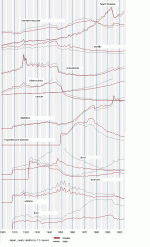
Japan, yearly exports of silk in Myen, 1868-1889:
6,6,4,8,5,7,5,5,13,10,8,10,9,11,16,16,11,13,17,19, 26

Japan, length of railway in km, 1872-1888 :
29,29,62,62,105,105,105,118,158,197,275,393,412,57 7,693,956,1468

Japan, yearly railway passengers in thousand, 1872-1889
495,1415,2094,4238,2933,3097,3478,4337,5332,5759,6 004,5161,4100,
3761,5919,8405,11366,

Japan, merchant ships registered 1870-1888:
35,71,96,110,118,149,159,183,195,199,210,298,344,3 90,412,461,460,486,524
Japan,mail traffic in millions, 1870-1888:
?,?,?,17,?,30,37,45,54,67,79,94,112,107,113,115,12 1,137,159
Japan, currency in banknotes in circulation, in MYen 1868-1888:
24,50,56,60,68,90,104,100,107,119,166,164,159,153, 144,132,124,123,136,138,137
Japan gov.expenditure in MYen,1868-1888:
31,21,20,19,58,63,82,69,59,48,61,60,63,71,73,83,77 ,61,83,79,82
Japan, number of children in school in thousand,1873-1888:
1326,1715,1926,2068,2163,2273,2315,2349,2607,3004, 3238,3233,3097,2893,2714,2928
-------------------------------
http://www.san.beck.org/21-7-JapanMo...on1800-94.html
The Conscription Act in January 1873 required all twenty-year-old males to register for military service
in 1872 the Education Ordinance mandated modern elementary education
The number of western educators and advisors in Japan reached a peak of 574 in 1874.


Code:
int(-10000+40000*deathrate(1957)/
(deathrate(1958)+deathrate(1955)+deathrate(1956)+deathrate(1959)))

   55-59 60-64 65-69 70-74 75-79 80-84 85-89
---------------------------------------------
de, 475 , 464 , 563 , 479 , 289 ,  75 , 171
us, 202 , 333 , 328 , 205 ,  78 ,  96 , 193
uk, 139 , 158 ,  24 ,-117 ,-408 ,-474 ,-601
fr, 391 , 368 , 425 , 396 , 134 ,- 11 ,  49
it, 626 , 586 , 774 , 565 , 361 , 113 , 260
jp, 745 , 778 , 897 ,1154 ,1227 ,1210 ,1551


AUS   46  -48  128 - 71 - 79 -280 -262
tha  114  369  323  813  490 1002 1199
mex  365  309  458  109  157  177   43
usa  160  377  324  213   39  140  222
CDN  361  391  393 -  8   22   36 - 55
PHI  441  963 1349 1253 1571 1388 ....
chi  313  172  645  350 1267  437  513
COL  320  288  289   39   97 -147  280
egy 1486 1602 1615 2348 2336 2340 2845
FRG  547  424  576  462  286  219 - 26
ita  644  559  800  542  265  181  107
jpn  803  798  935  980 1226 1333 1107
hk_  833 -409  489   70-1013  310 -132
SGP  516  837  657   94  756 -164  218
saw -682  831  259 - 77   69 -373 -471
FRA  314  161  427  427  370  263 -  8
Human Mortality Database. University of California, Berkeley (USA), and Max Planck
Institute for Demographic Research (Germany). Available at www.mortality.org or
www.humanmortality.de (data downloaded on [date]).


---------------------------------------

http://www.stat.go.jp/english/data/
http://www.stat.go.jp/english/data/chouki/02.htm
(why didn't I find that earlier) from:
A comparative study of the 1918?1920 influenza pandemic
in Japan, USA and UK: mortality impact and implications
for pandemic planning , 2009

> Regarding our copyright, please refer to the link below for details.
> http://www.stat.go.jp/english/info/riyou.htm


--------------------------------------------
Tokyo:
http://www.toukei.metro.tokyo.jp/tne...index.htm#1961
------------------------------------------
In Japan, the system of influenza reporting detailed in the
Communicable Disease Prevention Law was used during
1948?1998. The law required physicians to report all cases
of clinically diagnosed influenza to a nearby health center
within 24 hours. The health centers transferred these reports
to the local governments and to the Ministry of Health
and Welfare. Influenza morbidity data were regularly reported
to the Secretariat of the Ministry of Health and Welfare and
published in an annual periodical, Statistics on Communicable
Diseases, during 1948?1998.28

Statistics on Communicable Diseases, during 1948?1998

.28
28. Statistics and Information Department, Minister?s Secretariat,
Ministry of Health and Welfare in Japan. Statistics of
communicable diseases. 1968?1999 (in Japanese).
Densenby? t?kei

(I can't find this online)

nihon tokai nenkan = Japan statistical yearbook
-----------------------------------------------------------------
 

Attachments
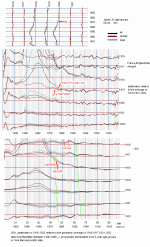
  • jpn20.GIF
    jpn20.GIF
    10.8 KB · Views: 0
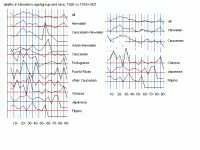
  • 1968_6.GIF
    1968_6.GIF
    11 KB · Views: 0
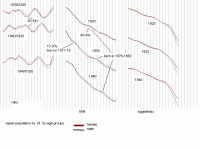
  • jpnmo2.GIF
    jpnmo2.GIF
    9.7 KB · Views: 0
  • 5yh0.GIF
    5yh0.GIF
    30.6 KB · Views: 0
  • jpnc0.GIF
    jpnc0.GIF
    32.4 KB · Views: 0
Last edited:
Re: Analysis: Did an isolated Japan prevent elderly from acquiring naturally protective immunity from circulating flu strains and result in higher than normal mortality in 1918 pandemic?

I found the statistics Japan webpage , downloaded and convereted
their Excel files.
Most of the previous post should be rewritten ...
I added some pics above.

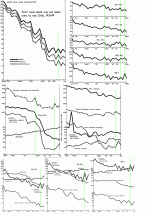
The elderly were somehow protected from death in wave2 in 1920
but to a lesser degree in wave1 in 1918.

In Japan until ~1950 the main peak of deaths was in August
Reports about the prevalence of infectious diseases, i.e. influenza,
before 1875 or 1889 are hard to find
They had bad cholera outbreaks in 1879 and 1886 (+1890,+1895)

Tuberculosis was bad in Japan until ~1950

--------------------------------------------------------------------
fevers were less common in Japanese cities
than in European, and in rural famine epidemic disease itself wreaked a
lesser toll than in Europe).31

31Infectious diseases were, however, a significant factor in 1837. See A. Hayami,
‘Population changes’, in Jansen and Rozman, Japan in transition, p.295. Cholera epi-
demics – which occurred outside a famine context – were a major health hazard of the
1860s. Cholera first made its appearance in Nagasaki in 1832.

Diseases known to
have afflicted the Japanese include leprosy, smallpox,
syphilis, malaria, tuberculosis, influenza, and
measles.

Due to its relative geographical isolation and pro-
hibitions on travel into and out of the country,
Japan escaped comparatively unscathed from
many of the major epidemics that decimated the
populations of Europe. However, diseases such as
influenza, smallpox, measles, and leprosy contin-
ued to afflict the inhabitants of Japan, particularly
the poorer segments of society.

-----------------------------------------------------------------------
(the Tokugawa Bakufu’s
strict regulation of the trade and human movement between Japan and other
countries) protected its population from foreign infectious diseases to a consid-
erable extent.23
[article about measles in Japan]

23Jannetta, Epidemics and mortality, p. 144.

--------------------------------------------------------------------------------------
Cholera was disseminated to Nagasaki, Japan in the mid September of 1822. It is
controversial how cholera was brought in to Japan. Some argues that it came directly to
Nagasaki via the Strait of Java.18 Others claim that it was though Joseon to Tsushima
Island and to Shimonoseki in Japan.19 Still others insist that how cholera was spread to
Japan is unclear.20
Fujikawa Yu, Nihonshipeishi (The History of Diseases in Japan) (Tokyo: Heibonsha, 1969):
213-234.
---------------------------------------------------------------------------------------
www.helsinki.fi/iehc2006/papers2/Sihn.pdf
about the spread of Cholera to Japan and how diseases followed
trade-routes. However, it is hard to imagine that influenza,
which dies in summer, could persist in seasonal waves
in sakoku-Japan.
------------------------------------------------
measles failed to settle itself as an endemic disease in Edo,Kyoto,Osaka
measles in Japan had remained a disease that was imported
from abroad, engulfed the nation with intervals of 10 to 20 years between epi-
demics, and died out without becoming endemic in any of these cities
----------------------------------------------------
“Japanese sources, which include excellent accounts of influenza in
the Edo Period, make no mention of influenza in 1836–1837” (Jannetta, 1992, p.
Jannetta finds no evidence of typhus before the 1890s
Early European contacts brought a panoply of new viral diseases: influenza to Tahiti in
disease,medicine and western imperialism

"Disease Dissemination in the Early Modern World"
------------------------------------------------------------------
(diseases in the Edo-period)
but according to the medical historian Fujikawa Yu, there were 507 episodes ...
13.2 per cent was smallpox, 8.3 per cent was influenza, and 7.5 per cent was
The History of Public Health and the Modern State

------------------------------------------------------------------------
Fujikawa Yu , Nihon shippei shi , Tokyo Heibonsha,1969, pp62-63, 110-11
influenza = ryuakosei- kambo
Byoka sutchi, by Kakukei or Shigesata HIRANO,
published in eight volumes from 1832 to 1834.
Kolobukigusa
---------------------------------------------------
 
Re: Analysis: Did an isolated Japan prevent elderly from acquiring naturally protective immunity from circulating flu strains and result in higher than normal mortality in 1918 pandemic?


Estimation of the excess death associated with influenza pandemics
and epidemics in Japan after world war II: relation with pandemics
and the vaccination system, 2011


At the beginning of pandemics, 1957-58, 1968-69, 1969-70, the proportion of those
aged <65 years in excess deaths rose compared with 'non-pandemic' years

Since 1963 mass vaccination against influenza has
been carried out in Japan by the imunization, first,
of all children in kindergartens and primary and
secondary schools (vaccinations conducted through
the government public health administration) and,
secondly, of workers in factories, offices and certain
other places where people are subject to crowded con-
ditions of work

The epidemic did break out at the beginning of
October, but its progress was slow and the real
climax can be said to have taken place early in 1969.
Mass vaccination, although delayed somewhat be-
yond what had been expected, had been almost com-
pleted by theend of1968. Theeffectiveness ofthatvac-
cination is discussed in the paper by Dr Sonoguchi.b
bSee the paper on page 517 of this issue.


Vaccination against Hong Kong influenza in Japan


Haemagglutination-inhibiting antibody response to and efficacy of inactivated
Hong Kong influenza vaccine,1969


In one vaccinated camp an epidemic of Hong Kong influenza broke out in
January—March 1969. In a unit in which 80% of the men had been vaccinated,
there was an infection rate of 16% among the vaccinated, of 26% among the
unvaccinated living in the same barracks and of 63% among the unvaccinated
living in separate barracks; these figures suggest that vaccination of at least 80%
of a population group will afford some protection to the unvaccinated remainder of
the group against an epidemic of influenza provided the vaccinated and the
unvaccinated are living in close association.

Interpretation of influenza antibody patterns in man,1969


In sera drawnfrompersons over 72 years ofage living in an oldpeople's home in.Japan
there wasfound to be a certain degree ofantibody to Hong Kong virus before the outbreak
of the Hong Kong influenza epidemic


Interpretations of influenza antibody patterns of man


Summary report on Hong Kong influenza in Japan,1969


a true epidemic of Hong Kong influenza did not start in Japan until October 1968
influenza B epidemic affected Japan in September-October 1968 to March 1969

A number of laboratory infections, confirmed by virus isolation, were reported
from almost all the manufacturers.

Even after the Hong Kong influenza epidemic had
started, its spread was not as rapid as might be
expected when a new antigenic variant appears and
it can hardly be said to have developed typically
epidemic features until January 1969.


============================================

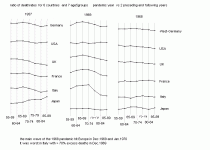
so it seems that there was some protection in the elderly in Japan in
1968, but not in 1957 (as in USA,Europe)
And the protection in 1968-1970 is hardly seen in the age-shift
in deathrates. This could be due to the vaccination, or the cocirculating
flu-B in late 1968, or the mild early H3N2, which only became more
aggressive after new reassortments, i.e. in Italy,France,Yugoslavia
in Dec.1969.
On the other hand, the H2N2 in 1957 was very contagious and
aggressive in the first wave, even in summer 1957 or early fall.


----------------other countries in 1968-1970 --------------------
http://www.ncbi.nlm.nih.gov/pmc/articles/PMC2427648/
East Africa,1969

A2-Hong Kong influenza in Dakar in 1969].

Sera were collected from 320 shearwaters (Puffinus pacificus chlororhynchus)
nesting on two islands off the east coast of northern Australia in December 1969.

Hong Kong virus reached Australia
in September 1968, we had no evidence of its pres-
ence in Melbourne until February 1969,

perhaps there was
quite a lot of very mild and subclinical Hong Kong
influenza in Melbourne during the winter of 1969

epidemics occurred in many countries in the northern hemisphere in
the winter of 1968-69. In all these countries except the United States
of America the disease was mild and not associated with a large increase
of deaths. In the United States of America, however, the number of "excess
deaths" was similar to the number in 1957-58.In the southern hemisphere
epidemics began in May-June 1969; they have been clinically mild and the
reported incidence of disease has been only moderately high.In many
countries the infection has spread slowly and smouldered instead of
bursting into the usual sharp epidemics.The smouldering spread and
the contrast in the behaviour of the disease in the USA compared with
the rest of the world are the outstanding features of the Hong Kong
strain of virus
 
Re: Analysis: Did an isolated Japan prevent elderly from acquiring naturally protective immunity from circulating flu strains and result in higher than normal mortality in 1918 pandemic?


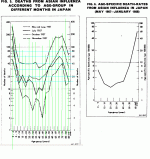
Summary report on the Asian influenza epidemic in Japan, 1957


figure 5 has deaths per age5groups in May-June,July,Oct.,Nov. 1957
presumably (preliminary) deaths from influenza in Japan.
The total number of deaths from influenza in Japan in 1957 was 7735
with 983105 cases.
Trying to extract the numbers from that chart, I get

Code:
M+J,105, 47,22,17,12,20,19,19,18,20,23, 33, 42, 58, 80,106, 59,34   = 734
Jul,180, 47,14,22,14,17,14,07,11,09,18, 35, 35, 47, 59, 50, 27,15   = 621
Oct, 50, 25,13,06,07,06,03,06,05,02,08, 09, 22, 24, 33, 41, 13,14   = 290
Nov,300, 99,43,41,40,40,40,43,33,36,41, 76,122,180,170,190,120,65   =1679
--------------------------------------------------------------------------------
    635,218,92,86,73,83,76,75,67,67,90,153,221,309,342,387,219,128  =3321

the population of Japan in these age5groups in Japan in 1957 was: (times 1000)
8361,11160,9389,9012,8608,7920,6797,5305,4978,4634,3882,3430,2674,2046,1409,906,426,151

so, this gives death-rates of:

deathrates from influenza in Japan in these 5 months of 1957
per million population for these 18 age5groups:
76,19,10,10,08,10,11,14,13,14,23,45,83,151,243,423,514,845


figure 6 had the deathrates, but doesn't separate the agegroups above 60y.


--these 7735 are influenza deaths only
you'd also want pneumonia,cardio,diabetes deaths by agegroup
(and month) and compare with other years and other countries

total 1957 deaths in Japan seem to show no protection of the elderly
as in other countries

this must/should have been examined in 1957 ?!?

------------------------------

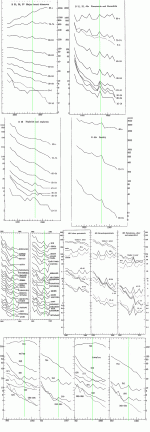
Code:
yearly deathrates per 1000 in Japan(excluding Okinawa) from all causes by 17 age5groups

year,00-04,05-09,10-14,15-19,20-24,25-29,30-34,35-39,40-44,45-49,50-54,55-59,60-64,65-69,70-74,75-79,80+
----------------------------------------------------------------------------------------------------------
1955, 10.7,  1.3,  0.7,  1.3,  2.3,  2.5,  2.7,  3.2,  4.2,  6.2,  9.4, 14.0, 22.3, 35.6, 57.6, 88.3,153.5
1956, 10.8,  1.2,  0.6,  1.2,  2.2,  2.4,  2.6,  3.1,  4.1,  6.1,  9.6, 14.5, 22.7, 36.9, 61.4, 95.8,168.4
1957, 10.4,  1.1,  0.6,  1.2,  2.1,  2.3,  2.6,  3.1,  4.1,  6.1,  9.5, 15.0, 23.5, 38.2, 64.4,102.1,180.2
1958,  9.4,  1.0,  0.6,  1.1,  2.0,  2.1,  2.3,  2.8,  3.7,  5.7,  8.8, 13.7, 21.1, 34.1, 56.4, 89.2,154.0
1959,  9.1,  1.0,  0.6,  1.0,  1.8,  2.0,  2.2,  2.7,  3.6,  5.4,  8.4, 13.6, 20.7, 33.8, 55.4, 89.4,157.9

deaths
1955,99399,14240, 6548,10992,19383,19362,16659,16452,20742,26955,36042,44993,55659,69952,80172,77338, 78609
1956,94865,13610, 5704,10437,18638,18422,16655,16165,20393,27538,36610,48190,59151,73998,85030,85913, 93110
1957,87064,12736, 5995,10823,18322,18403,17474,16376,20416,28419,36953,51285,62730,78180,90730,92522,103990
1958,76404,10530, 5618, 9902,16874,17268,16248,15295,18387,26653,34637,48050,58549,70854,81606,82418, 94858
1959,72702, 9812, 5937, 9931,15253,16527,16520,15496,17823,25729,34531,48650,58996,71162,83717,83985,103128

population/1000
1955, 9248,11043, 9508, 8626, 8403, 7604, 6117, 5115, 4945, 4367, 3850, 3206, 2497, 1967, 1393,  876,   512  
1956, 8781,11575, 9058, 8793, 8530, 7757, 6474, 5174, 4989, 4544, 3817, 3319, 2604, 2007, 1385,  897,   553 
1957, 8361,11160, 9389, 9012, 8608, 7920, 6797, 5305, 4978, 4634, 3882, 3430, 2674, 2046, 1409,  906,   578  
1958, 8107,10494, 9912, 9240, 8598, 8072, 7100, 5503, 4962, 4712, 3948, 3518, 2780, 2077, 1448,  924,   616 
1959, 8008, 9702,10398, 9634, 8497, 8171, 7350, 5813, 4884, 4786, 4087, 3589, 2845, 2106, 1510,  939,   654

so that drop in deaths from influenza at age ~75-80 that you see in figure 5
is not seen in deaths from all causes, where we have a steady increase
in 1957 in all agegroups as compared to neighboring years in Japan

Code:
USA,deathrate from all causes for 11 age groups
1955,93,285,11,5,12,15,31,76,173,381,879,1898
1956,94,282,11,5,12,15,30,75,174,381,879,1923
1957,96,280,11,5,12,15,31,76,178,390,881,1979
1958,95,281,11,5,11,15,30,75,174,384,879,1980
1959,94,275,11,5,11,15,29,74,171,376,858,1942

USA, deathrate from P+I for 11 age groups
1955,271,2216,149,25,27,31, 68,142,295, 764,2498,7911
1956,282,2253,153,23,24,30, 70,140,304, 806,2580,8536
1957,358,2399,183,38,55,56,102,206,443,1069,2986,9798
1958,331,2453,160,23,29,43, 78,173,389, 960,2928,9881
1959,312,2392,153,25,27,38, 77,155,335, 865,2816,9243

USA,deathrate from heart-disease for 11 age groups
1955,5060,149,31,34,108,278,1057,3555,9583,24033,62192,142224
1956,5105,150,31,32,101,275,1030,3517,9647,24076,62002,144248
1957,5235,145,32,31,105,278,1035,3575,9831,24542,62198,148599
1958,5235,137,29,26, 90,275,1024,3542,9630,24205,62437,149944
1959,5159,131,29,26, 86,268, 997,3461,9390,23587,60861,147369

agegroups:<1,1-4,5-14,15-24,25-34,35-44,45-54,55-64,65-74,75-84,>84


------------------------------------------------------------------------

WHO : ANNUAL EPIDEMIOLOGICAL AND VITAL STATISTICS, 1959

PUBLICATIONS OF THE WORLD HEALTH ORGANIZATION
ANNUAL EPIDEMIOLOGICAL AND VITAL STATISTICS, 1959
This Annual, published by the Wodd Health
Organization, is the twelfth of the series. It will
appear in the middle of 1962 and will contain
about 700 pages of statistical data relating to the
year 1959, in three Parts, as follows:
I.
General demography and causes of death.
Brief information on population
(censuses
and estimates), natality, general mortality and
infant mortality in the various countries. A
series of tables, by country, gives absolute fig-
ures for deaths, by sex and age groups accord-
ing to the abridged international list of causes.
More detailed tables are, in addition, devoted
to important causes of death such as tubercu-
losis, cancer, cardiovascular diseases, and acci-
dents, and to maternal and infant mortality.
II.
Communicable diseases. Revised statistics
of cases and deaths notified during the year,
including their seasonal fluctuations. With re-
spect to some diseases, the notified cases are
given by sex and age group.
III.
Medical personnel and hospital establish.
ments. This part gives information concerning
number of physicians, dentists, nurses, etc.,
number, type and capacity of hospitals.
Data on hospital in-patients will be pub-
lished for the second time, covering the year
1959, because of the increasing demand for
information on morbidity.
This volume contains a mass of valuable in-
formation on the health of the populations of
many countries and territories in so far as it is
available and sufficiently reliable to justify pub-
lication.
Prepared by the Divisionof Health Statistics
OF THE WORLD HEALTH ORGANIZATION, GENEVA


--------------------------------------------------------------------------------------------------------
STATISTICAL OFFICE OF THE UNITED NATIONS
SELECTED LIST OF PUBLICATIONS JULY 1962
STATISTICAL YEARBOOK 1961
(ElF) 678 pages. Paperbound $8.00; clothbound $10.00, Sales No.
62.XVII.1.
DEMOGRAPHIC YEARBOOK 1960
(ElF) 621 pages. Paperbound $8.00; clothbound $10.00, Sales No.
61.XIII.I
YEARBOOK OF NATIONAL ACCOUNTS STATISTICS 1960
(ElF) 284 pages, $3.50, Sales No. 61.XVII.4.
YEARBOOK OF INTERNATIONAL TRADE STATISTICS 1960
(E) Sales No. 61.XVII.9, 604 pages, $7.00.
MONTHLY BULLETIN OF STATISTICS
(ElF) Annual Subscription: $10.00, $1.00 per copy. Subscribers receive
the 1959 Supplement (E).
CURRENT ECONOMIC INDICATORS
(ElF) Annual Subscription: $4.00, $1.00 per copy. Issued quarterly.
UN: (1959)
Series A:
POPULATION AND VITAL STATISTICS REPORTS
(quarterly) (E) $0.30 per copy. Annual subscription $1.00
Series B:·
STATISTICAL NOTES (current events in international statistics) (peri.
odicallyl, (E)
Series M, No. 19:
PRINCIPLES FOR A VITAL STATISTICS SYSTEM
(E, F, 5) 28 pages, $0.30, Sales No. 53.XVII.8.
Series M, No. 20:
---------------------------------------------------------------------------------------
The following periodicals appeared regularly:
Monthly Bulletin of Statistics;
Population and Vital Statistics Reports (quarterly) ;
-----------------------------------------------------------------------
Annual Epidemiological and Vital Statistics
World Health Organization
1957
University of California
Digitalized 17. Sept. 2011

(this should have deaths by (cause and agegroup) for 1957
from Japan and other countries)


un1961,509,table 18

1959,jpn,all,m,367562,30646,9881,9143,15109,35807,100911,166041,24
1959,jpn,all,f,322370,24122,6053,6606,10075,30559,66995,175951,9
1959,jpn,b30,m,533,100,29,13,14,37,83,257,0
1959,jpn,b30,f,468,86,23,14,16,25,47,257,0
1959,jpn,b31,m,15647,5086,1269,439,298,554,1740,6261,0
1959,jpm,b31,f,13864,4260,1222,451,357,772,1242,5560,0
1959,jpn,b32,m,4076,605,148,46,23,58,362,2834,0
1959,jpn,b32,f,3713,485,108,41,21,93,267,2698,0


all,0-0,1-4,5-14,15-24,25-44,45-64,65+,?


1959,turkey,
1959,nz


un1957,472,table 16

1955,jpn,b30,m,265,58,32,20,8,17,30,100,0
1955,jpn,b30,f,274,51,24,15,2,24,35,123,0
1955,jpn,b31,m,15499,5336,2046,598,317,492,1653,5057,0
1955,jpn,b31,f,14218,4578,2159,636,340,787,1202,4516,0
1955,jpn,b32,m,4632,980,195,56,27,80,466,2828,0
1955,jpn,b32,f,4213,839,207,46,38,113,334,2636,0

----------------------------------------------------------------------------------
 

Attachments
  • jpn57c.gif
    jpn57c.gif
    40.7 KB · Views: 0
Re: Analysis: Did an isolated Japan prevent elderly from acquiring naturally protective immunity from circulating flu strains and result in higher than normal mortality in 1918 pandemic?

I finally found it here: (Japan deaths from respir.diseases
by age in 1957)

http://www.cdc.gov/nchs/data/series/sr_03/sr03_010acc.pdf

it confirms that there was no or very little protection
from death of the elderly Japanese by immunity in 1957

other than in Europe,North America,
(South America, South Africa, Australia

small protection was also maybe in other parts of Asia :
Hongkong,Singapore,Thailand,Taiwan,Ceylon,India?,Philippines
but the available data don't yet show this clearly enough

no data at all is available from (Mao-)China

-------------------------------------------------------------------------
SOURCE: Health and Welfare Statistics Division, Ministry of Health and Welfare,
Japan, National Health Survey, Report, published annually, 1953-62
for a listing of all such subcategories, see Vital Statistics 1964,
Japan, Vol. 2, Health and Welfare Statistics division,
Ministry of Health and Welfare, ,Japan, pp. 39-43 ]
---------------------------------
(USA):
Series 13
Data from the Hospital Discharge Survey. - Statistics relating to discharged
patients in short-stay hospitals, based on a sample of patient records
in a national sample of hospitals.
Series 20:
Data on mortality. -Various statistics on mortality other than as included in annual or
monthly reports - special analyses by cause of death, age, and other demographic variables,
also geographic and time series analyses.

---------------------------------------------
The population and mortality data for Hong Kong and Singapore were obtained from the
World Health Organization, whereas the Taiwanese death data came from death certificate tapes
provided by the Statistics Department, Ministry of Health, Republic of China and the Taiwanese
population data were obtained from the Taiwan-Fukien Demographic Factbook

http://www3.stats.govt.nz/New_Zealand_Official_Yearbooks/1957/NZOYB_1957.html

Health and Welfare Statistics Division:
Vital Statistics, Japan,
published annually.
Ministry of Health and Welfare. Japan.


-----------------------------------------------------------------------------
Philippines: http://pubmedcentralcanada.ca/pmcc/articles/PMC2031368/pdf/pubhealthreporig00142-0005.pdf
60-70 vs. 75- would be useful
----------------------------------------------------------------------------------
 

Attachments
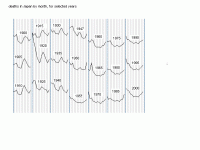
  • makay1.GIF
    makay1.GIF
    92 KB · Views: 0
  • chile2.GIF
    chile2.GIF
    50.3 KB · Views: 0
Re: Analysis: Did an isolated Japan prevent elderly from acquiring naturally protective immunity from circulating flu strains and result in higher than normal mortality in 1918 pandemic?

wikipedia:
In pre-Meiji Japan, horses were only considered in a context of warfare and transportation
of cargo. As a general rule non-samurai and Japanese women did not ride in a saddle as
this was reserved for samurai warriors, however, Tomoe Gozen was an exception to the
general rule[29] The appearance of women and non-samurai on horseback in Meiji period
[since 1868] prints represented an innovative development.
-------------------------------------------------------------------------------------------
http://www.ncbi.nlm.nih.gov/pmc/articles/PMC3180823/pdf/nihms-320467.pdf
1872 western hemispheric equine panzootic By some accounts, the panzootic stopped at
Panama, where there were no horses.62
although enzootic and epizootic equine influenza prevailed in Europe that year,
principally in England and Germany, there is no good evidence of importation from
America.
there were numerous
outbreaks and single cases of mild influenza in humans as well, often linked to equine
exposures.63 National epidemics of influenza in 1873 and 1874 that seemed to spare old
people were linked by some physicians to the equine epizootic,64 but as mild seasonal
influenza had already been prevailing in some locales in late 1872, a causal association is
speculative.
Equine epizootics were
common across the United States for the next 30 years, but with the exception of major
epizootics in 1880–1881 and 1900–1901, they tended to be local, to affect mostly young
horses, and to feature much lower attack rates.68,69 One of the last widespread equine
influenza epizootics in the United States occurred in the winter of 1915–1916, concurrent
with a major epidemic season.70
Similar canine and
feline illnesses and deaths were reported frequently in the 1872 equine panzootic
we have been unable to identify any
epizootics that appear highly consistent with swine influenza until the fall wave of the 1918
between 15 November and 15 December 1872, an explosive, fatal, and
still mysterious epizootic in poultry, prairie chickens, turkeys, ducks, and geese occurred
over much of the populated United States in temporal–geographic association with the
panzootic of equine influenza that had just begun.43,60
fatality at or near 100%
--------------------------------------------------------------------------------------------------------
Hirsch gives these flu outbreaks in that time:
1873 Jan.—March Universally in North America
: Pennsylvania, Ohio, Virginia, Illinois, Iowa, Michigan,
Wisconsin, Minnesota, Missouri, Alabama, Louisiana, Texas, and other States (1).
1874—75 Winter
Widely spread over the Western and Eastern Hemispheres.
North America : Texas, New York, South Carolina, Ohio, Iowa, and other
States (1).
Germany: Austria (2). France: Paris, Bordeaux, Toulouse, Havre, &c.(3),
Dpt. des Ardennes(4),Lyons (5). Sweden (6).
------------------------------------------------------------------------------------------------------------------
George Newman in 1920:
Statistics give no reason to suppose that influenza was truly epidemic
in England in any year later than 1858 [and before 1889], so that the
interval free from explosions must be put as
at least 30 years, although, during this period influenza was
pandemic in Europe and North America in 1874-5 and in
North America in the previous year.
Judging from the earlier
experience we ought to have had pandemic influenza in 1875 ;
actually the only even minor outbreaks before 1890 and after
1874 were in Norfolk (1878) and the Northallerton incident
mentioned above.
--------------------------------------------------------------------------------------------------------

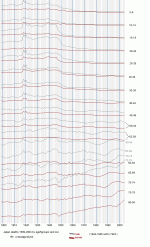
still England and Japan had that same mortality peak in 1918 at ~30 years or 28 years
respectively when "protection" seems to set in at those born before ~1890 and the
protection is linearly increasing until the birthdate of ~1870, when it flattens.
By the most prevalent explanation theory this is due to immunity from repeated exposure to
an H1N1-like virus that circulated permanently between 1870 and 1890, then killed
by H3 in the 1889-1892 pandemic.
However there are several problems with this.
First, there are no signs for such a H1-circulation in 1870-1890, see the report from
England above and other reports.
Then serology in ~1950 found no increasing antibodies to swine-H1 from 1930
during that period.
Then, the protection increases continuously over 1870-1890, with no big jumps
during 1874 or other times of possible H1-epidemics.
Then, there is clear evidence of another protection , in 1957, from a H2-like virus
in those born before ~1885 in USA and Europe, but not Japan.
And protection in 1968-70 from a H3-like virus in those born before ~1895,
supposedly from H3 coming in the 1889 pandemic and lasting until 1895 or 1897
or even 1900.
Permanent exposure from animal viruses could be one explanation.

Previously I speculated that immunity in 1918 came from the 1889 pandemic itself,
providing less immunity in growing children before puberty and increasing with age at exposure.
I found no evidence for this in other flu-outbreaks and step back from this.

Another speculation was original antigenical sin with a virulent reaction in 1918 to those
exposed to H3 in infancy. That doesn't make sense to me either.

--------------------------------------------------------------------------
another problem is, how that immunity protection can prevail over centuries,
when vaccination has to be repeated each year and doesn't protect well
from elderly deaths.
And when flu immunity evades by mutation even after a few years
of circulation.
And that H3 in 1968 and H2 from 1957 even came from birds,
with a probably distant,unknown connection to the strains
from 1894 and 1884 and evolution in HA in birds for > 70 years,
maybe > 100 years.
-------------------------------------------------------
For a fashionable woman in Victorian England a pet miniature dog was as indispensable
horseflesh as the food of choice for bourgeois pets in Victorian England
when these Saint Bernard dogs became popular as pets in Victorian England
Ferrets were so popular as pets in Victorian England that Queen Victoria gave them
Mice were particularly popular as pets in Victorian England
Fancy rat first became popular pets in Victorian England,
Guinea Pigs were so called because that's how much they had cost when they first
became popular pets in Victorian England
when canaries were first brought to popularity as pets (in Victorian England,
------------------------------------------------------------
the headline of this thread is not from me
-------------------------------------------------------
 

Attachments
  • 18r.GIF
    18r.GIF
    37.9 KB · Views: 0
Re: Analysis: Did an isolated Japan prevent elderly from acquiring naturally protective immunity from circulating flu strains and result in higher than normal mortality in 1918 pandemic?

Hawaii
----------

http://library.thinkquest.org/20619/Japanese.html
From 1885 through 1894, over 28000 Japanese migrated to Hawaii,
the vast majority
single men, working in sugar plants.
Initially, ~75% returned to Japan, this declined to 25%
In 1900 USA took over
>26000 contract laborers came from Japan in 1899

population of Hawaii on 1920/01/01:
all:255912
Hawaiian:23723
part-Hawaiian:18027
Caucasian:54742
Chinese:23507
Japanese:109274
Korean:4950
Filipino:21031
Others:658

in 1918 the first waves in 1918 and 1919 were relatively mild.
Much worse was 1920.
Indicating that the decrease in virulence during 1919,1920
in other parts of the world was due to acquired immunity
and not virus-change. While serology did show a sharp change
in the years after 1918, presumably a new H1-HA was reassorted.

http://evols.library.manoa.hawaii.edu/bitstream/handle/10524/538/JL33107.pdf?sequence=2
http://en.wikipedia.org/wiki/Japanese_in_Hawaii
http://en.wikipedia.org/wiki/Filipinos_in_Hawaii
http://en.wikipedia.org/wiki/Chinese_in_Hawaii
http://www.hawaiian-roots.com/PIships.htm


circulatory deaths:
http://www.flutrackers.com/forum/attachment.php?attachmentid=17731&d=1401204574

(in mainland Japan there were so few deaths from heart disease as compared to USA,Europe)
 

Attachments

  • hawg4.GIF
    hawg4.GIF
    13.7 KB · Views: 0
https://www.nippon.com/en/japan-topics/b09903/ (Originally published in Japanese) Ishi Hiroyuki In the Edo period (1603–1868), influenza epidemics swept through the country several times. The sickness that spread in Edo (Tokyo) in 1716, presumed to have been influenza, killed over 80,000 people in one month. An account of the time noted that “Crematoriums cannot handle all the dead; the bodies of the poor are wrapped in straw matting and given a water burial in Edo Bay off Shinagawa.” -------------------------------------------------- influenza epidemic raging in Edo in 1795 ------------------------------------------------------- A detailed account of epidemics in the Edo period can be found in Nansō Satomi hakkenden (The Eight Dog Chronicles) by the popular novelist Takizawa (Kyokutei) Bakin (1767–1848). { a massive novel consisting of 106 volumes written in 1712-1842 } https://satomi-hakkenden.com/welcome-to-the-website-eight-dog-cronicles/ According to Bakin’s collection of essays, starting around September 1825, a coldlike illness swept through the country, spreading from Edo to Kyoto, Osaka, and Nagasaki. This epidemic was so contagious that “in a family of 10 people, not one was unaffected,” and it was followed by a second wave the following year. ------------------------------------------------------------------- The influenza epidemic of 1854 came to be called the “American flu,” perhaps because the public believed the affliction had arrived in Japan together with Matthew Perry’s fleet of “black ships” the previous year. --------------------------------------------------------------- sumō wrestler Tanikaze Kajinosuke, who had an unbeaten record in the late 1700s, died of influenza on Jan09 despite being in his prime. --------------------------------------------------------------------------------------- In Japan, there is documentation showing that influenza epidemics have occurred since at least the Muromachi period (1333–1568). One of Japan’s oldest extant history texts, the Sandai jitsuroku (The True History of Three Reigns of Japan, completed in 901), covering the period 858–887, states that influenza was rampant in Heiankyō (now Kyoto) and its adjacent provinces, and elsewhere in the country. In 872, the Sandai jitsuroku notes that gaigyaku had been widespread since the previous winter in and outside the five Kinai provinces of Kyoto, Yamashiro, Yamato, Kawachi, and Settsu, causing numerous deaths. What does gaigyaku refer to? According to Ishinpō—Japan’s surviving oldest medical text, dating from 984—gaigyaku, an influenza-like illness accompanied by coughing, was also referred to as shiwabuki, a different reading of the same kanji (咳逆). Tsunoda Takafumi, an infectious disease specialist and medical historian, notes a passage in the Tale of Genji describing Yūgao suffering from a headache and shiwabuki, symptoms consistent with influenza. The historical tale Ōkagami (The Great Mirror), completed in the late eleventh or early twelfth century, mentions the Emperor Ichijō dying at age 32 in 1011, after coming down with shiwabuki, an illness like influenza. Masukagami (Clear Mirror), another historical tale written in the early fourteenth century, relates that an epidemic of shiwabuki had caused many deaths. In the Edo period (1603–1868), influenza epidemics swept through the country several times. The sickness that spread in Edo (Tokyo) in 1716, presumed to have been influenza, killed over 80,000 people in one month. An account of the time noted that “Crematoriums cannot handle all the dead; the bodies of the poor are wrapped in straw matting and given a water burial in Edo Bay off Shinagawa.” One interesting aspect to observe is that influenza epidemics were given names like Oshichi kaze (the Oshichi flu), Okoma kaze (the Okoma flu) or Tanikaze, reflecting popular preoccupations at the time. Oshichi was a greengrocer’s daughter, disappointed in love, who committed arson in the hope of reuniting with her lover; she was burned at the stake for her crime. Okoma refers to the unlucky Okoma of Shirokiya, a character in a popular bunraku puppet play. Tanikaze, meanwhile, was the name of a famous sumō wrestler who joked, “If you want to see me lose a bout, come to a tournament when you have a cold.” Ironically, Tanikaze succumbed to the influenza epidemic raging in Edo in 1795 at the age of 44, in the midst of an unbroken 35-win streak. A detailed account of epidemics in the Edo period can be found in Nansō Satomi hakkenden (The Eight Dog Chronicles) by the popular novelist Takizawa (Kyokutei) Bakin (1767–1848). According to Bakin’s collection of essays, starting around September 1825, a coldlike illness swept through the country, spreading from Edo to Kyoto, Osaka, and Nagasaki. This epidemic was so contagious that “in a family of 10 people, not one was unaffected,” and it was followed by a second wave the following year. In those days, many people were concerned with the source of the affliction. A satirical verse of the day had it that “Couriers employed by Jūshichiya will surely bring colds with them,” a reference to the hikyaku couriers traveling on the Tōkaidō road between Edo and Kyoto and spreading colds. Following the end of Japan’s long period of seclusion in the mid-nineteenth century, travel between Japan and the West brought infectious diseases back to the country. There were epidemics of cholera, smallpox, measles and other illnesses during this period. Although no accurate records exist, it is estimated that up to 100,000 Japanese a year died from imported infectious diseases. The influenza epidemic of 1854 came to be called the “American flu,” perhaps because the public believed the affliction had arrived in Japan together with Matthew Perry’s fleet of “black ships” the previous year. The Industrial Revolution in the eighteenth century greatly stimulated mobility. As people began to travel more to all corners of the world, the influenza virus spread along with them. There were repeated waves of influenza everywhere, eventually leading to the Spanish Flu in 1918, the most explosive spread of infection that the world had seen up to then. (Originally published in Japanese. Banner photo: An 1892 advertisement for “carbolic smoke balls,” rubber balls containing medicine to prevent colds meant to be inhaled through the nose. Courtesy Hulton Archive/Getty Images.)
 
Back
Top