

Sally Furniss
Well-known member
An Australian perspective of the 1918?1919 influenza pandemic
http://www.publish.csiro.au/?act=view_file&file_id=NB06025.pdf
Peter Curson and Kevin McCracken
Department of Human Geography
Macquarie University
Abstract
The 1918?1919 influenza pandemic stands as one of the
greatest natural disasters of all time. In a little over a year
the disease affected hundreds of millions of people and
killed between 50 and 100 million. When the disease finally
reached Australia in 1919 it caused more than 12,000
deaths. While the death rate was lower than in many other
countries, the pandemic was a major demographic and
social tragedy, affecting the lives of millions of Australians.
This paper briefly assesses the impact of the pandemic
on Australia and NSW with particular reference to the
demographic and social impact and the measures advanced
to contain it.
The 1918?1919 influenza pandemic remains among the
greatest natural disasters of recorded history, rivalling the
Black Death of the 14th century in mortality and social and
economic effects. Emerging in Europe in the final months
of the Great War, in the short space of a little over a year the
pandemic swept around the world, killing between 50 and
100 million people.1 Few families or communities escaped
its effects and possibly 25?30 per cent of the world?s
population was infected with influenza in 1918?1919.
There was a series of pandemic waves, the first striking
in the Northern Hemisphere spring of 1918. By October
the disease had reached New Zealand. Despite a vigorous
policy of maritime quarantine, the disease reached Australia
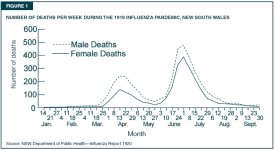
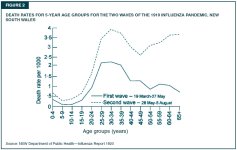
in early 1919. The first wave in NSW occurred between
mid March and late May, affecting twice as many males as
females and resulting in about 31 per cent of total deaths.
The second wave peaked in June and July and was more
virulent than the first?it produced a higher mortality rate,
involved more females and affected far more people over
the age of 50 years (Figures 1 and 2).2
In Australia the pandemic was a major demographic and
social tragedy, affecting the lives of millions of people. In
a period of six months in 1919, probably more than 15,000
died from influenza and possibly as many as two million
Australians were infected. The 1920 Offi cial Year Book of
the Commonwealth of Australia put forward a fi gure of
just under 12,000 deaths3, but that is almost certainly an
underestimate by at least 3000 to 4000. More than 5000
marriages were affected by the loss of a partner and over
5000 children lost one or both parents. In 1919, almost 40
per cent of Sydney?s population had infl uenza, more than
4000 people died, and in some parts of Sydney infl uenza
deaths comprised up to 50 per cent of all deaths.
Unlike other infl uenza pandemics, which mainly impacted
on people at the extremes of life, the 1918?1919 outbreak
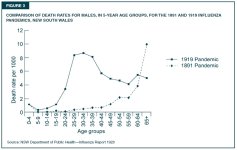
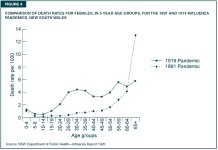
infected young, healthy adults. In NSW, more than 52
per cent of all deaths occurred in people aged between 20
and 39 years, and there were twice as many deaths from
influenza in this age cohort than in the 0?4 years and the 50
years and over age groups combined. Adults aged between
25 and 34 years contributed almost one third of all deaths.
Such an age distribution stands in sharp contrast to most
other influenza pandemics, including the 1891 influenza
pandemic, when the majority of deaths in NSW occurred
in people aged over 60 (Figures 3 and 4).4 It is uncertain
why the epidemic infected so many people in the prime
of life.
As indicated in Figures 3 and 4, the epidemic also took
a substantially heavier toll of males than females. It is
hypothesised that this sex-patterning is explained by
differential socio-behavioural risk factors relating to
geographic mobility and mixing; for example, the higher
workforce participation rate of males and male-dominated
practices such as drinking in hotel bars and attending
crowded sporting events were likely sources of increased
risk of infection.
Globally, the mortality rate varied considerably. Australia
experienced a mortality rate of close to three deaths per
thousand, while in nearby New Zealand it was almost
double this figure. In some isolated populations the
pandemic took a much heavier toll. In Western Samoa there
were 8,500 deaths in a total population of only 38,000?a
death rate of 221.92 per thousand.5
Indigenous populations were also severely affected. In
New Zealand, the Maori population was seven times
more likely to die from influenza than European New
Zealanders, and their death rate exceeded 42.3 per
thousand.6 Australia?s indigenous population was also
severely affected, with a mortality rate approaching 50 per
cent in some communities.7 The pandemic created terror
among the inhabitants of Aboriginal stations and missions.
At Barambah Station in Queensland at least 600 contracted
the disease and in early 1919 a total of 800 became infected
at Yarabah and Taroom Stations.
Australia, like most countries, was ill prepared to cope
with such a disaster. The war had severely disrupted social
and economic life, removed many medical personnel and
disrupted public services. In an attempt to contain the
outbreak, Australian authorities instigated a combination
of strategies. Schools, theatres, dance halls, churches,
pubs and other places of public congregation were shut,
streets were sprayed, special isolation depots were
established and people were compelled to wear masks
in public. Movement by public transport was restricted
and state borders were closed, with quarantine camps
established at border crossings. Attempts were made to
produce a vaccine using a mixture of victims? sputum,
streptococcus and staphylococcus concoctions. Hundreds
of thousands of people demanded inoculation and the
government established more than 1260 public inoculation
depots throughout Sydney, as well as relying on private
practitioners. In a little over six months, more than 819,000
inoculations were performed, including more than 440,000
in Sydney, which was more than 50 per cent of the city?s
population.9 People were urged to practice personal
preventive measures such as cough etiquette, hand washing,
ventilation and disinfection.
In a short time, hospitals were overwhelmed and health
care workers pushed to breaking point. At the onset of the
pandemic, NSW had only 2000 hospital beds. Between
January and September more than 25,000 people in NSW
were admitted to hospital with influenza, requiring the
establishment of hundreds of temporary influenza hospitals
in private homes, schools, showground buildings, churches,
gaols, bowling clubs, tearooms, drill halls and courthouses.
The pandemic also took its toll on medical and healthcare
workers. In Sydney more than 800 were incapacitated with
influenza and many temporary hospitals had to be staffed
by lay volunteers.
The public was stunned by the ferocity of the pandemic and
newspapers fanned public unease with regular reports of
cases and deaths and lurid descriptions of former plagues.
There were reports of people waking fine in the morning
and being dead from influenza by nightfall. With so many
people off work due to illness, normal services and activities
were severely disrupted. Thousands sought popular cures
and medicines. Many people rebelled by circumventing
the quarantine blockade at state borders or refusing to wear
masks. Waterside workers refused to unload ships for fear
of infection and some public workers demanded ?epidemic
pay?. People shunned outsiders and interstate visitors,
fearing they were a potential source of infection.
The pandemic caused disputes between all the states
and between the states and the Commonwealth over
border closures, differing policies of border controls and
quarantine, interstate transport links, and the quarantine of
returning servicemen. Eventually, cooperation between the
states and the Commonwealth authorities was abandoned,
with each state imposing its own conditions and organising
its own containment policies.
There are many lessons to be learnt from Australia?s
experience of influenza in 1919. The pandemic tells us
something about how people and communities react to severe
disease crises, particularly in a context where governments
and conventional medical science offer no real measures of
abatement or cure. Secondly, Australia?s experience with
the pandemic demonstrates how public health preparedness
for such events requires a full appreciation of the impact
on health care facilities and medical personnel, as well as
of the logistical difficulties of delivering vaccines or other
drugs in a timely fashion to a large population. Thirdly, it
is clear that the media play a defining role in presenting
a pandemic to the public and can, by word and image,
temper or enflame human reaction. Many of the measures
introduced by governments to contain pandemics, such as
quarantine, border controls and restrictions on travel and
public gatherings, may in their own right aggravate the
human response by heightening fears and anxieties. Finally,
the 1919 experience clearly demonstrates that cooperation
between various governments and government authorities
during such crises cannot always be taken for granted.
http://www.publish.csiro.au/?act=view_file&file_id=NB06025.pdf
Peter Curson and Kevin McCracken
Department of Human Geography
Macquarie University
Abstract
The 1918?1919 influenza pandemic stands as one of the
greatest natural disasters of all time. In a little over a year
the disease affected hundreds of millions of people and
killed between 50 and 100 million. When the disease finally
reached Australia in 1919 it caused more than 12,000
deaths. While the death rate was lower than in many other
countries, the pandemic was a major demographic and
social tragedy, affecting the lives of millions of Australians.
This paper briefly assesses the impact of the pandemic
on Australia and NSW with particular reference to the
demographic and social impact and the measures advanced
to contain it.
The 1918?1919 influenza pandemic remains among the
greatest natural disasters of recorded history, rivalling the
Black Death of the 14th century in mortality and social and
economic effects. Emerging in Europe in the final months
of the Great War, in the short space of a little over a year the
pandemic swept around the world, killing between 50 and
100 million people.1 Few families or communities escaped
its effects and possibly 25?30 per cent of the world?s
population was infected with influenza in 1918?1919.
There was a series of pandemic waves, the first striking
in the Northern Hemisphere spring of 1918. By October
the disease had reached New Zealand. Despite a vigorous
policy of maritime quarantine, the disease reached Australia
in early 1919. The first wave in NSW occurred between
mid March and late May, affecting twice as many males as
females and resulting in about 31 per cent of total deaths.
The second wave peaked in June and July and was more
virulent than the first?it produced a higher mortality rate,
involved more females and affected far more people over
the age of 50 years (Figures 1 and 2).2
In Australia the pandemic was a major demographic and
social tragedy, affecting the lives of millions of people. In
a period of six months in 1919, probably more than 15,000
died from influenza and possibly as many as two million
Australians were infected. The 1920 Offi cial Year Book of
the Commonwealth of Australia put forward a fi gure of
just under 12,000 deaths3, but that is almost certainly an
underestimate by at least 3000 to 4000. More than 5000
marriages were affected by the loss of a partner and over
5000 children lost one or both parents. In 1919, almost 40
per cent of Sydney?s population had infl uenza, more than
4000 people died, and in some parts of Sydney infl uenza
deaths comprised up to 50 per cent of all deaths.
Unlike other infl uenza pandemics, which mainly impacted
on people at the extremes of life, the 1918?1919 outbreak
infected young, healthy adults. In NSW, more than 52
per cent of all deaths occurred in people aged between 20
and 39 years, and there were twice as many deaths from
influenza in this age cohort than in the 0?4 years and the 50
years and over age groups combined. Adults aged between
25 and 34 years contributed almost one third of all deaths.
Such an age distribution stands in sharp contrast to most
other influenza pandemics, including the 1891 influenza
pandemic, when the majority of deaths in NSW occurred
in people aged over 60 (Figures 3 and 4).4 It is uncertain
why the epidemic infected so many people in the prime
of life.
As indicated in Figures 3 and 4, the epidemic also took
a substantially heavier toll of males than females. It is
hypothesised that this sex-patterning is explained by
differential socio-behavioural risk factors relating to
geographic mobility and mixing; for example, the higher
workforce participation rate of males and male-dominated
practices such as drinking in hotel bars and attending
crowded sporting events were likely sources of increased
risk of infection.
Globally, the mortality rate varied considerably. Australia
experienced a mortality rate of close to three deaths per
thousand, while in nearby New Zealand it was almost
double this figure. In some isolated populations the
pandemic took a much heavier toll. In Western Samoa there
were 8,500 deaths in a total population of only 38,000?a
death rate of 221.92 per thousand.5
Indigenous populations were also severely affected. In
New Zealand, the Maori population was seven times
more likely to die from influenza than European New
Zealanders, and their death rate exceeded 42.3 per
thousand.6 Australia?s indigenous population was also
severely affected, with a mortality rate approaching 50 per
cent in some communities.7 The pandemic created terror
among the inhabitants of Aboriginal stations and missions.
At Barambah Station in Queensland at least 600 contracted
the disease and in early 1919 a total of 800 became infected
at Yarabah and Taroom Stations.
Australia, like most countries, was ill prepared to cope
with such a disaster. The war had severely disrupted social
and economic life, removed many medical personnel and
disrupted public services. In an attempt to contain the
outbreak, Australian authorities instigated a combination
of strategies. Schools, theatres, dance halls, churches,
pubs and other places of public congregation were shut,
streets were sprayed, special isolation depots were
established and people were compelled to wear masks
in public. Movement by public transport was restricted
and state borders were closed, with quarantine camps
established at border crossings. Attempts were made to
produce a vaccine using a mixture of victims? sputum,
streptococcus and staphylococcus concoctions. Hundreds
of thousands of people demanded inoculation and the
government established more than 1260 public inoculation
depots throughout Sydney, as well as relying on private
practitioners. In a little over six months, more than 819,000
inoculations were performed, including more than 440,000
in Sydney, which was more than 50 per cent of the city?s
population.9 People were urged to practice personal
preventive measures such as cough etiquette, hand washing,
ventilation and disinfection.
In a short time, hospitals were overwhelmed and health
care workers pushed to breaking point. At the onset of the
pandemic, NSW had only 2000 hospital beds. Between
January and September more than 25,000 people in NSW
were admitted to hospital with influenza, requiring the
establishment of hundreds of temporary influenza hospitals
in private homes, schools, showground buildings, churches,
gaols, bowling clubs, tearooms, drill halls and courthouses.
The pandemic also took its toll on medical and healthcare
workers. In Sydney more than 800 were incapacitated with
influenza and many temporary hospitals had to be staffed
by lay volunteers.
The public was stunned by the ferocity of the pandemic and
newspapers fanned public unease with regular reports of
cases and deaths and lurid descriptions of former plagues.
There were reports of people waking fine in the morning
and being dead from influenza by nightfall. With so many
people off work due to illness, normal services and activities
were severely disrupted. Thousands sought popular cures
and medicines. Many people rebelled by circumventing
the quarantine blockade at state borders or refusing to wear
masks. Waterside workers refused to unload ships for fear
of infection and some public workers demanded ?epidemic
pay?. People shunned outsiders and interstate visitors,
fearing they were a potential source of infection.
The pandemic caused disputes between all the states
and between the states and the Commonwealth over
border closures, differing policies of border controls and
quarantine, interstate transport links, and the quarantine of
returning servicemen. Eventually, cooperation between the
states and the Commonwealth authorities was abandoned,
with each state imposing its own conditions and organising
its own containment policies.
There are many lessons to be learnt from Australia?s
experience of influenza in 1919. The pandemic tells us
something about how people and communities react to severe
disease crises, particularly in a context where governments
and conventional medical science offer no real measures of
abatement or cure. Secondly, Australia?s experience with
the pandemic demonstrates how public health preparedness
for such events requires a full appreciation of the impact
on health care facilities and medical personnel, as well as
of the logistical difficulties of delivering vaccines or other
drugs in a timely fashion to a large population. Thirdly, it
is clear that the media play a defining role in presenting
a pandemic to the public and can, by word and image,
temper or enflame human reaction. Many of the measures
introduced by governments to contain pandemics, such as
quarantine, border controls and restrictions on travel and
public gatherings, may in their own right aggravate the
human response by heightening fears and anxieties. Finally,
the 1919 experience clearly demonstrates that cooperation
between various governments and government authorities
during such crises cannot always be taken for granted.