• FluTrackers.com Inc. does not provide medical advice. Information on this web site is collected from various internet resources, and the FluTrackers board of directors makes no warranty to the safety, efficacy, correctness or completeness of the information posted on this site by any author or poster. The information collated here is for instructional and/or discussion purposes only and is NOT intended to diagnose or treat any disease, illness, or other medical condition. Every individual reader or poster should seek advice from their personal physician/healthcare practitioner before considering or using any interventions that are discussed on this website. By continuing to access this website you agree to consult your personal physican before using any interventions posted on this website, and you agree to hold harmless FluTrackers.com Inc., the board of directors, the members, and all authors and posters for any effects from use of any medication, supplement, vitamin or other substance, device, intervention, etc. mentioned in posts on this website, or other internet venues referenced in posts on this website.
  • We are not asking for any donations. Do not donate to any entity who says they are raising funds for us.

Alpha B.1.1.7 Variant of COVID19 coronavirus thread

snip

The Department for Transport added: “BTP officers are in place to ensure that only essential journeys take place.”

Mr Shapps has said the extra police and transport staff will be deployed to London train stations to stop people making "unnecessary" journeys out of Tier 4.

He said: "Follow the guidance and please do not come to a station unless you are permitted to travel."

Londoners fled the capital en masse last night after the announcement of the new Tier 4 restrictions.

https://www.express.co.uk/news/uk/1...coronavirus-christmas-latest-transport-police
 
Mutant coronavirus in the United Kingdom sets off alarms but its importance remains unclear


By Kai Kupferschmidt

Dec. 20, 2020 , 5:45 PM

Science’s COVID-19 reporting is supported by the Pulitzer Center and the Heising-Simons Foundation.

On 8 December, during a regular Tuesday meeting about the spread of the pandemic coronavirus in the United Kingdom, scientists and public health experts saw a diagram that made them sit up straight. Kent, in the southeast of England, was experiencing a surge in cases, and a phylogenetic tree showing viral sequences from the county looked very strange, says Nick Loman, a microbial genomicist at the University of Birmingham. Not only were half the cases caused by one specific variant of SARS-CoV-2, but that variant was sitting on a branch of the tree that literally stuck out from the rest of the data. “I've not seen a part of the tree that looks like this before,” Loman says.

Less than two weeks later, that variant is causing mayhem in the United Kingdom and elsewhere in Europe. Yesterday, U.K. prime minister Boris Johnson announced stricter lockdown measures, saying the strain, which goes by the name B.1.1.7, appears to be better at spreading between people. The news led many Londoners to leave the city today, before the new rules take effect, causing overcrowded railway stations. Also today, the Netherlands, Belgium, and Italy announced they were temporarily halting passenger flights from the United Kingdom. The Eurostar train between Brussels and the British capital will stop running at midnight tonight for at least 24 hours.

Scientists, meanwhile, are hard at work trying to figure out whether B.1.1.7 is really more adept at human-to-human transmission—not everyone is convinced yet—and if so, why. They’re also wondering how it evolved so fast. B.1.1.7 has acquired 17 mutations all at once, a feat never seen before. “There's now a frantic push to try and characterize some of these mutations in the lab,” says Andrew Rambaut, a molecular evolutionary biologist at the University of Edinburgh.

more...

https://www.sciencemag.org/news/202...om-sets-alarms-its-importance-remains-unclear
 
France's Covid freight ban 'will have devastating effect' on UK supplies

Sun 20 Dec 2020 16.36 EST
Lisa O'Carroll

France’s decision to block lorries arriving from the UK for 48 hours in response to the emergence of a new strain of Covid-19 will have a “devastating effect” on the supply of food and other consumer goods to Britain, industry representatives have warned.

The French government said on Sunday that all passenger and human-handled freight transport from the UK to France would be suspended for 48 hours from 11pm GMT.

Eurotunnel said access to its Folkestone terminal would be suspended for passenger and freight traffic from 11pm ...

https://www.theguardian.com/world/20...k-sector-warns
------------------------------------------------------------------------------

Christmas fresh food supplies 'could be disrupted' as freight traffic to France is shut

Sunday 20 December 2020, 11:07pm

... with 10,000 trucks normally crossing the Channel daily in the run up to Christmas - according to the British Retail Consortium - there are serious concerns within the food and drink industry.

... "The government must very urgently persuade the French government to exempt accompanied freight from its ban.”

https://www.itv.com/news/2020-12-20/...france-is-shut
 
Covid: New coronavirus variant 'in every part of Wales'

There could be a spike in coronavirus cases after Christmas, even with the early lockdown, the health minister has said.

Vaughan Gething said the stay-at-home rule was introduced from midnight "partly" as a result of a new variant of the virus.

The variant is "seeded" in all parts of Wales, including the north, he said.

<snip>

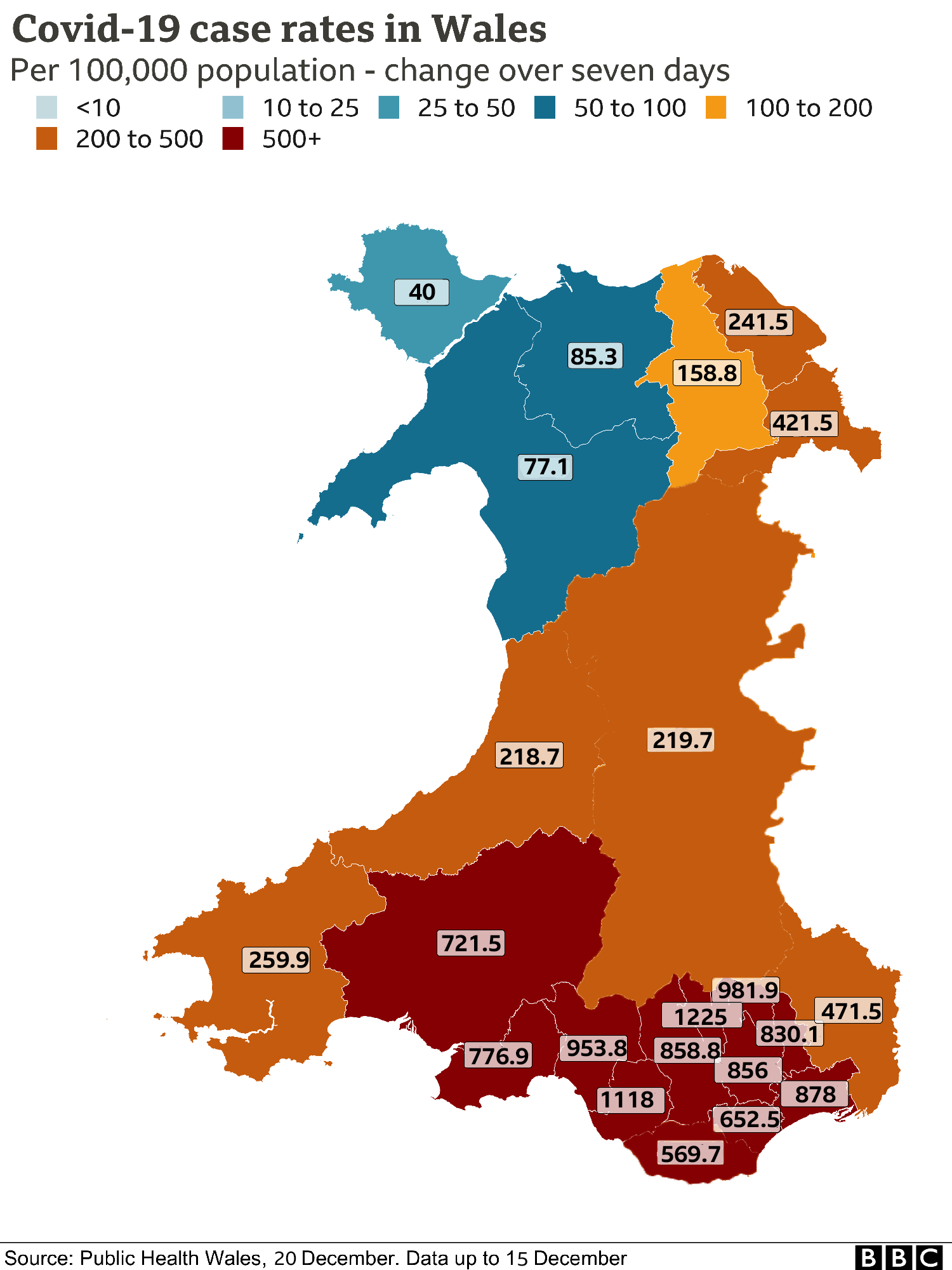
What is the Covid case rate?

_116189895_steve3.png


The Covid-19 case rate for Wales has jumped to 613.3 cases per 100,000 for the past seven days, up from 530.2 on Thursday.

<snip>

https://www.bbc.com/news/uk-wales-55384502

---------------------------------

Okieman Comment: I do not remember ever seeing Covid-19 case rates this high. Quite amazing.
 
BBC-report recommended by Nick Loman :
https://www.bbc.com/news/health-55388846

25% in London in Nov. , 66% in Dec
emerged in a UK-patient (immuno-deficient ?) or was imported from a country with low sequencing
again no mentioning of the stop-codon which might (should ?) reduce virulence
 
Boris Johnson calls crisis meeting over new Covid strain

PM may introduce tighter travel restrictions due to rapid spread of virus mutation in south-east England

https://www.theguardian.com/world/2...eting-to-discuss-response-to-new-covid-strain


EU to hold crisis talks as countries block travel from UK over new Covid strain


EU ambassadors are to hold a crisis meeting in Brussels on Monday to discuss travel restrictions on the UK as multiple countries began closing their doors to travellers from Britain after the discovery of a fast-spreading strain of Covid-19.

As the World Health Organization called on European members to step up measures, Belgium, France, Germany, Ireland and the Netherlands on Sunday announced the suspension of air links – and in some cases rail and ferry routes – from Britain.


https://www.theguardian.com/world/2...nds-ban-flights-from-uk-over-new-covid-strain
 
for once it's not the other way around


What would happen if in UK, given the vaccine stock available and the fact that in a vial marked 5 doses, there are 6, if the sauce was diluted once or twice.

So one vial would allow 12 or 24 doses?

Of course, this excess dose should be used as best as possible.

Mathematicians, who are very quick to produce numbers, can present the results in how long?

To be more specific, you have x doses for a boat, do you comply with the recommendations or?

In agriculture, for pesticides, the very large have done it for years, example:
https://www.youtube.com/results?search_query=lucien+seguy+agronome
 
I think the bottleneck is vaccinating-procedure-capacity , not available doses.
2 doses are required/recommended, some suggest to give only one dose with 55% efficacy
so to be able to vaccinate more people
 
I think, London should not let people leave without testing. Remember, how we blamed China for spreading it by airplane in Jan. Now all the possible recipient countries have to decide whether they accept London-flights causing dissent and criticism by neighbors. It's like exporting weapons to conflict-regions
 
GOG-UK Update and PHE Q&A On New COVID Variant

GOG-UK Update and PHE Q&A On New COVID Variant


Credit COG-UK

#15,641

Today marks 7 days since we first learned of a new, more transmissible SARS-CoV-2 variant (VUI – 202012/01 aka B.1.1.7 ), spreading in the UK (see UK Health Secretary Announces A New COVID Variant), and while there remain a good many unanswered questions, we have seen a commendable amount of preliminary data being released.

While claims of `up to 70% increased transmissibility', increased lockdown restrictions where the variant is circulating - and travel bans enacted over the weekend by several nations to and from the UK - have created quite a commotion, it should be noted that much of this response has been based on preliminary information gleaned from a relatively small (but growing) dataset.

Kai Kupferschmidt at Science magazine has an excellent overview (see Mutant coronavirus in the United Kingdom sets off alarms but its importance remains unclear) on what we know, and don't know, about the impacts that are likely to arise from these mutations.​


Yesterday the UK agencies released two new reports on this COVID variant; one from the PHE (Public Health England) that takes a more `lay' approach, and 9-page - far more technical - report from COG-UK.

We'll make the Q&A from PHE our first stop.

COVID-19 (SARS-CoV-2): information about the new virus variant

The new strain transmits more easily than the previous variant but there is no evidence that it is more likely to cause severe disease or mortality.Published 20 December 2020

from:
Public Health England

Main points

Data from Whole Genome Sequencing, epidemiology and modelling suggest the new variant ‘VUI – 202012/01’ (the first Variant Under Investigation in December 2020) transmits more easily than other strains.

We currently have no evidence that the variant is more likely to cause severe disease or mortality – but we are continuing investigations to understand this better.

The way to control this virus is the same, whatever the variant. It will not spread if we avoid close contact with others. Wash your hands, wear a mask, keep your distance from others, and reduce your social contacts.

Is there any evidence that the variant is more serious?

We currently have no evidence that this variant causes more severe disease or higher mortality – but we continue to study cases to understand this better. We know that mortality is a lagging indicator and we will need to continually monitor this over the coming weeks.

Why is this more transmissible?

We know that mutations in the spike protein, the part of the virus that makes it infectious, can change how the virus interacts with human cells. However, we do not yet know the mechanism for this increase in transmission.

The evidence shows that infection rates in geographical areas where this particular strain has been circulating have increased faster than expected, and the modelling evidence has demonstrated that this variant has a higher transmission rate than other variants in current circulation.

How long has this variant been in circulation?

All viruses mutate over time and new variants emerge regularly.

Backwards tracing using the genetic evidence suggests this variant emerged in September 2020 and then circulated at very low levels in the population until mid-November.

The increase in cases linked to the new variant first came to light in late November when PHE was investigating why infection rates in Kent were not falling despite national restrictions. We then discovered a cluster linked to this variant spreading rapidly into London and Essex.

Evidence of increased transmissibility was provided to
NERVTAG and ministers on December 18.
I
s this strain resistant to the Pfizer vaccine?


There is currently no evidence to suggest that the Pfizer vaccine would not protect people against the new strain.

Further laboratory work is currently being undertaken as a priority to understand this.

How widespread is the variant geographically?

144 Lower Tier Local Authorities have identified at least 1 case genomically, although the vast majority of cases identified are in London, the South East and the East of England.

Can tests detect this new variant?

Labs have been issued with guidance to adapt processes to ensure that PCR tests can detect this variant.

PCR tests can be adapted rapidly to respond to the new variant.


A more technical report comes from COG-UK - the COVID-19 Genomics UK-Consortium - which not only describes the new B.1.1.7 lineage, but also goes into considerable detail on the other variants and mutations that have appeared in SARS-CoV-2 since it emerged just over a year ago.

Due to its length (9 pages), I've only reproduced the summary. Follow the link to download and read the report in its entirety.

COG-UK update on SARS-CoV-2 Spike mutations of special interest Report 1

Prepared by COG-UK, 20th December 2020 Summary

This report provides background context on mutation tracking by COG-UK and describes a priority set of SARS-CoV-2 Spike mutations that are of particular interest based on potential epidemiological significance in the UK and/or biological evidence based on the literature or unpublished work. It provides details on the frequency of mutations, and their potential biological and immunological significance as we currently understand it. At this point in time, there is no reason to believe that any of the mutations discussed here will affect vaccine efficacy. Appendix 1 provides explanations for terms (mutation, variant, lineage) and the basis for prioritising the mutations described here.

The analysis described below (using complete data up to 15th December 2020) is based on 126,219 genomes from positive samples generated by the COG-UK consortium. This identified 1,777 different amino acid changing (non-synonymous) mutations in Spike glycoprotein’s gene S (this does not include mutations that do not lead to an alternation of amino acid (which are more numerous), or mutations elsewhere in the genome). Of these non-synonymous changes, 37% (n=654) mutations were only observed in a single sequence, while 5% (n=87) were observed in at least 100 sequences.

Five amino acid replacements (D614G, A222V, N439K, Y453F and N501Y), one deletion (del) and cooccurrence of some of these changes are actively being investigated by COG-UK. Further details, including the reason for their inclusion, is provided in Table 1. This is a shortlist of Spike-focused priority mutations, but others are being monitored in S and other SARS-CoV-2 genes.

The lineage B.1.1.71 is of particular interest (see footnote) and is notable for a higher number of mutations in one lineage than observed previously (Table 1b). It has been speculated that it may have arisen from a chronically infected individual. One of these (the N501Y mutation) occurs in the region of the Spike protein, the receptor binding domain (RBD), that the virus uses to bind to the human ACE2 receptor. Changes in this region of the Spike protein can result in the virus changing its ACE2 binding specificity and alter antibody recognition.

Two other mutations (N439K and Y453F) also occur in the RBD region and increase binding affinity to ACE2 and have been shown to escape the neutralising effect of a few monoclonal antibodies (mAbs). The 69- 70del has co-occurred with all three of these RBD mutations.


(Continue . . . . )


As we saw in yesterday's ECDC Threat Assessment Brief On UK SARS-CoV-2 Variant, we see speculation that the large number of concurrent mutations in the B.1.1.7 variant may have arised from a single chronically-infected, likely immunocompromised, individual.

B.1.1.7 lineage. This variant has 23 mutations with 14 amino acid replacements and 3 in-frame deletions which are listed in Table 1b. Two of these mutations have already been described to alter SARS-CoV-2 biology: N501Y sits in the receptor binding motif (RBM) of the Spike protein, and has been described to increase binding affinity to the human ACE-2 receptor; 69-70del has been identified in variants associated with immune escape in immunocompromised patients and is responsible for a “dropout” in the S gene PCR target in certain diagnostic tests (e.g. Thermo Fisher TaqPath). These tests target multiple regions of the virus genome, so the test itself is not compromised. Reported cases and phylogenetic analyses have indicated an exceptional rate of introduction of mutations into this lineage. It has been hypothesised that this lineage may have resulted from the transmission of the virus from a chronically infected individual. This is based on observations that a high rate of mutations may accumulate in immunocompromised patients with chronic infections of SARS-COV-2.


Along this same vein, late last week COG-UK released a report on multiple escape mutants generated in a chronically ill, immunocompromised patient, after receiving convalescent plasma therapy.


https://afludiary.blogspot.com/2020/12/gog-uk-update-and-phe-q-on-new-covid.html

 
Britain holds crisis talks as Europe cuts transport links on virus fears


Issued on: 21/12/2020 - 11:50

snip

As families and truck drivers tried to navigate the travel bans to get back home in time for Christmas, Britain's second-largest supermarket chain, Sainsbury's, said gaps will start to appear on shelves within days if transport ties are not quickly restored with mainland Europe.

"If nothing changes, we will start to see gaps over the coming days on lettuce, some salad leaves, cauliflowers, broccoli and citrus fruit – all of which are imported from the continent at this time of year," Sainsbury's said.

https://www.france24.com/en/europe/...-cuts-transport-links-on-virus-fears?ref=tw_i
 
Given this map and the fact that we have found it in Belgian and Dutch ports, it is an epidemiological profession in France:

we only find what is requested when requested ...
 
@kakape 33m
UK experts have grown more confident about their conclusions on B.1.1.7, says @PeterHorby
, who chairs NERVTAG (New and Emerging Respiratory Virus Threats Advisory Group):
“We now have high confidence
that this variant does have a transmission advantage.” (“moderate” on 18.12.)

lots more interesting info in the SMC organised presser with several NERVTAG members (still going on).
-------------------------------------------------------------------------------
In 2 weeks we may discover that even the most stringent lockdown cannot prevent the spread
of the new variant of Covid. If so the government will have to develop a new strategy based
on containment of the vulnerable while the vaccine is rolled out. https://thetimes.co.uk/article/race-t
------------------------------------------------------------------------
Preprint on the South African #sarscov2 variant 501Y.V2 by
@Tuliodna
and others is now up here: https://krisp.org.za/manuscripts/MEDRXIV-2020-248640v1-de_Oliveira.pdf
 
Last edited:
Early sign that new strain of Covid infects more children


Strong evidence new mutant strain is 50% more transmissible than previous virus

There is an indication that the new variant of coronavirus infected more children, a scientist on the Government’s New and Emerging Respiratory Virus Threats advisory group (NervTag) has said.

Speaking at the NervTag Q&A briefing on the new variant, hosted by Science Media Centre, Professor Neil Ferguson of Imperial College London said there was strong evidence the new mutant strain is 50% more transmissible than the previous virus.

He added: “We will need to gather more data to see how it behaves going forward.

“There are other epidemiologically interesting trends with virus, there is a hint that it has a higher propensity to infect children … but we haven’t established any sort of causality on that, but we can see that in the data.”

<snip>

https://www.kentlive.news/news/uk-world-news/early-sign-new-strain-covid-4820586
 
Back
Top Bottom