Blue
Well-known member
Bird Makes Longest Nonstop Flight Ever Measured
http://news.nationalgeographic.com/news/2007/09/070913-longest-flight_2.html
This information is startling for those of us who do not get just how far these birds can travel.
What might this one species have come in contact with along the Chinese border?
http://news.nationalgeographic.com/news/2007/09/070913-longest-flight_2.html
This information is startling for those of us who do not get just how far these birds can travel.
What might this one species have come in contact with along the Chinese border?
//news.nationalgeographic.com/news/2007/09/070913-longest-flight_2.html said:A female shorebird was recently found to have flown 7,145 miles (11,500 kilometers) nonstop from Alaska to New Zealand?without taking a break for food or drink.
It's the longest nonstop bird migration ever measured, according to biologists who tracked the flight using satellite tags.
The bird, a wader called a bar-tailed godwit, completed the journey in nine days.
In addition to demonstrating the bird's surprising endurance, the trek confirms that godwits make the southbound trip of their annual migration directly across the vast Pacific rather than along the East Asian coast, scientists said.
"This shows how incredible and extreme birds can be," said Phil Battley of New Zealand's Massey University, who took part in the study.
"The prospect of a bird flying all the way across the Pacific was so much further than what we thought possible, it seemed ludicrous," he said.
"Like Running for a Week"
The long haul was documented during a study of godwit migration conducted by the U.S. Geological Survey and PRBO Conservation Science, a California-based nonprofit dedicated to bird research.
Some 70,000 godwits make the epic journey from their northern summer breeding grounds in Alaska down to New Zealand each September, before flying all the way back the following March.
To study this annual trek north, Battley and his colleagues fitted satellite transmitters to 16 godwits at two locations in New Zealand last summer.
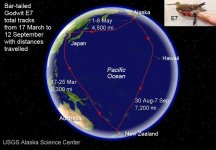
Battley was amazed, he said, to find that one of the birds, dubbed E7, flew some 6,340 miles (10,200 kilometers) directly to a wetland on the North Korea-China border (see map).
After feeding and resting there, she continued another 3,000 miles (5,000 kilometers) to Alaska.
The flock's arrival in the U.S. was supposed to mark the end the study, but some of the tags' transmitters continued to send data, giving scientists the unexpected bonus of tracking the birds' return trip.
Scientists found that, on E7's way back south, with the help of tailwinds, she made the epic 7,145-mile (11,500-kilometer) flight to New Zealand uninterrupted.
"This organism is absolutely outstanding," said Rob Schuckard, a team leader at the Ornithological Society of New Zealand, which helped with the migration research.
"It's the equivalent of a human running at 70 kilometers an hour [43.5 miles an hour] for more then seven days."
According to satellite data, E7 flew at an average speed of 34.8 miles an hour (56 kilometers an hour), seeking favorable winds at elevations between 1.85 miles (3 kilometers) and 2.5 miles (4 kilometers).
Along the way, the bird "slept" by shutting down one side of her brain at a time and burned up the huge stores of fat?more than 50 percent of her body weight?that she had piled on in Alaska.
E7 found her way by analyzing polarized light to get a fix on the sun by day, even in heavy clouds, and by following the stars at night, Battley said.
"They learn the rotation of the sky when they're young," he explained.
"They can work out where north is, but presumably they have to learn a Southern Hemisphere compass as well. It's no good looking for the North Star in New Zealand."
An Uncertain Future
Despite the birds' hearty endurance, Schuckard fears for the godwits. The number of birds successfully reaching New Zealand each year has fallen sharply, he said, from around 155,000 in the mid-1990s to just 70,000 today.
"Something is seriously wrong," he said.
He suspects that widespread development along the Yellow Sea, which sits between China and North and South Korea, is depriving the birds of vital food sources, as mudflats and wetlands there are drained.
At one such site, the Saemangeum wetlands of South Korea, recognized as a crucial staging site for waders, a 20.5-mile (33-kilometer) seawall built last year has drained 154 square miles (400 square kilometres) of tidal flats.
"That's equal to the entire New Zealand estuarine habitat [where rivers meet the sea]," Schuckard said.
Battley agreed that godwits and other migrating waders face serious threats, as their feeding and resting grounds dwindle.
"Loss of habitat on the staging grounds is a real concern," he said. "The Yellow Sea is a particular problem, because virtually every godwit from New Zealand will go through there. If you look at South Korea, it's full of seawalls?they reclaim entire estuaries at a go."
Some mudflat loss has been offset by increased sediment loads dumped by China's Yellow and Yangtze rivers, he added.
"[But] the problem now is that with all the dams on those rivers, the Yellow River is running dry half the year, and the Three Gorges Dam is trapping most of the sediment that came down the Yangtze," Battley said.