Re: Alaska: unidentified outbreak kills dozens of ringed seals- Walruses ill as well - Ribbon seal found with syndrome 3/12
Here's the lastest update from NOAA/U.S. Fish and Wildlife. Test results still not reported are most man-made pollutants, including radionuclides, and also the advanced screening to find a new pathogen.
I don't see testing for iodine-131 being done, nor any analysis on thyroid tissue.
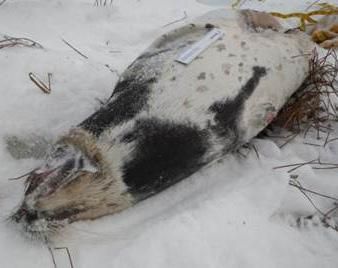
There are necropsy photos at the link.
http://alaskafisheries.noaa.gov/protectedresources/seals/ice/diseased/ume_qa0612.pdf
Northern Pinnipeds (ice seals and walruses)
Unusual Mortality Event (UME)
Q&A
June 25, 2012
How many seals in Alaska have been reported ill? How many necropsies (animal autopsies) have been performed?
In 2011, over 100 seal strandings were reported. Approximately 60% of animals were alive or moribund (near death) and approximately 40% were found dead. In 2012, Native subsistence hunting communities have documented over 40 seals (primarily adult bearded and ringed seals) with clinical signs, namely: hair loss, weakness, unresponsiveness to human approach, skin sores, or some combination thereof. As the Alaska Native subsistence bearded seal harvest in the Bering Strait region precedes hunting in the Chukchi and Beaufort Sea, all seal reports for 2012 have been from the Bering Strait region.
Pacific walruses are less affected and cases tend to involve juveniles and subadults. There have been no reports of widespread illness or mortality in subsistence harvested walruses in 2012. In 2011, approximately 6% of the herd hauled out at Point Lay in September had round skin ulcers or sores throughout their bodies; the majority looked healthy. There have been few reports of skin wounds in Pacific walruses from the Bering Strait region or Bristol Bay, and high definition photos from Round Island haulouts have been reviewed and support this as well.
Necropsies have been performed on 28 deceased ice seals (ringed, bearded, spotted, ribbon) and two deceased walruses. Small skin samples have also been collected from a few live, but sick, animals. Subsistence-harvested animals have yielded the best samples because those animals have not yet developed secondary infections or other diseases, which can obscure the primary wound process.
What characterizes the UME-related illness in these animals?
In order to recognize and help differentiate the UME condition from other unrelated disease conditions in ice seals and Pacific walruses, a ?case definition? has been developed. Current case definitions are based on available clinical and necropsy data and will continue to be reviewed and revised as more information becomes available. Preliminary pathological description in ice seals and walruses summarizes what is currently known about the histopathological features of ulcerative dermatitis.
SEALS:
Based on review of pathologic findings to date, we believe there are two categories of disease in ice seals related to this UME (referred to as case type 1 and type 2 below). All animals consistently feature abnormal hair loss due to lack of regrowth (alopecia or baldness) or persistence of old coats. Old hair is distinguishable from developing hair by its dull, yellowish or ?sun bleached? appearance.
Case Type 1: animals have varying degrees of hair loss or baldness and otherwise seem healthy. Ringed seals with these signs have been reported by subsistence communities from the Bering Strait and North Slope for many years, but not in great numbers. However, in 2011 reports from hunters indicated a significant increase in the number of affected animals.
Case Type 2: animals appear/act ?sick?. They have skin sores, often around the eyes, snout, and hind flippers. Hunter and biologists observations indicate that many of the affected seals are easily approachable/remain hauled out on land for prolonged periods of time.
WALRUS:
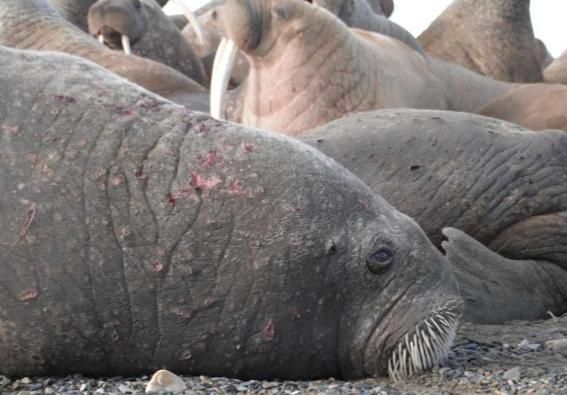
Affected walruses feature a very distinctive pattern of small ulcers or skin sores widely distributed across the body. Sores tend to be the same size and fresh (new) lesions may ooze bloody fluid. Walruses normally
have many scars and cuts, so it can be difficult to determine whether they are cases. (Photo by Tony Fishbach)
Since we are not yet able to define the optimal specimen to be tested at any given stage of the illness the necropsy protocol for sample collection is extensive and highly detailed. The samples collected for testing include:
Hair
Skin
Skin lesions
Nasal swabs
Rectal swabs
Blubber
Lymph nodes
Tongue
Brain
Muscle
Chest fluid (if present)
Thymus
Blood
Lung
Heart
Bile
Liver
Spleen
Kidney
Urine
Stomach contents
Feces
What tests for pathogens are being performed?
What other tests are being done to understand the disease?
To date, numerous tests for viral, bacterial pathogens, and biotoxins have been performed. Despite extensive laboratory analysis, no specific disease agent or process has been identified. This may suggest that the underlying cause of this disease is most likely complex, involving a variety of factors.
The following disease agents, some of which cause ulcerative skin disease in marine animals, have been screened for and ruled out as possible causes: Calicivirus, Morbillivirus, Pan-Picornavirus, Herpesvirus, Papillomavirus, Poxvirus, Parapoxvirus, Vesicular Stomatitis Virus, Foot and Mouth Disease, Circovirus, Influenza A/B, Arterivirus, Adenovirus, Coronavirus, Enterovirus, Flavivirus, Orbivirus, Orthohepadnavirus, Paramyxovirus, Rhabdovirus, and Papovavirus.
Advanced molecular screening for unknown viruses has been a continued effort. Results of ?4-5-4? research (an advanced molecular testing technique) are still pending.
In addition, tissue samples have been collected for heavy metal, radionuclides (radiation), and persistent organic pollutant analysis. Results for these studies are pending and will be made available as soon as possible.
During the summer of 2012, additional biological sampling from live captured ice seals during permitted research (captured and released following health assessment) is scheduled to take place and may help to further resolve the understanding of the disease process associated with this UME.
What environmental factors are currently being investigated?
When are the environmental results anticipated?
An oceanography working group of Arctic researchers was established under the framework of this UME investigation. Factors that are being investigated in relation to this disease include water temperatures, changes in sea ice, ocean salinity and pH, terrestrial outflows, ocean currents, and composition and amount of food sources for each seal species.
What are veterinarians/pathologists finding inside dead pinnipeds that they consider unusual? Which internal organs are affected?
Post-mortem examinations of animals with skin sores have revealed a variety of changes in internal organs. Among the most striking is bloody fluid accumulation in the lungs (which are occasionally collapsed and/or discolored). Other changes include softened livers and a rare enlargement of the heart. Changes in the lungs are most commonly seen in animals that strand and die on the beach, and are likely due to the animals having septicemia/blood poisoning, secondary to the skin lesions. Almost all the seals necropsied had some form of hepatitis or inflammation of the liver. Immune organs such as lymph nodes and the thymus have also shown consistent changes. These changes include enlarged lymph nodes draining the skin and very reduced thymus glands in many of the young animals (< 1 year). The thymus, a specialized gland in the chest, is an important part of the developing immune system. The observed immune system changes may be secondary to the ulcers and the associated bacteria but could also suggest widespread compromised immune systems in affected ice seals.
Are there any clinical data that suggest walruses have the same illness as the seals?
Are results still pending? If so, when are the results anticipated?
The presence of an unusual skin condition suggests that walruses have an illness similar to the seals. The affected age classes and distribution of the skin lesions on the body are different between walruses and seals; however the ulceration and inflammation of the skin with damage to blood vessels suggest a similar disease process. In 2012, there were two reports from harvested walruses with unusual skin findings: one from Savoonga and one from Chefornak. Submitted skin samples from these animals were examined and one animal had skin lesions consistent with ulcerative dermatitis while the other was consistent with lesions due to trauma.
Are there any clinical data that suggest polar bears have the same illness as the seals?
Are results still pending? If so, when are the results anticipated?
Veterinarians who have accompanied the U.S. Geological Survey on capture missions this year have confirmed that hair loss and other abnormal characteristics in polar bears appear similar to those observed in ice seals. However, it is unclear if the condition is the same as that exhibited by ice seals and walruses under the UME. Similar clinical signs were recorded in polar bears in 1998-1999 with up to 20% of bears reported with hair loss. Between 1999 and 2011, individual bears were anecdotally observed with comparable hair loss.
In 2012, 23 out of 82 bears handled had unusual hair loss/thinning and/or nodules in the Barrow, Kaktovik, and Prudhoe Bay regions. USGS has collected a number of biological samples (blood, biopsies, feces, urine, hair) from both affected and unaffected bears for histopathology, genetic sequencing of viruses, fungal and bacterial culture, contaminants, and serology. Microscopic examination of skin lesions revealed changes distinct to those observed in seals and walruses and most likely represents a different condition in polar bears.
As reported by local hunters from Gambell, St. Lawrence Island, all polar bears harvested during spring 2012 were normal and healthy. Subsequent examinations of the hides by a U.S. Fish and Wildlife Service walrus harvest monitor confirmed the normal condition. No hair loss or ulcers were present.
What is the new date for release of University of Alaska Fairbanks radiation testing results?
Muscle and liver samples from sick and healthy seals were collected in 2011 and 2012 for radionuclide analysis, specifically cesium 134/137. All the muscle samples had to undergo an extensive four week freeze-drying process in preparation for analysis and are currently being analyzed. Preliminary analysis of control samples from healthy seals has been completed and composite tissue samples from diseased seal samples are undergoing analysis. As soon as final results are available they will be provided.
Why are the seals tired / approachable?
Seals that were tired and approachable were most likely in the end stages of the disease. Based on necropsy findings and microbial culture results, many seals generally had bacteria throughout their blood stream and tissues. Widespread infection was most likely via invasion through the skin ulcers.
Why are there sores on the body?
Skin sores on the seals and walruses are due to inflammation of the small skin blood vessels. This results in an ?infarct? or blockage of blood flow to the overlying skin that the vessels normally support which results in the skin dying. After a time, this dead skin sloughs and leaves an open bleeding area susceptible to colonization and invasion by bacteria that are in the environment or on the surface of normal intact skin. Some seals also have heavy fungal and bacterial colonization in these areas.
Why did ice seals not grow their hair/fur last summer? Will their hair/fur grow back?
The fact that four different species of ice-associated seals had hair loss suggests a common cause to this condition that has yet to be determined. Examined hair follicles exhibit degenerative changes, with mostly inactive follicles, suggesting that old hair will not be replaced with new hair until a new normal cycle of hair growth occurs. There was no scarring of the tissue in these areas, so seals should be able to regrow hair in the next molt cycle.
Are there any clinical data to suggest this illness can be transmitted to people?
Currently there is no evidence that people can be affected by this disease through handling and or consumption of traditionally prepared foods from seals and walruses. However, it is strongly recommended that Alaska Native coastal communities continue to rely on their customary and traditional practices as well as seek advice by community elders to aid in the decision process as to whether a harvested ice seal or walrus is fit for human consumption.
What, if anything, has been ruled out as a cause?
Testing has ruled out a number of bacteria and viruses known to affect marine mammals, including phocine distemper virus, influenza virus, leptospirosis, calicivirus, orthopoxvirus, and poxvirus. Exotic or foreign animal diseases and some domestic animal pathogens that produce lesions similar to those observed in ringed seals and walruses, were tested and found negative include foot and mouth disease, vesicular exanthema of swine, select picornaviruses, and Rickettsial agents. Many bacteria have been isolated from animals that were in the late stages of the disease, but these are generally organisms that reside on skin and in the gastrointestinal tract of both humans and animals and are generally not
considered serious pathogens. Consuming an animal that has blood poisoning with these microbes however, could produce illness, such as food poisoning.
The standard suite of biotoxins known to affect marine mammals in Alaska have also tested and proved negative. These algal toxins include domoic acid and saxitoxin (also known as PSP or paralytic shellfish poisoning).
What, if anything, is suspected as a cause?
To determine if there may be a novel virus affecting ice seals and walruses in this UME, more advanced molecular testing of sampled tissues has been undertaken and is currently underway at Columbia University, Mailman School of Public Health, a preeminent pathogen discovery laboratory, that has been involved from the early stages of this investigation.
Until a thorough understanding of the disease is reached, no environmental factor or disease can be ruled out as a cause.
Body condition: Why do some of the seals look so fat? Why are others so thin?
Nutritional status provides some insight into how long a particular disease process may have occurred. In animals with more blubber, death may have occurred more acutely, whereas, those individuals that are thin, likely had a more long-term disease course. Secondary pneumonia and an inability to dive and successfully forage for prey, secondary infections, poor or no appetite, lack of available prey, and other processes may contribute to loss of condition. This most likely depends on whether these are type 1 or type 2 cases. We suspect that thin animals are in the terminal stage of type 2 and are either unable, or unwilling, to feed normally due to their overall state of health.
What are the clinical international results from Canada, Russia, and/or Japan? Do we know? How many infected seals (by species, region, etc) and walruses have been reported in these countries and/or how many have been tested?
A few seals from Canada appear to be in the late stages of this disease, or a clinically related disease, and often have a systemic illness due to Streptococcus spp. Comparison of bacterial isolates from seals in Alaska and Canada is underway to better define the pathologic similarities of this disorder. Collaborative efforts are underway with Russian Native hunters and biologists to continue monitoring for the specific sickness among ice seals and walruses throughout Chukotka. Biologists stationed at walrus haulouts have reported that the condition of unusual skin lesions is most common in younger age classes of animals. Real time information sharing on diagnostic results and disease dynamics is ongoing with Russia and Japan. Due to the remoteness of Russian haul out sites and associated sample transport logistics, no necropsies of Russian walruses or ice seals have occurred.
From the recent seals reported or sent in, are the animals healing, getting sicker, and/or is there a ?new? round of diseased seals this spring?
Cases are still being assessed and categorized. From initial public reports, it appears that most animals from 2012 are most likely survivors, and a smaller group appears to be ?new? cases.
What kind of collaboration is occurring with other countries?
The investigation includes a transboundary working group which communicates about cases, monitoring, and testing with the Canadian, Russian, and European circumpolar members. A monitoring program has been established with Chukotkan hunters and biologists to monitor Russian walrus haulouts. This summer and fall systematic and comparable information in Alaska and Russia on mortality levels at coastal walrus haulouts is being collected. In Alaska, monitoring will include haulouts at Cape Pierce, Cape Newenham, Hagemeister Island, and Round Island in Bristol Bay as well as further north at Point Lay. Russian collaborators have agreed to gather the information from coastal haulouts in Chukotka.