tetano
Editor, Senior Moderator
J Infect Dis. 2012 Dec 10. [Epub ahead of print]
Age and gender mortality profileassociated with the 1918-19 influenza pandemic in Kentucky, USA.
Viboud C, Eisenstein J, Reid AH, Janczewski TA, Morens DM, Taubenberger JK.
Source
Fogarty International Center.
Abstract
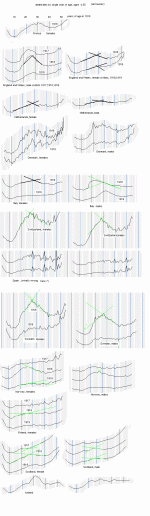
Background. The reasons for the unusual age-specific mortality patterns of the 1918-19influenza pandemic remain unknown. Here we characterize pandemic-related mortality by single year of age in a unique statewide Kentucky datasetand explore breakpoints in the age curves.Methods. Individual death certificates from Kentucky were abstracted by medically-trained personnelfor 1911-1919. Pandemic excess mortality rates were calculated by subtracting observed rates during pandemic months from rates in previous years, separately for each single-year of age group and gender.Results. The age profile of excess mortality risk infall 1918 was characterizedby a maximum in infants, a minimum at ages9-10 yrs, a maximum at ages 24-26 yrs, and a second minimumat ages 56-59 yrs. The excess mortality risk in young adults had been greatly attenuated by winter 1919. The age breakpoints of mortality risk did not differ between males and females.Conclusions. The observed mortality breakpoints in male and female cohorts born in 1859-62, 1892-94, and 1908-9 did not coincide with known dates of historical pandemics. The atypical age mortality patterns of the 1918-19 pandemic cannot be explained by military crowding, war-related factors, or prior immunity alone, and likely result from a combination of unknown factors.
PMID:
23230061
[PubMed - as supplied by publisher]
http://www.ncbi.nlm.nih.gov/pubmed/23230061
Age and gender mortality profileassociated with the 1918-19 influenza pandemic in Kentucky, USA.
Viboud C, Eisenstein J, Reid AH, Janczewski TA, Morens DM, Taubenberger JK.
Source
Fogarty International Center.
Abstract
Background. The reasons for the unusual age-specific mortality patterns of the 1918-19influenza pandemic remain unknown. Here we characterize pandemic-related mortality by single year of age in a unique statewide Kentucky datasetand explore breakpoints in the age curves.Methods. Individual death certificates from Kentucky were abstracted by medically-trained personnelfor 1911-1919. Pandemic excess mortality rates were calculated by subtracting observed rates during pandemic months from rates in previous years, separately for each single-year of age group and gender.Results. The age profile of excess mortality risk infall 1918 was characterizedby a maximum in infants, a minimum at ages9-10 yrs, a maximum at ages 24-26 yrs, and a second minimumat ages 56-59 yrs. The excess mortality risk in young adults had been greatly attenuated by winter 1919. The age breakpoints of mortality risk did not differ between males and females.Conclusions. The observed mortality breakpoints in male and female cohorts born in 1859-62, 1892-94, and 1908-9 did not coincide with known dates of historical pandemics. The atypical age mortality patterns of the 1918-19 pandemic cannot be explained by military crowding, war-related factors, or prior immunity alone, and likely result from a combination of unknown factors.
PMID:
23230061
[PubMed - as supplied by publisher]
http://www.ncbi.nlm.nih.gov/pubmed/23230061