• FluTrackers.com Inc. does not provide medical advice. Information on this web site is collected from various internet resources, and the FluTrackers board of directors makes no warranty to the safety, efficacy, correctness or completeness of the information posted on this site by any author or poster. The information collated here is for instructional and/or discussion purposes only and is NOT intended to diagnose or treat any disease, illness, or other medical condition. Every individual reader or poster should seek advice from their personal physician/healthcare practitioner before considering or using any interventions that are discussed on this website. By continuing to access this website you agree to consult your personal physican before using any interventions posted on this website, and you agree to hold harmless FluTrackers.com Inc., the board of directors, the members, and all authors and posters for any effects from use of any medication, supplement, vitamin or other substance, device, intervention, etc. mentioned in posts on this website, or other internet venues referenced in posts on this website.
  • We are not asking for any donations. Do not donate to any entity who says they are raising funds for us.

AFD - Personal Preparedness

sharon sanders

Editor-in-Chief & President
The 90% Solution


# 2039


http://afludiary.blogspot.com/


It is not a new message, but it is one worth repeating.


In a pandemic, you will need to be prepared to care for yourself, or your loved ones, in your home.

Based on most US government estimates, 90% of pandemic flu victims are not expected to see the inside of a hospital. And as you will see, the idea that we could provide hospital care to 10% of those afflicted may be wildly optimistic.


If you think that is an exaggeration, and that health authorities will somehow magically squeeze all critically ill patients into a hospital, think again.


We have a finite number of hospital beds available, a nursing shortage during normal times, and precious little surge capacity. Every winter we see many of our hospitals pushed to the breaking point by seasonal flu.


A pandemic would be orders of magnitude more demanding of our health care resources.


This graphic is from the State of Florida Pandemic plan, but is representative of many state pandemic assumptions.


Admitting 640,000 patients into Florida hospitals would be a monumental task. The State has roughly 3 hospital beds for every 1000 residents. That's about 50,000 beds.

And most of the time, 90% are occupied.

The math, as you can see, doesn't look good. And it is no better in other states, or other nations.


The hope is that the impact of a pandemic can be reduced through the use of NPI's (Non Pharmaceutical Interventions) and spread across many months, thus reducing the impact on a daily or weekly basis.


Still, with only 50,000 beds in Florida, trying to get even 10% of flu victims treated in hospitals would be a major feat. Many would say that it is impossible.


As for the other 90%? They will have to stay home, and hope someone can care for them.


Complicating matters, nearly 1.7 million Floridians live alone.

This chart is from the 2000 Florida Census. The numbers vary from state to state, with the District of Columbia having the highest percentage of Live-alone's and Utah having the lowest, but Florida is fairly representative of the nation.


(click to enlarge)


Nationwide, 27 million Americans live alone. On the island of Manhattan, more than 350,000 people live alone. During a pandemic, these people will be particularly at risk.


Statistically speaking, if the attack rate of the virus is 35%, then nearly 10 million Americans will have no one living with them to care for them when they fall ill.

Of course, living with someone is no guarantee that you will have someone to care for you. Entire households could be stricken by the virus at the same time, and many people are living with someone who would be physically incapable of rendering assistance.


As bad as all of this sounds, it only grows worse when you add in the millions of single parents living with infants and small children. Not only are they at similar risk, their children are as well.


The point of this little mental exercise is that people need to be thinking about how they will cope during a pandemic, particularly those who live alone or with small children. Pandemic influenza isn't just a `bad flu', it can render a victim incapable of caring for themselves in a matter of hours, and they could remain that way for a week or longer.


Everyone should get a copy of Dr. Grattan Woodson's Good Home Treatment of Influenza, and have obtained the medical supplies they will need to treat themselves, or their loved ones during a pandemic. That includes making up packets of ORS (Oral Rehydration Solution) in advance.


While everyone needs to be preparing to care for flu victims at home in a pandemic, those who live alone, or know someone who lives alone, need to be thinking about how they will cope with this situation.


Having a pre-prepared `Flu Box' under the bed, filled with medicines and hydration supplies, is an important first step. Having a telephone next to the bed, is also an important consideration. Singles should make arrangements with neighbors or friends who can check in on them, tend to them, and who can call for assistance if needed.


A flu victim who might otherwise survive could die in a matter of hours without proper care, particularly if they are severely dehydrated. Having (and being) a `flu buddy' during the next pandemic could make all the difference.

I understand there will be resistance to the idea. People will ask, Why should I expose myself to the virus and risk illness or death to care for a friend or neighbor?


It is, admittedly, a calculated risk. And it is one that many will choose not to accept. But unless a substantial number of people do accept that risk, we risk losing millions of people due to simple neglect during the next pandemic.


A severe pandemic wave could last 12 weeks, and a pandemic could consist of multiple waves over a year or even two. While I'm sure some will try, the idea that most people will be able to completely isolate themselves from the virus is pretty remote.


After all, even in a pandemic people will need to go to work, get supplies, pay their bills, and yes, even care for each other.


Obviously children, young adults, parents of small children, and pregnant women should avoid exposure if at all possible. They are at the greatest risk of contracting and dying from a novel pandemic virus.

But there are millions of others who are not similarly constrained.

The government, and our health care infrastructure, won't be able to handle a severe pandemic without the help of ordinary citizens like you and I. There will be a great need for community volunteers and for neighbors to help one another during a crisis.

Yes, there will be risks involved. There always are.

But it will be how we respond to those risks that will determine how well our society, and our world, will fare during the next pandemic.

posted by FLA_MEDIC @ 8:03 AM
 
Re: AFD - Personal Preparedness - The 90% Solution

Re: AFD - Personal Preparedness - The 90% Solution

The Long And The Short Of It


# 2122


One of the less frequently mentioned aspects of a pandemic is that the better job we do of lessening it's impact and slowing it down, the longer a pandemic wave is expected to last.


While the ultimate presentation of the next pandemic remains unknown, it is assumed that it will come in one or more `waves' over a year or longer. The number and duration of these waves is largely speculative, and based on a very limited data-set.


The chart above, taken from the PNAS journal article entitled Public Health Interventions and Pandemic Intensity During the 1918 Influenza Pandemic, illustrates what happened in two American cities during the 1918 pandemic.


The sharp, but much shorter pandemic wave depicted by the solid line occurred in Philadelphia, where relatively few steps were taken by the public health department to slow the spread of the disease.


The dotted line represents St. Louis, which closed schools early and where the Health Department prohibited public gatherings in places like theaters, churches, and restaurants.


As you can see, the percentage of cases reported on a daily basis were far fewer, but the pandemic wave lasted nearly twice as long as in Philadelphia.


At its worst, the percentage of excess of people afflicted in the city of Philadelphia was 5 times greater than what St. Louis experienced. The burden on hospitals, mortuaries, and practically all segments of the economy was certainly far greater.


The only saving grace was that it was over in 6 weeks instead of 12.


This is the tradeoff we face in a pandemic. Impact vs. duration.


Unchecked, an influenza virus will generally spread through a community until enough of the population becomes immune (through exposure or vaccines) to deny the virus new hosts. Not everyone who is exposed, and develops immunity, will fall ill.


Since the virus cannot live for long outside of a host, once `herd immunity' is reached in a community, the outbreak withers and dies.


With insufficient antivirals, and no prospects of a targeted vaccine during the first pandemic wave, our national strategy is to slow down the virus through the use of NPI's, or Non-Pharmaceutical Interventions.

These may include:

  • Social Distancing
  • Frequent Hand Washing or Sanitizing
  • Covering your coughs and sneezes
  • School and day care closures
  • Targeted business closures
  • The use of masks, gloves, and other barriers
  • Isolation of those infected
  • Voluntary quarantine of those exposed

In addition, it is hoped that the use of antivirals, particularly for outbreak prophylaxis among high risk employees, may also slow the spread of the disease.


By using these NPI's, and slowing the spread of the virus, it is hoped that the impact on our health-care systems, infrastructure, and overall community can be lessened.


Ironically, the more successful these steps are, the longer a pandemic wave is likely to persist. While this certainly is a downside, I'm convinced it beats the alternative.


This has real-world implications for all of us. Our preparations need to take into account these longer pandemic waves. And while we talk in terms of a `12 week wave', the actual length of a pandemic wave could vary significantly from one community to the next.


The upshot is that individuals, families, and businesses all need to be thinking about how they will function for roughly three months of `pandemic conditions' at a time.

How challenging all of this will be will depend largely on the severity of the next pandemic.


Future Pandemics will be ranked from Category 1 (mild) to Category 5 (severe) based on the CFR (Case Fatality Ratio) of the virus. This chart is from comes from the HHS/CDC document: Interim Pre-Pandemic Planning Guidence: Community Strategy For Pandemic Influenza Mitigation In the United States.


Figure A. Pandemic Severity Index

clip_image002.jpg


You will notice that while Category 5 is the top level of the scale, the severity of a CAT 5 pandemic is purposefully left open-ended. There is a growing acceptance in official circles that a `1918-style pandemic' is not the worst that nature could throw at us.


The bottom line is that for a society to function, and for essential services to continue during a pandemic, we all need to be preparing for a long haul.


Businesses, individuals, families, and communities.


Yes, I know it will be frightfully expensive, unpopular, and difficult to sell to the public. To many people, all of this may seem unreasonable.

But a pandemic isn't something you can reason with. You can't explain the difficulties involved and try to bargain with a virus.

A pandemic doesn't care.

It just is.

posted by FLA_MEDIC @ 10:01 AM
 
Re: AFD - Personal Preparedness - The 90% Solution

Re: AFD - Personal Preparedness - The 90% Solution

A Shared Responsibility To Prepare


# 2132


Of late, we've heard a good deal about `shared responsibility' when it comes to preparing for a pandemic.


The concept, promoted by Federal officials, is that the task ahead is too large for the government to handle alone, and that the private sector must shoulder a large share of the burden of pandemic preparedness.

For some, I'm sure, laying the burden off on the private sector must seem like an abdication of the government's responsibilities. An admission of incompetence or worse.

A pandemic is a national security issue, after all. It shouldn't be up to the little guy; the individual or the family, or the small business owner to pony up the costs of preparedness, should it?

It simply isn't fair to be asked, as a people, to take on the responsibility for our own welfare, and that of our neighbors and our community.

That's what we pay taxes for, isn't it?

Under normal circumstances, I might even agree with that. But a pandemic is so far and above what we could consider `normal', as to require a rewriting of the rules.

Secretary of HHS Michael Leavitt is perhaps most famous for his quote:


"Any community that fails to prepare with the expectation that the federal or state government will rescue them will be tragically mistaken.

The same can be said globally for any Nation that fails to prepare and relies on others to rescue them." - Michael Leavitt June 8th, 2006

Today, I think you can easily replace the word `community' with the words `business', `agency', or even `family'.

It is a hard truth, but true none-the-less.

Our Federal, State, and local governments have finite resources, and will be hard pressed to keep the basics of our infrastructure running during a pandemic crisis. They will be tied up trying to maintain interstate transportation, our railway systems, communications, utilities, vaccine production, along with providing for local and national security.

FEMA won't be landing in your neighborhood with pallets of relief supplies for your family. Nor will they show up at your business with N95 masks, hand sanitizer, or Tamiflu for your employees so you can keep your doors open.

These are preparations you must make yourself.

There simply are not enough government employees or resources available. It isn't a cop-out to say the government can't do it all.


They really can't.


None of this is to suggest that the government couldn't do more - a lot more - than it already has done to prepare. I doubt anyone at the CDC or HHS is totally satisfied with their response.


But given the amount of lead time that the private sector will need to prepare, we really haven't the luxury of delaying while we debate the finer points of this issue.


The time for the private sector to prepare is now.


Unfortunately, at least so far, this message doesn't seem to be getting through. Not to businesses, and certainly not to families and individuals.


The belief still persists that the government will somehow come to our rescue. That they would never let anything really bad happen to our nation. That they are overstating the problem, so as not to have to deal with it.

If anything, I'm convinced the government is understating the problem.

Sure, we could get lucky and the next pandemic might not turn out to be so bad. We could see a reprise of 1957 or 1968. If that happens, we will have dodged a bullet.

But a severe pandemic, what we now refer to as a CAT 4 or CAT 5 event, would subject our society and our economy to unimaginable strain. In that sort of scenario, it would be important that every family, every community, and every business be as resilient as possible.

That can only happen if we accept our share of the responsibility to prepare. Families, and businesses alike.

I know it's expensive. I know it's damnably inconvenient as well. Preparing for a pandemic, or any other disaster, takes valuable resources away from other areas. It makes it a very tough sell, particularly in a stalling economy.

And it is an investment that, admittedly, may not pay off for years.

And yet, a failure to prepare could be catastrophic. To your business, to your family, and to your community.

That it should fall on individuals, families, businesses, and communities to prepare for a pandemic is, no doubt, unfair.

But the last time I checked, there is absolutely nothing fair about a pandemic.

posted by FLA_MEDIC @ 3:44 PM
 
Re: AFD - Personal Preparedness - The 90% Solution

Re: AFD - Personal Preparedness - The 90% Solution

Personal preparedness includes being in the best personal health...(Fla1)

PAMP and Circumstance


# 2175


Today we have an interesting study from Yale, published in the Journal of Clinical Investigation, suggesting why cigarette smokers are more apt to suffer greater ill effects, or even die, from viral respiratory infections.

The study:

Cigarette smoke selectively enhances viral PAMP? and virus-induced pulmonary innate immune and remodeling responses in mice
Min-Jong Kang<sup>1</sup>, Chun Geun Lee<sup>1</sup>, Jae-Young Lee<sup>1</sup>, Charles S. Dela Cruz<sup>1</sup>, Zhijian J. Chen<sup>2</sup>, Richard Enelow<sup>1</sup> and Jack A. Elias<sup>1,</sup><sup>3 </sup>


. . . was performed on mice, since it wouldn't be ethical to infect humans with potentially lethal viruses.

As you might guess from the title, this is a complex, and very technical journal article. Unless you are a physician, a biologist, or a masochist you may not choose to wend your way through this entire study.


Luckily, we have a synopsis even I can understand.


But first, a little background on PAMP, our innate immune system, and how all of this may relate to pandemic flu.

Relax, I promise I'll be gentle.

Each of us is born with what we call Innate Immunity, or a generic immune response that is not pathogen-specific.

As we are exposed to various viruses, our bodies learn to recognize them, and create pathogen-specific antibodies against them - this is called acquired immunity.

For our innate immunity to work, it must have a way to recognize an infective agent, even from a virus it has never seen before.

Here is where PAMPs come in.

PAMPs (Pathogen-Associated Molecular Patterns) are patterns of molecules associated with many types of pathogens.

In other words, PAMPs are an easily recognizable signature that tells our innate immune system that we have been infected . . . with something.

Our immune systems have cells designed to recognize, and react to these signatures. We are born with this ability, and they keep us alive while our bodies learn to recognize and fight new infections.

Our innate immune responses involve the following cells (taken from Doc Kaisers Microbiology Course)

  • phagocytic cells (neutrophils, monocytes, and macrophages);
  • cells that release inflammatory mediators (basophils, mast cells, and eosinophils);
  • natural killer cells (NK cells); and
  • molecules such as complement proteins, acute phase proteins, and cytokines.
In other words, our innate immune system throws just about everything but the kitchen sink at an unrecognized infection.

In response our bodies spike a fever while natural killer cells and phagocytes rush to fight the infection. Our bodies produce protein and cytokine rich fluids at the site of the infection and cells throughout our body release inflammatory mediators.

Generally all of these things are good things, as they help fight the viral invader, although they are what make us so miserable when we have the flu.

These immune responses, particularly with respiratory infections, can also make our lungs ideal breeding grounds for bacterial infections.

Bacteria that normally live dormant and unnoticed in our lungs suddenly find a nutrient rich broth building up in the lungs, and warmer temperatures, courtesy of a fever. Practically overnight they can bloom.

This is why secondary bacterial pneumonia is a common complication of a viral respiratory infection.

During a pandemic caused by a novel influenza virus, it will be our innate immune system that will react to any infection. We will have very little acquired immunity (unless the virus shares some component with a previously circulating influenza virus).

How our innate immune system responds to this novel infection will determine, in large measure, our fate.

Now that I've set the stage, we can now proceed on to the Yale Study.


Simply put, we've always known that cigarette smokers fare far worse with respiratory infections than non-smokers. The assumption has been that smokers have a dampened immune response, and therefore are unable to combat a viral invader.


This study suggests just the opposite. That smokers mount a much stronger immune response via their innate immune system, than non-smokers. And it is this hyper-response that causes the trouble.

I'll let this article from Medical-News Today carry on.


Yale Study Shows Why Cigarette Smoke Makes Flu, Other Viral Infections Worse


Article Date: 25 Jul 2008 - 1:00 PDT

A new study by researchers at Yale School of Medicine could explain why the cold and flu virus symptoms that are often mild and transient in non-smokers can seriously sicken smokers. Published in the Journal of Clinical Investigation, the study also identified the mechanism by which viruses and cigarette smoke interact to increase lung inflammation and damage.


Until recently, scientists haven't been able to explain why smokers have more exaggerated responses to viral infections. Smokers have been more likely than non-smokers to die during previous influenza epidemics and are more prone to chronic obstructive pulmonary disease (COPD). Furthermore, children who are exposed to second-hand smoke have more severe responses when infected with respiratory synctial virus.


The prevailing view has been that cigarette smoke decreases anti-viral responses. But the Yale researchers-lead author Jack A. Elias, M.D., the Waldermar Von Zedtwitz Professor of Medicine and chair of internal medicine at Yale School of Medicine, and first author Min-Jong Kang, M.D., associate research scientist-found the opposite to be true.


Their experiments showed that the immune systems of mice exposed to cigarette smoke from as little as two cigarettes a day for two weeks overreacted when they were also exposed to a mimic of the flu virus.

The mice's immune systems cleared the virus normally but the exaggerated inflammation caused increased levels of tissue damage.

"The anti-viral responses in the cigarette smoke exposed mice were not only not defective, but were hyperactive," said Elias. "These findings suggest that smokers do not get in trouble because they can't clear or fight off the virus; they get in trouble because they overreact to it."


"It's like smokers are using the equivalent of a sledge hammer, rather than a fly swatter, to get rid of a fly," said Elias.

(Continued . . .)


Another good reason to give up cigarettes. As if we needed another.

And as a former smoker myself, I recognize how tough quitting can be. I was about as addicted as you can get to them. I grew up with smokers, was married twice to smokers, and finally succumbed to the habit myself in my late 30's.

Stupid, I know.

I tried repeatedly to quit, without success. The physical cravings were my undoing. Then, 14 months ago, I tried Chantix. I was off cigs in a week, and never looked back.

I know it doesn't work for everyone, and some people have had unpleasant side-effects. If you are considering it, you need to consult with your doctor. And you need to be ready to quit.

I can only say that it worked for me.

posted by FLA_MEDIC @ 8:40 AM
 
Re: AFD - Personal Preparedness - The 90% Solution

Re: AFD - Personal Preparedness - The 90% Solution

Saturday, July 26, 2008

<!-- Begin .post --> The Long And Whining Road


# 2178


Today we get a pretty good article out of Canada about the need for the general public to get, and remain, prepared for emergencies.

Sadly, it also points out how few people actually do it.


I'll post a link, and a snippet here, but there is a section about half way down I want to focus on today.


TORONTO: EMERGENCY 101
Be prepared. Be very, very prepared

Flooding, hydro explosions, flu pandemics. It could - it does - happen here. The city and its hospitals are girding for the worst


WENDY BANKS
Special to The Globe and Mail
July 26, 2008

When west Toronto homeowner Dave Mckellar found a flyer tucked in with his hydro bill warning him to keep 72 hours worth of food and water on hand in case of emergency, he wasn't alarmed. "It sounds reasonable, but who's going to do that?" he says. "It's a little bit hard to imagine, really, having no supplies whatsoever for three days ... I think I would just go to the store."

The notion of a Toronto so paralyzed by disaster that you couldn't go out for a falafel if the need arose does seem far-fetched. But ominous ads that have cropped up on waste bins around the city suggest otherwise. The ads feature a message straight out of Cormac McCarthy's post-apocalyptic novel, The Road: "Dad I'm hungry. Dad I'm hungry. Dad I'm hungry. Dad I'm thirsty." They're sponsored by Toronto's Office of Emergency Management (OEM); the fine print urges citizens to stock up on three days worth of provisions in case of disaster.

So, should we be worried? Is there some new threat that we should know about?

Not according to Warren Leonard, who heads up the OEM. "There's no change in the profile of the risks in this city ... the ads are just a new mechanism to reach out to the public."

(Continue reading . . .)


Halfway through the article, we get this assessment as to why people don't prepare: (reparagraphing & Highlighting mine)


That's why his office is urging people to prepare generic emergency kits: backpacks stocked with basic survival goods, including food and water, flashlights, a radio and medical supplies.

But a poll quoted on the Ontario government's website says that only 12 per cent of Canadians have made any such preparations at all.

Some of this reluctance may be because the very generic nature of the preparations strikes people as futile. "I think that you wouldn't have the right stuff," Mr. Mckellar says. "Imagine if you stocked up on batteries for your flashlight and all that, and then it turned out that what you really needed was an N95 face mask."


Being prepared isn't something you can buy off the rack with one easy payment.

It is a mindset. A lifestyle. A commitment.

Apparently most people would rather find reasons not to prepare. They will also be the ones who will whine the loudest when help doesn't arrive during a crisis.


Notice, the poll doesn't say that 12% have prepared 72-hour emergency kits. It says that 12% have made some sort of preparation. Maybe they have a battery operated radio, or maybe they have a first aid kit. But they don't have to have both in order to answer `yes' to this poll.

I doubt, except for places like earthquake prone California and perhaps the barrier islands and coastal cities of Florida, that U.S. citizens would be any better prepared.
I confess, I'm bewildered by this failure to prepare. This willingness to place their lives, and the lives of their loved ones, in the hands of a government that is loudly saying they can't come to everyone's rescue during a crisis.

At least, not right away.


What part of, "You need to be prepared to fend for yourself' do people not get?


* * * * *


When I was 17, and still in High School, I took a 3-night American Red Cross first aid course. At the time, I had no idea that a year later I'd be working on an ambulance.

It just seemed like a good idea.

Since I was approaching my 18th birthday, and would soon be out on my own, it seemed like the responsible thing to do. No one told me I should, my parents certainly didn't suggest it. I just decided that there was useful knowledge there that I should know.

So I went.

I spent 3 nights listening to the local fire chief teach us about first aid. I watched the films (most from the 1950's, btw), practiced bandaging the guy next to me, and I made my own first aid kit.

Since that day, I've never been without a serious first aid kit. In my car, and in my home.

* * * * *


Two weeks after I graduated from High School, during the summer of 1972, Hurricane Agnes clipped the west coast of Florida. It wasn't much as hurricanes go, but it sent tropical storm force winds, torrential rain, and some small tornadoes through our area.


Hurricane Agnes
Category 1 hurricane (SSHS)

<small>Hurricane Agnes approaching Florida</small>


My brother and I both ended up as part of the rescue effort that night, pulling the trapped and injured from collapsed trailers, and setting up an ad hoc emergency first aid center in an old post office.

We used the supplies from the first-aid kits we kept in the trunks of our cars to care for the injured.

For several hours, we were the only aid available to a half-dozen injured people. For a kid fresh out of highschool, it was a long night. It also spurred me on to a career in emergency medicine.

* * * * *


Why anyone would abdicate their personal responsibility to care for themselves, and their loved ones, is a mystery to me.

Sure, if there's an ambulance handy, use it.

But what if there isn't?

* * * * *


In the mid-1970's I became a CPR instructor. I taught CPR to hundreds of high school students every year. I was also working as a paramedic for the county EMS.

One day we were called for a cardiac arrest. We found a teenager doing effective CPR on an elderly man. My partner and I were able to cardiovert him; get his heart started, and him breathing again.

Honestly, even with the cardiac drugs and defibrillator we carried- that doesn't happen often.

The kid had done a good job. He'd saved his grandfather's life.

As we were loading the patient into the back of my rig, I asked him where he learned CPR?

He beamed proudly and said, "Don't you remember? You taught me!".

It was one of the proudest days of his life.

And mine.

* * * * *


Hundreds of thousands of years of human evolution has been dependant upon our ability, as a species, to survive.

A hundred and fifty years ago, just about everyone was a `survivalist'. As were all the generations that had come before. You either knew how to survive . . .or you didn't survive.

Somehow, just over the last generation or two, most of us in `civilized and enlightened nations' have forgotten the skills needed survive. We have become a race of specialists, when in order to survive in a crisis, you need to be a generalist.

Ironic, isn't it, that the more advanced our society becomes, the less capable individuals seem to be.


* * * * *


Our government, and the government of Canada, have asked that people be prepared. In Canada, they are asking for people to put together 72-hour kits. Here in the US, the Federal Government is asking people to stockpile for 2-weeks.

Being prepared is all about social responsibility. By relying, at least a little, on ourselves we remove a burden from society to rush to our aid in a crisis.

Being prepared should be taught as being part of our civic duty. Part of being a responsible member of society.

I know we expect the government (ambulance, police, fire, etc.) to respond immediately when we need them. The truth is, they often arrive too late. And during a crisis, they may not be able to respond to everyone right away.

That's why people need to be prepared for emergencies. They need to have that fire extinguisher in the kitchen, or workshop. They need to have the radios, and lanterns, and food in the pantry. They need to have that first aid kit in the trunk of the car.

And they need to know how to use them.

Someday, a disaster will strike your community. It may be a hurricane, or a tornado, or an earthquake or a flood. It might even be a pandemic.

For those who aren't prepared, I suppose they can console themselves by writing a nasty letter of complaint to the editor of their local paper.

They can whine, and complain bitterly about the system that they depended on. The one that wasn't able to respond when they needed it.

Assuming they survived, of course.

posted by FLA_MEDIC @ 12:00 PM
 
Re: AFD - Personal Preparedness - The 90% Solution

Re: AFD - Personal Preparedness - The 90% Solution

HHS September PlanFirst Webcast


# 2274


Over the past 6 months the HHS (Department of Health and Human Services) has conducted a series of webinars, or web broadcasts, on pandemic preparedness.


This month they will hold the 6th in the series, this time focusing on individual preparedness.


September Webcast

Join us on September 25, 2008, at 2:00 pm ET, for our Webcast on individual preparedness.


No registration is required. Email your questions for the Webcast panelists before and/or during the program to hhsstudio@hhs.gov. Please include your first name, state and town.


Previous Webcasts

A Webcast on home health care agencies planning aired on July 8, 2008.

A Webcast on preparing the workplace aired on June 4, 2008.


Webcasts, on the State planning and assessment process, aired on March 13, April 2 and April 30, 2008.


The pandemic influenza PlanFirst Webcasts are brought to you by the U.S. Department of Health and Human Services.


The HHS maintains an extensive pandemic flu information site at www.pandemicflu.gov, where visitors may access historical pandemic information, state and Federal pandemic plans, and a wealth of data on how to prepare for a pandemic crisis


Below are some of the challenges our society is expected to face during a pandemic, as listed by the HHS website.

Reasons enough to prepare.


Individuals & Families Planning

<hr size="1" width="98%"> Social Disruption May Be Widespread

  • Plan for the possibility that usual services may be disrupted. These could include services provided by hospitals and other health care facilities, banks, stores, restaurants, government offices, and post offices.
  • Prepare backup plans in case public gatherings, such as volunteer meetings and worship services, are canceled.
  • Consider how to care for people with special needs in case the services they rely on are not available.

<hr size="1" width="98%"> Being Able to Work May Be Difficult or Impossible

  • Find out if you can work from home.
  • Ask your employer about how business will continue during a pandemic. (A Business Pandemic Influenza Planning Checklist is available at www.pandemicflu.gov/plan/business/businesschecklist.html.)
  • Plan for the possible reduction or loss of income if you are unable to work or your place of employment is closed.
  • Check with your employer or union about leave policies.

<hr size="1" width="98%"> Schools May Be Closed for an Extended Period of Time

  • Help schools plan for pandemic influenza. Talk to the school nurse or the health center. Talk to your teachers, administrators, and parent-teacher organizations.
  • Plan home learning activities and exercises. Have materials, such as books, on hand. Also plan recreational activities that your children can do at home.
  • Consider childcare needs.

<hr size="1" width="98%"> Transportation Services May Be Disrupted

  • Think about how you can rely less on public transportation during a pandemic. For example, store food and other essential supplies so you can make fewer trips to the store.
  • Prepare backup plans for taking care of loved ones who are far away.
  • Consider other ways to get to work, or, if you can, work at home.

<hr size="1" width="98%"> People Will Need Advice and Help at Work and Home

  • Think about what information the people in your workplace will need if you are a manager. This may include information about insurance, leave policies, working from home, possible loss of income, and when not to come to work if sick. (A Business Pandemic Influenza Planning Checklist is available at www.pandemicflu.gov/plan/business/businesschecklist.html.)
  • Meet with your colleagues and make lists of things that you will need to know and what actions can be taken.
  • Find volunteers who want to help people in need, such as elderly neighbors, single parents of small children, or people without the resources to get the medical help they will need.
  • Identify other information resources in your community, such as mental health hotlines, public health hotlines, or electronic bulletin boards.
  • Find support systems?people who are thinking about the same issues you are thinking about. Share ideas.

<hr size="1" width="98%"> Be Prepared
Stock a supply of water and food. During a pandemic you may not be able to get to a store. Even if you can get to a store, it may be out of supplies. Public waterworks services may also be interrupted. Stocking supplies can be useful in other types of emergencies, such as power outages and disasters. Store foods that:

  • are nonperishable (will keep for a long time) and don't require refrigeration
  • are easy to prepare in case you are unable to cook
  • require little or no water, so you can conserve water for drinking
See a checklist of items to have on hand for an extended stay at home.


Given the importance of this webcast subject, I'll be sure to remind my readers as the broadcast date approaches.

Posted by FLA_MEDIC at <a class="timestamp-link" href="http://afludiary.blogspot.com/2008/09/hhs-september-planfirst-webcast.html" rel="bookmark" title="permanent link"><abbr class="published" title="2008-09-04T07:49:00-04:00">7:49 AM</abbr>
 
Re: AFD - Personal Preparedness - The 90% Solution

Re: AFD - Personal Preparedness - The 90% Solution

And the Answer Is . . . At Least Two Weeks


# 2330


During yesterday's HHS Webcast on personal preparedness the question was asked:


How long should American households be stocking up for?


The answer given by Dr. Richard Benjamin, Chief Medical Officer, of the American Red Cross was:


"At least two-weeks."

He went on to say, "but if you could do more, that would be a wonderful thing." He added, "Six to 12 months would be wonderful, but that's probably not practical for most people."


And indeed, individual stockpiling for 6 to 12 months for a family would be a huge undertaking. There are, however, quite a few families that either have achieved that goal, or are working towards it.

Lest you think it involves some form of madness to stockpile weeks or months of food and water in your home, consider how much less pain and misery there would have been on the Texas Gulf Coast last week if every family had gone into Hurricane Ike fully prepared with at least two weeks of emergency supplies.


It doesn't require a pandemic to ruin your entire day. A hurricane, or other natural disaster, can do nicely.


Here is some preparedness advice from the American Red Cross Pandemic Preparedness page.


Planning Ahead

During a flu pandemic, government officials may be required to limit community movement or impose travel restrictions to help prevent the flu virus from spreading. Things to keep in mind:

  • You may be asked to stay home for an extended period of time even if you are not sick.
  • Schools, workplaces and public gatherings such as sporting events or worship services may close temporarily.
  • Mass transportation such as subways, buses, trains and air travel may be limited.
  • You, your family and friends may need to rely on each other when you cannot depend on the services you normally use.
Think about how you handle stress and know your strengths. Take steps to plan for, get through and recover from a flu pandemic...

Planning at Home
cleaningsupplies.jpg


Along with food, water and medical supplies, store cleaning supplies such as bleach with household emergency supplies.


  • Store a two-week supply of food. Select foods that do not require refrigeration, preparation or cooking. Ensure that formula for infants and any child?s or older person?s special nutritional needs are a part of your planning. Plan for your pets as well.
  • Store a two-week supply of water, 1 gallon of water per person per day, in clean plastic containers. Avoid using containers that will decompose or break, such as milk cartons or glass bottles.
  • Store a supply of nonprescription drugs, such as pain relievers, cough and cold medicines, stomach remedies and anti-diarrheal medication, as well as vitamins and fluids with electrolytes (such as sports drinks).
  • Store health and cleaning supplies, such as bleach, tissues, a thermometer, disposable gloves, soap and alcohol-based hand sanitizers.
  • Ask your health care provider and health insurance company if you can get an extra supply of your regular prescription drugs and medical supplies, such as glucose monitoring supplies.
  • Talk with family members and loved ones about how they would be cared for if they got sick.
Planning in Your Community

  • Ask about plans to enable you to stay home if you are or a family member is sick.
  • Find out your employer?s plans to keep the business open if key staff can?t come to work.
  • Find out now about your child?s school or daycare provider?s plans for handling a flu pandemic.
  • Ask if there are plans to encourage sick children to stay home to reduce the spread of the disease.
  • Ask if there are plans to close during a pandemic that would require all the children to remain at home.
Finding out the answers ahead of time will have a significant impact on your plans and decisions during a flu pandemic.
Related Content


Remember, two-weeks is the minimum recommendation. More, like they say, `would be wonderful'.


For more in-depth emergency preparedness information I can think of no better resource than GetPandemicReady.Org. Admittedly, as a minor contributor to that site, I'm a little biased.


But whether you are preparing for two-weeks or three-months, the important thing is to start.

Today.
 
Re: AFD - Personal Preparedness

October 1, 2008

Prepping And Morality


# 2351


My last blog, which highlighted the John's Hopkins Study entitled Ethics and Severe Pandemic Influenza: Maintaining Essential Functions through a Fair and Considered Response, included the following snippet from the summary provided on the Johns Hopkins Berman Institute of Bioethics website.


. . . individuals and families who can afford it should do their best to prepare for any disaster. The paper notes, the more initiative the general public exercises in stockpiling several weeks' worth of food, water, paper goods, batteries medicines, and other needed supplies, the less vulnerable they will be to a break in the supply chain.

It is important for leaders to communicate to the middle class and the wealthy that it is their responsibility to prepare for self-sufficiency in order to free up scarce supplies and allow first responders to direct their attention towards those too poor or vulnerable to prepare themselves.

While this may not have been the main thrust of this paper's message, it is a powerful component. One that bloggers such as myself have been trying to promote for several years.


The GET PANDEMIC READY website is an excellent example of the kind of work being done by volunteers to try to get individual families and communities to prepare for a pandemic.

The various flu forums have been very vocal in recommending that people prepare personally for a pandemic.

Local health departments, like Larimer County in Colorado, have also been very proactive in encouraging families to prepare for a pandemic, or other disaster.

Larimer County's The Plan - How prepared are you to weather a disaster? This 15 minute video gives a good intro into planning to deal with a pandemic. Check out the other videos on this page. Broadband and dialup speeds are supported.

There is, in the opinion of this blogger, a moral imperative that people who can prepare should prepare.


It isn't fair to those who are unable to prepare to have to compete with those who could have prepared for scarce resources during a disaster. Nor should overworked and overburdened relief agencies have to provide for those who very well could have done so for themselves in advance.

For a reasonably affluent family of four, simple preparations can be made for the cost of a couple of family dinners out, or a couple of family outings to a movie theatre.

While a hundred dollars worth of preps might not break the bank for many families, there are some to whom that is a great deal of money. And while some families might elect to spend somewhat more to prepare, it can be done on a shoestring if needed.


Those who can afford to prepare can take a huge burden off the relief agencies during any disaster by simply not being in line to receive aid. They can also, at their discretion, elect to use some of their preps to help those around them who are less prepared during an emergency.


Preparing now, while there are no shortages, and there is no huge competition for resources, is not hoarding.


In June of 2006, I wrote a blog entitled Avian Affluenza, about some people's fears that prepping - when others might be unable to do so - is somehow a less than honorable thing to do.


I disagreed then, and it's nice to see that the authors of this report from John's Hopkins appear to disagree now.


Since it has languished deep in the archives for more than two years, I've resurrected it today.


Avian Affluenza
Monday, June 05, 2006


Of late, in some circles, there has been much debate over the ethics of prepping for a pandemic. There are some who contend that it is unethical to do so when there are others in this world who, due to economic reasons, are unable to do likewise. There are deep moral and religious reasons behind their thinking, and while I do not share them, I do respect them.

The idea of going down with the ship, tho, while noble, is not one that I embrace. We have always lived in a world with limited means, and there have always been people who, due to their location, or poverty, who do not have access to the things that others do. A sad reality.

But before too many people jump onto this bandwagon, I would submit that there is one overriding ethical reason to prepare. For everyone who does prepare, it takes some of the burden off of the governments and relief agencies who will be trying to feed and care for those who can?t.

By prepping, you will reduce the line for food and water during a crisis, and someone else can have those resources in your place. You will also free yourself up so you can help others.

It isn?t hoarding to buy now, while supplies are abundant. It isn?t selfish to take care of your loved ones. And by being prepared, you may be able to lend assistance to your neighbors and friends. It's a win-win situation.

Most Americans, and a great many of other people around the world, could set back a modest supply of food and water. A hundred dollars will buy several hundred pounds of beans and rice. Water can be stored in rinsed recycled 2 liter bottles. It doesn?t take a lot of money to be minimally prepared.

Perhaps it will mean skipping going out to the movies once a month. Or forgoing a dinner at a nice restaurant. But a few hundred dollars spent today, could save your life during a crisis.

Guilt over being affluent enough to prep is, in my opinion, misplaced. But everyone has to seek their own level of comfort, and reach their own moral decision here.

While the virus may get me, despite my preps, I do not intend to assist it in that endeavor. There are people I care about, and intend to help during this crisis. I can't do that if I'm dead or scrambling for my daily cup of rice from the government.

But hey, that's just me. YMMV. (Your mileage may vary)


Re: AFD - Personal Preparedness

Up Close And A Little Too Personal


# 2373


The NEJM (New England Journal of Medicine) has a feature where they display some unique medical image every week. These images vary widely, but they are almost always fascinating . . . assuming it isn't lunch time.


This week the NEJM presents a series of photographs and short video showing the expulsion of air during a single 1/2 second cough.


If you've ever wonder how it is that colds, flu's, and pneumonia's are so easily transmitted, then these images should do the trick. If you were standing next to this guy, you would be breathing in what he is coughing out.


Coughing and Aerosols


View larger version (51K):
View Video (2M)

When a healthy volunteer coughs, he expels a turbulent jet of air with density changes that distort a projected schlieren light beam (Panel A). A velocity map early in the cough (Panel B) was obtained from image analysis. Sequential schlieren images during the cough (Panel C and video) were recorded at 3000 frames per second. A maximum airspeed of 8 m per second (18 mph) was observed, averaged during the half-second cough. Several phases of cough airflow are revealed in the figure.

The cough plume may project infectious aerosols into the surrounding air. There is an increasing interest in visualizing such expelled airflows without the use of intrusive methods because of concern regarding the transmission of various airborne pathogens, such as viruses that cause influenza and the severe acute respiratory syndrome (SARS).
Julian W. Tang, F.R.C.Path.
Gary S. Settles, Ph.D.
Pennsylvania State University
University Park, PA 16802


It would have been interesting to see a comparison between an uncovered cough, as shown above, and a cough into one's sleeves or hands.

Imagine being in a crowded bus, subway, or airplane with someone coughing like this.

Notice too, that when the subject coughs, that the spray of particulates begins to drift towards the ground. Larger, heavier droplets are the first to descend. This is one in the ways that inanimate object, or fomites, become contaminated by infected patients.


A person's cough can deposit virus laden droplets on desks, keyboards, telephones . . . practically any surface you can imagine. And those viruses may remain viable, and capable of infecting others, for hours.

The good news here is that the bulk of these droplets appear to drift downward relatively quickly after expulsion, giving credence to idea that maintaining a 6 foot separation between people during a pandemic could help reduce infections.

Of course, the key word here is `reduce'. A far cry from `eliminate'.

The take home message here should be : If you are sick . . . PLEASE STAY HOME.

Now, I've got to go out for awhile. Where did I put those N95 masks?
 
Re: AFD - Personal Preparedness

Friday?s Good-News Bad-News


# 3242


Anyone who has followed this blog for the past 3+ years (and you all have my deepest apologies) knows that I?ve always been a strong advocate of personal preparedness.

One of the things we?ve discussed, dozens of times, has been the efficacy of surgical facemasks during a pandemic.

Right now, the CDC is not advocating the use of facemasks by the general public due to the H1N1 swine flu virus. Their guidance is continually evolving, however, so check back if conditions change.
And quite frankly, right now, I don?t see much point in wearing facemasks in public, either.

But for those who have someone in their household ill with the flu, wearing a facemask or respirator may offer some protection.

(Please note the `weasel words?, like `may?, and `can?, and `might?. They are here for a reason.)


As I?ve always pointed out ? the science on how effective they are is pretty thin, and N95 respirators are far superior to surgical masks ? but in the end I believe that any mask beats no mask at all.
Over the years, despite a good deal of institutionalized bias against their use by the general public, we?ve seen studies that suggest that facemasks may be more protective than previously thought.

This week we get another study, this time appearing in the Risk Analysis Journal, which indicates (once again) that facemasks may be more protective than previously thought.


Face Protection Effective In Preventing The Spread Of Influenza, Study Suggests

ScienceDaily (May 22, 2009) ? A new article in the journal Risk Analysis assessed various ways in which aerosol transmission of the flu, a central mode of diffusion which involves breathing droplets in the air, can be reduced. Results show that face protection is a key infection control measure for influenza and can thus affect how people should try to protect themselves from the swine flu.

<snip>

Their model predicted that the use of face protection including N95 respirators (these fit tight around the face and are often worn by construction workers) and surgical masks (these fit looser around the face and are often worn by dental hygienists) are effective in preventing the flu. The filters in surgical masks keep out 98 percent of the virus. Also, only 30 percent of the benefits of the respirators and masks are achieved if they are used only after an infected person develops symptoms.

Whether you agree with the methods or the conclusions of this study or not, this is just part of the mounting evidence that surgical facemasks can play some role in personal protection against respiratory viruses.

Are they some guarantee that you won?t get infected?

Of course not. No more than wearing a seatbelt is a guarantee that you?ll not be injured in a car wreck.

But it appears they can help. Maybe.


Now for the bad news . . .

After less than one week of what can only be described as swine flu mania in Japan, they are already beginning to see shortages of masks.

This from the Wall Street Journal.

<small>MAY 22, 2009, 8:36 A.M. ET</small>
Japan's Mask Supply Falters as Flu and Fear Spread

TOKYO -- Japanese makers of surgical masks say that despite boosting production amid the spread of A/H1N1 influenza, they can't keep up with demand from consumers hyper-sensitized to hygiene issues.
"We are receiving inquiries from municipal governments all over Japan, informing us of a mask shortage," said Ryosuke Ikemi, managing director at the Japan Hygiene Products Industry Association, an industry organization.

As I blogged earlier this week (see Caught With Our Masks Down), we are facing an acute shortage of facemasks and respirators.

Should we see a more virulent virus return in the fall, and Americans embrace the use of facemasks the way they have in Japan, we?d run out in a matter of weeks, too.
 
Re: AFD - Personal Preparedness

CDC Issues New Facemask & Respirator Guidance For H1N1


# 3245


You have to give them credit.

The CDC hasn?t been shy about revising their interim guidance on dealing with the H1N1 virus as new information has come available.

Today we get a new set of interim guidance for non-hospital settings, on the use of respirators and facemasks by the public.

These guidelines are based on the current understanding of the virulence of the novel H1N1 virus, and will no doubt change if changes to the virus are detected.
The guidance is lengthy, so I encourage you to read it in its entirety. But I?ll try to summarize it here with some excerpts.

First we are reminded of the standard precautions that we should all be taking now, and in the future, to prevent respiratory infections.

In areas with confirmed human cases of novel influenza A (H1N1) virus infection, the risk for infection can be reduced through a combination of actions. No single action will provide complete protection, but an approach combining the following steps can help decrease the likelihood of transmission. These recommended actions are:

  • Wash hands frequently with soap and water or use alcohol-based hand cleaner when soap and water are not available.
  • Cover your mouth and nose with a tissue when coughing or sneezing.
  • Avoid touching your eyes, nose and mouth
  • People who are sick with an influenza-like illness should stay home and minimize contact with others, including avoiding travel, for 7 days after their symptoms begin or until they have been symptom-free for 24 hours, whichever is longer.
  • Avoid close contact (i.e. being within about 6 feet) with persons with influenza-like illness.
Next the difference between a facemask and a respirator are defined. Respirators are the more expensive, more securely fitted masks usually marked as N95. Facemasks are the less expensive surgical mask.

The CDC the describes those at higher risk of complications from contracting this new flu virus. Most of the recommendations for wearing facemaks or respirators are aimed at these groups.


Groups at Higher Risk for Severe Illness from Novel Influenza A (H1N1) Infection

Groups of people at higher risk for severe illness from novel influenza A (H1N1) infection are thought to be the same as those people at higher risk for severe illness from seasonal influenza. These groups include:

  • Children younger than 5 years old
  • Persons aged 65 years or older
  • Children and adolescents (younger than 18 years) who are receiving long-term aspirin therapy and who might be at risk for experiencing Reye syndrome after influenza virus infection
  • Pregnant women
  • Adults and children who have pulmonary, including asthma, cardiovascular, hepatic, hematological, neurologic, neuromuscular, or metabolic disorders such as diabetes
  • Adults and children who have immunosuppression (including immunosuppression caused by medications or by HIV)
  • Residents of nursing homes and other chronic-care facilities.

Depending on whether you fall into any of these high risk groups, or not, you can look up the current CDC recommendation in the table below.


Since facemasks, when worn by those who are sick, can also protect those people in contact with them, the CDC also has facemask recommendations for them.


Re: AFD - Personal Preparedness

Track Of The Cat


# 3302


It?s a scenario that Floridians, and many other coastal residents, face every year.

There is a threat out there; a category 1 ? bordering on Category 2 storm.
It is still days away, and while it is moving in our general direction, it is possible (but unlikely) that is could dissipate or turn away.

Between it, and landfall, is a lot of very warm water, which can feed the storm and make it grow; perhaps to a Cat 3 or greater.

But there is also wind shear out there, that if great enough, it could tear the tops off the clouds and inhibit the storm?s growth.
You?ve got some lead time to prepare. What do you do?

Essentially, this is the same situation we now face with the novel H1N1 Swine flu virus.


It?s out there, and it is headed in our general direction. We are unlikely to escape the effects of it, although it remains to be seen how bad it will be.

There are many external factors that could affect the strength of the virus as it moves inexorably closer to us. Some of those factors could weaken it, while others could make it stronger.

Our ability to forecast these changes in intensity are extremely limited.
There is time to prepare ? if we choose to ? but the threat isn?t imminent. In fact, to many it seems quite distant.

By the time it is apparent when it will strike, and how bad it will be, it may be too late for many to do much about it.

So again, the question is. What do you do?


Pandemics (and we might as well get used to calling this virus a pandemic) are rated by the HHS like hurricanes. The mildest being a category 1 pandemic, and the worst being a category 5.

While the WHO is still trying to figure out how to implement a severity index, the HHS came up with one for the United States more than 2 years ago.

One that takes into account the possibility of a mild pandemic.


A Category 1 pandemic essentially has the same mortality rate as seasonal flu, but because it stems from a novel virus, it is assumed that 30% of the population (3 times normal) would be stricken.

Instead of the estimated 36,000 deaths we see in a normal year, with more people ill, we could see 90,000 deaths.
A Category 2 pandemic would be expected to produce between 90,000 and 450,000 fatalities in the United States.

With the high CFR (Case fatality Ratio) of bird flu, many people have been expecting a Cat 5 pandemic (which could still happen).

To some, in comparison, a Cat 1 or Cat 2 pandemic seems almost anti-climactic.

Of course, the residents of Galveston Beach, who are still cleaning up after Cat 2 Hurricane Ike, might take issue with that stance.
The point is, even if the H1N1 virus proves to be no worse than seasonal flu in virulence (and it is too soon to know if that will happen), it is likely to affect a greater percentage of the population, and that would amplify its impact.


As you can see, a strong Category 2 pandemic could be 12 times worse than our standard seasonal flu.

In a pandemic, young adults and children are often hit disproportionately harder than other age groups. To put it bluntly, even a mild pandemic could claim a lot of young lives.

Early (and likely incomplete) analysis (see More On The Ferguson Study) has put the CFR of the swine flu virus somewhere around 4 deaths per 1,000 infected.

What would normally be associated with a moderately strong Category 2 pandemic. Or roughly equivalent to the 1957 pandemic.

Whether this virus retains that virulence, or grows stronger or weaker, is something we can only wait to find out. Influenza viruses are unpredictable.

All we really know is that the threat is out there, beyond the horizon perhaps, but growing nearer. It has the ability to cause great damage, but it could weaken before it arrives.

It is impossible to forecast accurately. It could appear mild up until the very last minute, then flare up like a hurricane crossing the gulf stream just before it reaches the coast.

The question remains. What do you do?


Take it from a native of Hurricane country, the one thing you don?t do is ignore the threat.

There is no need to panic (I?ve yet to find any situation where that helps, quite frankly), but there is great need to prepare.

Your family, your neighborhood, your business, and your community.
Since we can?t know how bad this pandemic will be, the prudent thing is to prepare for a reasonable worst-case scenario based on what we know right now.

And we need to be prepared to alter our plans down the line if we learn that the threat has changed.
Right now, it appears that we may be looking at a Category 1 or perhaps even a Category 2 pandemic. That?s a reasonable assumption based on what we know right now.

Neither are to be trifled with.

Both could bring personal loss to you or your loved ones, and could cause significant societal, economic, and health-care delivery disruptions.

Those of us who live in the northern hemisphere have been given a gift.

The gift of time.

We have a few months before our next flu season begins. There is no guarantee that the virus will hold off until then (the 1918 pandemic arrived in late summer) but our major concern right now is what happens in the fall.

The focus of this blog has always been preparation, and so it will be as we watch this virus develop in the southern hemisphere.

Yes, we?ll follow the news, and the science behind this story. I?m as interested in that as you are.

But it is imperative that we not become so fascinated with the details of the story that we forget to prepare to meet whatever challenges this pandemic throws at us.

To get you started, if you haven?t already visited (and really examined) the HHS Family pandemic planning page, you should do so this weekend.

Individuals & Families Planning


Topics on this page


Right now, our next flu season and any pandemic may seem a long way off. But given the amount of work to be done, they could be here all too soon.

We?ve got some time. Let?s use it wisely.
 
Re: AFD - Personal Preparedness

Avoiding The Christmas Rush In July


# 3472


Imagine for a minute that it is late December, not mid-July, and that the H1N1 virus has ramped up to the point where 10% of the country has the flu. That?s 30 million people.

Most will probably have relatively mild flu symptoms.

And to be clear, that simply means that their illness won?t be severe enough to require hospitalization. It doesn?t mean they won?t be sick, miserable, and in need of tending.
Since there are fewer than 1 million hospital beds in the United States - and at any given time between 85% and 90% are usually occupied with non-flu cases ? our medical surge capacity is fairly limited.

An extra 200,000 hospital cases all at the same time would very difficult to handle, particularly since HCW?s (Health Care Workers) are likely to be out sick with the flu as well.

Which means that somewhere on the order of 98% of all flu cases are going to need to be treated at home.
Over the course of this winter, 1/3rd of the population (or more) could eventually fall ill. That means that few households will be spared. That, by the way, would be triple the number of flu cases we normally see in a flu season.

As you might imagine, certain supplies may be hard to come by during the height of the outbreak. Fever reducers, expectorants, pedialyte or other rehydration solutions, and especially facemasks could be in very short supply.

Now is the time to be checking your medicine cabinet and stocking up ? while stores are well stocked ? on a reasonable quantity of these supplies. There is no need to buy more than you, and your family, can use.

If you have young children, you should speak to their pediatrician and ask what medications would be most appropriate for them. Many over-the-counter flu medications are not appropriate for (or even shown to help) young children.

Warning! Do not give aspirin (acetylsalicylic acid) to children or teenagers who have the flu; this can cause a rare but serious illness called Reye?s syndrome. For more information about Reye?s syndrome, visit the National Institute of Health website.
In addition to over-the-counter medicines, you may wish to invest in a quantity of facemasks and respirators for use when caring for a flu victim in your home.


N-95 Respirator Surgical Facemask

The CDC now recommends for other NON-CAREGIVING members of the household:

  • If you are in a high risk group for complications from influenza, you should attempt to avoid close contact (within 6 feet) with household members who are sick with influenza.
  • If close contact with a sick individual is unavoidable, consider wearing a facemask or respirator, if available and tolerable. For more information, see the Interim Recommendations for Facemask and Respirator Use.
  • Avoid having pregnant women care for the sick person. (Pregnant women are at increased risk of influenza-related complications and immunity can be suppressed during pregnancy).

For the patient, the CDC recommends:

  • If persons with the flu need to leave the home (for example, for medical care), they should wear a facemask, if available and tolerable, and cover their nose and mouth when coughing or sneezing
  • Have the sick person wear a facemask ? if available and tolerable ? if they need to be in a common area of the house near other persons.

For CAREGIVERS the CDC recommends:

  • If you are at high risk of influenza associated complications, you should not be the designated caretaker, if possible.
  • If you are in a high risk group for complications from influenza, you should attempt to avoid close contact (within 6 feet) with household members who are sick with influenza. Designate a person who is not at high risk of flu associated complications as the primary caretaker of household members who are sick with influenza, if at all possible. If close contact with a sick individual is unavoidable, consider wearing a facemask or respirator, if available and tolerable. For more information, see the Interim Recommendations for Facemask and Respirator Use

If you sense a theme, it is that facemasks and respirators may come in very handy if, and when, you are confronted with caring for a flu victim in your home.

And by this winter, they are probably going to be about as hard to find as an honest lawyer.
If we all wait until fall to start buying these supplies, we are all but guaranteed to create shortages. Besides . . .who in their right mind wants to go shopping at the last minute in the dead of winter during a flu pandemic?


We aren?t talking a huge investment here.

For the price of a couple of delivery pizzas, you can probably lay in the basic caregiver supplies for a family of four. But having them when you need them will be invaluable.

For more information on what you should be stocking, download Dr. Grattan Woodson?s excellent (and free) booklet on caring for influenza at home.


The smart money says, do it now. Avoid the Christmas rush.
 
Re: AFD - Personal Preparedness


Study: Facemasks And Influenza Transmission In Households


# 3580


The debate over the effectiveness of simple surgical facemasks for protection against influenza has been a long, drawn out, and contentious one.

The `conventional wisdom? has been that surgical masks are too porous to stop aerosolized virus particles, and therefore not protective. Only properly fit tested N95 (or better) respirators, they claim, are effective in preventing infection from influenza.


N-95 Respirator Surgical Facemask

And I?ve no doubt that N95 respirators are more protective than surgical facemasks, and certainly more appropriate in a health care setting as protective equipment.

I?ve always felt, however, that if the choice however no mask, or an inexpensive surgical mask, I would personally opt for the facemask.

Admittedly, there hasn?t been a lot of data one way or another on this issue, although over the past few years we?ve seen a number of studies that strongly suggest that facemasks, when used consistently, may be more protective than previously thought.

Some of my previous blogs on this subject include:

While not advocating the use of facemasks in public, the CDC has released guidelines for caring for flu victims at home that include the use of facemasks in some circumstances.

And today we learn of a new study which appears in the Annals of Internal Medicine that once again supports the idea that the use of facemasks in the home, when a family member has the flu, can reduce the transmission of the virus.

Facemasks and Hand Hygiene to Prevent Influenza Transmission in Households

A Randomized Trial

Cowling, Chan, Fang, Cheng, Fung, Wai, and others

6 October 2009 | Volume 151 Issue 7

Conclusion:

Hand hygiene and facemasks seemed to prevent household transmission of influenza virus when implemented within 36 hours of index patient symptom onset.

These findings suggest that nonpharmaceutical interventions are important for mitigation of pandemic and interpandemic influenza.
In an article that appears on the CNN website tonight, entitled Study: Face masks seem to protect against flu, the lead author states:

"Many people believe that coughs and colds are so infectious that there is really no stopping them, however hard we try," says Benjamin Cowling, Ph.D., the lead author of the study published this week in Annals of Internal Medicine. "Our results suggest that is not the case, and, in fact, transmission can be effectively stopped with just some simple precautions."
The best results were obtained by those who began interventions early, when someone in their household came down with the flu. Hand washing and the wearing of facemasks, together, produced the best results according to this study.

The CNN report goes on to say:

In tandem with hand-washing, face masks seem to work better than hand-washing alone, but the authors could not conclusively prove which intervention was responsible for the drop in infections of family members

While this study supports (but doesn?t overwhelmingly prove) the idea that facemasks are protective, there?s major hitch to all of this:

We have a limited supply of facemasks, and the demand for them will no doubt soar over the next couple of months.
I seriously doubt that manufacturers will be able to keep up with the demand and shortages this fall are all but guaranteed.

So don?t expect any strong recommendations from health officials to run out and buy masks. There simply aren?t going to be enough to supply the needs of the nation, and the world.

Of course, there?s nothing to stop you from buying a box or two of surgical masks right now, while they are still plentiful and easy to obtain.

Just don?t be surprised if that window of opportunity closes over the next few weeks.
I?ll present a potential alternative to store bought disposable masks in an upcoming blog.


Re: AFD - Personal Preparedness

The Man In The Ironed Mask


# 3582

There is a very strong possibility that later this year, and over this winter, you may find yourself wishing you had a facemask to wear, and there may be none available.

In an earlier blog tonight, I reported on a new study that suggests that simple facemasks may be at least somewhat protective in the home setting when caring for someone with influenza.


The bad news is, we haven?t nearly enough masks to go around, as this article from last May reminds us.


A New Pandemic Fear: A Shortage of Surgical Masks

By Bevan Schneck Tuesday, May. 19, 2009
masks_0515.jpg

A man wears a medical mask during the morning commute in New York City, April 29, 2009.
Brendan McDermid / Reuters

The surgical face mask has become perhaps the most recognizable symbol of the H1N1 pandemic threat, but if the currently circulating flu virus does in fact reach full-fledged pandemic proportions, U.S. health officials say there won't be enough face masks to go around.

The Department of Health and Human Services (HHS) says the nation would need more than 30 billion masks ? 27 billion of the simple surgical kind, which can be worn safely for only about two hours before needing replacement, and 5 billion of the sturdier respirator variety, which also requires regular replacement ? to protect all Americans adequately in the event of a serious epidemic. But the Centers for Disease Control and Prevention (CDC) Strategic National Stockpile currently contains only 119 million masks ? 39 million surgical and 80 million respirator. That's less than 1% of the goal health officials set in 2007 following the devastation of Hurricane Katrina, which highlighted the country's shortages of vital medical gear.

The U.S. mask gap stands in stark contrast to what other nations have on hand: the U.S. has one mask for every three Americans (masks are not supposed to be shared), while Australia has 2.5 masks per resident and Great Britain boasts six.
(Continue . . . )
While supplies of manufactured surgical and N95 masks may be difficult or impossible to find during the height of a pandemic, there is one possible alternative which was published in the CDC?s Journal of Emerging Infectious Diseases back in 2006.

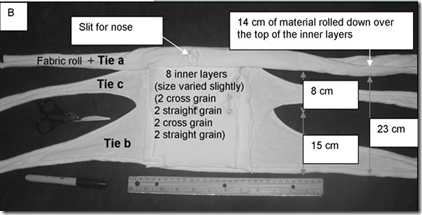
A homemade reusable mask made out of Tee-shirt material.
SophiaZoe, atA Pandemic Chronicle, has kept the idea at the top of her blog.

She offers it without recommendation, as do I.

Emerging Infectious Diseases Volume 12, Number 6, June 2006

Simple Respiratory Mask
Virginia M. Dato,* David Hostler,* and Michael E. Hahn*
*University of Pittsburgh, Pittsburgh, Pennsylvania, USA
05-1468_b.jpg

Back to article
Figure. Prototype mask. A) Side view, B) Face side. This mask consisted of 1 outer layer (≈37 cm ? 72 cm) rolled and cut as in panel B with 8 inner layers (<18 cm<sup>2</sup>) placed inside (against the face). The nose slit was first placed over the bridge of the nose, and the roll was tied below the back of the neck. The area around the nose was adjusted to eliminate any leakage. If the seal was not tight, it was adjusted by adding extra material under the roll between the cheek and nose or by pushing the rolled fabric above or below the cheekbone. Tie b was tied over the head. A cloth extension was added if tie b was too short. Finally, tie c was tied behind the head. The mask was then fit tested.

image%5B4%5D.png


A very strong caveat is in order here.

I?ve no idea how well this idea will work. I have to believe, however, that it beats no protection at all.

While my sewing skills are non-existent, I may try to make a few of these for myself over the next couple of months.
 
Back
Top