• FluTrackers.com Inc. does not provide medical advice. Information on this web site is collected from various internet resources, and the FluTrackers board of directors makes no warranty to the safety, efficacy, correctness or completeness of the information posted on this site by any author or poster. The information collated here is for instructional and/or discussion purposes only and is NOT intended to diagnose or treat any disease, illness, or other medical condition. Every individual reader or poster should seek advice from their personal physician/healthcare practitioner before considering or using any interventions that are discussed on this website. By continuing to access this website you agree to consult your personal physican before using any interventions posted on this website, and you agree to hold harmless FluTrackers.com Inc., the board of directors, the members, and all authors and posters for any effects from use of any medication, supplement, vitamin or other substance, device, intervention, etc. mentioned in posts on this website, or other internet venues referenced in posts on this website.
  • We are not asking for any donations. Do not donate to any entity who says they are raising funds for us.

AFD - Pandemic Communication

Re: AFD - Pandemic Communication

Media: Under Reporting Bird Flu In Indonesia


# 2276


A pledge to limit the amount of sarcasm in my blogs prevents me from opening this blog with Stop the Presses!


After all, the assumption has been for a very long time that we aren't hearing about all of the bird flu cases in Indonesia. We are likely missing cases from other parts of the world as well.


That is hardly news.


It is, however, unusual to see it admitted in the Indonesian media. Below we are told that 70% of bird flu cases go unreported in Indonesia.


At least that is the number used by Amen Soebandrio at an Avian Influenza workshop in Jakarta. How that number was derived wasn't made clear.


Amen Soebandrio was the first speaker at the Bali Flu Conference last spring, however, and his credentials in Indonesia are obviously substantial.


This machine translation is rough (they almost always are), and it is difficult to tell whether or not this 70% gap in reporting applies equally to human cases as well as birds.


It is also a bit difficult to fathom how you can assign a number (like 70%) to something which, quite obviously, hasn't been counted. I'll assume it's a best `guesstimate'.


In any event, this is further `evidence' that we are only hearing part of the bird flu story from Indonesia. Big surprise.


This from news.okezone.com. A hat tip to Dutchy on Flutrackers for posting this translation.


4 September 2008

Indonesia Only reported 30% Cases of Bird Flu

Jakarta - the Case avian influenza or bird flu in Indonesia including highest in in the Asian region. Unfortunately, only 30 percent that was reported to the health body of the world like WHO and FAO.


This was revealed by the Deputy the Sipteknas Field, Kementerian of the Riset Country and Technology (KNRT) Amen Soebandrio in gaps workshop Avian Influenza in the Lipi Building, Gatot Subroto, Jakarta, on Thursday (4/9/2008).


"This because Indonesia did not yet have the complete and accurate data." Indeed if the death of the poultry was not reported, but if the case of the death of the humankind because of being not detected by "words Amin."


This, he continued, was caused from the community's reluctance to report this case. "They were frightened if being reported will cause the problem," he stated. Amin also acknowledged, still many weaknesses in surveilance also increased the list of the lack of the data. "Ought to be reported periodically, was not waiting for a certain case," he stressed.


In the meantime, he continued, to 2008 Indonesia experienced the case of the decline in bird flu. "Indeed this something that was positive, but not meant us ignored him." Justeru in the case of the decline, we must be on the alert because the incident to the poultry continued to be and humankind continued to be threatened, "he said."
Posted by FLA_MEDIC at <a class="timestamp-link" href="http://afludiary.blogspot.com/2008/09/media-under-reporting-bird-flu-in.html" rel="bookmark" title="permanent link"><abbr class="published" title="2008-09-04T08:41:00-04:00">8:41 AM</abbr>
 
Re: AFD - Pandemic Communication

Health Officials Fight `Flu Fatigue'


# 2298


In a world that seems to serve up new threats every day, along with a myriad of other distractions, it isn't difficult to understand how the pandemic threat can slip beneath most people's radar.


Of course, the virus (H5N1) we are watching doesn't care. It just is.


And the H5N1 virus isn't the only candidate out there.


One of them will eventually acquire pandemic capability. And that will happen when it happens.


And that will happen whether we are ready or not.


`Flu Fatigue' Poses Public Health Threat, WHO Says

By Simeon Bennett and Jason Gale

Sept. 15 (Bloomberg) -- Apathy toward the pandemic risk posed by bird flu is one of the greatest threats to public health and may undermine efforts to improve disease detection and control systems in developing countries, a World Health Organization official said.

Health authorities have been monitoring the H5N1 strain of avian influenza for more than a decade for any sign that it is becoming as contagious as seasonal flu. While millions of birds have been infected, fewer than 400 people are reported to have contracted the illness, including 36 this year.

``The threat of a pandemic, of a virus jumping from animals into humans, is still there, but the biggest threat that we have now is `flu fatigue','' Dr. Julie Hall, deputy regional adviser on communicable disease surveillance and response with the WHO's Western Pacific region, told reporters in Sydney today.

Misconceptions that the pandemic threat is ``a storm in a teacup'' may sap investment in surveillance for bird flu as well as other infectious diseases, particularly in parts of Asia, where systems are ``very weak,'' Hall said. Donor governments and organizations such as the World Bank have pledged more than $2 billion the past three years to help poorer nations stem bird flu's spread and prepare for any pandemic it spawns.
(Continue )
Posted by FLA_MEDIC at <a class="timestamp-link" href="http://afludiary.blogspot.com/2008/09/health-officials-fight-flu-fatigue.html" rel="bookmark" title="permanent link"><abbr class="published" title="2008-09-15T08:21:00-04:00">8:21 AM</abbr>
 
Re: AFD - Pandemic Communication

Sept. 26, 2008

No News Is No News


# 2334


Yesterday's `technical error' by Xinhua news - where they published the details of a space launch hours before it happened- would have been more amusing had it not occurred at the same time as another, more serious, media manipulation.


China space mission article hits Web before launch

Thu Sep 25, 9:20 AM ET

BEIJING - A news story describing a successful launch of China's long-awaited space mission and including detailed dialogue between astronauts launched on the Internet Thursday, hours before the rocket had even left the ground.


The country's official news agency Xinhua posted the article on its Web site Thursday, and remained there for much of the day before it was taken down.


A staffer from the Xinhuanet.com Web site who answered the phone Thursday said the posting of the article was a "technical error" by a technician. The staffer refused to give his name as is common among Chinese officials.


The Shenzhou 7 mission, which will feature China's first-ever spacewalk, is set to launch Thursday from Jiuquan in northwestern China between 9:07 a.m. EDT and 10:27 p.m. EDT.


The arcticle, dated two days from now on Sept. 27, vividly described the rocket in flight, complete with a sharply detailed dialogue between the three astronauts.

Absurd? Yes, in the extreme.


And so clich? as to evoke a bit of a smile.


After all, this is propaganda so blatant, so unapologetic, so unabashedly bold as to be worthy of some sort of award.


Unfortunately, this is also indicative of just how reliable the news is coming out of China.


Today we are now learning just how widespread the tainted milk scandal in China really is, and along with it, charges of government cover ups.


Chinese officials ordered cover-up of tainted milk


  • Richard Spencer, Beijing
  • September 26, 2008
svCHINA-420x0.jpg

<small>A baby whose urine has just been tested for kidney stones waits with his mother in a hospital in Taipei. PICTURE: REUTERS Photo: Reuters </small>

CHINESE authorities ordered a cover-up of a tainted milk scandal that has poisoned tens of thousands of babies because they feared social unrest if the news was made public.

Senior officials gave the order to Sanlu, the company whose poisoned milk powder is said to be responsible for at least four deaths and illnesses in almost 53,000 infants.

<snip>

The central Government had issued orders to suppress "bad news" during the period of the Olympic Games, which were starting that week. The authorities were also concerned about the effect on "social stability" - a euphemism for public protest - according to a source briefed by those present.

The details of the meetings are the first confirmation that the cover-up was deliberate policy and not bureaucratic inertia.

(Continue . . .)


This goes beyond the absurd. This is tragic. Or as the WHO (World Health Organization) has called it: Deplorable.


For the want of `keeping the lid on things', thousands of babies have been poisoned, and appropriate medical care has been delayed.


Of course, we've seen this sort of thing before.


In 2003 Chinese officials covered up the existence of a new, infectious, and highly fatal virus called SARS. Their denials allowed thousands to become infected, and for the virus to escape the confines of China and make it to dozens of countries around the world.


We've been assured that such cover ups wouldn't happen again. That China learned their `lesson'.


Apparently not.


Hardly a comforting thought in a world where early notification of an outbreak of a novel influenza virus could mean the difference between life and death for thousands of people.


The general lack of bird flu news over the summer has been slightly encouraging. China hasn't reported a human infection with the H5N1 virus since last February.


But of course, to be really heartened, you'd have to believe that no news really is good news.


And not just the result of a tightly controlled press.


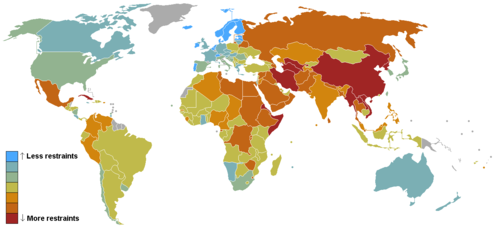
China consistently ranks near the bottom of countries ranked by the freedom of their press by Reporters Without Borders. Here are the bottom 10 countries on this year's list.
158 Iran
159 Saudi Arabia
160 Nepal
161 Vietnam
162 China
163 Eritrea
164 Turkmenistan
165 Burma
166 Cuba
167 North Korea


Many of the bird flu hot-zone countries fall into the more-restrictive press freedoms category.


500px-Reporters_Without_Borders_2007_Press_Freedom_Rankings_Map.PNG

RWB compiles and publishes an annual ranking of countries based upon the organization's assessment of their press freedom records
 
Re: AFD - Pandemic Communication

Sept 27, 2008

Dead Reckoning


# 2336


Note: This is a reprint (slightly updated) of a blog I did in May of 2007. The only difference since that time is the fog has gotten thicker.


As a cruising sailor, my ultimate worry was always a devastating storm, one that would overwhelm my little vessel or crew. Luckily, storms come around infrequently, and 95% of the time I cruised in relatively placid conditions.


For sailors, storms are not the only worry, however.


Another threat, appearing less dangerous, but in reality just as unnerving, is fog. A pea soup that would engulf my vessel, obscuring threats around me and, over time, erode my confidence as to exactly where I was.


My sailing days began before I could afford such niceties as Loran and GPS, which would give the navigator a precise, real-time, indication of the vessel's position.


Instead, we navigated by dead reckoning.


Basically by keeping track of where we'd been; and by adding our direction and speed over time, along with factors such as wind and tide, we could deduce where we were and what lay ahead.


The problem with dead reckoning is, you need a way to double check your position along the way; landmarks, buoys, even a sun sight with a sextant, in order to make corrections. Over time, errors creep into your calculations, and the longer you go without confirming your position, the farther astray your assumed position may wander.


In clear conditions, there are ways to double check yourself, and it is easier to see that storm on the horizon, or outcropping of rocks in your path. In a fog you lose that advantage.


Add in the surreal, and often unnerving aspects of sailing blind, and you begin to appreciate why they call it `dead reckoning'.


Today, the world is sailing in a fog when it comes to the H5N1 virus, and as time passes, we are less certain as to our actual position.

The fearsome storm over the horizon is a possible pandemic, and we have little forecasting ability as to when, or if it will strike. Our charts are old, out of date, and mostly comprised of data from nearly 90 years ago.


We lack equipment sophisticated enough to tell us exactly where we are, and so we must rely on the ancient but all-too fallible art of dead reckoning.


The fog obscuring our view, and masking dangers just beyond our vision, comes from multiple sources.


Indonesia continues to embargo virus samples from that hard hit nation, preventing scientists from around the world from seeing what new mutations are appearing. This refusal to share virus samples has been ongoing now for nearly two years.


In recent months Indonesia has stopped timely reporting of human cases, or fatalities due to the H5N1 virus. They will, they assure us, update us every few months.


Of course Indonesia isn't alone.


China hasn't reported a human case of avian flu since February, but it is difficult to take much solace from this lack of reporting given their long history of suppressing `bad news'. Their recent `adulterated milk scandal' is only the latest example of how costly, in terms of lives and health, that government controlled media can really be.


Our vision is also obscured by countries like Bangladesh, Myanmar, Nigeria, Cambodia, and Laos, where poor surveillance makes it difficult to know the situation on the ground. Poor nations, faced with a multitude of critical problems and few resources to deal with them, often put avian flu on the back burner.


And even in western nations, too many scientists have been slow to release crucial information, jealously guarding data until they can publish, or perhaps profit from it.


Add in politics, a fierce determination to protect local economies, fear, and corruption, and our ability to see beyond our own bowsprit degrades even more.


Recent financial upheavals, both here in the United States and around the world, are also likely to diminish our vigilance against the pandemic threat.

When the house is on fire, it's hard to worry about whether the creek might be rising.


As more time passes, and the fog grows thicker, we lose confidence in our position. Soon the charts become meaningless, for knowing that there are dangers out there does little good when you don't know how close you are to them.


Like sailors of old, we tend to see monsters in the swirling mists, often imaginary, but no less frightening. But one need only look to the charts to see evidence of ships lost and sunk to know that real dangers exist.


Reports of mystery swine diseases decimating herds in China, like stories of the feared Kraken from sailing lore, permeate the anxious discussions of those standing watch. Rumors from news services like Boxun, telling us of strange epidemics in China, vigorously denied by officials, only add to our sense of dread.


We try to tell ourselves that there are no such things as sea serpents, or Krakens, and that all we need to is stay the course, maintain a lookout, and all will be well. Those words, however, ring hollow as the hours pass.


The fog, we pray, won't last forever.


In the eerie stillness, we begin to see things looming in the distance, and unable to discern exactly what they are, assign fearsome traits to them. Some may really be threats, while others may be nothing more than the fruits of our imagination.


But in the fog, it is impossible to know which is which.


As the world gropes along in a pre-pandemic fog, we, like the sailors of old, must be ever vigilant. We can scarcely afford to ignore threats, even those that might ultimately prove to be imaginary, when we can't see where we are or where we are going.


For there are rocks out there, ready to hole our ship, and storms able to batter and sink us. It doesn't take a kraken or a sea serpent to ruin our entire day.


As we make our way through the darkness, unbeknownst to us, shoals in our path may be shifting or the barometer may be dropping unnoticed, and we must be ready to reef our sails and batten the hatches.


Just as aboard a boat, life can go from normal to chaos in an instant.


And so it is with our prepandemic world. We haven't run aground yet, and thus far, no monster has leapt up out of the sea, and we begin to think if it hasn't happened by now, it won't.


The tendency is to ignore the unseen threats, and go boldly forth without maintaining a proper watch. **** the torpedoes, full speed ahead. Romantic perhaps, but unrealistic. A prudent sailor knows better.


There is an old saying amongst sailors. There are old sailors, and there are bold sailors.


But there are no old, bold sailors.


A cautionary tale, one worth remembering, as we plow through this pre-pandemic fog while crossing an unknown and merciless sea.
 
Re: AFD - Pandemic Communication

When Mystery Diseases Attack


# 2371


A week scarcely goes by when we don't get a report of an outbreak of an unidentified `mystery' disease somewhere in the world.


With the advent of the Internet, and the increased flow of information due to cell phones and laptop computers - even from remote areas of the world - we tend to hear about these events more often than we did in the past.


That makes it difficult to judge whether or not the actual number of outbreaks is increasing, or its just our ability to hear about them.


Early news reports, however, are often fragmented, incomplete, speculative and sometimes misleading.


The quality of reporting varies from news source to news source, as does the official flow of information in different regions of the world. Frankly, I tend to take most of these reports with a very large grain of salt.


This past weekend many news services have been carrying reports of three such outbreaks. One in Alaska, one in Pakistan, and one in South Africa.


The Alaskan outbreak on Prince of Wales Island, first mentioned in the press on Oct 1st, now appears to be another outbreak of adenovirus-14, something we've seen several times in recent years.

The remaining two `mystery outbreaks', in South Africa and in Pakistan, remain under investigation. There are no indications at all that these are `avian flu related'.


ProMed Mail, the global electronic reporting system for outbreaks of emerging infectious diseases & toxins managed by ISID (The International Society For Infectious Diseases), sends out multiple notices each and every day about outbreaks around the world to its 40,000 subscribers.


And often they put out RFI's, or Requests for Information, regarding media reports of outbreaks. With 40,000 members, ProMed quite often gets a rapid response from someone knowledgeable near the outbreak.


Fair warning: While I am appreciative of ProMED's alerts, and recommend them highly, they are definitely not for hypochondriacs.


Sometimes it takes a few days, or even longer . . . but eventually most of these outbreaks are diagnosed. Initially, however, we often hear of `mystery fevers' or `atypical pneumonia's'.

We watch these outbreaks with great interest because, on rare occasions, these early reports can tip us off to a possible epidemic . . . or worse, a pandemic.


Most of the time, however, these incidents are quickly contained.


While I don't always blog on them, I do keep up with these reports. Given a few days investigation, health authorities can generally unravel these mysteries.


Unfortunately we are hampered by the lack of transparency (nice euphemism, isn't it?) by some nations when it comes to internal health threats.


China obfuscated the SARS outbreak of 2003 and more recently covered up the tainted milk scandal, while Indonesia has openly declared they will no longer report avian flu cases in `real-time'.


The quality of our information, this season, I suspect will be lower than in years past. This is a regrettable and dangerous trend, but one I fear other nations are adopting as well.


As the Internet abhors an informational vacuum, speculation can always be counted on to rush in to fill any void.

And on the Internet, the lines between news and speculation are often badly blurred. Sometimes, even the mainstream media can be guilty of speculative hyperbole.

After all, the intent is to sell papers or drive people to a website. As always, Caveat Lector.


As for this blog, I will probably be a little slow to jump on every `mysterious outbreak' report that crosses the wires this winter. If it strikes me as being unusual or significant, I'll blog on it, of course.


But most of the time, I'd rather wait until we have solid information.


Since there is no prize for being the first blogger to spot the start of a pandemic, I'd rather get it right than get it first.
 
Re: AFD - Pandemic Communication

Peter Sandman On Pandemic Risk Communication


# 3231


Peter Sandman is a risk communications expert, and makes his living advising companies, agencies, and governments on how to handle media relations during a crisis.

Risk communications can deal with everything from a terrorist attack or a pandemic to a CEO?s indiscretion or a product recall.

Depending on the circumstances, getting it right can salvage a company, resurrect a career, and even save lives.
The Peter M. Sandman Risk Communication Website combines the expertise of Dr. Sandman, along with his wife Jody Lanard M.D., and is is a veritable treasure trove of risk communications information.

Since the Sandman website has so much information, a good place to start is the Crisis Communication (High Hazard, High Outrage) page. Here you will find a number of articles on risk communication during events such as pandemics, hurricanes, and other disasters.

Today Dr. Sandman has a commentary that appears in Nature, which delves into the things that ? from a risk communications perspective ? the CDC has gotten right, and the things they have gotten wrong over the first few weeks of the H1N1 Swine flu outbreak.

By all means, read it in its entirety.

And then, when you are done, make plans to visit Dr. Sandman?s website.


But fair warning, pack a lunch. There is a lot to see and absorb.


Pandemics: good hygiene is not enough

Peter M. Sandman<sup>1</sup>

  1. Peter M. Sandman is a risk-communication consultant, 59 Ridgeview Road, Princeton, New Jersey 08540-7601, USA.
    Email:
    peter@psandman.com

Abstract

The US government is doing well to communicate uncertainty over swine flu. It must also help the public to visualize what a bad pandemic might be like, says Peter M. Sandman.
459322a-i1.0.jpg

R. LARSEN/THE GRAND RAPIDS PRESS/AP

Hygiene is useful, but getting ready for a pandemic also requires stocking up on key supplies.

By the time you read this, the outbreak of H1N1 'swine flu' may no longer seem to be a worldwide threat and the disease may have receded from the headlines. As the initial fuss dies down, public-health experts will remain on high alert, but the media and public will move on to something else, muttering about fear-mongering.

And whatever the situation is like now, it won't be the end of the story. A mutated virus (more virulent or transmissible or resistant to drugs) could appear a few months later.

As a risk-communication professional, I have been watching the US government walk a tightrope between over-reassurance and over-alarm about a swine-flu outbreak that could easily turn out to be devastating, relatively mild or anywhere in between. The United States hasn't issued false reassurances that they will keep the pandemic from 'our' shores ? a temptation to which dozens of governments have succumbed. Here I will show what else I think the country is doing right ? and wrong.

The US Centers for Disease Control and Prevention (CDC) is doing a superb job of explaining the current situation and how uncertain it is. The reiteration of uncertainty and what that means ? advice may change; local strategies may differ ? has been unprecedentedly good.

The CDC's biggest failure is in not doing enough to help people visualize what a bad pandemic might be like so they can understand and start preparing for the worst.

(Continue . . . )
 
Re: AFD - Pandemic Communication

Branswell On The Mounting Criticism Of The WHO


# 3314


Helen Branswell is just about everybody?s favorite flu reporter, and her rolodex (sorry, showing my age . . .PDA) must be the envy of every journalist.

She gets the stories, and the interviews, most reporters would kill for.
Today she brings us details on the controversy over the WHO?s (World Health Organization?s) delay in declaring a pandemic, with extensive comments by Michael Osterholm, director of CIDRAP.

As always, follow the link to read the article in its entirety.


WHO 'very close' to declaring a pandemic, concerned about Manitoba cases


Provided by: Canadian Press
Written by: Helen Branswell, Medical Reporter, THE CANADIAN PRESS
Jun. 9, 2009


TORONTO - The World Health Organization is very close to declaring the first influenza pandemic since 1968, the agency's senior influenza expert suggested Tuesday.

Dr. Keiji Fukuda all but acknowledged that a swine flu pandemic is underway, saying the WHO is aware there is "a great deal" of community spread of the virus in at least one part of Australia - a fact which under the WHO's definition should trigger a pandemic call.

He also said the WHO is concerned about reports of severe illness among First Nations people in Manitoba, noting that in previous pandemics such populations have been hit particularly hard.

The Geneva-based organization is facing criticism for its apparent slowness to declare a pandemic in the face of mounting evidence that the new H1N1 virus is spreading widely around the world. As of Tuesday, there were 26,563 confirmed cases in 73 countries and 140 deaths.

"I believe that WHO is very close to going over the scientific credibility cliff, from which it will be hard to get back up out of that gorge if they hit the bottom," declared Dr. Michael Osterholm, director of the Center for Infectious Diseases Research and Policy at the University of Minnesota.

(Continue . . .)
 
Re: AFD - Pandemic Communication

Risky Communications


If you ever go down Trinidad
No Virus there make you feel too bad
Don? Worry bout no Flu of Swine
Guarantee you one real good fine time
- With apologies to Morey Amsterdam


# 3393

I?ve seen some ham-handed (sorry, couldn?t resist) attempts at disinformation regarding the H1N1 swine flu virus, but I confess, this editorial which appeared in the Trinidad and Tobago Express is by far the most egregious example to date.


Swine flu overreaction
Thursday, June 25th 2009
op-ee.jpg

Let us be quite clear: the H1N1 virus, or swine flu, is not dangerous. It is highly contagious but the flu symptoms are not generally life-threatening and, in fact, you are more at risk if you get the more common flu.

We feel it necessary to state this in light of what may be growing, and quite unnecessary, terror over the spreading of the swine flu.

<snip>

What also exacerbates such unfounded fears is the fact that deaths from the disease naturally garner more attention than mere infections. But the number of fatalities worldwide from the swine flu, as a percentage of infections, has been quite small. And most of the persons who have died from this disease have been very old, very young, or had compromised immune systems.

Put another way, if you are in good health and you get the H1N1 virus, you are going to have flu symptoms-the cough, the sniffles, the fever, and so on-and be fine again within ten days.

Of course, everyone should take all sensible precautions to avoid getting ill. But you need not add unwarranted stress to your mind as you do so.
Where to begin?

The Swine Flu virus is not dangerous?
You are more at risk if you get the more common flu?

Two lies for the price of one I guess. Early data indicates that this virus has a CFR (Case Fatality Ratio) roughly equal to, or perhaps slightly higher than, seasonal flu.

And seasonal flu kills hundreds of thousands worldwide every year. That, in my book, makes it at least a little dangerous.

There is little evidence to suggest that this virus is less dangerous than seasonal flu, particularly to those under the age of 50.

It may be that those over the age of 50 are less likely to contract it, or if they do, may see milder illness.

But it is probably too soon to draw that conclusion.
But to say this flu is less dangerous than seasonal flu is misleading. and also discounts the possibility that this virus could mutate over time.


Only the very old, very young, or those with compromised immune systems have died?
If you are in good health, all you will get is a cough, a fever and the sniffles?

Again, misleading to the extreme.

Very few elderly people have contracted this virus, and relatively few deaths have occurred in that age group. That may change with time, but for now, the elderly are not at particularly high risk from H1N1.

The `very young? have also mostly been spared, with the bulk of hospitalizations occurring in the 5 to 24 year old age group. Scarcely the `very young?.

As far as those with compromised immune systems, it is true that they are at greater risk of serious illness, but they are hardly alone.

According to the WHO (World Health Organization) 1/3rd to 1/2 of serious illnesses have been reported in people with no known health problems.
Some very common health issues, things not normally lumped in with `immuno-compromised?, are particularly risky with this flu.

This includes Asthma, diabetes, and pregnancy.

Instead of trying to convince their readers that Swine flu was nothing to be concerned about, this paper should be urging people to take common sense precautions ? including staying home if they have the `cough, the fever, and the sniffles?, washing their hands frequently, and covering their coughs.

Another teachable moment squandered. And in the process, lives may very well be endangered.

But hey, Mon. Don? Worry, Be Happy!
 
Re: AFD - Pandemic Communication

Experts: `Mild? Is A Misleading Term For This Pandemic


# 3404


Helen Branswell brings us a terrific article today on the concerns of experts over the use of the word `mild? to describe the H1N1 swine flu virus.

It?s been a recurring theme in this blog that the use of that term may come back to haunt officials this fall, when it comes time to convince people of the need to protect themselves with a vaccine.

It also results in editorials, like the one I highlighted earlier this week (see Risky Communications), that blatantly misrepresent the threat.

Helen Branswell brings us the thoughts of Risk Communications expert Peter Sandman ? whom I?ve featured many times in this blog (including here, here, here, and here), along with Dr. Keiji Fukuda, the World Health Organization's top flu expert, and Dr. Michael Osterholm, Director of CIDRAP.

A better lineup of experts you aren?t going to find.

As always, follow the link to read the article in its entirety.


Constant use of 'mild' to describe swine flu misleading people about threat

Provided by: Canadian Press
Written by: Helen Branswell, THE CANADIAN PRESS
Jun. 28, 2009

TORONTO - Officialdom's mantra about swine flu - "it is overwhelmingly mild" - might seem incongruous if we knew the number of children, teens and young adults in ICU beds right now alive only because a breathing machine has taken over for their ravaged lungs.

The heavy reliance on the word "mild " could be creating a false impression of what is actually going on and what the world may face in coming months, some experts worry.

Peter Sandman, a risk communications guru from Princeton, N.J., suggests if authorities are trying to ensure people don't panic about the new H1N1 outbreak, they are concerned about the wrong thing.

"In North America, swine flu panic is much rarer than swine flu deaths," Sandman says.

"The problem isn't panic or even excessive anxiety. The problem is complacency, both about what's going to happen and about what might happen."
(Continue . . .)


Back
Top